Thank you for visiting SNEWPapers!
Sign up free
The Kentucke Gazette
Lexington, Fayette County, Kentucky
What is this article about?
An Anti-Federalist critique of the proposed U.S. Constitution, arguing it establishes internal slavery by undermining liberty through the unrepresentative Senate, convoluted presidential election, congressional control over elections, and a clause protecting the slave trade until 1808. Calls for rejection to preserve rational liberty. Signed Republicus.
Merged-components note: These three components form a single continuous opinion piece critiquing the proposed U.S. Constitution, signed 'REPUBLICUS'; the first was labeled editorial, but as a signed argumentative essay, letter_to_editor is more appropriate.
Clippings
1 of 2
OCR Quality
Full Text
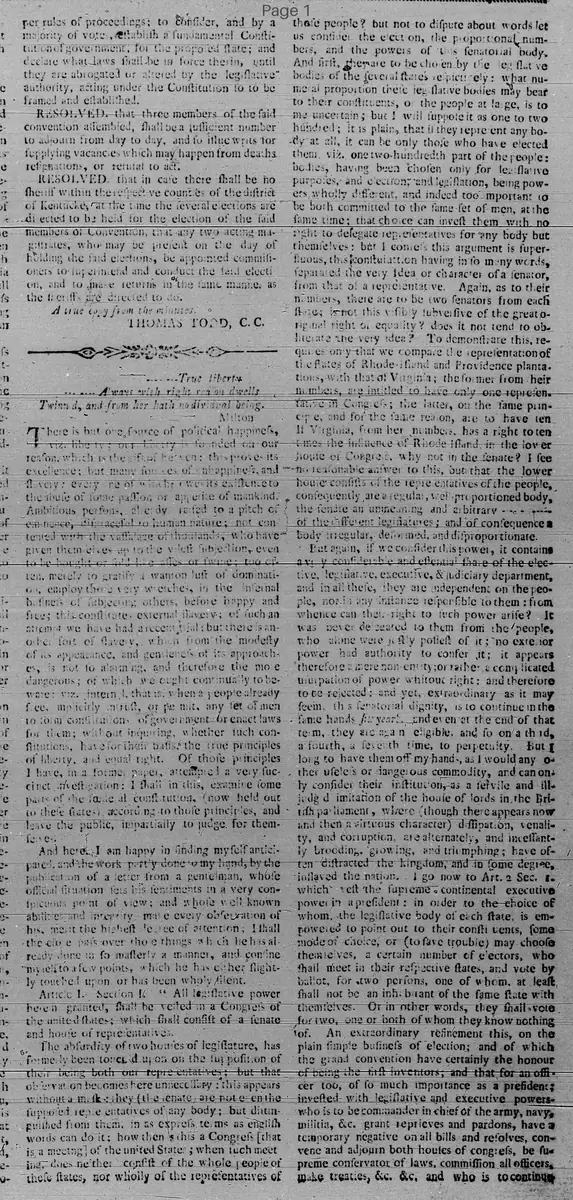
Ambitious persons, already raised to a pitch of grandeur conformable to human nature; not content with the gaze of thousands, who have given them every degree to the highest objection, even to be lords of the land or seas or something to eat. Ten merely to gratify a wanton lust of domination, employ those terrible machines, in the infernal business of subjecting others, before happy and free; this constitutes external slavery; of such an attempt we have had a recent trial: but there is another sort of slavery, which from the modesty of its appearance, and gentleness of its approach, is not so alarming, and therefore the more dangerous; of which we ought continually to be ware: viz. internal, that is, when a people already free, implicitly trust, or permit any set of men to form constitution of government, or enact laws for them; without inquiring, whether such constitutions, have for their basis, the true principles of liberty, and equal right. Of those principles I have, in a former paper, attempted a very succinct investigation: I shall in this, examine some parts of the said constitution, (now held out to these states), according to those principles, and leave the public, impartially to judge, for themselves.
And here I am happy in finding myself anticipated, and the work partly done to my hand, by the publication of a letter from a gentleman, whose official situation sets his sentiments in a very conspicuous point of view; and whose well known abilities and integrity make every observation of his, merit the highest degree of attention; I shall therefore pass over those things which he has already done in so masterly a manner, and confine myself to few points, which he has either slightly touched upon or has been wholly silent.
Article I. Section I "All legislative powers herein granted, shall be vested in a Congress of the united states; which shall consist of a senate and house of representatives."
The absurdity of two houses of legislature, has formerly been touched upon on the simple position of their being both our representatives: but that observation becomes here unnecessary: this appears without a mask: they (the senate) are not even the supposed representatives of any body; but distinguished from them, in as express terms as English words can do it: how then is this a Congress that is a meeting) of the united States; when such meeting, does neither consist of the whole people of these states, nor wholly of the representatives of those people? but not to dispute about words let us consider the election, the proportional numbers, and the powers of this senatorial body.
And first, there are to be chosen by the legislative bodies of the several states respectively: what numerical proportion these legislative bodies may bear to their constituents, or the people at large, is to me uncertain; but I will suppose it as one to two hundred; it is plain, that if they represent any body at all, it can be only those who have elected them. viz. one two-hundredth part of the people: bodies, having been chosen only for legislative purposes, and election; and legislation, being powers, wholly different, and indeed too important to be both committed to the same set of men, at the same time; that choice can invest them with no right to delegate representatives for any body but themselves: but I confess this argument is superfluous, this constitution having in so many words, separated the very Idea or character of a senator, from that of a representative. Again, as to their numbers, there are to be two senators from each state is not this very subversive of the great natural right of equality? does it not tend to obliterate the very idea? To demonstrate this, requires only that we compare the representation of the states of Rhode-Island and Providence plantations, with that of Virginia; the former from their numbers, are entitled to have only one representative in Congress; the latter, on the same principle, and for the same reason, are to have ten.
If Virginia, from her numbers, has a right to ten times the influence of Rhode Island, in the lower house of Congress, why not in the senate? I see no reasonable answer to this, but that the lower house consists of the representatives of the people, consequently are a regular, well-proportioned body, the senate an unmeaning and arbitrary representation of the different legislatures; and of consequence a body irregular, deformed, and disproportionate.
But again, if we consider this power, it contains a very considerable and essential share of the elective, legislative, executive, & judiciary department, and in all these, they are independent on the people, nor in any instance responsible to them: from whence can their right to such power arise? It was never delegated to them from the people, who alone were justly possessed of it; no exterior power had authority to confer it; it appears therefore a mere non-entity; or rather a complicated usurpation of power without right: and therefore to be rejected: and yet, extraordinary as it may seem, this senatorial dignity, is to continue in the same hands six years. under certain the end of that term, they are again eligible. and so on a third. a fourth, a seventh time, to perpetuity. But long to have them off my hand, as I would any other useless or dangerous commodity, and can only consider their institution as a servile and ill-judged imitation of the house of lords in the British parliament, where (though there appears now and then a virtuous character) dissipation, venality, and corruption, are alternately, and incessantly brooding: growing, and triumphing; have often distracted the kingdom, and in some degree, enslaved the nation. - I go now to Art. 2 Sec. 1. which vests the supreme continental executive power in a president : in order to the choice of whom, the legislative body of each state. is empowered to point out to their constituents, some mode of choice, or (to save trouble) may choose themselves, a certain number of electors, who shall meet in their respective states, and vote by ballot, for two persons, one of whom, at least shall not be an inhabitant of the same state with themselves. Or in other words, they shall vote for two, one or both of whom they know nothing of. An extraordinary refinement this, on the plain simple business of election; and of which the grand convention have certainly the honour of being the first inventors; and that for an officer too, of so much importance as a president invested with legislative and executive powers who is to be commander in chief of the army, navy militia, &c. grant reprieves and pardons, have a temporary negative on all bills and resolves, convene and adjourn both houses of congress, be supreme conservator of laws, commission all officers. make treaties, &c. &c. and who is to continue
four years. and is only removable on conviction of treason or bribery and triable only by the senate.
who are to be his own counsel whose interest in every instance runs parallel with his own; and who are neither the officers of the people, nor accountable to them. Is it then become necessary, that a free people, bound first resign their right of suffrage into other hands besides their own; and then, secondly, that those to whom they resign it. should be compelled to choose men, whose persons, characters manners, or principles they know nothing of; and after all, (excepting some such change as is not likely to happen twice in the same century) to intrust Congress with the final decision at last? -Is it necessary, is it rational that the sacred rights of mankind should thus dwindle down to Electors of electors, and those again electors of other electors; this seems to be degrading them, even below the prophetical curse denounced by the good old patriarch, on the offspring of his degenerate son; servant of servants" &c
Art. i. Sec. 4. "The times, places, and manner of holding elections for senators, and representatives, shall be prescribed in each State, by the legislature thereof; but the Congress may, at any time by law, make or alter such regulations. except as to the place of choosing senators. Whether this clause gives Congress a power to call the people of Georgia to choose their representatives in the city of Boston, and on the twentieth of December, and so of every other State, I leave to be determined by better judges of language than myself: however, I believe I shall not be amiss in asserting, that it invests them with power to appoint the time of choosing senators, at the greatest possible distance from the usual, and perhaps constitutionally appointed time of meeting for the purpose of legislation: This latter in large States, or newly settled countries amounts to little less than a peremptory exclusion of all members of legislature, in exterior districts: who from their situation, are less liable to corruption : the former, if true, would put it into the power of a few, a very few! to appoint representatives for the whole continent : and both together; tend to perpetuate the authority, not only of the same men, but also of their heirs for ever. Again, I would ask (considering how prone mankind are to engross power, and then to abuse it) is it not probable, at least possible, that the president who is to be vested with all this demi-omnipotence, who is not chosen by the community. and who consequently, as to them, is irresponsible, and independent ; that he, I say; by a few, grateful and dependant emissaries in congress; may not only perpetuate his own personal administration, but also make it hereditary: that by the same means, he may render his suspensive power over the laws, as operative: and permanent, as that of G. the IId over the acts of the British parliament: and under the modest title of president, may exercise the combined authority of legislation, and execution, in a latitude yet unthought of: or, that upon his being invested with those powers a second, or third time, he may acquire such enormous influence, as, added to his uncontrollable power over the army, navy, and militia; together with his private interest in the officers, of all these different departments, who are all to be appointed by himself, and so his creatures, in the true political sense of the word; and more especially when added to all this, he has. the power of forming treaties, and alliances, and calling them to his assistance; that he may, I say, under all these advantages, and almost irresistible temptations, on some pretended pique, haughtily, and contemptuously, turn our poor lower house, (the only shadow of liberty we shall have left) out of doors, and give us law at the bayonets point: or may not the senate, who are nearly in the same situation, with respect to the people, from similar motives, and by similar means, erect themselves easily into an oligarchy, towards which they have already attempted so large a stride; to one of which channels, or rather to a confluence of both, we seem to be fast gliding away; and the moment we arrive at it-...--farewell liberty.
This leads me to Art. I. Sec. 9. "The migration or importation of such persons, as any of the. States now existing, shall think proper to admit, shall not be prohibited by the Congress prior to the year 1808; (twenty years hence) but a tax, or duty may be imposed on such importation, not exceeding ten dollars for each person. An excellent clause this, in an Algerine constitution: but not so well calculated (I hope) for the latitude of America. It is not to be disguised. that by " such persons, " slaves are principally, if not wholly intended: and shall this be
found among the principles of a free people, and making a radical part of the grand base, on which they would erect an edifice sacred to it. 'Tell it not in Gath! " O that no envious surge might ever roll it to the eastern side of the atlantic! Unhappy africans! what have they done? Have they murdered our citizens or burnt our settlements? Have they butchered, scalped, and exhausted every device of torture, on our defenceless women, and innocent children; as the savage inhabitants of our own country have done? No, no! Then, why deprive them of the greatest of all blessings, liberty, " without which, " says Dr. Price man is a beast. and life a curse; while coward like, we court caresses, and cringe to our murderers. Ignorant, and comparatively innocent, till we taught them the diabolical arts of destruction, captivity, and death; and provided them with the infernal means of carrying them into practice; and all this to furnish ourselves with slaves, at the guilty expence of times, of the blood of, ten times the number of those thus enslaved, who lost their lives in the gallant, the virtuous defence of themselves, and families. Has this guilt ever been atoned? and do we boast of being advocates for liberty? shocking absurdity! More absurd still that a licence for such an execrable trade, should be radically woven into, and become an essential part of our national constitution! a constitution, formed by a chosen assembly of our most eminent and respectable citizens: and where a personage presided, second to no individual of the human family.
The boast of America.--The wonder of Europe.…. O liberty! O virtue! O my country.
Tell us, ye who can thus, coolly, reduce the impious principle of slavery, to a constitutional system: ye professed vindicators of the liberties of mankind : where will ye stop? what security can you give, that, when there shall remain no more black people, ye will not enslave others, white as yourselves? when Africa is exhausted, will ye spare America? and is not twenty years (taking into the account--the slain with the more unhappy captives, victims to perpetuate slavery) sufficient to depopulate her inmost forests? Or is this only an ill boding prelude. founded in the fears, and designedly introductory to the fate of those (yet unhappy) states, who gave you existence; and who even now, while you are thus ungratefully soaring toward the summit of Aristocracy, are languishing you with their confidence? I shudder at the catastrophe ? awake my fellow citizens! and let this infamous clause, together with the principle which gave it birth, be not only expunged out of your constitution: but contemned, eradicated; torn from your heart forever.
To conclude, I can think of but one source of right to government. or any branch of it; and that is the people. They, and only they, have a right to determine whether they will make laws, or execute them, or do both in a collective body, or by a delegated authority. Delegation is a positive actual investiture. Therefore if any people are subjected to an authority which they have not thus actually chosen: even though they may have tamely submitted to- it, yet it is not their legitimate government : they are wholly passive' and as far as they are so, :are in a state of slavery. Thank heaven we are not yet arrived at that state; and while we continue to have sense enough to discover and detect, and virtue e- nough to detect and oppose every attempt, either of force or fraud, either from without or within, to bring us into it, we never will.
Let us therefore continue united in the cause of rational liberty. Let unity and liberty be our mark as well as our motto: for only such an union can se- cure our freedom; and division will inevitably destroy. it. Thus a mountain of sand may peace meal be re- moved by the feeble hands of a child: but if consolidated into a rock, it mocks the united efforts of man- kind, and can only fall in a general wreck of nature
REPUBLICUS.
What sub-type of article is it?
What themes does it cover?
What keywords are associated?
What entities or persons were involved?
Letter to Editor Details
Author
Republicus
Main Argument
the proposed constitution establishes internal slavery by delegating power to unrepresentative bodies like the senate and president, allowing congressional interference in elections, and protecting the slave trade until 1808, all of which undermine the true principles of liberty and equal rights derived from the people.
Notable Details