Thank you for visiting SNEWPapers!
Sign up free
The Virginia Gazette
Richmond, Williamsburg, Richmond County, Virginia
What is this article about?
Trial in King's Bench Court, Westminster, on July 7, between Lord Grosvenor (plaintiff) and Duke of Cumberland (defendant) for adultery damages of 100,000l. Evidence included letters and witness testimony of discovery at St. Alban's. Jury awarded 10,000l to plaintiff after deliberation.
Merged-components note: Continuation of the narrative account of the Grosvenor trial across pages; merged into single story component.
Clippings
1 of 2
OCR Quality
Full Text
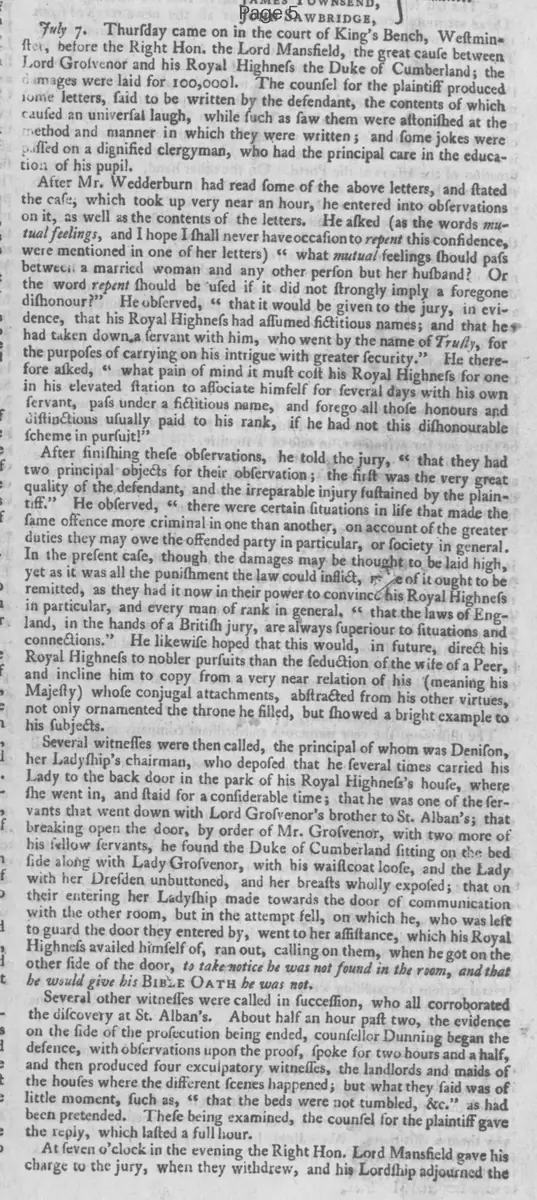
After Mr. Wedderburn had read some of the above letters, and stated the case; which took up very near an hour, he entered into observations on it, as well as the contents of the letters. He asked (as the words mutual feelings, and I hope I shall never have occasion to repent this confidence, were mentioned in one of her letters) "what mutual feelings should pass between a married woman and any other person but her husband? Or the word repent should be used if it did not strongly imply a foregone dishonour?" He observed, "that it would be given to the jury, in evidence, that his Royal Highness had assumed fictitious names; and that he had taken down a servant with him, who went by the name of Truy, for the purposes of carrying on his intrigue with greater security." He therefore asked, "what pain of mind it must cost his Royal Highness for one in his elevated station to associate himself for several days with his own servant, pass under a fictitious name, and forego all those honours and distinctions usually paid to his rank, if he had not this dishonourable scheme in pursuit!"
After finishing these observations, he told the jury, "that they had two principal objects for their observation; the first was the very great quality of the defendant, and the irreparable injury sustained by the plaintiff." He observed, "there were certain situations in life that made the same offence more criminal in one than another, on account of the greater duties they may owe the offended party in particular, or society in general. In the present case, though the damages may be thought to be laid high, yet as it was all the punishment the law could inflict, none of it ought to be remitted, as they had it now in their power to convince his Royal Highness in particular, and every man of rank in general, that the laws of England, in the hands of a British jury, are always superior to stations and connections." He likewise hoped that this would, in future, direct his Royal Highness to nobler pursuits than the seduction of the wife of a Peer, and incline him to copy from a very near relation of his (meaning his Majesty) whose conjugal attachments, abstracted from his other virtues, not only ornamented the throne he filled, but showed a bright example to his subjects.
Several witnesses were then called, the principal of whom was Denison, her Ladyship's chairman, who deposed that he several times carried his Lady to the back door in the park of his Royal Highness's house, where she went in, and stayed for a considerable time; that he was one of the servants that went down with Lord Grosvenor's brother to St. Alban's; that breaking open the door, by order of Mr. Grosvenor, with two more of his fellow servants, he found the Duke of Cumberland sitting on the bedside along with Lady Grosvenor, with his waistcoat loose, and the Lady with her gown unbuttoned, and her breasts wholly exposed; that on their entering her Ladyship made towards the door of communication with the other room, but in the attempt fell, on which he, who was left to guard the door they entered by, went to her assistance, which his Royal Highness availed himself of, ran out, calling on them, when he got on the other side of the door, to take notice he was not found in the room, and that he would give his Bible oath he was not.
Several other witnesses were called in succession, who all corroborated the discovery at St. Alban's. About half an hour past two, the evidence on the side of the prosecution being ended, counsellor Dunning began the defence, with observations upon the proof, spoke for two hours and a half, and then produced four exculpatory witnesses, the landlords and maids of the houses where the different scenes happened; but what they said was of little moment, such as, "that the beds were not tumbled, &c." as had been pretended. These being examined, the counsel for the plaintiff gave the reply, which lasted a full hour.
At seven o'clock in the evening the Right Hon. Lord Mansfield gave his charge to the jury, when they withdrew, and his Lordship adjourned the court.
Court to his house in Bloomsbury square. Exactly at ten the jury left the hall, and proceeded to his Lordship's house, where they gave a verdict for the plaintiff, with 10,000l. damages.
What sub-type of article is it?
What themes does it cover?
What keywords are associated?
What entities or persons were involved?
Where did it happen?
Story Details
Key Persons
Location
Court Of King's Bench, Westminster; St. Alban's
Event Date
July 7
Story Details
Trial for criminal conversation damages against Duke of Cumberland for affair with Lady Grosvenor. Evidence includes incriminating letters and witness account of discovery in bed at St. Alban's. Defense weak; jury awards 10,000l to Lord Grosvenor.