Thank you for visiting SNEWPapers!
Sign up free
Constitutional Whig
Richmond, Virginia
What is this article about?
A letter to the editors of the Constitutional Whig defends 'Presbyter' against claims that his essay on obituary notices in the Southern Religious Telegraph was a personal attack. The writer argues it was a general critique of extravagant eulogies, promotes justice to the dead, and condemns accusations of fanaticism as threats to religious liberty.
Clipping
OCR Quality
Full Text
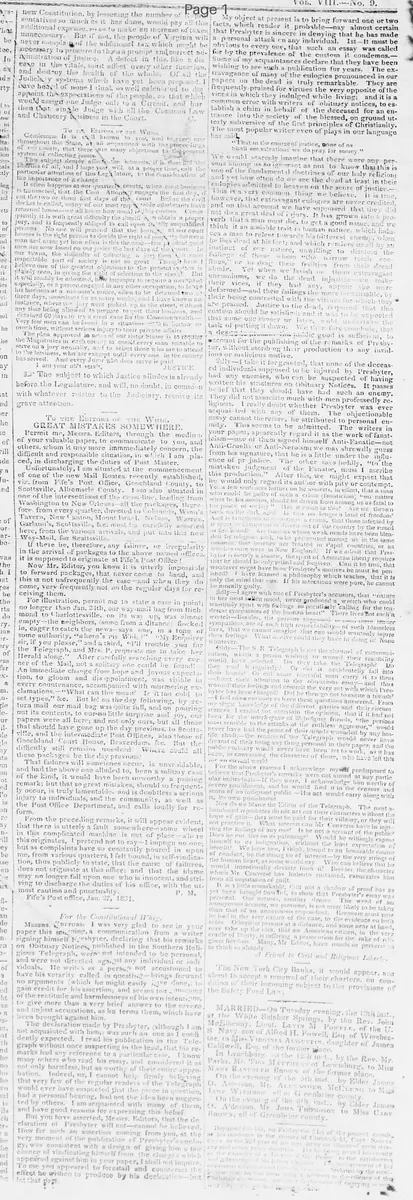
Messrs. Editors: I was very glad to see in your paper this morning, a communication from a writer signing himself Presbyter, declaring that his remarks on Obituary Notices, published in the Southern Religious Telegraph, were not intended to be personal, and were not directed against any individual or individuals. He writes as a person not accustomed to have his veracity called in question—brings forward no arguments which he might easily have done, to gain credit for his assertion; and seems too conscious of the rectitude and harmlessness of his own intentions, to give more than a very brief answer to the severe and unjust accusations, as he terms them, which have been brought against him.
The declaration made by Presbyter, although I am not acquainted with him,) was such an one as I confidently expected. I read his publication in the Telegraph without once suspecting in the least, that his remarks had any reference to a particular case. I know many others who read his essay, and considered it as not only harmless, but as worthy of their entire approbation. Indeed, sir, I cannot help firmly believing that very few of the regular readers of the Telegraph would ever have suspected that the piece in question, had a personal bearing, had not the idea been suggested by others. I am acquainted with many of them, and have good reasons for expressing this belief.
But you have asserted, Messrs. Editors, that the declaration of Presbyter will not—cannot be believed. How far such an assertion coming from you, at the very moment of the publication of Presbyter's apology, was consistent with a design of giving him a fair chance of vindicating himself from the charges which appeared against him in your paper, I shall not inquire. To me you appeared to forestall and counteract the effect he wished to produce by his declaration—but let that pass.
My object at present is to bring forward one or two facts, which render it probable—nay almost certain that Presbyter is sincere in denying that he has made a personal attack on any individual. 1st—It must be obvious to every one, that such an essay was called for by the prevalence of the custom it condemns.—Some of my acquaintances declare that they have been wishing to see such a publication for years. The extravagance of many of the eulogies pronounced in our papers on the dead is truly remarkable. They are frequently praised for virtues the very opposite of the vices in which they indulged while living; and it is a common error with writers of obituary notices, to establish a claim in behalf of the deceased for an entrance into the society of the blessed, on ground utterly subversive of the first principles of Christianity.
The most popular writer even of plays in our language has said,
"That in the course of justice, none of us
Shall see salvation: we do pray for mercy"
We would scarcely imagine that there were any persons among us so ignorant as not to know that this is one of the fundamental doctrines of our holy religion; and yet how often do we see the dead at least in their eulogies admitted to heaven on the score of justice.—This is a very common thing we believe. It is true, however, that extravagant eulogies are never credited, and on that account we have supposed that they did not do a great deal of injury. It has grown into a proverb that a man must die, to get a good name, and we think it an amiable trait in human nature, which induces a man to relent towards his bitterest enemy, when he lies dead at his feet: and which renders us all by an instinct of our nature, unwilling to disclose the failings of those whom "the narrow tomb confines," or to drag their frailties from their dread abode. Yet when we lavish on them extravagant encomiums, we do the dead injustice—we make their vices, if they had any, appear the more deformed—and their failings the more inexcusable, by their being contrasted with the virtues for which they are praised. Justice to the dead, requires that this custom should be discountenanced: and it was to be expected that some one sooner or later, would undertake the task of putting it down. We therefore conclude, that a desire to promote the public good is sufficient, to account for the publishing of the remarks of Presbyter, without ascribing their production to any invidious or malicious motive.
2dly—I take it for granted, that none of the deceased individuals supposed to be injured by Presbyter, had any enemies, who can be suspected of having written his strictures on Obituary Notices. It passes belief that they should have had such an enemy. They did not associate much with men professedly religious. I really doubt whether Presbyter was ever acquainted with any of them. The objectionable essay cannot therefore, be attributed to personal enmity. This seems to be admitted. The writers in your paper, apparently regard it as the work of fanaticism—one of them signed himself Anti-Fanatic—not Anti-Cruelty or Anti-Neroism: we may shrewdly guess from his signature, that he is a little under the influence of prejudice. The other says boldly, "to the mistaken judgment of the Fanatic, must I ascribe this production." After this, we might expect that he would only regard its author with pity or contempt. Yet a few sentences further on he asserts, in effect, that a man who could be guilty of such a crime (fanaticism) "no matter what his motives, should be driven from among us as fatal to the peace of society." Has it come to this? Are we thrown back on the dark ages? Is this no longer a land of freedom? And is fanaticism so heinous a crime, that those infected by it must be driven out of the country by the sword or fire brand? Are fanatics whose weak minds have been blinded by religious zeal, to be persecuted among us in the same manner that heretics are treated in Papal countries, or as witches once were in New England? If we admit that Presbyter is merely a fanatic, the spirit of American liberty requires that he should be only pitied and forgiven. Can it be true, that whatever might have been Presbyter's motives he must be punished? I have learned a philosophy which teaches, that it is only the mind that sins. If his intentions were pure, he cannot be morally guilty.
3dly—I agree with one of Presbyter's accusers, that "nature in her most sullen mood, never produced a wretch who could wantonly sport with feelings so peculiarly calling for the tenderest sympathies of the human heart." There lives not such a wretch—Besides, the persons supposed to have these tender sympathies, are of such high respectability—of such blameless lives, that we cannot imagine that one would wantonly injure their feelings. What motive could they have in doing it? None whatever.
4thly—The S. R. Telegraph is not the channel of communication, which a person wishing to wound their sensibility would have selected. Do they take the Telegraph? Do they read it regularly? Or did it "accidentally fall into their hands?" Or did some malicious man carry it to them—direct their attention to the obnoxious essay—and thus wound their feelings and commit the very act with which Presbyter has been charged? Did he then go out to excite a tumult?—I feel some curiosity to have these questions answered. From my slight knowledge of the different parties and their circumstances I cannot but entertain the opinion, that if it had not been for the interference of ill-judging friends, "the persons most sensible to the attacks of the ruthless aggressor," would never have had the peace of their minds wounded by any hostile shaft,—the readers of the Telegraph would never have dreamt of their being anything personal in their paper: and the public curiosity would never have been set to work, as it has been, in canvassing the character of those, who have left this world for an eternal world.
For the above reasons I acknowledge myself predisposed to believe that Presbyter's remarks were not aimed at any particular individuals—If they were, I acknowledge him worthy of severe punishment, and he would find it in the censure and scorn of an intelligent public—His act would carry along with it, its own punishment.
Nor do we blame the Editor of the Telegraph. The most abandoned reprobates do not act out their characters without the hope of gain—they must be paid for their villainy, or they will not practice it. What interest can Mr. Converse have in injuring the feelings of any one? Is he not a servant of the public—Does he not live on its patronage? Would he willingly expose himself to its indignation, without the least expectation of benefit? We have men, I think, bound to an honorable course of conduct, by the strong tie of interest—by the very strings of the human heart, as some would say. Who can believe that he would intentionally deviate from it? Besides the character which Mr. Converse has hitherto sustained, exonerates him from all imputation of guilt.
It is a little remarkable, that not a shadow of proof has as yet been brought forward, to show that Presbyter's essay was personal. One accuses, another denies. The word of an anonymous accuser, we presume, is not more likely to be taken than that of an anonymous respondent. Recourse must now be had in the very nature of the case, to the evidence on both sides. Otherwise persons at a distance, and some near at hand, may take up the idea, that an American citizen, in the very cradle of liberty, is suffering a persecution for the sake of religious freedom." Many, Mr. Editor, have minds so perverse as to think so already.
A Friend to Civil and Religious Liberty.
What sub-type of article is it?
What themes does it cover?
What keywords are associated?
What entities or persons were involved?
Letter to Editor Details
Author
A Friend To Civil And Religious Liberty
Recipient
Messrs. Editors
Main Argument
presbyter's essay on obituary notices was a general critique of extravagant eulogies and not a personal attack on any individuals; accusations of fanaticism threaten religious liberty and should be rejected in favor of pity and forgiveness if intentions were pure.
Notable Details