Thank you for visiting SNEWPapers!
Sign up free
Evening Journal
Wilmington, New Castle County, Delaware
What is this article about?
British Food Controller sets maximum prices for bread and flour in England, enabling 9d (18 cents) 4-pound loaf and $7/barrel flour, contrasting US prices of $10.50-$12. Details from London Times on controls, compensation, and licensing.
Clipping
OCR Quality
Full Text
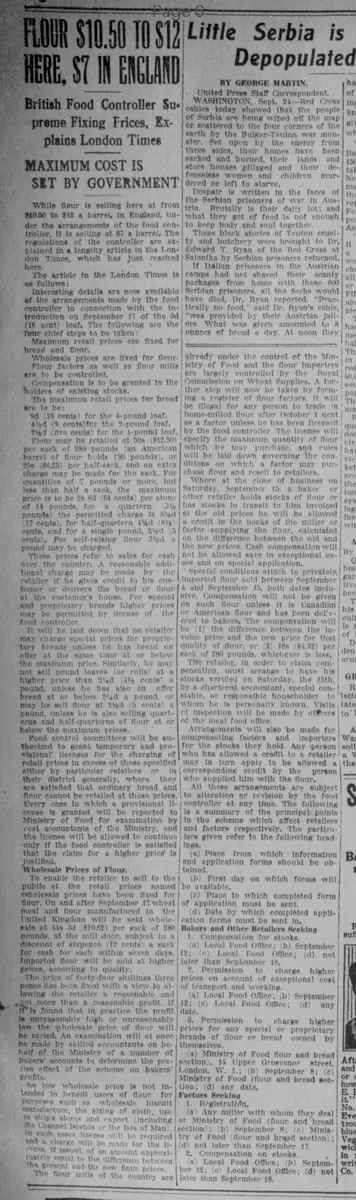
HERE, $7 IN ENGLAND
British Food Controller Supreme Fixing Prices, Explains London Times
MAXIMUM COST IS
SET BY GOVERNMENT
While flour is selling here at from $10.50 to $12 a barrel, in England, under the arrangements of the food controller, it is selling at $7 a barrel. The regulations of the controller are explained in a lengthy article in the London Times, which has just reached here.
The article in the London Times is as follows:
Interesting details are now available of the arrangements made by the food controller in connection with the introduction on September 17 of the 9d (18 cent) loaf. The following are the four chief steps to be taken:
Maximum retail prices are fixed for bread and flour.
Wholesale prices are fixed for flour.
Flour factors as well as flour mills are to be controlled.
Compensation is to be granted to the holders of existing stocks.
The maximum retail prices for bread are to be:
9d (18 cents) for the 4-pound loaf.
4½d (9 cents) for the 2-pound loaf.
2½d (five cents) for the 1-pound loaf.
Flour may be retailed at 50s ($12.50) per sack of 280 pounds (an American barrel of flour holds 196 pounds), or 25s ($6.25) per half-sack, and an extra charge may be made for the sack. For quantities of 7 pounds or more, but less than half a sack, the maximum price is to be 2s 8d (64 cents) per stone of 14 pounds; for a quartern (3½ pounds) the permitted charge is 8½d (17 cents); for half-quartern 4½d (8½ cents), and for a single pound, 2½d (5 cents). For self-raising flour 3½d a pound may be charged.
These prices refer to sales for cash over the counter. A reasonable additional charge may be made by the retailer if he gives credit to his customer or delivers the bread or flour at the customer's house. For special and proprietary brands higher prices may be permitted by license of the food controller.
It will be laid down that no retailer may charge special prices for proprietary breads unless he has bread on offer at the same time at or below the maximum price. Similarly, he may not sell pound loaves (or rolls) at a higher price than 2½d (4½ cents) a pound, unless he has also on offer bread at or below 9d a pound, or may he sell flour at 2½d (5 cents) a pound, unless he is also selling quarterns and half-quarterns of flour at or below the maximum prices.
Food control committees will be authorized to grant temporary and provisional licenses for the charging of retail prices in excess of those specified either by particular retailers or in their district generally, where they are satisfied that ordinary bread and flour cannot be retailed at those prices.
Every case in which a provisional license is granted will be reported to Ministry of Food for examination by cost accountants of the Ministry, and the license will be allowed to continue only if the food controller is satisfied that the claim for a higher price is justified.
Wholesale Prices of Flour
To enable the retailer to sell to the public at the retail prices named wholesale prices have been fixed for flour. On and after September 17 wheat meal and flour manufactured in the United Kingdom will be sold wholesale at 44s 3d ($10.62) per sack of 280 pounds, at the mill door, subject to a discount of sixpence (12 cents) a sack for cash for each within seven days.
Imported flour will be sold at higher prices, according to quality.
The price of forty-four shillings three pence has been fixed with a view to allowing the retailer a reasonable and not more than a reasonable profit. If it is found that in practice the profit is unreasonably high or unreasonably low the wholesale price of flour will be varied. An examination will at once be made by skilled accountants on behalf of the Ministry of a number of bakers' accounts to determine the precise effect of the scheme on bakers' profits.
The low wholesale price is not intended to benefit users of flour for purposes such as wholesale biscuit manufacture, the sizing of cloth, use as ship's stores and export (including the Channel Islands or the Isle of Man). In such cases license will be required and a charge will be made for the license, if issued, of an amount approximately equal to the difference between the present and the now flour prices.
The flour mills are already under the control of the Ministry of Food and the flour importers are largely controlled by the Royal Commission on Wheat Supplies. A further step will now be taken by forming a register of flour factors. It will be illegal for any person to trade in home-milled flour after October 1 next as a factor unless he has been licensed by the food controller. The license will specify the maximum quantity of flour which he may purchase, and rules will be laid down governing the conditions on which a factor may purchase flour and resell to retailers.
Where at the close of business on Saturday, September 15, a baker or other retailer holds stocks of flour or has stocks in transit to him invoiced at the old prices he will be allowed a credit in the books of the miller or factor supplying the flour, calculated on the difference between the old and the new prices. Cash compensation will not be allowed save in exceptional cases and on special application.
Special conditions attach to privately imported flour sold between September 4 and September 15, both dates inclusive. Compensation will not be given on such flour unless it is Canadian or American flour and has been delivered to bakers. The compensation will be (1) the difference between the invoice price and the new price for that quality of flour, or (2) 18s ($4.32) per sack of 280 pounds, whichever is less.
The retailer, in order to claim compensation, must arrange to have his stocks verified on Saturday, the 15th, by a chartered accountant, special constable, or responsible householder to whom he is personally known. Visits of inspection will be made by officers of the local food office.
Arrangements will also be made for compensating factors and importers for the stocks they hold. Any person who has allowed a credit to a retailer may in turn apply to be allowed a corresponding credit by the person who supplied him with the flour.
All these arrangements are subject to alteration or revision by the food controller at any time. The following is a summary of the principal points in the scheme which affect retailers and factors respectively. The particulars given refer to the following headings:
(a) Place from which information and application forms should be obtained.
(b) First day on which forms will be available.
Retailers Seeking
1. Compensation on stocks.
(a) Local Food Office; (b) September 12; (c) Local Food Office; (d) not later than September 18.
2. Permission to charge higher prices on account of exceptional cost of transport and working.
(a) Local Food Office; (b) September 12; (c) Local Food Office; (d) any date.
3. Permission to charge higher prices for any special or proprietary brands of flour or bread owned by themselves.
(a) Ministry of Food (flour and bread section), 14 Upper Grosvenor street, London, W. 1.; (b) September 8; (c) Ministry of Food (flour and bread section); (d) any date.
Factors Seeking
1. Registration.
(a) Any miller with whom they deal or Ministry of Food (flour and bread section); (b) September 8; (c) Ministry of Food (flour and bread section); (d) not later than September 17.
2. Compensation on stocks.
(a) Local Food Office; (b) September 12; (c) Local Food Office; (d) not later than September 18.
What sub-type of article is it?
What keywords are associated?
Where did it happen?
Foreign News Details
Primary Location
England
Event Date
September 17
Outcome
maximum retail prices fixed for bread at 9d for 4-pound loaf, 4½d for 2-pound, 2½d for 1-pound; flour at 50s per 280-pound sack or equivalent rates; wholesale at 44s 3d per sack; controls on mills, factors, and compensation for stocks.
Event Details
The British Food Controller is fixing maximum prices for bread and flour effective September 17 to introduce the 9d loaf. Details include retail and wholesale price caps, controls on flour mills and factors, compensation for existing stocks, and provisions for licenses and adjustments.