Thank you for visiting SNEWPapers!
Sign up free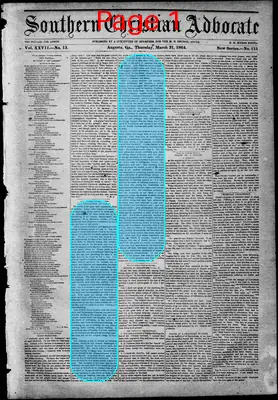
Editorial
March 31, 1864
Southern Christian Advocate
Charleston, Charleston County, South Carolina
What is this article about?
An editorial advocating the philosophy of labor as essential to human improvement, happiness, and divine law. It critiques idleness, luxury, and wealth accumulation, arguing that true achievement comes from toil and that indulgence leads to moral and societal downfall.
Clipping
OCR Quality
98%
Excellent
Full Text
For the Southern Christian Advocate.
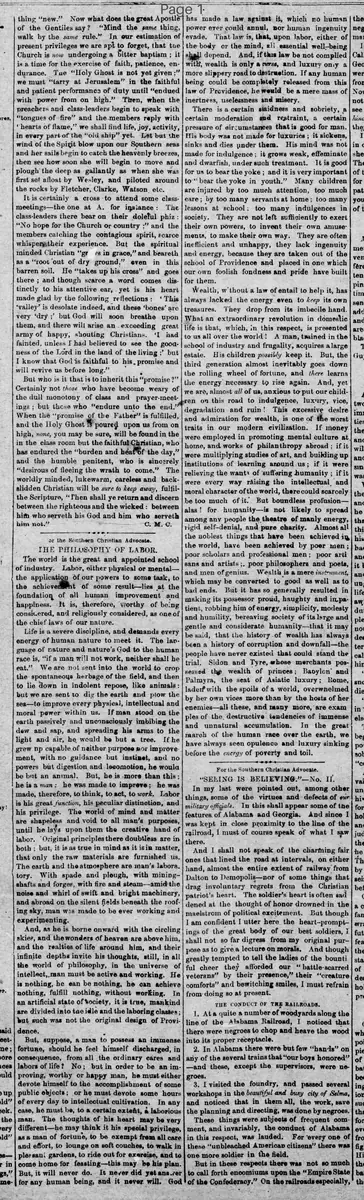
THE PHILOSOPHY OF LABOR.
The world is the great and appointed school of industry. Labor, either physical or mental— the application of our powers to some task, to the achievement of some result—lies at the foundation of all human improvement and happiness. It is, therefore, worthy of being considered, and religiously considered, as one of the chief laws of our nature.
Life is a severe discipline, and demands every energy of human nature to meet it. The language of nature and nature's God to the human race is, "if a man will not work, neither shall he eat." We are not sent into the world to crop the spontaneous herbage of the field, and then to lie down in indolent repose, like animals: but we are sent to dig the earth and plow the sea—to improve every physical, intellectual and moral power within us. If man stood on the earth passively and unconsciously imbibing the dew and sap, and spreading his arms to the light and air, he would be but a tree. If he grew up capable of neither purpose nor improvement, with no guidance but instinct, and no powers but digestion and locomotion, he would be but an animal. But, he is more than this; he is a man; he was made to improve; he was made, therefore, to think, to act, to work. Labor is his great function, his peculiar distinction, and his privilege. The world of mind and matter are shapeless and void to all man's purposes, until he lays upon them the creative hand of labor. Original principles there doubtless are in both; but, it is as true in mind as it is in matter, that only the raw materials are furnished us. The earth and the atmosphere are man's laboratory. With spade and plough, with mining-shafts and forges, with fire and steam—amid the noise and whirl of swift and bright machinery, and abroad on the silent fields beneath the roofing sky, man was made to be ever working and experimenting.
And, as he is borne onward with the circling skies, and the wonders of heaven are above him, and the realities of life around him, and their infinite depths invite his thoughts, still, in all the world of philosophy, in the universe of intellect, man must be active and working. He is nothing, he can be nothing, he can achieve nothing, fulfill nothing, without working. In an artificial state of society, it is true, mankind are divided into the idle and the laboring classes; but such was not the original design of Providence.
But, suppose, a man to possess an immense fortune, should he feel himself discharged, in consequence, from all the ordinary cares and labors of life? No; but in order to be an improving, worthy or happy man, he must either devote himself to the accomplishment of some public objects; or he must devote some hours of every day to intellectual cultivation. In any case, he must be, to a certain extent, a laborious man. The thoughts of his heart may be very different—he may think it his special privilege, as a man of fortune, to be exempt from all care and effort, to lounge on soft couches, to walk in pleasant gardens, to ride out for exercise, and to come home for feasting—this may be his plan. But, it will never do. It never did yet answer for any human being, and it never will. God has made a law against it, which no human power ever could annul, nor human ingenuity evade. That law is, that, upon labor, either of the body or the mind, all essential well-being shall depend. And, if the law be not complied with, wealth is only a curse, and luxury only a more slippery road to destruction. If any human being could be completely released from this law of Providence, he would be a mere mass of inertness, uselessness and misery.
There is a certain staidness and sobriety, a certain moderation and restraint, a certain pressure of circumstances that is good for man. His body was not made for luxuries; it sickens, sinks and dies under them. His mind was not made for indulgence; it grows weak, effeminate and dwarfish, under such treatment. It is good for us to bear the yoke; and it is very important to "bear the yoke in youth." Many children are injured by too much attention, too much care; by too many servants at home; too many lessons at school; too many indulgences in society. They are not left sufficiently to exert their own powers, to invent their own amusements, to make their own way. They are often inefficient and unhappy, they lack ingenuity and energy, because they are taken out of the school of Providence and placed in one which our own foolish fondness and pride have built for them.
Wealth, without a law of entail to help it, has always lacked the energy even to keep its own treasures. They drop from its imbecile hand. What an extraordinary revolution in domestic life is that, which, in this respect, is presented to us all over the world! A man, trained in the school of industry and frugality, acquires a large estate. His children possibly keep it. But, the third generation almost inevitably goes down the rolling wheel of fortune, and there learns the energy necessary to rise again. And, yet we are, almost all of us, anxious to put our children on this road to indulgence, luxury, vice, degradation and ruin! This excessive desire and admiration for wealth, is one of the worst traits in our modern civilization. If money were employed in promoting mental culture at home, and works of philanthropy abroad; if it were multiplying studies of art, and building up institutions of learning around us; if it were relieving the wants of suffering humanity; if it were every way raising the intellectual and moral character of the world, there could scarcely be too much of it. But boundless profusion— alas! for humanity—is not likely to spread among any people the theatre of manly energy, rigid self-denial, and pure charity. Almost all the noblest things that have been achieved in the world, have been achieved by poor men; poor scholars and professional men; poor artisans and artists; poor philosophers and poets, and men of genius. Wealth is a mere instrument, which may be converted to good as well as to bad ends. But it has so generally resulted in making its possessor proud, haughty and impatient, robbing him of energy, simplicity, modesty and humility, bereaving society of its large and gentle and considerate humanity—that it may be said, that the history of wealth has always been a history of corruption and downfall—the people have never existed that could stand the trial. Sidon and Tyre, whose merchants possessed the wealth of princes; Babylon and Palmyra, the seat of Asiatic luxury; Rome, laden with the spoils of a world, overwhelmed by her own vices more than by the hosts of her enemies—all these, and many more, are examples of the destructive tendencies of immense and unnatural accumulation. In the great march of the human race over the earth, we have always seen opulence and luxury sinking before the energy of poverty and toil.
THE PHILOSOPHY OF LABOR.
The world is the great and appointed school of industry. Labor, either physical or mental— the application of our powers to some task, to the achievement of some result—lies at the foundation of all human improvement and happiness. It is, therefore, worthy of being considered, and religiously considered, as one of the chief laws of our nature.
Life is a severe discipline, and demands every energy of human nature to meet it. The language of nature and nature's God to the human race is, "if a man will not work, neither shall he eat." We are not sent into the world to crop the spontaneous herbage of the field, and then to lie down in indolent repose, like animals: but we are sent to dig the earth and plow the sea—to improve every physical, intellectual and moral power within us. If man stood on the earth passively and unconsciously imbibing the dew and sap, and spreading his arms to the light and air, he would be but a tree. If he grew up capable of neither purpose nor improvement, with no guidance but instinct, and no powers but digestion and locomotion, he would be but an animal. But, he is more than this; he is a man; he was made to improve; he was made, therefore, to think, to act, to work. Labor is his great function, his peculiar distinction, and his privilege. The world of mind and matter are shapeless and void to all man's purposes, until he lays upon them the creative hand of labor. Original principles there doubtless are in both; but, it is as true in mind as it is in matter, that only the raw materials are furnished us. The earth and the atmosphere are man's laboratory. With spade and plough, with mining-shafts and forges, with fire and steam—amid the noise and whirl of swift and bright machinery, and abroad on the silent fields beneath the roofing sky, man was made to be ever working and experimenting.
And, as he is borne onward with the circling skies, and the wonders of heaven are above him, and the realities of life around him, and their infinite depths invite his thoughts, still, in all the world of philosophy, in the universe of intellect, man must be active and working. He is nothing, he can be nothing, he can achieve nothing, fulfill nothing, without working. In an artificial state of society, it is true, mankind are divided into the idle and the laboring classes; but such was not the original design of Providence.
But, suppose, a man to possess an immense fortune, should he feel himself discharged, in consequence, from all the ordinary cares and labors of life? No; but in order to be an improving, worthy or happy man, he must either devote himself to the accomplishment of some public objects; or he must devote some hours of every day to intellectual cultivation. In any case, he must be, to a certain extent, a laborious man. The thoughts of his heart may be very different—he may think it his special privilege, as a man of fortune, to be exempt from all care and effort, to lounge on soft couches, to walk in pleasant gardens, to ride out for exercise, and to come home for feasting—this may be his plan. But, it will never do. It never did yet answer for any human being, and it never will. God has made a law against it, which no human power ever could annul, nor human ingenuity evade. That law is, that, upon labor, either of the body or the mind, all essential well-being shall depend. And, if the law be not complied with, wealth is only a curse, and luxury only a more slippery road to destruction. If any human being could be completely released from this law of Providence, he would be a mere mass of inertness, uselessness and misery.
There is a certain staidness and sobriety, a certain moderation and restraint, a certain pressure of circumstances that is good for man. His body was not made for luxuries; it sickens, sinks and dies under them. His mind was not made for indulgence; it grows weak, effeminate and dwarfish, under such treatment. It is good for us to bear the yoke; and it is very important to "bear the yoke in youth." Many children are injured by too much attention, too much care; by too many servants at home; too many lessons at school; too many indulgences in society. They are not left sufficiently to exert their own powers, to invent their own amusements, to make their own way. They are often inefficient and unhappy, they lack ingenuity and energy, because they are taken out of the school of Providence and placed in one which our own foolish fondness and pride have built for them.
Wealth, without a law of entail to help it, has always lacked the energy even to keep its own treasures. They drop from its imbecile hand. What an extraordinary revolution in domestic life is that, which, in this respect, is presented to us all over the world! A man, trained in the school of industry and frugality, acquires a large estate. His children possibly keep it. But, the third generation almost inevitably goes down the rolling wheel of fortune, and there learns the energy necessary to rise again. And, yet we are, almost all of us, anxious to put our children on this road to indulgence, luxury, vice, degradation and ruin! This excessive desire and admiration for wealth, is one of the worst traits in our modern civilization. If money were employed in promoting mental culture at home, and works of philanthropy abroad; if it were multiplying studies of art, and building up institutions of learning around us; if it were relieving the wants of suffering humanity; if it were every way raising the intellectual and moral character of the world, there could scarcely be too much of it. But boundless profusion— alas! for humanity—is not likely to spread among any people the theatre of manly energy, rigid self-denial, and pure charity. Almost all the noblest things that have been achieved in the world, have been achieved by poor men; poor scholars and professional men; poor artisans and artists; poor philosophers and poets, and men of genius. Wealth is a mere instrument, which may be converted to good as well as to bad ends. But it has so generally resulted in making its possessor proud, haughty and impatient, robbing him of energy, simplicity, modesty and humility, bereaving society of its large and gentle and considerate humanity—that it may be said, that the history of wealth has always been a history of corruption and downfall—the people have never existed that could stand the trial. Sidon and Tyre, whose merchants possessed the wealth of princes; Babylon and Palmyra, the seat of Asiatic luxury; Rome, laden with the spoils of a world, overwhelmed by her own vices more than by the hosts of her enemies—all these, and many more, are examples of the destructive tendencies of immense and unnatural accumulation. In the great march of the human race over the earth, we have always seen opulence and luxury sinking before the energy of poverty and toil.
What sub-type of article is it?
Moral Or Religious
Labor
Social Reform
What keywords are associated?
Philosophy Of Labor
Divine Law Of Work
Critique Of Wealth
Idleness Dangers
Luxury Corruption
Moral Improvement
Providence School
Historical Examples
What entities or persons were involved?
Providence
God
Southern Christian Advocate
Editorial Details
Primary Topic
Philosophy Of Labor As Divine Law And Critique Of Idleness And Wealth
Stance / Tone
Advocacy For Labor's Necessity And Virtue Against Luxury And Indulgence
Key Figures
Providence
God
Southern Christian Advocate
Key Arguments
Labor Is Foundational To Human Improvement And Happiness
God's Law: If A Man Will Not Work, Neither Shall He Eat
Man Is Made To Think, Act, And Work, Distinguishing Him From Animals And Plants
Wealth Does Not Exempt One From Labor; Idleness Leads To Misery
Luxury Weakens Body And Mind; Bearing The Yoke In Youth Builds Character
Wealth Often Leads To Corruption And Downfall, As Seen In Historical Examples Like Rome And Babylon
Noblest Achievements Come From Poor Men Of Toil
Society's Division Into Idle And Laboring Classes Defies Providence's Design