Thank you for visiting SNEWPapers!
Sign up free
Literary
June 24, 1861
The Shreveport Weekly News
Shreveport, Caddo County, Louisiana
What is this article about?
Talbot Bland recounts to his friend Austin his frantic journey from Canada to Europe to reunite with his dying sister Alice, their emotional reunion during a stormy voyage to France, and her peaceful death on a remote island, followed by her burial in Jersey.
Clipping
OCR Quality
95%
Excellent
Full Text
Selected Expressly for the Daily News.
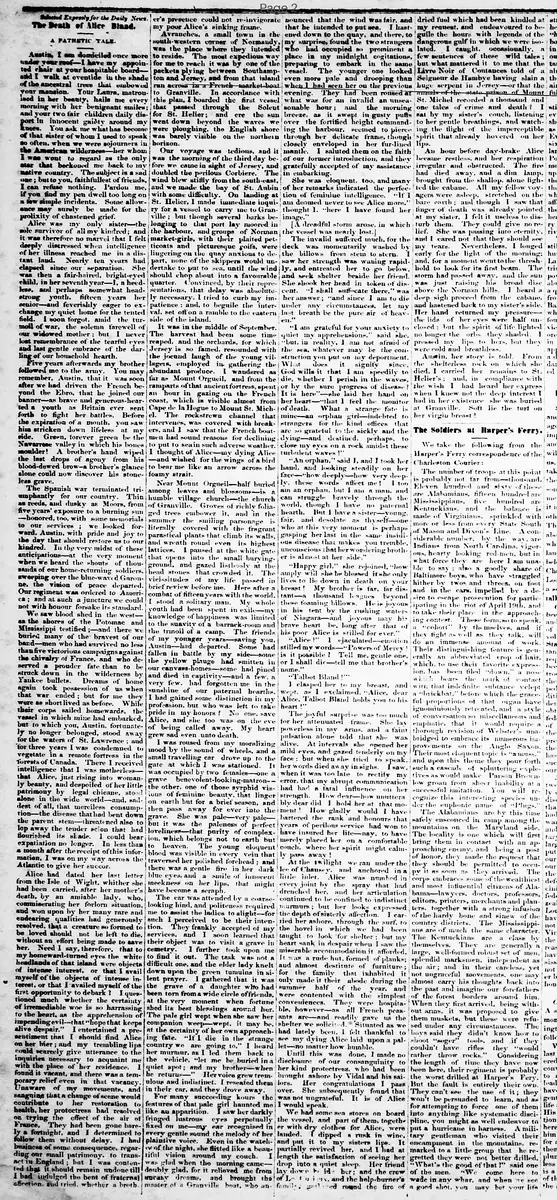
The Death of Alice Bland.
PATHETIC TALE.
Austin, I am domiciled once more under your roof—I have my appointed chair at your hospitable board—and I walk at eventide in the shade of the ancestral trees that embowered your mansion.
Your Laura, matured in her beauty, hails me every morning with her benignant smiles; and your two fair children daily divert innocent gayety around my knees. You ask me what has become of that sister of whom I used to speak so often, when we were sojourners in the American wilderness—her whom I was wont to regard as the only star that beckoned me back to my native country. The subject is a sad one; but to you, faithfullest of friends, I can refuse nothing. Pardon me, if you find my pen dwell too long on a few simple incidents. Some allowance may surely be made for the prolixity of chastened grief.
Alice was my only sister—the sole survivor of all my kindred; and it was therefore no marvel that I felt deeply distressed when intelligence of her illness reached me in a distant land. Nearly ten years had elapsed since our separation. She was then a fair-haired, bright-eyed child, in her seventh year—I, a heedless, and perhaps somewhat headstrong youth, fifteen years her senior—and feverishly eager to exchange my quiet home for the tented field. I soon forgot, amid the turmoil of war, the solemn farewell of our widowed mother: but I never lost remembrance of the tearful eyes and last gentle embrace of the darling of our household hearth.
Five years afterwards my brother followed me to the army. You may remember, Austin, that it was soon after we had driven the French beyond the Ebro, that he joined our banner—as brave and generous-hearted a youth as Britain ever sent forth to fight her battles. Before the expiration of a month, you saw him stricken down lifeless at my side. Green, forever green be the Navarrese valley in which his bones moulder! A brother's hand wiped the last drops of agony from his blood-dowered brow—a brother's glance alone could now discover his stoneless grave.
The Spanish war terminated triumphantly for our country. Thin as reeds, and dusky as Moors, from five years' exposure to a burning sun—honored, too, with some memorials to our services; we looked forward, Austin, with pride and joy to the day that should restore us to our kindred. In the very midst of these anticipations—at the very moment when we heard the shouts of thousands of our home-returning soldiers, weeping over the blue-waved Garonne, the vision of peace departed.
Our regiment was ordered to America; and at such a juncture we could not with honour forsake its standard. We saw blood shed in the west—and the shores of the Potomac and Mississippi testified;—and there we buried many of the bravest of our band—men who had survived no less than five victorious campaigns against the chivalry of France, and who deserved a prouder fate than to be struck down in the wilderness by Yankee bullets. Dreams of home again took possession of us when that war ended; but for me they were as shortlived as before. While their corps sailed homewards, the vessel in which mine had embarked, but to which you, Austin, fortunately no longer belonged, stood away for the waters of St. Lawrence: and for three years I was condemned to vegetate in a remote fortress in the forests of Canada. There I received intelligence that I was motherless—that Alice, just rising into womanly beauty, and despoiled of her little patrimony by legal chicane, stood lone in the wide world—and, saddest of all, that merciless consumption—the disease that had bent down the parent stem—threatened also to lop away the tender scion that had flourished in its shade. I could bear expatriation no longer. In less than a month after the receipt of this information, I was on my way across the Atlantic to give her succor.
Alice had dated her last letter from the Isle of Wight, whither she had been carried, after her mother's death, by an amiable lady, who, commiserating her forlorn situation, and won upon by her many rare and endearing qualities had generously resolved, that a creature so formed to be loved should not be left to die, without an effort being made to save her. Need I say, therefore, that to my homeward-turned eyes the white headlands of that island were objects of intense interest, or that I availed myself of the first opportunity to debark? I questioned much whether the certainty of irremediable woe is so harrassing to the heart, as the apprehension of impending evil—that 'hope that keeps alive despair.' I entertained a presentiment that I should find Alice on her bier; and my trembling lips could scarcely give utterance to the inquiries necessary to acquaint me with the place of her residence. I found it vacant, and there was a temporary relief even in that vacancy.
Unaware of my movements, and sanguine that a change of scene would contribute to her restoration to health, her protectress had resolved on trying the effect of the air of France. They had been gone barely a fortnight, and I determined to follow them without delay. I had business of some consequence, regarding our small patrimony, to transact in England; but I was contented that it should remain undone till I had indulged the bent of fraternal affection, and tried, whether a brother's presence could not re-invigorate my poor Alice's sinking frame.
Avranches, a small town in the south-western corner of Normandy, was the place where they intended to reside. The most expeditious way for me to reach it was by one of the packets plying between Southampton and Jersey, and from that island run across in a French market-boat to Granville. In accordance with this plan, I boarded the first vessel that passed through the Solent for St. Helier: and ere the sun went down beyond the waves we were ploughing, the English shore was barely visible on the northern horizon.
Our voyage was tedious, and it was the morning of the third day before we came in sight of Jersey, and doubled the perilous Corbiere. The wind blew stiffly from the south-east, and we made the bay of St. Aubin with some difficulty. On landing at St. Helier, I made immediate inquiry for a vessel to carry me to Granville: but though several barks belonging to that port lay moored in the harbour, and groups of Norman market-girls, with their plaited petticoats and picturesque coifs, were lingering on the quay anxious to depart, none of the skippers would undertake to put to sea, until the wind should chop about into a favourable quarter. Convinced, by their representations, that delay was absolutely necessary, I tried to curb my impatience: and, to beguile the interval, set off on a ramble to the eastern side of the island.
It was in the middle of September. The harvest had been some time reaped, and the orchards, for which Jersey is so famed, resounded with the jocund laugh of the young villagers, employed in gathering the abundant produce. I wandered as far as Mount Orgueil, and from the ramparts of that ancient fortress, spent an hour in gazing on the French coast, which is visible almost from Cape de la Hogue to Mount St. Michael.
The rockstrewn channel that intervenes, was covered with breakers, and I saw that the French boatmen had sound reasons for declining to put to sea in such adverse weather. I thought of Alice—my dying Alice—and wished for the wings of a bird to bear me like an arrow across the foamy strait.
Near Mount Orgueil—half buried among leaves and blossoms—is a humble village church—the church of Granville. 'Groves of richly foliaged trees embower it, and in the summer the smiling parsonage is literally covered with the fragrant parasitical plants that climb its walls, and wreath round even its highest lattices. I paused at the white gate that opens into the small burying-ground, and gazed listlessly at the head stones that crowded it. The vicissitudes of my life passed in brief review before me.
Here, after a combat of fifteen years with the world, I stood a solitary man. My whole youth had been spent in exile—my knowledge of happiness was limited to the suavity of a barrack-room and the turmoil of a camp. The friends of my younger years—saving you, Austin—had departed. Some had fallen in battle by my side; some the yellow plague had smitten in our canvass-homes; some had pined and died in captivity—and a few, a very few, had forgotten me in the sunshine of our paternal hearths.
I had gained some distinction in my profession, but who was left to take pride in my honors? No one, save Alice, and she too was on the eve of being called away. My heart grew sad even unto death.
I was roused from my moralizing mood by the sound of wheels, and a small travelling car drove up to the gate at which I was stationed. It was occupied by two females—one a grave benevolent-looking matron—the other, one of those seraphic visitations of feminine beauty, that linger on earth but for a brief season, and then pass away for ever into the grave.
She was pale—very pale—but it was the paleness of perfect loveliness—that purity of complexion, which belongs not to earth but to heaven. The young eloquent blood was visible in every vein that traversed her polished forehead: and there was a gentle fire in her dark blue eyes, and a smile of innocent meekness on her lips, that might have become a seraph.
The car was attended by a coarse-looking hind, and politeness required me to assist the ladies to alight—for such I perceived to be their intention. They frankly accepted of my services, and I soon learned that their object was to visit a grave in the cemetery. I further took upon me to find it out. The task was not a difficult one, and the elder lady knelt down upon the green tumulus in silent prayer. I gathered that it was the grave of a daughter who had been torn from a wide circle of friends, at the very moment when fortune shed its best blessings around her.
The pale girl wept when she saw her companion weep—wept, it may be, at the certainty of her own approaching fate. 'If I die in the strange country we are going to,' I heard her murmur, as I led them back to the vehicle, 'let me be buried in a quiet spot; and my brother—when he returns—' Her voice grew tremulous and indistinct. I reseated them in their car, and they drove away.
For many succeeding hours the features of that pale girl haunted me like an apparition. I saw her darkly fringed lustrous eyes perpetually fixed on me—my ear recognised in every gentle sound the melody of her plaintive voice. Even in the watch of the night, she flitted like a beautiful vision around my couch. I was glad when the morning came—doubly glad, for it relieved me from uneasy dreams, and brought the master of a Granville boat, who announced that the wind was fair, and that he intended to put to sea. I hastened down to the quay, and there, to my surprise, found the two strangers who had occupied so prominent a place in my midnight cogitations, preparing to embark in the same vessel. The younger one looked even more pale and drooping than when I had seen her on the previous evening. They had been roused at what was for an invalid an unseasonable hour; and the morning breeze, as it swept in gusty puffs over the fortified height commanding the harbour, seemed to pierce through her delicate frame, though closely enveloped in her fur-lined mantle. I saluted them on the faith of our former introduction, and they gratefully accepted of my assistance in embarking.
She was eloquent, too, and many of her remarks indicated the perfection of feminine intelligence. 'If I am doomed never to see Alice more,' thought I, 'here I have found her image.'
[A dreadful storm arose, in which the vessel was nearly lost.]
The invalid suffered much, for the deck was momentarily washed by the billows from stem to stern. I saw her strength was waning rapidly, and entreated her to go below, and seek shelter beside her friend. She shook her head in token of dissent. 'I shall suffocate there,' was her answer; 'and since I am to die under any circumstances, let my last breath be the pure air of heaven.'
'I am grateful for your anxiety to quiet my apprehensions,' said she, 'but, in reality, I am not afraid of the sea, whatever may be the construction you put on my deportment. What does it signify since, God wills it that I am speedily to die, whether I perish in the waves, or by the sure progress of disease? It is here'—she laid her hand on her heart—'that I feel the monitor of death. What a strange fate is mine—an orphan girl—indebted to strangers for the kind offices that are so grateful to the sickly and the dying—and destined, perhaps, to close my eyes on a rock amidst these turbulent waves!'
'An orphan,' said I, and I took her hand, and looking steadily on her face—'how deeply—how very deeply these words affect me! I too am an orphan, but I am a man, and can struggle bravely through the world, though I have no paternal hearth. But I have a sister—young, fair, and desolate as thyself—one who at this very moment is perhaps gasping her last in the same insidious disease that makes you tremble, unconscious that her wondering brother is almost at her side.'
'Happy girl,' she rejoined, 'how amply will she be blessed if she only lives to lie down in death on your breast! My brother is far, far distant—a thousand leagues beyond these foaming billows. He is joyous in his tent by the rushing waters of Niagara—and joyous may his brave heart be, long after that of his poor Alice is stilled for ever.'
'Alice!' I ejaculated—emotion stilled my words—'Powers of Mercy! is it possible? Tell me, gentle one, or I shall die—tell me that brother's name.'
'Talbot Bland.'
I clasped her to my breast, and wept, as I exclaimed, 'Alice, dear Alice, Talbot Bland holds you to his heart!'
The joyful surprise was too much for her attenuated frame. She lay powerless in my arms, and a faint pulsation alone told that she was alive. At intervals she opened her mild eyes, and gazed tenderly on my face: but when she tried to speak, her words died away in sighs. I saw, when it was too late to rectify my error, that my abrupt communication had had a fatal influence on her strength. How dear—how unutterably dear did I hold her at that moment! How gladly would I have bartered the rank and honour that years of perilous service had won to have insured her life—nay, to have merely placed her on a comfortable couch, where her spirit might calmly pass away.
At the twilight we ran under the lee of Chausey, and anchored in a little inlet. Alice was numbed in every joint by the spray that had drenched her, and her articulation continued to be confined to indistinct murmurs; but her looks expressed the depth of sisterly affection. I carried her ashore, through the surf, to the hovel in which we had been taught to look for shelter; but my heart sank in despair when I saw the miserable accommodation it afforded.
It was a rude hut, formed of planks; and almost destitute of furniture: for the family that inhabited it only made it their abode during the summer half of the year, and were contented with the simplest conveniences. They were hospitable, however—as all French peasants are—and readily gave us the shelter we solicited. Situated as we had lately been, I felt thankful to see my dying Alice laid upon a pallet—no matter how humble.
Until this was done, I made no disclosure of our consanguinity to her kind protectress, who had been brought ashore by Vidal and his sailors. Her congratulations I pass over. She subsequently found that I was not ungrateful. It is of Alice I would speak.
We had some sea stores on board the vessel, and part of them, together with dry clothes for Alice, were landed. I dipped a rusk in wine, and put it to my sister's lips. It partially revived her, and I had at length the satisfaction of seeing her drop into a quiet sleep. Her friend lay down by her; and the crew of the shallop, and the help-burner's family, gathered round the fire of dried fuel which had been kindled at my request, and endeavoured to beguile the hours with legends of the dangerous gulf in which we were isolated. I caught, occasionally, a few sentences of these wild tales: but what mattered it to me that the Livre Noir of Coutances told of a Seigneur de Hambye having slain a huge serpent in Jersey—or that the annals of the state prison of Mount St. Michael recorded a thousand and one tales of crime and death? I sat by my sister's couch, listening to her gentle breathings, and watching the flight of the imperceptible spirit that already hovered on her lips.
An hour before day-break Alice became restless, and her respiration irregular and obstructed. The fire had died away, and a dim lamp, brought from the shallop, alone lighted the cabane. All my fellow voyagers were asleep, stretched on the bare earth: and though I saw that finger of death was already pointed at my sister, I felt it useless to disturb them. They could give no relief. She was passing into eternity, and I feared not that they should see my tears. Nevertheless, I longed early for the light of the morning; and, for a moment went to the threshold to look for its first beam. The storm had passed away, and the sun was just raising his broad disc above the Norman hills. I heard a deep sigh proceed from the cabane, and hastened back to my sister's side. Her hand returned my pressure—the lids of her eyes were half unclosed: but the spirit of life lighted no longer the orbs they shaded. I pressed my lips to hers, but they were cold and breathless.
Austin, her story is told. From the shelterless rock on which she died, I carried her remains to St. Helier's: and, in compliance with the wish I had heard her express when I knew not the deep interest I had in her existence she was buried at Granville. Soft lie the turf on her virgin breast!
The Death of Alice Bland.
PATHETIC TALE.
Austin, I am domiciled once more under your roof—I have my appointed chair at your hospitable board—and I walk at eventide in the shade of the ancestral trees that embowered your mansion.
Your Laura, matured in her beauty, hails me every morning with her benignant smiles; and your two fair children daily divert innocent gayety around my knees. You ask me what has become of that sister of whom I used to speak so often, when we were sojourners in the American wilderness—her whom I was wont to regard as the only star that beckoned me back to my native country. The subject is a sad one; but to you, faithfullest of friends, I can refuse nothing. Pardon me, if you find my pen dwell too long on a few simple incidents. Some allowance may surely be made for the prolixity of chastened grief.
Alice was my only sister—the sole survivor of all my kindred; and it was therefore no marvel that I felt deeply distressed when intelligence of her illness reached me in a distant land. Nearly ten years had elapsed since our separation. She was then a fair-haired, bright-eyed child, in her seventh year—I, a heedless, and perhaps somewhat headstrong youth, fifteen years her senior—and feverishly eager to exchange my quiet home for the tented field. I soon forgot, amid the turmoil of war, the solemn farewell of our widowed mother: but I never lost remembrance of the tearful eyes and last gentle embrace of the darling of our household hearth.
Five years afterwards my brother followed me to the army. You may remember, Austin, that it was soon after we had driven the French beyond the Ebro, that he joined our banner—as brave and generous-hearted a youth as Britain ever sent forth to fight her battles. Before the expiration of a month, you saw him stricken down lifeless at my side. Green, forever green be the Navarrese valley in which his bones moulder! A brother's hand wiped the last drops of agony from his blood-dowered brow—a brother's glance alone could now discover his stoneless grave.
The Spanish war terminated triumphantly for our country. Thin as reeds, and dusky as Moors, from five years' exposure to a burning sun—honored, too, with some memorials to our services; we looked forward, Austin, with pride and joy to the day that should restore us to our kindred. In the very midst of these anticipations—at the very moment when we heard the shouts of thousands of our home-returning soldiers, weeping over the blue-waved Garonne, the vision of peace departed.
Our regiment was ordered to America; and at such a juncture we could not with honour forsake its standard. We saw blood shed in the west—and the shores of the Potomac and Mississippi testified;—and there we buried many of the bravest of our band—men who had survived no less than five victorious campaigns against the chivalry of France, and who deserved a prouder fate than to be struck down in the wilderness by Yankee bullets. Dreams of home again took possession of us when that war ended; but for me they were as shortlived as before. While their corps sailed homewards, the vessel in which mine had embarked, but to which you, Austin, fortunately no longer belonged, stood away for the waters of St. Lawrence: and for three years I was condemned to vegetate in a remote fortress in the forests of Canada. There I received intelligence that I was motherless—that Alice, just rising into womanly beauty, and despoiled of her little patrimony by legal chicane, stood lone in the wide world—and, saddest of all, that merciless consumption—the disease that had bent down the parent stem—threatened also to lop away the tender scion that had flourished in its shade. I could bear expatriation no longer. In less than a month after the receipt of this information, I was on my way across the Atlantic to give her succor.
Alice had dated her last letter from the Isle of Wight, whither she had been carried, after her mother's death, by an amiable lady, who, commiserating her forlorn situation, and won upon by her many rare and endearing qualities had generously resolved, that a creature so formed to be loved should not be left to die, without an effort being made to save her. Need I say, therefore, that to my homeward-turned eyes the white headlands of that island were objects of intense interest, or that I availed myself of the first opportunity to debark? I questioned much whether the certainty of irremediable woe is so harrassing to the heart, as the apprehension of impending evil—that 'hope that keeps alive despair.' I entertained a presentiment that I should find Alice on her bier; and my trembling lips could scarcely give utterance to the inquiries necessary to acquaint me with the place of her residence. I found it vacant, and there was a temporary relief even in that vacancy.
Unaware of my movements, and sanguine that a change of scene would contribute to her restoration to health, her protectress had resolved on trying the effect of the air of France. They had been gone barely a fortnight, and I determined to follow them without delay. I had business of some consequence, regarding our small patrimony, to transact in England; but I was contented that it should remain undone till I had indulged the bent of fraternal affection, and tried, whether a brother's presence could not re-invigorate my poor Alice's sinking frame.
Avranches, a small town in the south-western corner of Normandy, was the place where they intended to reside. The most expeditious way for me to reach it was by one of the packets plying between Southampton and Jersey, and from that island run across in a French market-boat to Granville. In accordance with this plan, I boarded the first vessel that passed through the Solent for St. Helier: and ere the sun went down beyond the waves we were ploughing, the English shore was barely visible on the northern horizon.
Our voyage was tedious, and it was the morning of the third day before we came in sight of Jersey, and doubled the perilous Corbiere. The wind blew stiffly from the south-east, and we made the bay of St. Aubin with some difficulty. On landing at St. Helier, I made immediate inquiry for a vessel to carry me to Granville: but though several barks belonging to that port lay moored in the harbour, and groups of Norman market-girls, with their plaited petticoats and picturesque coifs, were lingering on the quay anxious to depart, none of the skippers would undertake to put to sea, until the wind should chop about into a favourable quarter. Convinced, by their representations, that delay was absolutely necessary, I tried to curb my impatience: and, to beguile the interval, set off on a ramble to the eastern side of the island.
It was in the middle of September. The harvest had been some time reaped, and the orchards, for which Jersey is so famed, resounded with the jocund laugh of the young villagers, employed in gathering the abundant produce. I wandered as far as Mount Orgueil, and from the ramparts of that ancient fortress, spent an hour in gazing on the French coast, which is visible almost from Cape de la Hogue to Mount St. Michael.
The rockstrewn channel that intervenes, was covered with breakers, and I saw that the French boatmen had sound reasons for declining to put to sea in such adverse weather. I thought of Alice—my dying Alice—and wished for the wings of a bird to bear me like an arrow across the foamy strait.
Near Mount Orgueil—half buried among leaves and blossoms—is a humble village church—the church of Granville. 'Groves of richly foliaged trees embower it, and in the summer the smiling parsonage is literally covered with the fragrant parasitical plants that climb its walls, and wreath round even its highest lattices. I paused at the white gate that opens into the small burying-ground, and gazed listlessly at the head stones that crowded it. The vicissitudes of my life passed in brief review before me.
Here, after a combat of fifteen years with the world, I stood a solitary man. My whole youth had been spent in exile—my knowledge of happiness was limited to the suavity of a barrack-room and the turmoil of a camp. The friends of my younger years—saving you, Austin—had departed. Some had fallen in battle by my side; some the yellow plague had smitten in our canvass-homes; some had pined and died in captivity—and a few, a very few, had forgotten me in the sunshine of our paternal hearths.
I had gained some distinction in my profession, but who was left to take pride in my honors? No one, save Alice, and she too was on the eve of being called away. My heart grew sad even unto death.
I was roused from my moralizing mood by the sound of wheels, and a small travelling car drove up to the gate at which I was stationed. It was occupied by two females—one a grave benevolent-looking matron—the other, one of those seraphic visitations of feminine beauty, that linger on earth but for a brief season, and then pass away for ever into the grave.
She was pale—very pale—but it was the paleness of perfect loveliness—that purity of complexion, which belongs not to earth but to heaven. The young eloquent blood was visible in every vein that traversed her polished forehead: and there was a gentle fire in her dark blue eyes, and a smile of innocent meekness on her lips, that might have become a seraph.
The car was attended by a coarse-looking hind, and politeness required me to assist the ladies to alight—for such I perceived to be their intention. They frankly accepted of my services, and I soon learned that their object was to visit a grave in the cemetery. I further took upon me to find it out. The task was not a difficult one, and the elder lady knelt down upon the green tumulus in silent prayer. I gathered that it was the grave of a daughter who had been torn from a wide circle of friends, at the very moment when fortune shed its best blessings around her.
The pale girl wept when she saw her companion weep—wept, it may be, at the certainty of her own approaching fate. 'If I die in the strange country we are going to,' I heard her murmur, as I led them back to the vehicle, 'let me be buried in a quiet spot; and my brother—when he returns—' Her voice grew tremulous and indistinct. I reseated them in their car, and they drove away.
For many succeeding hours the features of that pale girl haunted me like an apparition. I saw her darkly fringed lustrous eyes perpetually fixed on me—my ear recognised in every gentle sound the melody of her plaintive voice. Even in the watch of the night, she flitted like a beautiful vision around my couch. I was glad when the morning came—doubly glad, for it relieved me from uneasy dreams, and brought the master of a Granville boat, who announced that the wind was fair, and that he intended to put to sea. I hastened down to the quay, and there, to my surprise, found the two strangers who had occupied so prominent a place in my midnight cogitations, preparing to embark in the same vessel. The younger one looked even more pale and drooping than when I had seen her on the previous evening. They had been roused at what was for an invalid an unseasonable hour; and the morning breeze, as it swept in gusty puffs over the fortified height commanding the harbour, seemed to pierce through her delicate frame, though closely enveloped in her fur-lined mantle. I saluted them on the faith of our former introduction, and they gratefully accepted of my assistance in embarking.
She was eloquent, too, and many of her remarks indicated the perfection of feminine intelligence. 'If I am doomed never to see Alice more,' thought I, 'here I have found her image.'
[A dreadful storm arose, in which the vessel was nearly lost.]
The invalid suffered much, for the deck was momentarily washed by the billows from stem to stern. I saw her strength was waning rapidly, and entreated her to go below, and seek shelter beside her friend. She shook her head in token of dissent. 'I shall suffocate there,' was her answer; 'and since I am to die under any circumstances, let my last breath be the pure air of heaven.'
'I am grateful for your anxiety to quiet my apprehensions,' said she, 'but, in reality, I am not afraid of the sea, whatever may be the construction you put on my deportment. What does it signify since, God wills it that I am speedily to die, whether I perish in the waves, or by the sure progress of disease? It is here'—she laid her hand on her heart—'that I feel the monitor of death. What a strange fate is mine—an orphan girl—indebted to strangers for the kind offices that are so grateful to the sickly and the dying—and destined, perhaps, to close my eyes on a rock amidst these turbulent waves!'
'An orphan,' said I, and I took her hand, and looking steadily on her face—'how deeply—how very deeply these words affect me! I too am an orphan, but I am a man, and can struggle bravely through the world, though I have no paternal hearth. But I have a sister—young, fair, and desolate as thyself—one who at this very moment is perhaps gasping her last in the same insidious disease that makes you tremble, unconscious that her wondering brother is almost at her side.'
'Happy girl,' she rejoined, 'how amply will she be blessed if she only lives to lie down in death on your breast! My brother is far, far distant—a thousand leagues beyond these foaming billows. He is joyous in his tent by the rushing waters of Niagara—and joyous may his brave heart be, long after that of his poor Alice is stilled for ever.'
'Alice!' I ejaculated—emotion stilled my words—'Powers of Mercy! is it possible? Tell me, gentle one, or I shall die—tell me that brother's name.'
'Talbot Bland.'
I clasped her to my breast, and wept, as I exclaimed, 'Alice, dear Alice, Talbot Bland holds you to his heart!'
The joyful surprise was too much for her attenuated frame. She lay powerless in my arms, and a faint pulsation alone told that she was alive. At intervals she opened her mild eyes, and gazed tenderly on my face: but when she tried to speak, her words died away in sighs. I saw, when it was too late to rectify my error, that my abrupt communication had had a fatal influence on her strength. How dear—how unutterably dear did I hold her at that moment! How gladly would I have bartered the rank and honour that years of perilous service had won to have insured her life—nay, to have merely placed her on a comfortable couch, where her spirit might calmly pass away.
At the twilight we ran under the lee of Chausey, and anchored in a little inlet. Alice was numbed in every joint by the spray that had drenched her, and her articulation continued to be confined to indistinct murmurs; but her looks expressed the depth of sisterly affection. I carried her ashore, through the surf, to the hovel in which we had been taught to look for shelter; but my heart sank in despair when I saw the miserable accommodation it afforded.
It was a rude hut, formed of planks; and almost destitute of furniture: for the family that inhabited it only made it their abode during the summer half of the year, and were contented with the simplest conveniences. They were hospitable, however—as all French peasants are—and readily gave us the shelter we solicited. Situated as we had lately been, I felt thankful to see my dying Alice laid upon a pallet—no matter how humble.
Until this was done, I made no disclosure of our consanguinity to her kind protectress, who had been brought ashore by Vidal and his sailors. Her congratulations I pass over. She subsequently found that I was not ungrateful. It is of Alice I would speak.
We had some sea stores on board the vessel, and part of them, together with dry clothes for Alice, were landed. I dipped a rusk in wine, and put it to my sister's lips. It partially revived her, and I had at length the satisfaction of seeing her drop into a quiet sleep. Her friend lay down by her; and the crew of the shallop, and the help-burner's family, gathered round the fire of dried fuel which had been kindled at my request, and endeavoured to beguile the hours with legends of the dangerous gulf in which we were isolated. I caught, occasionally, a few sentences of these wild tales: but what mattered it to me that the Livre Noir of Coutances told of a Seigneur de Hambye having slain a huge serpent in Jersey—or that the annals of the state prison of Mount St. Michael recorded a thousand and one tales of crime and death? I sat by my sister's couch, listening to her gentle breathings, and watching the flight of the imperceptible spirit that already hovered on her lips.
An hour before day-break Alice became restless, and her respiration irregular and obstructed. The fire had died away, and a dim lamp, brought from the shallop, alone lighted the cabane. All my fellow voyagers were asleep, stretched on the bare earth: and though I saw that finger of death was already pointed at my sister, I felt it useless to disturb them. They could give no relief. She was passing into eternity, and I feared not that they should see my tears. Nevertheless, I longed early for the light of the morning; and, for a moment went to the threshold to look for its first beam. The storm had passed away, and the sun was just raising his broad disc above the Norman hills. I heard a deep sigh proceed from the cabane, and hastened back to my sister's side. Her hand returned my pressure—the lids of her eyes were half unclosed: but the spirit of life lighted no longer the orbs they shaded. I pressed my lips to hers, but they were cold and breathless.
Austin, her story is told. From the shelterless rock on which she died, I carried her remains to St. Helier's: and, in compliance with the wish I had heard her express when I knew not the deep interest I had in her existence she was buried at Granville. Soft lie the turf on her virgin breast!
What sub-type of article is it?
Prose Fiction
Journey Narrative
What themes does it cover?
Death Mortality
War Peace
Friendship
What keywords are associated?
Sisterly Death
Fraternal Reunion
Stormy Voyage
Consumption Illness
Military Exile
Literary Details
Title
The Death Of Alice Bland.
Subject
The Death Of A Beloved Sister Amid Fraternal Reunion
Key Lines
'If I Die In The Strange Country We Are Going To,' I Heard Her Murmur, As I Led Them Back To The Vehicle, 'Let Me Be Buried In A Quiet Spot; And My Brother—When He Returns—'
'Alice!' I Ejaculated—Emotion Stilled My Words—'Powers Of Mercy! Is It Possible? Tell Me, Gentle One, Or I Shall Die—Tell Me That Brother's Name.'
'Talbot Bland.'
I Clasped Her To My Breast, And Wept, As I Exclaimed, 'Alice, Dear Alice, Talbot Bland Holds You To His Heart!'
I Pressed My Lips To Hers, But They Were Cold And Breathless.
Austin, Her Story Is Told. From The Shelterless Rock On Which She Died, I Carried Her Remains To St. Helier's: And, In Compliance With The Wish I Had Heard Her Express When I Knew Not The Deep Interest I Had In Her Existence She Was Buried At Granville. Soft Lie The Turf On Her Virgin Breast!
'And Since I Am To Die Under Any Circumstances, Let My Last Breath Be The Pure Air Of Heaven.'