Thank you for visiting SNEWPapers!
Sign up free
Richmond Enquirer
Richmond, Richmond County, Virginia
What is this article about?
U.S. company contracts with Central American government to build ship canal across Isthmus via Lake Nicaragua, uniting Atlantic and Pacific. Ratified June 17, 1826; offers major trade advantages. U.S. officials approve. Details include duties split, government aid, open navigation.
Clipping
OCR Quality
Full Text
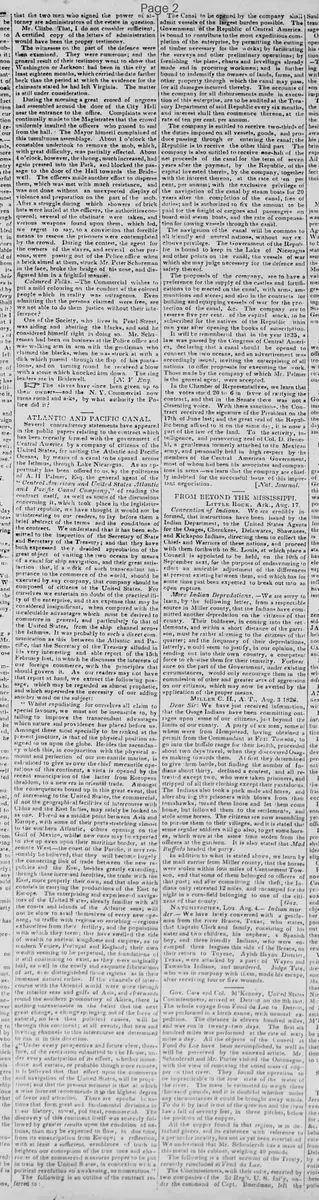
Several contradictory statements have appeared in the public papers relating to the contract which has been recently formed with the government of Central America by a company of citizens of the United States, for uniting the Atlantic and Pacific Oceans, by means of a canal to be opened across the Isthmus, through Lake Nicaragua. As an opportunity has been offered to us, by the politeness of A. H. Palmer, Esq. the general agent of the "Central American and United States Atlantic and Pacific Canal Company," of reading the contract itself, as well as some of the discussions concerning it, which took place in the legislature of that republic, we have thought it would not be uninteresting to our readers, to lay before them a brief abstract of the terms and the conditions of the contract. We understand that it has been submitted to the inspection of the Secretary of State and Secretary of the Treasury; and that they have both expressed their decided approbation of the great object of uniting the two oceans by means of a canal for ship navigation, and their great satisfaction that, if a work of such transcendant importance to the commerce of the world, should be executed by any company, that company should be composed of citizens of the United States. For ourselves we entertain no doubt of the practical utility of the enterprise, and at an expense that may be considered insignificant, when compared with the incalculable advantages which must be derived to commerce in general, and particularly to that of the United States, from the ship channel across the Isthmus. It was probably to such a direct communication as this between the Atlantic and Pacific, that the Secretary of the Treasury alluded in his very interesting and able report of the 15th February last, in which he discusses the interests of our foreign commerce, with the principles that should govern it. As our readers may not have that report at hand, we extract the following passage, which may be regarded as almost prophetic, and which supersedes the necessity of our adding another word on the subject:
"Whilst repudiating for ourselves all claim to special favours, we must not be insensible to, by failing to improve the transcendant advantages which nature and providence has placed before us. Amongst these most specially to be ranked at the present juncture, is that of the physical position assigned to us upon the globe. Besides the ascendancy which this, in conjunction with the physical amount and perfection of our mercantile marine, is calculated to give us over the chief mercantile operations of this continent, a vista is opened by the recent emancipation of the latter from European thraldom, to a new era in oriental trade. Amongst the consequences bound up in this great event, that of increasing to the United States, the commercial, if not the geographical facilities of intercourse with China and the East Indies, may safely be looked to as one. Placed as a middle point between Asia and Europe, with some of their ports stretching almost to the southern Atlantic, others opening on the Gulf of Mexico, whilst new ones may be expected to rise up even upon their maritime border, at the remote West the coast of the Pacific, it may reasonably be believed, that they will become largely the connecting link of trade between the new republics and the East, besides greatly extending, through these increased faculties, the trade with the East, more properly their own, and that also which consists in carrying the productions of the East to Europe. The enterprising and experienced navigators of the United States, already familiar with all the coasts and islands of the Atlantic seas; will not be slow to avail themselves of every new opening, to traffic with regions so enriching--regions exhaustless from their fertility, and the population with which they teem; that have swelled the tide of wealth to ancient kingdoms and empires, as to modern Venice, Portugal and England; their own wealth seeming to be perpetual, the foundations of it still continuing to exist, as they were originally laid, as well in the costly and exquisite fabrications of art, ever distinguished those regions as in their immense natural riches. If the channels of intercourse with the Oriental world were once through the interior seas and gulfs of Asia, and afterwards round the southern promontory of Africa, there is nothing unreasonable in the belief that the next great change, a change springing out of the force of natural, no less than political causes, will be through this continent; at all events, that new and inviting channels to this intercourse are determined to run it in this direction.
"Under every prospective and future view, therefore, of the resolution submitted to the House, under every anticipation of its effect, whether immediate and certain, or probable though more remote, it is believed that that effect upon the commerce and navigation of the United States, will be propitious; and that the present moment is that at which a wise forecast recommends it to the highest degree of favor and attention. There are epochs in nations that form great and fundamental divisions in their history, moral, political, commercial. The discovery of this continent itself was scarcely followed by greater results upon the condition of nations, than may be expected to flow, in due time, from its emancipation from Europe; a reflection, with at least a sufficient semblance of truth to heighten our conception of the true tone and character of the commercial measures proper to be put in train by the United States, in connexion with a political revolution so awakening, so momentous.'"
The following is an outline of the contract referred to :
The Canal to be opened by the company shall admit vessels of the largest burden possible. The Government of the Republic of Central America, is bound to contribute to the most expeditious completion of the enterprise, by permitting the cutting of timber necessary for the works; by facilitating the surveys and other preliminary operations; by furnishing the plans, charts and levellings already made and in procuring workmen; and is further bound to indemnify the owners of lands, farms, and other property through which the canal may pass, for all damages incurred thereby. The accounts of the company for all disbursements made in execution of this enterprise, are to be audited at the Treasury Department of said Republic every six months, and interest shall then commence thereon, at the rate of ten per cent. per annum.
The company is entitled to receive two-thirds of the duties imposed on all vessels, goods, and produce passing through or entering the canal; the Republic is to receive the other third part. The company is also entitled to receive one-half of the net proceeds of the canal for the term of seven years after the payment, by the Republic, of the capital invested therein, by the company, together with the interest thereon, at the rate of ten per cent, per annum; with the exclusive privilege of the navigation of the canal by steam boats for 20 years after the completion of the canal, free of duties; and is authorized to fix the amount to be paid for the freight of cargoes and passengers on board said steam boats, and the rate of compensation for towing vessels through the canal.
The navigation of the canal will be common to all friendly and neutral nations, without any exclusive privilege. The Government of the Republic is bound to keep in the Lake of Nicaragua and other points on the canal, the vessels of war which she may judge necessary for the defence and safety thereof.
The proposals of the company, are to have a preference for the supply of the castles and fortifications to be erected on the canal, with arms, ammunition and stores; and also in the contracts for building and equipping vessels of war for the protection of the canal, &c. The company are to reserve five per cent. of the capital stock, to be subscribed for the natives of the Republic within one year after opening the books of subscription.
It will be remembered that in the year 1825, a law was passed by the Congress of Central America, declaring that a canal should be opened to connect the two oceans, and an advertisement was accordingly issued, inviting the enterprising of all nations to offer proposals for executing the work. Those made by the company of which Mr. Palmer is the general agent, were accepted.
In the Chamber of Representatives, we learn that the votes stood 20 to 6 in favor of ratifying the contract, and that in the Senate there was not a dissenting voice. With these sanctions, the Contract received the signature of the President on the 17th of June last; and the great seal of the Republic being affixed to it on the same day, it is now a part of the law of the land. To the activity, intelligence, and persevering zeal of Col. D. Henski, a gentleman formerly attached to the Mexican army, and personally held in high respect by the members of the Central American Government, most of whom had been his associates and companions in arms --we learn that the company are chiefly indebted for the successful issue of this important negociation.
[Nat. Journal.
What sub-type of article is it?
What keywords are associated?
What entities or persons were involved?
Where did it happen?
Foreign News Details
Primary Location
Central America
Event Date
17th Of June Last
Key Persons
Outcome
contract ratified by chamber of representatives (20 to 6) and senate unanimously; signed by president and affixed with great seal on 17th of june last, becoming law.
Event Details
A company of U.S. citizens formed a contract with the Central American government to build a canal across the Isthmus through Lake Nicaragua uniting Atlantic and Pacific Oceans. The government aids with timber, surveys, plans, workmen, and indemnifies property owners. Company receives two-thirds of duties, one-half net proceeds for seven years after capital repayment with 10% interest, exclusive steam boat navigation for 20 years, and sets rates. Navigation open to all friendly nations; government provides defense. Company prefers for fortifications and vessels. 5% stock reserved for natives. Law passed in 1825 inviting proposals; this company's accepted. Negotiated by Col. D. Henski.