Thank you for visiting SNEWPapers!
Sign up free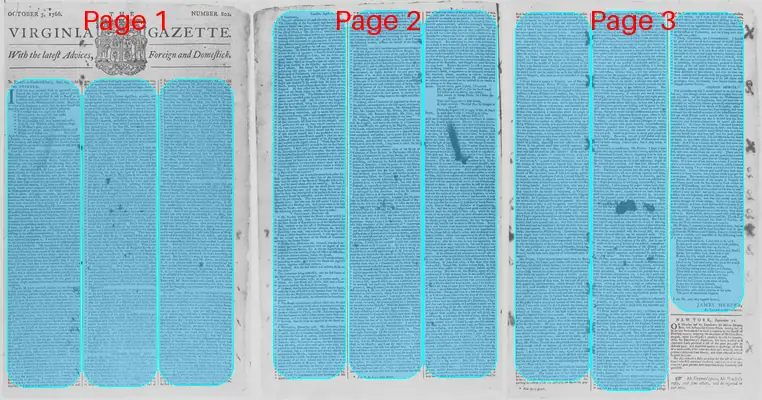
The Virginia Gazette
Richmond, Williamsburg, Richmond County, Virginia
What is this article about?
In a September 14, 1766, letter from Fredericksburg, James Mercer accuses Richard Henry Lee of hypocrisy for initially seeking the Stamp Act distributorship out of self-interest before leading opposition to it. Mercer defends his brother George Mercer's unwitting acceptance of the role and cites Assembly journals and testimonies to expose Lee's motives.
Merged-components note: This is a single continuous letter to the editor from James Mercer, dated Sept. 14, 1766, criticizing R.H. Lee's actions regarding the Stamp Act. It spans pages 1-3 with sequential reading orders. The second component was incorrectly labeled as 'story' but is part of the letter's narrative, including quotes and historical context.
Clippings
1 of 3
OCR Quality
Full Text
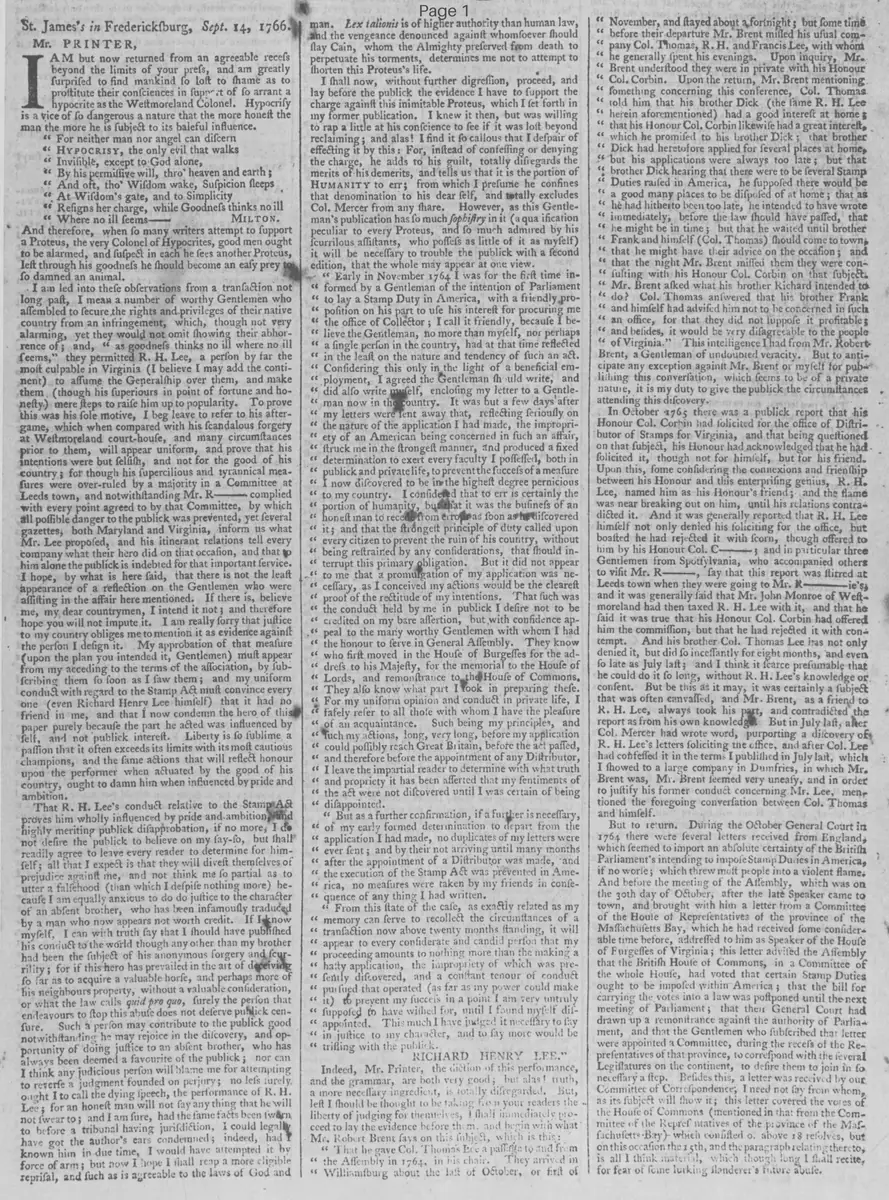
Mr. PRINTER,
A Man but now returned from an agreeable recess beyond the limits of your press, and am greatly surprised to find mankind so slow to shame as to prostitute their consciences in support of so arrant a hypocrite as the Westmoreland Colonel. Hypocrisy is a vice of so dangerous a nature that the more honest the man the more he is subject to its baleful influence.
"For neither man nor angel can discern
Hypocrisy, the only evil that walks
"Invisible, except to God alone,
"By his permissive will, thro' heaven and earth;
"And oft, tho' Wisdom wake, Suspicion sleeps
"At Wisdom's gate, and to Simplicity
Resigns her charge, while Goodness thinks no ill
"Where no ill seems
MILTON.
And therefore, when so many writers attempt to support a Proteus, the very Colonel of Hypocrites, good men ought to be alarmed, and suspect in each he sees another Proteus, Lest through his goodness he should become an easy prey to so damned an animal.
I am led into these observations from a transaction not long past, I mean a number of worthy Gentlemen who assembled to secure the rights and privileges of their native country from an infringement, which, though not very alarming, yet they would not omit showing their abhorrence of; and, as goodness thinks no ill where no ill seems," they permitted R. H. Lee, a person by far the most culpable in Virginia (I believe I may add the continent) to assume the Generalship over them, and make them (though his superiors in point of fortune and honesty.) mere steps to raise him up to popularity. To prove this was his sole motive, I beg leave to refer to his after-game, which when compared with his scandalous forgery at Westmoreland court-house, and many circumstances prior to them, will appear uniform, and prove that his intentions were but selfish, and not for the good of his country; for though his supercilious and tyrannical measures were over-ruled by a majority in a Committee at Leeds town, and notwithstanding Mr. R- complied with every point agreed to by that Committee, by which all possible danger to the publick was prevented, yet several gazettes, both Maryland and Virginia, inform us what Mr. Lee proposed, and his itinerant relations tell every company what their hero did on that occasion, and that of him alone the publick is indebted for that important service.
I hope, by what is here said, that there is not the least appearance of a reflection on the Gentlemen who were assisting in the affair here mentioned. If there is, believe me, my dear countrymen, I intend it not; and therefore hope you will not impute it. I am really sorry that justice to my country obliges me to mention it as evidence against the person I design it. My approbation of that measure (upon the plan you intended it, Gentlemen) must appear from my acceding to the terms of the association, by subscribing them so soon as I saw them; and my uniform conduct with regard to the Stamp Act must convince every one (even Richard Henry Lee himself) that it had no friend in me, and that I now condemn the hero of this paper purely because the part he acted was influenced by self, and not publick interest. Liberty is so sublime a passion that it often exceeds its limits with its most cautious champions, and the same actions that will reflect honour upon the performer when actuated by the good of his country, ought to damn him when influenced by pride and ambition.
That R. H. Lee's conduct relative to the Stamp Act proves him wholly influenced by pride and ambition and highly meriting publick disapprobation, if no more, I do not desire the publick to believe on my say-so, but shall readily agree to leave every reader to determine for himself; all that I expect is that they will divest themselves of prejudice against me, and not think me so partial as to utter a falsehood (than which I despise nothing more) because I am equally anxious to do justice to the character of an absent brother, who has been infamously traduced by a man who now appears not worth credit. If I know myself, I can with truth say that I should have published his conduct to the world though any other than my brother had been the subject of his anonymous forgery and scurrility; for if this hero has prevailed in the art of deceiving so far as to acquire a valuable horse, and perhaps more of his neighbours property, without a valuable consideration, or what the law calls quid pro quo, surely the person that endeavours to stop this abuse does not deserve publick censure. Such a person may contribute to the publick good notwithstanding he may rejoice in the discovery, and opportunity of doing justice to an absent brother, who has always been deemed a favourite of the publick; nor can I think any judicious person will blame me for attempting to reverse a judgment founded on perjury; no less surely ought I to call the dying speech, the performance of R. H. Lee; for an honest man will not say any thing that he will not swear to; and I am sure, had the same facts been sworn to before a tribunal having jurisdiction, I could legally have got the author's ears condemned; indeed, had I known him in due time, I would have attempted it by force of arm; but now I hope I shall reap a more eligible reprisal, and such as is agreeable to the laws of God and man. Lex talionis is of higher authority than human law, and the vengeance denounced against whosoever should slay Cain, whom the Almighty preserved from death to perpetuate his torments, determines me not to attempt to shorten this Proteus's life.
I shall now, without further digression, proceed, and lay before the publick the evidence I have to support the charge against this inimitable Proteus, which I set forth in my former publication. I knew it then, but was willing to rap a little at his conscience to see if it was lost beyond reclaiming; and alas! I find it so callous that I despair of effecting it by this: For, instead of confessing or denying the charge, he adds to his guilt, totally disregards the merits of his demerits, and tells us that it is the portion of HUMANITY to err; from which I presume he confines that denomination to his dear self, and totally excludes Col. Mercer from any share. However, as this Gentleman's publication has so much Sophistry in it (a qualification peculiar to every Proteus, and so much admired by his currilous assistants, who possess as little of it as myself) it will be necessary to trouble the publick with a second edition, that the whole may appear at one view.
"Early in November 1764 I was for the first time informed by a Gentleman of the intention of Parliament to lay a Stamp Duty in America, with a friendly proposition on his part to use his interest for procuring me the office of Collector; I call it friendly, because I believe the Gentleman, no more than myself, nor perhaps a single person in the country, had at that time reflected in the least on the nature and tendency of such an act. Considering this only in the light of a beneficial employment, I agreed the Gentleman should write, and did also write myself, enclosing my letter to a Gentleman now in the country. It was but a few days after my letters were sent away that, reflecting seriously on the nature of the application I had made, the impropriety of an American being concerned in such an affair, struck me in the strongest manner, and produced a fixed determination to exert every faculty I possessed, both in publick and private life, to prevent the success of a measure I now discovered to be in the highest degree pernicious to my country. I considered that to err is certainly the portion of humanity, but that it was the business of an honest man to recede from errors as soon as he discovered it; and that the strongest principle of duty called upon every citizen to prevent the ruin of his country, without being restrained by any considerations, that should interrupt this primary obligation. But it did not appear to me that a promulgation of my application was necessary, as I conceived my actions would be the clearest proof of the rectitude of my intentions. That such was the conduct held by me in publick I desire not to be credited on my bare assertion, but with confidence appeal to the many worthy Gentlemen with whom I had the honour to serve in General Assembly. They know who first moved in the House of Burgesses for the address to his Majesty, for the memorial to the House of Lords, and remonstrance to the House of Commons. They also know what part I took in preparing these. For my uniform opinion and conduct in private life, I safely refer to all those with whom I have the pleasure of an acquaintance. Such being my principles, and such my actions, long, very long, before my application could possibly reach Great Britain, before the act passed, and therefore before the appointment of any Distributor, I leave the impartial reader to determine with what truth and propriety it has been asserted that my sentiments of the act were not discovered until I was certain of being disappointed
"But as a further confirmation, if a further is necessary, of my early formed determination to depart from the application I had made, no duplicates of my letters were ever sent; and by their not arriving until many months after the appointment of a Distributor was made, and the execution of the Stamp Act was prevented in America, no measures were taken by my friends in consequence of any thing I had written.
"From this state of the case, as exactly related as my memory can serve to recollect the circumstances of a transaction now above twenty months standing, it will appear to every considerate and candid person that my proceeding amounts to nothing more than the making a hasty application, the impropriety of which was presently discovered, and a constant tenor of conduct pursued that operated (as far as my power could make it) to prevent its success in a point I am very untruly supposed to have wished for, until I found myself disappointed. This much I have judged it necessary to say in justice to my character, and to say more would be trifling with the publick.
RICHARD HENRY LEE."
Indeed, Mr. Printer, the diction of this performance, and the grammar, are both very good; but alas! truth, a more necessary ingredient, is totally disregarded. But, lest I should be thought to be taking upon your readers the liberty of judging for themselves, I shall immediately proceed to lay the evidence before them, and begin with what Mr. Robert Brent says on this subject, which is this:
"That he gave Col. Thomas Lee a pass to and from the Assembly in 1761. in his chair." They arrived in Williamsburg about the last of October, or first of November, and stayed about a fortnight; but some time before their departure Mr. Brent missed his usual company Col. Thomas, R. H. and Francis Lee, with whom he generally spent his evenings. Upon inquiry, Mr. Brent understood they were in private with his Honour Col. Corbin. Upon the return, Mr. Brent mentioning something concerning this conference, Col. Thomas told him that his brother Dick (the same R. H. Lee herein aforementioned) had a good interest at home that his Honour Col. Corbin likewise had a great interest, which he promised to his brother Dick; that brother Dick had heretofore applied for several places at home, but his applications were always too late; but that brother Dick hearing that there were to be several Stamp Duties raised in America, he supposed there would be a good many places to be disposed of at home; that as he had hitherto been too late, he intended to have wrote immediately; before the law should have passed, that he might be in time; but that he waited until brother Frank and himself (Col. Thomas) should come to town that he might have their advice on the occasion; and that the night Mr. Brent missed them they were consulting with his Honour Col. Corbin on that subject Mr. Brent asked what his brother Richard intended to do? Col. Thomas answered that his brother Frank and himself had advised him not to be concerned in such an office, for that they did not suppose it profitable; and besides, it would be very disagreeable to the people of Virginia." This intelligence I had from Mr. Robert Brent, a Gentleman of undoubted veracity. But to anticipate any exception against Mr. Brent or myself for publishing this conversation, which seems to be of a private nature, it is my duty to give the publick the circumstances attending this discovery.
In October 1765 there was a publick report that his Honour Col. Corbin had solicited for the office of Distributor of Stamps for Virginia, and that being questioned on that subject, his Honour had acknowledged that he had. solicited it, though not for himself, but for his friend. Upon this, some considering the connexions and friendship between his Honour and this enterprising genius, R. H. Lee, named him as his Honour's friend; and the flame was near breaking out on him, until his relations contradicted it. And it was generally reported that R. H. Lee himself not only denied his soliciting for the office, but boasted he had rejected it with scorn, though offered to him by his Honour Col. C--- and in particular three Gentlemen from Spottsylvania, who accompanied others to visit Mr. R---, say that this report was stirred at Leeds town when they were going to Mr. R--- and it was generally said that Mr. John Monroe of Westmoreland had then taxed R. H. Lee with it, and that he said it was true that his Honour Col. Corbin had offered him the commission, but that he had rejected it with contempt. And his brother Col. Thomas Lee was not only denied it, but did so incessantly for eight months, and even so late as July last; and I think it scarce presumable that he could do it so long, without R. H. Lee's knowledge or consent. But be this as it may, it was certainly a subject that was often canvassed, and Mr. Brent, as a friend to R. H. Lee, always took his part, and contradicted the report as from his own knowledge. But in July last, after Col. Mercer had wrote word, purporting a discovery of R. H. Lee's letters soliciting the office, and after Col. Lee had confessed it in the terms I published in July last, which I showed to a large company in Dumfries, in which Mr. Brent was, Mr. Brent seemed very uneasy, and in order to justify his former conduct concerning Mr. Lee, mentioned the foregoing conversation between Col. Thomas and himself.
But to return. During the October General Court in 1764 there were several letters received from England, which seemed to import an absolute certainty of the British Parliament's intending to impose Stamp Duties in America, if no worse; which threw most people into a violent flame: And before the meeting of the Assembly, which was on the 30th day of October, after the late Speaker came to town, and brought with him a letter from a Committee of the House of Representatives of the province of the Massachusetts Bay, which he had received some considerable time before, addressed to him as Speaker of the House of Burgesses of Virginia; this letter advised the Assembly that the British House of Commons, in a Committee of the whole House, had voted that certain Stamp Duties ought to be imposed within America; that the bill for carrying the votes into a law was postponed until the next meeting of Parliament; that their General Court had drawn up a remonstrance against the authority of Parliament, and that the Gentlemen who subscribed that letter were appointed a Committee, during the recess of the Representatives of that province, to correspond with the several Legislatures on the continent, to desire them to join in so necessary a step. Besides this, a letter was received by our Committee of Correspondence; I need not say from whom, as its subject will show it; this letter covered the votes of the House of Commons (mentioned in that from the Committee of the Representatives of the province of the Massachusetts-Bay)- which consisted of above 18 resolves, but on this occasion the 15th, and the paragraph relating thereto, is all I think material, which though long I shall recite, for fear of some lurking slander's future abuse.
London, April 11, 1764.
"Gentlemen,
re The first resolution is the most alarming to the colonies. The Chancellor of the Exchequer had determined this measure should take place, but I informed you in my last of the check we gave to its progress (the last was the 9th of March.) Mr. G., after declaring it was far from his intentions to force any measure without hearing every objection, put the House in mind that the national debt amounted to 146,000,000, so alarming a circumstance that great attention was due to the revenue; that America gave birth to the last war, which cost us 74,000,000. He stated the annual expense of America proposed would be insufficient, without the addition of stamp taxes, which he thought might be raised without fewer officers. But though he readily acquiesced in postponing this point, yet hoped that the power and sovereignty of Parliament, over every part of the British dominions, for the purpose of raising or collecting any tax, would never be disputed. That if there was a single man doubted it he would take the sense of the House, having heard without doors hints of this nature dropped. He then called for the sense of Parliament, and that the House might not suffer objections of that nature at a future day. The Members interested in the plantations expressed great surprise that a doubt of that nature could ever exist. Mr. G. then suggested that this great object, being the relief of this kingdom from the burden which in justice America should bear, it would be as satisfactory to him if the several provinces would among themselves, and in modes best suited to their circumstances, raise a sum adequate to the expense of their defence. This, to the best of recollection, was all that materially fell from him on this subject; AND IT APPEARS TO ME OF THE FIRST IMPORTANCE TO THE COLONIES. The House appeared so unanimous in opinion that America should ease the revenue not listen to any remonstrance against it (but the introduction of this annual expense that I am persuaded they will and moment to the subjects there.) What steps the respective provinces will fall on must be left to their better judgment; I shall only presume to add what appears the determined sense of Government, that this money of incapacity will scarce avail, and therefore I SHOULD CONCEIVE IT WOULD BE EXTREMELY WORTHY OF YOUR SERIOUS ATTENTION WHAT MAY BE THE CONSEQUENCE OF INTRODUCING SUCH A PRECEDENT AS THE IMPOSITION OF A STAMP TAX BY a British Parliament."
were read by many of the House of Burgesses before they met, and by many others after the meeting. In short, I can say with great certainty that the whole House was in a flame before they met, and every thing that could be done by them was determined to be pursued so soon as the Governor should be addressed, and the first forms of the House be got through. This was not only intended, but actually done; but who was the first mover I know not. Agreeable to a standing rule, such letters were to be laid before the House; and accordingly I find on their journals the following minutes, which I beg leave to insert:
"THURSDAY, November 1st.
Mr. Speaker laid before the House a letter which he received in July last, from a Committee appointed by the Hon. House of Representatives of the Massachusetts Bay, relative to the late act of Parliament concerning the sugar trade with the foreign colonies, &c. and the said letter was read, and ordered to lie on the table."
From a resolve hereafter mentioned, it will appear that the &c. related to the votes of the House of Commons relative to the Stamp Duties.
Wednesday, November 7th. Ordered, that the Committee appointed to correspond with the Agent of this colony in Great Britain, &c. do lay the Agent's letters received since the meeting of the last session of Assembly, and their answers thereto, before the House.
"Mr. Attorney from the Committee of Correspondence, according to order, laid before the House the Agent's letters, together with their answers.
"Ordered, that the said letters and answers do lie on the table."
The Governor being addressed, and the first forms of the House being now got through, on Tuesday, November 13th, on a motion made, resolved, that this House will resolve itself into a Committee to consider the state of the colony.
"Ordered, that the several letters to and from the Agent, with the letter addressed to the Speaker from the Committee for the Massachusetts Government, which were ordered to lie on the table, be referred to the same Committee
The House immediately resolved itself into the said Committee, pursuant to the above mentioned resolution of the House: and after some time spent therein, Mr. Speaker resumed the Chair, and Mr. Attorney reported that the Committee had had that matter under their consideration, and had come to several resolutions thereon.
"Ordered, that the same be reported to the House to-morrow."
"Wednesday, November 14th. Mr. Attorney, from the Committee of the whole House, reported, according to order, that the Committee had had under their consideration the state of the colony, and the several letters to them referred, and had come to several resolutions thereon: which he read in his place, and then delivered in at the table, where they were again twice read, and agreed to with some amendments, and are as follows
"Resolved, that a most humble and dutiful address be presented to his Majesty, imploring his Royal protection if his faithful subjects the people of this colony in the s enjoyment of all their natural and civil rights as men and as descendants of Britons, which rights must be violated if laws respecting the internal government and taxation of themselves are imposed upon them by any other power than that derived from their own consent, by and with the approbation of their Sovereign or his Substitute. &c. &c.
"Resolved, that a memorial be prepared to be laid before the Right Honourable the Lords, &c.
"Resolved, that a memorial be prepared to be laid before the Honourable the House of Commons, &c."
I have recited more of the address than memorials, in order to show that the House thought it very essential to the preservation of their rights and privileges to be wholly exempt from the authority of Parliament as to every species of internal taxation, without criticising on the nature and tendency of the act," as Col. Lee did! And I insert the following resolve, to show the subject of the Massachusetts letter.
"Resolved, that the Committee appointed to correspond with the Agent of this colony, in Great Britain, &c. be directed to answer the letter of the 20th of June last, from the Committee of the House of Representatives for the province of the Massachusetts Bay, to the Hon. the Speaker of the House of Representatives for the province of Virginia; and to assure that Committee that the Assembly of Virginia (methinks R. H. Lee ought to have been excepted) are highly sensible of the very great importance it is, as well to the colony of Virginia as to America in general, that the subjects of Great Britain in this part of its dominion should continue in possession of their ancient and most valuable right of being taxed only by consent of their Representatives, and that the Assembly here (I presume except as before excepted) will omit no measure in their power to prevent such essential injury from being done to the rights and liberties of the people.
"Ordered, that a Committee be appointed to draw up the address and memorials in the said report mentioned, and it is referred to Mr. Attorney, Mr. Richard Henry Lee, Mr. Landon Carter, Mr. Wythe, Mr. Edmund Pendleton, Mr. Benjamin Harrison, Mr. Cary, and Mr. Fleming, to prepare and bring in the same."
On Tuesday, December 18th, after several conferences with the Council, and many alterations in a Committee of the whole House, the address to his Majesty, memorial to the Lords, and memorial to the Commons (which before now was new christened by the name of a remonstrance) were completed, and passed; but to prove that the House was privy to the printed votes mentioned in my former publication, and now said to have come enclosed in the letter herein afore set forth, I beg leave to insert the following clause of the remonstrance:
It appearing by the printed votes of the House of Commons of Great Britain, in Parliament assembled, that in a Committee of the whole House, the 17th day or March last, it was resolved that towards defending, protecting, and securing the British colonies and plantations in America, it may be proper to charge Stamp Duties in the said colonies and plantations; and that it being apprehended that the same subject, which was then declined, may be resumed and further pursued in a succeeding session, the Council and Burgesses of Virginia, met in General Assembly, judge it their indispensable duty, in a respectful manner, but with decent firmness, to remonstrate against such a measure, that at least a cession of those rights, which in their opinion must be infringed by that procedure, may not be inferred from their silence at so important a crisis, &c.
From this undeniable authority, it appears that the letter from the Massachusetts Bay was read in the House of Burgesses on the first day of November, the other on the 7th; so that from these dates, if no earlier (not to mention the conference with his brothers) the Westmoreland Colonel must have had publick and judicial notice "in what manner the tax was to be laid, and the consequences of it," and that at the time he wrote his private address for the deputation, though early in November, he must have been fully convinced of the impropriety of "traitorously aiding and assisting in the destruction of his country's liberty, and that with parricidal hands he was endeavouring to fasten chains of slavery on this his native country, although like the tenderest and best of mothers she had long fostered and powerfully supported him." As to his conduct in the Senate, I really do not recollect it with that certainty I would choose to do to repeat it. All that I can say is, that the motion was consequential to the letters being ordered to lie on the table and though R. H. Lee may have made the first motion for the address to the Commons, yet I do deny he first proposed the address to his Majesty and memorial to the Lords, for I well remember the late Speaker proposed them when in a Committee of the whole House, as an amendment to the first motion; and his reasons were, "that the meanest subject in the British dominions had a right to approach the Throne, but that it would be doing nothing to remonstrate to the Commons, for that the bill for laying the Stamp Duties would be looked on as a money bill, against which not even a petition would be received, nor could any Member be prevailed on to present it, being so contrary to the rules of Parliament."
But admitting R. H. Lee did make the first motion for the memorial to the Commons, which I am sure is the utmost he did do, what does it prove? Can any one person who reads his sophistical piece, and the journals of the House, tell which was prior, his private address for a deputation, or the address to his Majesty? Who can determine the date of the word EARLY? I readily agree I cannot; indeed I despair of finding it out until Col. Mercer arrives. Unless he had returned to England we should have never known of the address, and without his assistance I fear we shall never know the date of it; for the author is too knowing to let conscience give evidence against him. I am also at a loss to know what part the Westmoreland Colonel took in preparing them, or else I would confess it. There were eight Gentlemen (if the Colonel is to be reckoned) appointed a private Committee for to prepare them. They were all very capable, but I have heard, and believe it to be true, that the Westmoreland Colonel prepared the address to his Majesty; and I can but laugh now to think how very properly that task was assigned him: A person that had been a Solicitor General for every vacancy in the colony for more than seven years (I mean the death of his Honour the late Collector of South Potowmack) must certainly be well qualified to prepare addresses; if he was in London, he would be entitled to the freedom of the city, having served seven years apprenticeship to this science. From these circumstances, I hope it appears that R. H. Lee ought not to have said that his application was hasty and without due notice of the impropriety of such a measure, and that the word EARLY is so equivocal that he intended it to impose on the publick; for surely when he appeals to his conduct in the Senate, as receding from HIS EARLY APPLICATION, which he cunningly imputes to ERROUR THE PORTION OF HUMANITY, he ought to have condescended to the dates of these transactions; for at the best but a few days intervened the ADDRESS to his Majesty for a deputation and the ADDRESS against the act. Which was prior I know not, or else would not trust to his telling it. But admitting the latter to be subsequent, yet I think it very imperfect proof to satisfy unprejudiced people that it was a departure from his PRIMARY OBLIGATION, which I take to be self interest; for his ambition always made him restless in his own seat, nothing less than the seat of the good old Speaker could satiate his ambition in the Senate; his relations were always canvassing for the suffrages of the Burgesses, and thought the good old man too long lived. Besides this motive (which is proved by his declaring himself a candidate immediately upon this good man's death, in opposition to the then only candidate Mr. Attorney, whom, according to custom, he loaded with objections, because a placeman) Mr. Addison gives an instance which proves that the conduct in the Senate is not always to be depended on:
Semp. Let me alone, good Syphax, I'll conceal
My thoughts in passion ('tis the surest way)
I'll bellow out for liberty, my country,
And mouth at Stamp Duties, 'til I shake the
house.
Your cold hypocrisy's a stale device,
A worn out trick: Wouldst thou be thought in
earnest?
Clothe thy feigned zeal in rage, in fire, in fury!
SYPH.
In troth thou'rt able to instruct gray hairs,
And teach the wily African DECEIT.
And yet he depends on this single circumstance to contradict my former publication, wherein I say HIS SENTIMENTS OF THE MEASURE WERE NOT DISCOVERED UNTIL HE WAS CERTAIN HAVING BEEN DISAPPOINTED, but with what justice I have already shown; and I am sure, if this do not serve his turn, he is without any other subterfuge The does not pretend to have shown any other dissimulation until the burning of the effigy the 24th of Sept 1765. But though he should go further back, I defy to date it earlier than the confirmation of Col. Mercer's appointment; for surely he will not pretend to say his lying can be called an opposition. That such was his conduct every person I hear speak on the subject agrees; his sons do not deny it. However, if he did any thing in opposition to it, it certainly must be known to some Burgesses besides himself; and therefore, when he exhibits in the gazette again, I hope to hear what, and when it was. But I must inform him it will be very essential to get some creditable person to vouch for him, and also to condescend to some date, and not rely on his favourite words EARLY, and LONG, VERY LONG; for such will not determine the merits of transactions that depend on dates. It is also expected he will let the publick know by what ship his address went, and when she sailed, and whether no other ships sailing before the spring was not the reason of his not writing a duplicate, or whether it may not be owing to custom; and therefore it may not be improper for him to say whether he wrote duplicates of his addresses for the place of Collector of South Potowmack, Deputy Postmaster, Collector of Rappahannock, &c. &c. and that he will assign some good reason for his absence from the Assembly in May 1765, which was upwards of thirty days, and yet he never attended one hour though in perfect health, and contrary to his former custom he usually giving close attendance, for fear the Speaker should die, and he not be there to fill the Chair. Many say it was because some important advices were expected from England about that time, which is not improbable; for the Stamp Act did actually arrive, and occasioned some spirited resolves, which were approved of by all of the new world, except himself. Indeed, to do him justice, I must confess that, after he was sure he was not appointed, he approved of them too; not only so, but was so good natured as not to be angry with his relations in Virginia and Maryland who paid him the compliment of having framed them. A Gentleman of my acquaintance would also be glad to know what he said about these resolves when shown by the late Mr. John Ambler at Capt. Weedon's in Fredericksburg, at June Fair 1765, a few days after they were passed; though Mr. Ambler is since dead, I can remember some others of that company, besides myself, are yet living. But above all, Mr. Printer, many of your readers are at a loss to know how it was possible that his ADDRESS for a deputation should not arrive in England "UNTIL MANY MONTHS AFTER THE APPOINTMENT OF A DISTRIBUTOR WAS MADE, AND THE EXECUTION OF THE STAMP ACT PREVENTED IN AMERICA," notwithstanding he says it was shipped EARLY in November. For my part I am at a loss how to calculate it, as I do not know when to fix the time of the execution of the Stamp Act's being prevented in America; but if I may reckon from the appointment of a Distributor, I suppose that may be ascertained, as I presume it could not be prior to the passage of the act, which I believe was not so early as March 1765. However, admitting it to be March, if we add three months, the fewest that will satisfy the word MANY, it will make it the last of June, which from EARLY in November are eight months: A prodigious voyage indeed, if true! I think he may reap this admonition from it, that he has very bad luck, the fates counter to his industry, and therefore he had better drop all thoughts of a place to support his family, and patiently put down the chariot; for as he has "But A SMALL ESTATE, and A LARGE FAMILY," if he will not be content to live within bounds, some of his noble issue may hereafter be obliged to have recourse to that vile art of Faber, a blacksmith. or. as a late currilous Grecian ignorantly construes it, a CARPENTER, from either of which the community will receive no advantage, unless their mechanical genius should be better than that of their father, who by the effigy he fabricated is generally estimated no higher than a logmauler. But, Mr. Printer, as this transaction (though acknowledged to be an unprecedented piece of scurrility) seems to be relied on by the Colonel in private, and his scandalous slanderers, his auxiliaries in publick, as necessary to prevent the country from ruin, it may not be amiss to inquire whether he was influenced by
such laudable motives, or as I insist, by envy and malice.
What are the secret thoughts of the heart nothing but divinity can know, but, if I may appeal to outward actions, surely I am right in saying he was not influenced by the good of his country; for all Virginia will readily agree with me when I say they wanted no such scandalous invitations to guard their country from ruin. An opposition was determined in Virginia long before the 28th of September, without the assistance of the Westmoreland Colonel, who until then had kept aloof. It was universally known how Col. Mercer came to so disagreeable an appointment, and his friends, from their former knowledge of him, were sure he would readily resign his commission upon his arrival; his nearest relations also undertook for him; my father and myself wrote to him to resign, and lodged our letters with Mr. Royle in Williamsburg (I believe about the middle of July) to be delivered to him so soon as he should arrive (which I presume some of Mr. Royle's assistants yet remember) nothing doubting but that he would credit and be advised by us in that affair sooner than by strangers, who were no ways interested in his reputation.
I do not know a county in Virginia, out of fifty four except Westmoreland, Prince William, and Loudoun that took these steps to wound Col. Mercer's reputation. It is true that two of the Lees fill the highest military commissions in Prince William and Loudoun, but, to do them justice, I do not hear they promoted this scurrility; indeed I blame not any concerned in either of these, for in Prince William it was early in the year, and it was founded on a report that Col. Mercer was arrived, and intended to act under his commission; and the latter was to deter a Gentleman from accepting a deputation which the people of that county had been most untruly informed he had solicited by letters to my father and self. I presume I need not reckon in the number an effigy that was hung up at King William court-house, as it was intended for a stranger then at that place, whom the people understood was a Deputy; not to mention the little sanction given it by the Gentlemen of the county, it being only the fruits of the leisure hours of some prisoners who were within the bounds. But supposing a sacrifice in effigy was necessary, can a dying speech be justified, especially one that reflects on Colonel Mercer in his private more than publick capacity; and that too, together with the effigy, wholly prepared by a man who had solicited the office himself? If the author's damned error, or rather "LOVE OF GOLD, HAD LED"
"HIM ASTRAY FROM HONOUR, VIRTUE, AND PA-"
"TRIoTIsM." against man self conviction, was it not the portion of HUMANITY to suppose Col. Mercer had also erred, and that too without the least suspicion of the impropriety of the office, having only accepted it. If the people of Westmoreland were of such lethargick, pusillanimous, and base dispositions (which I cannot suspect) as to require a sacrifice in effigy to invite them to contribute to the preservation of their freedom, where was the necessity of a dying speech? And if necessary then, why was it to be recorded in the Maryland Gazette? Was the publication intended for the benefit of Maryland, or Virginia? For Maryland it was certainly unnecessary, and for Virginia no less so; for I presume there are not more than fifty in the whole colony that subscribe to that gazette. However, be they more or less, it will be agreed, even by himself that they are only the most sensible and intelligent who did not require the aid of his scurrility and forgery to convince them of the impropriety of the Stamp Act. From this I hope it appears he could intend no good to his country from so scandalous a step. If he did not, some villainous motive must have spurred him on; and what less could it be than envy and ambition! Indeed the latter is proved by the same gazette, for there he finds out a new, but not ready, conveyance to Williamsburg. Common complaisance might have informed him that a correspondent of much less degree than his Governor ought to have seen the letter from the Justices of Westmoreland (which, not to rob the Gentleman of the merit of, I shall call his) before it was published in the Maryland Gazette; but truly if that piece had not got recorded, the Westmoreland Proteus would have been deprived of a favourite piece of apparel.
Mr. Printer, I have already taken more than my share of your paper, but I hope your readers will pardon me for pursuing this subject a little further; for as so many pieces have been published in my absence (which have increased in scurrility because the authors ran no risk of punishment, either from the censure of the publick or myself, as they did not choose to discover themselves) containing false insinuations in support of their hero, for the truth of which they appeal to my knowledge, which though small (they say) must necessarily be privy to some part of his so very conspicuous merit; it will certainly be improper for me to be silent, as such would be construed into a confession, than which nothing can be further from my sentiments.
I readily confess that when I first took my seat in the House of Burgesses I had a very good opinion of their hero, but indeed I can with truth avow that I altered my sentiments long, very long, before I knew my brother was Distributor of Stamps, which at the least is prior to every prejudice against him on that account. I soon found him hot, violent, and supercilious, in party; very tenacious of his opinion; and too great a slave to his ambition and desire for the Chair. He was, and yet is, very happy in face, and good in expression; as such many petitions went through his hands, and for this poor compliment he was always true to the petition, good or bad. Indeed I never knew him give up one; and certainly some, of a great number, ought not to have been insisted on. In short, Mr. Printer, I could give the publick many instances which would reflect no honour on this Gentleman as a Senator; but as I am prescribed by the length of your paper, I shall confine myself to one, which will at least convince the world that he is much affected with that damned disorder of the heart which the political Doctors call the auri sacra fames, even to such a malignant degree that the effigy catched it from him.
In January 1764 the Assembly was suddenly convened, in consequence of some instruction then lately received from England. The season was so bad that very few Members attended, I believe under forty; and the business so short, that the House sat not more than ten days. According to custom a bill was passed by the House for paying the Burgesses wages out of the Treasury, but the wages being fifteen shillings, instead of ten, the Council refused their concurrence, and the bill dropped; by which the Burgesses were entitled to be paid by their respective counties (under an old act passed in the fourth year of her late Majesty Queen Anne, now sixty one years old) after the rate of 130 lbs. of tobacco per day. This Senator (who never missed a session until May 1765, as before observed) and his colleague, were two of the few that attended that short session, and were entitled to be paid by their counties. I must here observe that as some Members give better attendance on the House than others, and as the counties of the absenting Members receive a mutual benefit from the laws passed with the counties whose Members make them, it has long been thought unreasonable to levy the tobacco on the counties; and accordingly, though a bill for paying the wages out of the publick fund should miscarry, by which it cannot be re-enacted the same session, it is always made part of the next bill. Agreeable to this practice, in the next session, October after, a bill was ordered to be brought in for the payment of the Burgesses wages of the then session at fifteen shillings per day; and then, agreeable to the rules of the House, a motion was made that the Committee should be directed to receive a clause for the payment of the wages of the session in January. But truly this patriotick and generous Senator was entitled to receive from his county, if tobacco was worth fourteen shillings, eleven pounds sixteen shillings and eight pence, but if paid out of the Treasury at fifteen shillings per day only nine pounds fifteen shillings, so here was a prospect of gaining two pounds one shilling and six pence to himself, and as much to his colleague, which he would not forego, though it would cost his constituents a penny three farthings per poll, supposing them at 3000, when in fact it would not have cost them a farthing if paid out of the Treasury, -and therefore he (and his colleague of course) opposed the motion with great warmth, notwithstanding they were apprised that a penny three farthings, when added to 46 lbs. of tobacco, the amount of the publick levy per poll, would be grievous to many poor people in their county. However, this act at last passed with this clause; but whether the Burgesses of Westmoreland were paid by their county, I know not; but if they were, it was wrong.
From these circumstances, Mr. Printer, I hope it does appear that the publick has formed a wrong opinion of the Westmoreland Colonel, that is, supposing it to be such as his anonymous auxiliaries say it is; and that the dying speech, being founded on his single testimony, ought to be reversed and annulled, and then Col. Mercer's character will stand unimpeached even from a youth until now: For though he entered into the army at eighteen, and has continued to act in a publick capacity ever since, from Georgia to Cape Breton while in America, and for three years past in Europe, I never heard him reflected on by a single person prior to his being Stampmaster; but on the contrary, I have among his papers letters from numberless sensible correspondents, from one end of the British America to the other, among which are those from the most honourable in every province he was in, and even from the General down to the merchant, which express the highest approbation of him as an acquaintance. The success his polite behaviour met with in Europe is no secret on this side the Atlantic. But report makes it unnecessary for me to say that subject indeed I would not have said but I have, but that they are such known truths to many in this colony that if any one should be so hardy as to deny them I can prove them. But I shall not regard any slanderer who shall be afraid of showing himself, nor would I now take any notice of that infamous and scurrilous dastard who dates his scandal from Stafford, but that he arms himself with the Stamp Act, the only weapon Colonel Mercer can be wounded with. This Scoundrel says "that Col. Mercer knew the sentiments of his country as to the propriety of the act; that he heard while at the Court of Britain of the addresses, remonstrances, and even spirited resolutions of the Assembly; and that he came into his country armed in full with all his boxes of baleful execution, and continued his design to his ne plus ultra." The bare repetition of these falsities, Mr. Printer, convinces me that this piece, instead of Stafford, ought to be dated from Chantilly in Westmoreland, the archives of which contain the dying speech, and many such like pieces, among the other achievements of its noble proprietor. But to convince the publick how true these malicious observations are, I dare say I need only refer them to the following declaration, which Colonel Mercer gave from under his hand at the time of his resignation, which at the least is as high an authority as the Westmoreland Colonel's piece, which all his auxiliaries rely on so much; but, with some other circumstances, I believe it will convince every unprejudiced person how little this slanderer regards the truth.
"Gentlemen, I have met you agreeable to yesterday's promise, to give my country some assurances which I would have been glad I could with any tolerable propriety have done sooner.
"I flatter myself no judicious man can blame me for accepting an office under an authority that was never disputed by any from whom I could be advised of the propriety or weight of the objections. I do acknowledge that some little time before I left England I heard of, and saw, some resolves which were said to be made by the House of Burgesses of Virginia; but as the authenticity of them was disputed, they never appearing but in private hands, and so often and differently explained to me, I determined to know the real sentiments of my countrymen from themselves: And I am concerned to say that those sentiments were so suddenly and unexpectedly communicated to me that I was altogether unprepared to give an immediate answer upon so important a point; for in however unpopular a light I may lately have been viewed, and notwithstanding the many insults I have from this day's conversation been informed were offered me in effigy in many parts of the colony, yet I still flatter myself that time will justify me, and that my conduct may not be condemned after being coolly inquired into.
"The commission so very disagreeable to my countrymen was solely obtained by the genteel recommendation of their Representatives in General Assembly, unasked for; and though this is contradictory to publick report, which I am told charges me with assisting the passage of the Stamp Act; upon the promise of the commission in this colony, yet I hope it will meet with credit when I assure you I was so far from assisting it, or having any previous promise from the Ministry, that I did not know of my appointment until some time after my return from Ireland, where I was at the commencement of the session of Parliament, and for a long time after the act had passed.
"Thus, Gentlemen, am I circumstanced. I should be glad to act now in such a manner as would justify me to my friends and countrymen here, and the authority which appointed me; but the time you have allotted me for my answer is so very short that I have not yet been able to discover that happy medium, therefore must intreat you to be referred to my future conduct, with this assurance in the mean-time that I will not, directly or indirectly, by myself or deputies, proceed in the execution of the act until I receive further orders from England, and not then without the assent of the General Assembly of this colony; and that no man can more ardently and sincerely wish the prosperity thereof or is more desirous of securing all its just rights and privileges, than, Gentlemen, your sincere friend, and obliged humble servant,
GEORGE MERCER."
The circumstances that I would appeal to on this occasion are, that though eleven months are elapsed since this was published, yet his sworn enemy the Westmoreland Colonel, nor any of his auxiliaries, have yet been able to contradict it; and as Col. Mercer generously acknowledged his seeing the resolves of the House of Burgesses, when it never could have been known but from himself, nor even presumed (as the earliest accounts of the disturbances here did not reach Britain until a month after he sailed) no honest man can presume but that if he had seen the ADDRESSES and REMONSTRANCES he would also have confessed it. As I hope for salvation, I do most solemnly declare that he never informed me he had; and from his letters from England (which many Gentlemen have seen, and any honest man may now see) and his most private conversation after he arrived, I do not believe he ever heard of them, or any other advices than what are above mentioned. And I do as solemnly declare that they were not of authenticity; they are not those that now remain on the journals of the House, but I believe were the first that passed, and were receded from the next day. There are but five resolves upon the journals, and his manuscript (which I understand a merchant gave him on Change) contained seven. If it was not of too private a nature, I could here add a circumstance that would sufficiently justify Colonel Mercer in saying THAT THEIR AUTHENTICITY WAS DISPUTED. Colonel Mercer and myself have both mentioned it to some friends, but I cannot think it proper for a news paper. But can any one believe that if Col. Mercer had known the sentiments of the people of Virginia he would have parted with the ship bound to York within 12 miles of Williamsburg, and have landed at Hampton, to run the risk of the attack of every rascal on his way by land? I believe I may say No! but on the contrary that the opposition was not suspected, and Col. Mercer was afraid he should not arrive in time, and was very uneasy upon that account through the whole voyage. In this I do not desire to be credited, as I have more disinterested evidences of so material a fact. Captain Anderson, master of the ship he came in, and three passengers now in this town, have often told me so. Besides these, there are many other passengers in the country, particularly the Reverend Mr. Thruston of Gloucester, and the Reverend Mr. Dade of Fairfax, of whom the Westmoreland Colonel may inquire.
Mr. Printer, I intended to have concluded here; but as I presume the publick will be soon furnished with an apology from the Westmoreland Colonel, I cannot dismiss him without a caution, well expressed in the following lines of a late modern writer:
RICHARD stand forth, I dare thee to be try'd
In that great court where conscience must preside;
At that most solemn bar hold up thy hand,
Think before whom, on what account, you stand;
Speak, but consider well, from first to last
Review thy life, weigh every action past.
Can'st thou remember, from thy earliest youth,
(And as thy God must judge thee speak the truth)
A single instance where self laid aside,
And justice taking place of fear and PRIDE,
Thou with an equal eye did'st Genius view,
And give to merit what was merit's due?
Genius and MERIT are a sure offence,
And thy soul sickens at the name of sense.
Is any one so lucky to succeed,
On Envy's altar he is sure to bleed;
RICHARD, with guilty pleasure in his eyes
The place of executioner supplies.
I am, Sir, your very humble servant,
JAMES MERCER,
An Enemy to Hypocrisy.
What sub-type of article is it?
What themes does it cover?
What keywords are associated?
What entities or persons were involved?
Letter to Editor Details
Author
James Mercer, An Enemy To Hypocrisy
Recipient
Mr. Printer
Main Argument
james mercer accuses richard henry lee of hypocrisy and self-interest in seeking the stamp act distributorship before publicly opposing it, using assembly records and testimonies to argue lee's actions were motivated by ambition rather than patriotism, while defending his brother george mercer's innocent acceptance of the role.
Notable Details