Thank you for visiting SNEWPapers!
Sign up free
Editorial
July 14, 1804
The Enquirer
Richmond, Henrico County, Virginia
What is this article about?
In the sixth installment of 'Vindication of Virginia,' the author defends Jefferson's administration against Northern Federalist criticisms, highlighting benefits of the Louisiana Purchase for Western and Northern states, refuting claims of Southern favoritism, and supporting the constitutional amendment for separate presidential and vice-presidential elections. It urges Federalists to emulate Virginia's past restraint during oppression.
Clipping
OCR Quality
95%
Excellent
Full Text
ENQUIRER
RICHMOND:
SATURDAY, JULY 14, 1804.
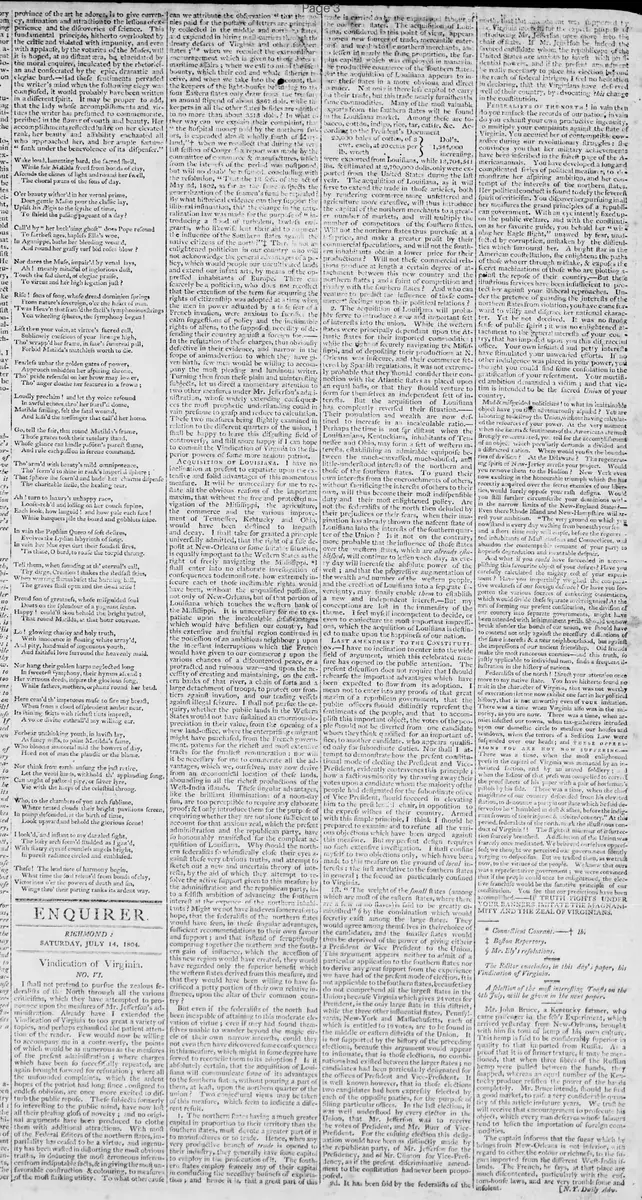
Vindication of Virginia.
NO. VI.
I shall not pretend to pursue the zealous federalists of the North through all the various criticisms, which they have attempted to pronounce upon the measures of Mr. Jefferson's administration. Already have I extended the Vindication of Virginia to too great a variety of topics, and perhaps exhausted the patient attention of the reader. Few would now be willing to accompany me in a controversy, the points of which would be as numerous as the measures of the present administration; where charges which have been so successfully repeated, are again brought forward for refutation; where all the unfounded complaints, which the ardent hopes of the patriot had long since consigned to endless oblivion, are once more excited to disturb the public repose. These subjects formerly so interesting to the public mind, have now lost all their pleasing gloss of novelty; and no original arguments have been produced to clothe them with additional attractions. With most of the Federal Editors of the northern states, impartiality has ceased to be a virtue, and ingenuity has been wasted in distorting the most obvious truths, in deducing the most erroneous inferences from indisputable facts, & in giving the most unfavorable construction & colouring, to measures of the most striking utility. To what other cause can we attribute the observation that the monies paid for the postage of letters are principally collected in the middle and north of states and expended in hiring mail-carriers through the dreary deserts of Virginia and other southern states:* when we recollect the extraordinary encouragement which is given to those states in maritime affairs: when we call to mind the sea bounty, which their cod and whale fisheries receive, and when we take into the account, that the keepers of the light-houses belonging to the four Eastern states only draw from the treasury an annual stipend of about 8567 dols. while the keepers in all the other states besides are entitled to no more than about 3515 dol.? In what other way can we explain their complaint. that "the hospital money paid by the northern sailors, is expended almost wholly south of Maryland,"† when we recollect that during the last session of Congress a report was made by the committee of commerce & manufactures, which from the lateness of the period was postponed but will no doubt be resumed. concluding with the resolution, "That the 1st sect. of the act of May 1st, 1802, as far as the same respects the generalization of the seamen's fund be repealed:"
By what historical evidence can they support the illiberal insinuation, that the change in the naturalization law was made for the purpose of "introducing a flood of turbulent, lawless emigrants, who likewise lent their aid to augment the influence of the Southern states against the native citizens of the north?"‡ There is not an enlightened politician in our country who will not acknowledge the general advantages of a policy, which would people our uncultivated lands and extend our infant arts, by means of the oppressed inhabitants of Europe. There can scarcely be a politician, who does not recollect that the extension of the term for acquiring the rights of citizenship was adopted at a time when the men in power actuated by a safe fear of a French invasion, were anxious to sacrifice the calm suggestions of policy and the inestimable rights of aliens, to the supposed necessity of defending their country against a foreign foe,--
In the refutation of these charges, thus obviously defective in their evidence, and narrow in the scope of animadversion to which they have given birth, few men would be willing to accompany the most pleasing and luminous writer.
Turning then from these plain and uninteresting subjects, let us direct a momentary attention to two other measures under Mr. Jefferson's administration, whose widely extending consequences the most prophetic understanding could in vain presume to grasp and reduce to calculation. These two measures being slightly examined in relation to the different quarters of the union, I shall be happy to leave this disgusting field of controversy, and still more happy if I can hope to commit the Vindication of Virginia to the superior powers of some more zealous patriot.
Acquisition of Louisiana. I have no inclination at present to expatiate upon the extensive and solid advantages of this momentous measure. It will be unnecessary for me to restate all the obvious reasons of the important maxim, that without the free and protected navigation of the Mississippi, the agriculture, the commerce and the various improvement of Tennessee, Kentucky and Ohio, would have been destined to languish and decay. I shall take for granted a principle universally admitted, that the right of a safe deposit at New-Orleans or some suitable situation, is equally important to the Western States as the right of freely navigating the Mississippi. I shall enter into no elaborate investigation of consequences to demonstrate, how extremely insecure each of those inestimable rights would have been, without the unqualified possession. not only of New-Orleans, but of that portion of Louisiana which touches the western bank of the Mississippi. It is unnecessary for me to expatiate upon the incalculable disadvantages which would have befallen our country, had this extensive and fruitful region continued in the possession of an ambitious neighbour: upon the incessant interruptions which the French would have given to our commerce; upon the various chances of a discontented peace, or a protracted and ruinous war--and upon the necessity of creating and maintaining, on the eastern banks of that river, a chain of forts and a large detachment of troops, to protect our frontiers against invasion, and our trading vessels against illegal seizure. I shall not pursue the enquiry, whether the public lands in the Western States would not have sustained an enormous depreciation in their value, from the opening of a new land-office, where the enterprising migrant might have purchased, from the French government, patents for the richest and most extensive tracts for the smallest remuneration: nor will it be necessary for me to enumerate all the advantages, which we, ourselves, may now derive from an economical location of these lands, abounding in all the richest productions of the West-India islands. These singular advantages, like the brilliant illuminations of a noon-day sun, are too perceptible to require any elaborate proof; & I only introduce them for the purpose of enquiring whether they are not alone sufficient to account for that anxious zeal, which the present administration and the republican party, have so honourably manifested for the complete acquisition of Louisiana. Why should the northern federalists so whimsically close their eyes against these very obvious truths, and attempt to sketch out a new and uncertain theory of interests, by the aid of which they attempt to resolve the active support given to this measure by the administration and the republican party, into a selfish ambition of advancing the southern interest at the expense of the northern inhabitants? Might we not have had even some reason to hope, that the federalists of the northern states would have seen, in these singular advantages, sufficient recommendations to their own favour and support; and that instead of scrupulously comparing together the northern and the southern gain of influence, which the accession of this new region would have created, they would have regarded only the superior benefit which the western states derived from this measure, and that they would have been willing to have sacrificed a petty portion of their own relative influence, upon the altar of their common country?
But even if the federalists of the north had been incapable of attaining to this moderate elevation of virtue; even if they had found themselves unable to wander beyond the magic circle of their own narrow interests, could they not even then have discovered some consequences in this measure, which might in some degree have served to reconcile them to its adoption? Is it absolutely certain, that the acquisition of Louisiana will communicate some of its advantages to the southern states, without pouring a part of them, at least, upon the northern quarter of the union? Two conjectural views may be taken of this measure, which seem to indicate a different result.
1. The northern states having a much greater capital in proportion to their territory than the southern states, must devote a greater part of it to manufactures or to trade. Hence, when any very productive branch of trade is opened to their industry, they generally have some capital to employ in the prosecution of it. The southern states employ scarcely any of their capital in conducting the necessary business of exportation: and hence it is that a great part of this trade is carried on by the capital and labour, of the northern states. The acquisition of Louisiana, considered in this point of view, appears to open new sources of trade, mercantile enterprize and wealth to the northern merchants, and to lessen in nearly the same proportion, the surplus capital which was employed in managing the productive commerce of the southern states. But the acquisition of Louisiana appears to injure these states in a more obvious and direct manner. Not only is there less capital to carry on their trade, but this trade nearly furnishes the same commodities. Many of the most valuable exports from the southern states will be found in the Louisiana market. Among these are tobacco, cotton, indigo, rice, tar, cattle, &c. According to the President's Document 80,000 bales of cotton, of 300 lb. each, at 20 cents per lb. worth 1,341,000 were exported from Louisiana, while 13,704,541 lbs. & estimated at 2,740,000 dolls. only were exported from the United States during the last year. The acquisition of Louisiana, as it will serve to extend the trade in those articles, both by rendering commerce more unfettered and agriculture more extensive, will thus introduce the capital of the northern merchants to a greater number of markets, and will multiply the number of competitors of the southern states. Will not the northern states thus purchase at a fair price, and make a greater profit by their commercial speculations, and will not the southern inhabitants obtain a lower price for their productions? Will not these commercial relations produce at length a certain degree of attachment between this new country and the northern states; and a spirit of competition and rivalry with the southern states? And who can venture to predict the influence of these commercial feelings upon their political relations?
2. The acquisition of Louisiana will probably serve to introduce a new and important set of interests into the union. While the western states were principally dependant upon the Atlantic states for their imported commodities; while the right of securely navigating the Mississippi, and of depositing their productions at N. Orleans was insecure, and their commerce fettered by Spanish regulations, it was not extremely probable that they should consider their connection with the Atlantic states as placed upon an equal basis, or that they should venture to form for themselves an independent set of interests. But the acquisition of Louisiana has completely reversed their situation. Their population and wealth are now destined to increase in an incalculable ratio.--Perhaps the time is not far distant when the Louisianians, Kentuckians, inhabitants of Tennessee and Ohio, may form a set of western interests, establishing an admirable equipoise between the much-canvassed, much-abused, and little-understood interests of the northern and those of the southern states. To guard their own interests from the encroachments of others, without sacrificing the interests of others to their own, will thus become their most indispensable duty and their most enlightened policy. Are not the federalists of the north then deluded by their prejudices or their fears, when their imagination has already thrown the nascent state of Louisiana into the interests of the southern quarter of the Union? Is it not on the contrary, more probable that the influence of those states over the western states, which are already established, will continue to lessen each day, as every day will increase the absolute power of the west; and that the progressive augmentation of the wealth and number of the western people, and the erection of Louisiana into a separate sovereignty, may finally enable them to establish a new and independent interest.--But my conceptions are lost in the immensity of the theme. I feel myself incompetent to decide, or even to conjecture the most important impressions, which the acquisition of Louisiana is destined to make upon the happiness of our nation.
Last amendment to the Constitution.--I have no inclination to enter into the wide field of argument, which this celebrated measure has opened to the public attention. The present discussion does not require that I should rehearse the important advantages which have been expected to flow from its adoption. I mean not to enter into any proofs of that great maxim of a republican government, that the public officers should distinctly represent the sentiments of the people, and that to accomplish this important object, the votes of the people should not be diverted from one candidate whom they think qualified for an important office, to another candidate, who appears qualified only for subordinate duties. Nor shall I attempt to demonstrate how the present constitutional mode of electing the President and Vice-President, evidently contravenes this principle; how a factious minority by throwing away their votes upon a candidate whom the majority of the people had designated for the subordinate office of Vice President, should succeed in elevating him to the presidential chair, in opposition to the express wishes of their country. Armed with this simple principle, I think I should be prepared to examine and to refute all the various objections which have been urged against this measure. But my present design requires no such extensive investigation. I shall confine myself to two objections only, which have been made to this measure on the ground of local interests: the first as relative to the southern states in general; the second as particularly confined to Virginia.
1st. "The weight of the Small states (among which are most of the eastern states, where there are a few or no slaves) is said to be greatly diminished" by the combination which would secretly exist among the large states. They would agree among themselves in their choice of the candidates, and the smaller states would thus be deprived of the power of giving either a President or Vice President to the Union.
This argument appears neither to admit of a particular application to the southern states nor to derive any great support from the experience we have had of the present mode of election. It is not applicable to the southern states, because they do not comprehend all the largest states in the Union; because Virginia which gives 24 votes for President, is the only large state in this district, while the three other influential states, Pennsylvania, New-York and Massachusetts, each of which is entitled to 19 votes, are to be found in the middle or eastern districts of the Union. It is not supported by the history of the preceding elections, because this argument would appear to insinuate, that in those elections, no combinations had existed between the larger states; no candidates had been particularly designated for the offices of President and Vice-President. It is well known however, that in those elections two candidates had been expressly selected by each of the opposite parties, for the purpose of filling particular offices. In the last election, it was well understood by every elector in the Union, that Mr. Jefferson was to receive the votes of President, and Mr. Burr of Vice-President. For the ensuing election this designation would have been as distinctly made by the republican party, of Mr. Jefferson for the Presidency, and of Mr. Clinton for Vice-Presidency, as if the present discriminative amendment to the constitution had never been proposed.
2d. It has been said by the federalists of the north, that this wish to be preferred by introducing Mr. Jefferson once more into the chair of state. If Mr. Jefferson be indeed the favored candidate whom the republicans of the United States are anxious to invest with presidential powers, and if the present amendment is really necessary to place his election beyond the reach of federal intrigue, I feel no hesitation in declaring, that the Virginians have deserved well of their country, by advocating this change in the constitution.
FEDERALISTS OF THE NORTH! in vain do you ransack the records of our nation, in vain do you exhaust your own productive ingenuity, to multiply your complaints against the state of Virginia. You accuse her of contemptible cowardice during our revolutionary struggles: she convinces you that her military achievements have been inscribed in the fairest page of the American annals. You have developed a long and complicated series of political measures, to demonstrate her aspiring ambition, and her contempt of the interests of the northern, states. Her political conduct is found to defy the severest spirit of criticism. You discover her pursuing in all her measures the grand principles of a republican government. With an eye intently fixed upon the public welfare, and with the constitution as her favorite guide, you behold her "winging her Eagle flight," undaunted by fear, unaffected by corruption, unshaken by the difficulties which surround her. A bright star in the American constellation, she enlightens the paths of those who err through mistake, & exposes the secret machinations of those who are plotting against the repose of their country.--But these illustrious services have been insufficient to protect her against your illiberal reproaches. Under the pretence of guarding the interests of the northern states from violation, you have come forward to vilify and disgrace her national character. Yet be not deceived. It was no strong sense of public spirit; it was no enlightened attachment to the general interests of your country, that has imposed upon you this disgraceful office. Your own insulated and petty interests have stimulated your unwearied efforts. If no other indulgence was placed in your power, you thought you could find some consolation in the gratification of your resentment. Your mortified ambition demanded a victim; and that victim is intended to be the sacred Union of your country.
Mad & misguided politicians! to what an unattainable object have you then adventurously aspired? You are labouring to destroy the Union, without having calculated the resources of your power. At the very moment when the hearts & sentiments of the Americans are most strongly concentered, you toil for the accomplishment of an object, which peculiarly demands a divided and a distracted Nation. "Where would you fix the boundaries of division? At the Delaware? The regenerating spirit of New-Jersey arrests your project. Would you remove them to the Hudson? New York even now exulting in the honourable triumph which she has recently acquired over the secret enemies of our liberties, would surely oppose your rash designs. Would you still further circumscribe your dominions within the narrow limits of the New-England States--Even there Rhode Island and New-Hampshire will arrest your ambition. "The very ground on which you now stand is every day washing from beneath your feet and a short time only will elapse, before the regenerated inhabitants of Massachusetts and Connecticut, will abandon the contemptible remnant of your party to hopeless degradation and inexorable despair.
And what if you could have succeeded in accomplishing this favourite object of your desires? Have you carefully calculated the mighty cost of your experiment? Have you impartially weighed the comparative weakness of our foreign defence? Or have you forgotten the various sources of cankering contentions, which would divide these separate sovereignties? At the era of forming our present constitution, the division of our country into separate governments, might have been attended with less imminent perils. Should we now break asunder the bonds of our union, we should have to contend not only against the necessary dissensions of the same interests & a near neighbourhood, but against the impressions of our ancient friendship. Old friends make the most rancorous enemies--and this truth, so justly applicable to individual men, finds a frequent illustration in the history of nations.
Federalists of the north! Direct your attention once more to my native state. You have hitherto found no trait in the character of Virginia, that was not worthy of execration: let me now exhibit one fact in her political history, that is not unworthy even of your imitation. There was a time when Virginia also was in the minority, as you are now. There was a time, when armies infested our towns, when tax-gatherers intruded upon our domestic circle to measure our houses and windows, when the terrors of a Sedition Law were suspended over our heads; and in THESE OPPRESSIONS YOU ARE NOT NOW SUFFERING.--There was a time, when the most enlightened press in the capital of Virginia was menaced by an infuriated faction, and by an armed soldiery; and when the Editor of that press was compelled to correct the proof sheets of his paper with a pair of horseman's pistols by his side. There was a time, when the chief magistrate of our country descended from his elevated station, to denounce a party in our state which he said deserved to be "humbled in dust & ashes, before the indignant frowns of their injured & insulted country." At this period, federalists of the north, mark the illustrious conduct of Virginia! The slightest murmur of insurrection scarcely breathed. A dissolution of the Union was scarcely once meditated. We believed ourselves oppressed; we thought we perceived our government silently verging to despotism But we trusted then, as we trust now, to the virtues of the people. We knew that ours was a representative government; we were convinced that if the people could once be enlightened, the elective franchise would be the sanative principle of our constitution. You see that our predictions have been accomplished.—-IF TRUTH FIGHTS UNDER YOUR BANNERS IMITATE THE MAGNANIMITY AND THE ZEAL OF VIRGINIANS.
* Connecticut Courant.~† Ib.
‡ Boston Repository.
§ Mr. Ely's resolutions.
The Editor concludes, in this day's paper, his Vindication of Virginia.
RICHMOND:
SATURDAY, JULY 14, 1804.
Vindication of Virginia.
NO. VI.
I shall not pretend to pursue the zealous federalists of the North through all the various criticisms, which they have attempted to pronounce upon the measures of Mr. Jefferson's administration. Already have I extended the Vindication of Virginia to too great a variety of topics, and perhaps exhausted the patient attention of the reader. Few would now be willing to accompany me in a controversy, the points of which would be as numerous as the measures of the present administration; where charges which have been so successfully repeated, are again brought forward for refutation; where all the unfounded complaints, which the ardent hopes of the patriot had long since consigned to endless oblivion, are once more excited to disturb the public repose. These subjects formerly so interesting to the public mind, have now lost all their pleasing gloss of novelty; and no original arguments have been produced to clothe them with additional attractions. With most of the Federal Editors of the northern states, impartiality has ceased to be a virtue, and ingenuity has been wasted in distorting the most obvious truths, in deducing the most erroneous inferences from indisputable facts, & in giving the most unfavorable construction & colouring, to measures of the most striking utility. To what other cause can we attribute the observation that the monies paid for the postage of letters are principally collected in the middle and north of states and expended in hiring mail-carriers through the dreary deserts of Virginia and other southern states:* when we recollect the extraordinary encouragement which is given to those states in maritime affairs: when we call to mind the sea bounty, which their cod and whale fisheries receive, and when we take into the account, that the keepers of the light-houses belonging to the four Eastern states only draw from the treasury an annual stipend of about 8567 dols. while the keepers in all the other states besides are entitled to no more than about 3515 dol.? In what other way can we explain their complaint. that "the hospital money paid by the northern sailors, is expended almost wholly south of Maryland,"† when we recollect that during the last session of Congress a report was made by the committee of commerce & manufactures, which from the lateness of the period was postponed but will no doubt be resumed. concluding with the resolution, "That the 1st sect. of the act of May 1st, 1802, as far as the same respects the generalization of the seamen's fund be repealed:"
By what historical evidence can they support the illiberal insinuation, that the change in the naturalization law was made for the purpose of "introducing a flood of turbulent, lawless emigrants, who likewise lent their aid to augment the influence of the Southern states against the native citizens of the north?"‡ There is not an enlightened politician in our country who will not acknowledge the general advantages of a policy, which would people our uncultivated lands and extend our infant arts, by means of the oppressed inhabitants of Europe. There can scarcely be a politician, who does not recollect that the extension of the term for acquiring the rights of citizenship was adopted at a time when the men in power actuated by a safe fear of a French invasion, were anxious to sacrifice the calm suggestions of policy and the inestimable rights of aliens, to the supposed necessity of defending their country against a foreign foe,--
In the refutation of these charges, thus obviously defective in their evidence, and narrow in the scope of animadversion to which they have given birth, few men would be willing to accompany the most pleasing and luminous writer.
Turning then from these plain and uninteresting subjects, let us direct a momentary attention to two other measures under Mr. Jefferson's administration, whose widely extending consequences the most prophetic understanding could in vain presume to grasp and reduce to calculation. These two measures being slightly examined in relation to the different quarters of the union, I shall be happy to leave this disgusting field of controversy, and still more happy if I can hope to commit the Vindication of Virginia to the superior powers of some more zealous patriot.
Acquisition of Louisiana. I have no inclination at present to expatiate upon the extensive and solid advantages of this momentous measure. It will be unnecessary for me to restate all the obvious reasons of the important maxim, that without the free and protected navigation of the Mississippi, the agriculture, the commerce and the various improvement of Tennessee, Kentucky and Ohio, would have been destined to languish and decay. I shall take for granted a principle universally admitted, that the right of a safe deposit at New-Orleans or some suitable situation, is equally important to the Western States as the right of freely navigating the Mississippi. I shall enter into no elaborate investigation of consequences to demonstrate, how extremely insecure each of those inestimable rights would have been, without the unqualified possession. not only of New-Orleans, but of that portion of Louisiana which touches the western bank of the Mississippi. It is unnecessary for me to expatiate upon the incalculable disadvantages which would have befallen our country, had this extensive and fruitful region continued in the possession of an ambitious neighbour: upon the incessant interruptions which the French would have given to our commerce; upon the various chances of a discontented peace, or a protracted and ruinous war--and upon the necessity of creating and maintaining, on the eastern banks of that river, a chain of forts and a large detachment of troops, to protect our frontiers against invasion, and our trading vessels against illegal seizure. I shall not pursue the enquiry, whether the public lands in the Western States would not have sustained an enormous depreciation in their value, from the opening of a new land-office, where the enterprising migrant might have purchased, from the French government, patents for the richest and most extensive tracts for the smallest remuneration: nor will it be necessary for me to enumerate all the advantages, which we, ourselves, may now derive from an economical location of these lands, abounding in all the richest productions of the West-India islands. These singular advantages, like the brilliant illuminations of a noon-day sun, are too perceptible to require any elaborate proof; & I only introduce them for the purpose of enquiring whether they are not alone sufficient to account for that anxious zeal, which the present administration and the republican party, have so honourably manifested for the complete acquisition of Louisiana. Why should the northern federalists so whimsically close their eyes against these very obvious truths, and attempt to sketch out a new and uncertain theory of interests, by the aid of which they attempt to resolve the active support given to this measure by the administration and the republican party, into a selfish ambition of advancing the southern interest at the expense of the northern inhabitants? Might we not have had even some reason to hope, that the federalists of the northern states would have seen, in these singular advantages, sufficient recommendations to their own favour and support; and that instead of scrupulously comparing together the northern and the southern gain of influence, which the accession of this new region would have created, they would have regarded only the superior benefit which the western states derived from this measure, and that they would have been willing to have sacrificed a petty portion of their own relative influence, upon the altar of their common country?
But even if the federalists of the north had been incapable of attaining to this moderate elevation of virtue; even if they had found themselves unable to wander beyond the magic circle of their own narrow interests, could they not even then have discovered some consequences in this measure, which might in some degree have served to reconcile them to its adoption? Is it absolutely certain, that the acquisition of Louisiana will communicate some of its advantages to the southern states, without pouring a part of them, at least, upon the northern quarter of the union? Two conjectural views may be taken of this measure, which seem to indicate a different result.
1. The northern states having a much greater capital in proportion to their territory than the southern states, must devote a greater part of it to manufactures or to trade. Hence, when any very productive branch of trade is opened to their industry, they generally have some capital to employ in the prosecution of it. The southern states employ scarcely any of their capital in conducting the necessary business of exportation: and hence it is that a great part of this trade is carried on by the capital and labour, of the northern states. The acquisition of Louisiana, considered in this point of view, appears to open new sources of trade, mercantile enterprize and wealth to the northern merchants, and to lessen in nearly the same proportion, the surplus capital which was employed in managing the productive commerce of the southern states. But the acquisition of Louisiana appears to injure these states in a more obvious and direct manner. Not only is there less capital to carry on their trade, but this trade nearly furnishes the same commodities. Many of the most valuable exports from the southern states will be found in the Louisiana market. Among these are tobacco, cotton, indigo, rice, tar, cattle, &c. According to the President's Document 80,000 bales of cotton, of 300 lb. each, at 20 cents per lb. worth 1,341,000 were exported from Louisiana, while 13,704,541 lbs. & estimated at 2,740,000 dolls. only were exported from the United States during the last year. The acquisition of Louisiana, as it will serve to extend the trade in those articles, both by rendering commerce more unfettered and agriculture more extensive, will thus introduce the capital of the northern merchants to a greater number of markets, and will multiply the number of competitors of the southern states. Will not the northern states thus purchase at a fair price, and make a greater profit by their commercial speculations, and will not the southern inhabitants obtain a lower price for their productions? Will not these commercial relations produce at length a certain degree of attachment between this new country and the northern states; and a spirit of competition and rivalry with the southern states? And who can venture to predict the influence of these commercial feelings upon their political relations?
2. The acquisition of Louisiana will probably serve to introduce a new and important set of interests into the union. While the western states were principally dependant upon the Atlantic states for their imported commodities; while the right of securely navigating the Mississippi, and of depositing their productions at N. Orleans was insecure, and their commerce fettered by Spanish regulations, it was not extremely probable that they should consider their connection with the Atlantic states as placed upon an equal basis, or that they should venture to form for themselves an independent set of interests. But the acquisition of Louisiana has completely reversed their situation. Their population and wealth are now destined to increase in an incalculable ratio.--Perhaps the time is not far distant when the Louisianians, Kentuckians, inhabitants of Tennessee and Ohio, may form a set of western interests, establishing an admirable equipoise between the much-canvassed, much-abused, and little-understood interests of the northern and those of the southern states. To guard their own interests from the encroachments of others, without sacrificing the interests of others to their own, will thus become their most indispensable duty and their most enlightened policy. Are not the federalists of the north then deluded by their prejudices or their fears, when their imagination has already thrown the nascent state of Louisiana into the interests of the southern quarter of the Union? Is it not on the contrary, more probable that the influence of those states over the western states, which are already established, will continue to lessen each day, as every day will increase the absolute power of the west; and that the progressive augmentation of the wealth and number of the western people, and the erection of Louisiana into a separate sovereignty, may finally enable them to establish a new and independent interest.--But my conceptions are lost in the immensity of the theme. I feel myself incompetent to decide, or even to conjecture the most important impressions, which the acquisition of Louisiana is destined to make upon the happiness of our nation.
Last amendment to the Constitution.--I have no inclination to enter into the wide field of argument, which this celebrated measure has opened to the public attention. The present discussion does not require that I should rehearse the important advantages which have been expected to flow from its adoption. I mean not to enter into any proofs of that great maxim of a republican government, that the public officers should distinctly represent the sentiments of the people, and that to accomplish this important object, the votes of the people should not be diverted from one candidate whom they think qualified for an important office, to another candidate, who appears qualified only for subordinate duties. Nor shall I attempt to demonstrate how the present constitutional mode of electing the President and Vice-President, evidently contravenes this principle; how a factious minority by throwing away their votes upon a candidate whom the majority of the people had designated for the subordinate office of Vice President, should succeed in elevating him to the presidential chair, in opposition to the express wishes of their country. Armed with this simple principle, I think I should be prepared to examine and to refute all the various objections which have been urged against this measure. But my present design requires no such extensive investigation. I shall confine myself to two objections only, which have been made to this measure on the ground of local interests: the first as relative to the southern states in general; the second as particularly confined to Virginia.
1st. "The weight of the Small states (among which are most of the eastern states, where there are a few or no slaves) is said to be greatly diminished" by the combination which would secretly exist among the large states. They would agree among themselves in their choice of the candidates, and the smaller states would thus be deprived of the power of giving either a President or Vice President to the Union.
This argument appears neither to admit of a particular application to the southern states nor to derive any great support from the experience we have had of the present mode of election. It is not applicable to the southern states, because they do not comprehend all the largest states in the Union; because Virginia which gives 24 votes for President, is the only large state in this district, while the three other influential states, Pennsylvania, New-York and Massachusetts, each of which is entitled to 19 votes, are to be found in the middle or eastern districts of the Union. It is not supported by the history of the preceding elections, because this argument would appear to insinuate, that in those elections, no combinations had existed between the larger states; no candidates had been particularly designated for the offices of President and Vice-President. It is well known however, that in those elections two candidates had been expressly selected by each of the opposite parties, for the purpose of filling particular offices. In the last election, it was well understood by every elector in the Union, that Mr. Jefferson was to receive the votes of President, and Mr. Burr of Vice-President. For the ensuing election this designation would have been as distinctly made by the republican party, of Mr. Jefferson for the Presidency, and of Mr. Clinton for Vice-Presidency, as if the present discriminative amendment to the constitution had never been proposed.
2d. It has been said by the federalists of the north, that this wish to be preferred by introducing Mr. Jefferson once more into the chair of state. If Mr. Jefferson be indeed the favored candidate whom the republicans of the United States are anxious to invest with presidential powers, and if the present amendment is really necessary to place his election beyond the reach of federal intrigue, I feel no hesitation in declaring, that the Virginians have deserved well of their country, by advocating this change in the constitution.
FEDERALISTS OF THE NORTH! in vain do you ransack the records of our nation, in vain do you exhaust your own productive ingenuity, to multiply your complaints against the state of Virginia. You accuse her of contemptible cowardice during our revolutionary struggles: she convinces you that her military achievements have been inscribed in the fairest page of the American annals. You have developed a long and complicated series of political measures, to demonstrate her aspiring ambition, and her contempt of the interests of the northern, states. Her political conduct is found to defy the severest spirit of criticism. You discover her pursuing in all her measures the grand principles of a republican government. With an eye intently fixed upon the public welfare, and with the constitution as her favorite guide, you behold her "winging her Eagle flight," undaunted by fear, unaffected by corruption, unshaken by the difficulties which surround her. A bright star in the American constellation, she enlightens the paths of those who err through mistake, & exposes the secret machinations of those who are plotting against the repose of their country.--But these illustrious services have been insufficient to protect her against your illiberal reproaches. Under the pretence of guarding the interests of the northern states from violation, you have come forward to vilify and disgrace her national character. Yet be not deceived. It was no strong sense of public spirit; it was no enlightened attachment to the general interests of your country, that has imposed upon you this disgraceful office. Your own insulated and petty interests have stimulated your unwearied efforts. If no other indulgence was placed in your power, you thought you could find some consolation in the gratification of your resentment. Your mortified ambition demanded a victim; and that victim is intended to be the sacred Union of your country.
Mad & misguided politicians! to what an unattainable object have you then adventurously aspired? You are labouring to destroy the Union, without having calculated the resources of your power. At the very moment when the hearts & sentiments of the Americans are most strongly concentered, you toil for the accomplishment of an object, which peculiarly demands a divided and a distracted Nation. "Where would you fix the boundaries of division? At the Delaware? The regenerating spirit of New-Jersey arrests your project. Would you remove them to the Hudson? New York even now exulting in the honourable triumph which she has recently acquired over the secret enemies of our liberties, would surely oppose your rash designs. Would you still further circumscribe your dominions within the narrow limits of the New-England States--Even there Rhode Island and New-Hampshire will arrest your ambition. "The very ground on which you now stand is every day washing from beneath your feet and a short time only will elapse, before the regenerated inhabitants of Massachusetts and Connecticut, will abandon the contemptible remnant of your party to hopeless degradation and inexorable despair.
And what if you could have succeeded in accomplishing this favourite object of your desires? Have you carefully calculated the mighty cost of your experiment? Have you impartially weighed the comparative weakness of our foreign defence? Or have you forgotten the various sources of cankering contentions, which would divide these separate sovereignties? At the era of forming our present constitution, the division of our country into separate governments, might have been attended with less imminent perils. Should we now break asunder the bonds of our union, we should have to contend not only against the necessary dissensions of the same interests & a near neighbourhood, but against the impressions of our ancient friendship. Old friends make the most rancorous enemies--and this truth, so justly applicable to individual men, finds a frequent illustration in the history of nations.
Federalists of the north! Direct your attention once more to my native state. You have hitherto found no trait in the character of Virginia, that was not worthy of execration: let me now exhibit one fact in her political history, that is not unworthy even of your imitation. There was a time when Virginia also was in the minority, as you are now. There was a time, when armies infested our towns, when tax-gatherers intruded upon our domestic circle to measure our houses and windows, when the terrors of a Sedition Law were suspended over our heads; and in THESE OPPRESSIONS YOU ARE NOT NOW SUFFERING.--There was a time, when the most enlightened press in the capital of Virginia was menaced by an infuriated faction, and by an armed soldiery; and when the Editor of that press was compelled to correct the proof sheets of his paper with a pair of horseman's pistols by his side. There was a time, when the chief magistrate of our country descended from his elevated station, to denounce a party in our state which he said deserved to be "humbled in dust & ashes, before the indignant frowns of their injured & insulted country." At this period, federalists of the north, mark the illustrious conduct of Virginia! The slightest murmur of insurrection scarcely breathed. A dissolution of the Union was scarcely once meditated. We believed ourselves oppressed; we thought we perceived our government silently verging to despotism But we trusted then, as we trust now, to the virtues of the people. We knew that ours was a representative government; we were convinced that if the people could once be enlightened, the elective franchise would be the sanative principle of our constitution. You see that our predictions have been accomplished.—-IF TRUTH FIGHTS UNDER YOUR BANNERS IMITATE THE MAGNANIMITY AND THE ZEAL OF VIRGINIANS.
* Connecticut Courant.~† Ib.
‡ Boston Repository.
§ Mr. Ely's resolutions.
The Editor concludes, in this day's paper, his Vindication of Virginia.
What sub-type of article is it?
Partisan Politics
Constitutional
Foreign Affairs
What keywords are associated?
Vindication Of Virginia
Louisiana Acquisition
Constitutional Amendment
Northern Federalists
Jefferson Administration
Partisan Controversy
Western Interests
Union Preservation
What entities or persons were involved?
Mr. Jefferson
Federalists Of The North
Virginia
Republican Party
Louisiana
Western States
Northern States
Southern States
Editorial Details
Primary Topic
Vindication Of Virginia Against Northern Federalist Criticisms Of Jefferson's Administration
Stance / Tone
Strongly Pro Virginia And Republican, Anti Northern Federalist
Key Figures
Mr. Jefferson
Federalists Of The North
Virginia
Republican Party
Louisiana
Western States
Northern States
Southern States
Key Arguments
Northern Federalists Distort Jefferson's Measures For Partisan Gain
Louisiana Acquisition Benefits Western States' Navigation And Deposit Rights, Prevents French Interference
Acquisition Opens New Trade Opportunities For Northern Merchants, Potentially Reducing Southern Influence
Western States May Form Independent Interests Balancing North And South
Constitutional Amendment Ensures Separate Election Of President And Vice President, Preventing Minority Elevation
Amendment Does Not Disadvantage Southern States As Large States Are Distributed Across Regions
Virginia Has Acted With Restraint And Principle During Past Oppressions, Unlike Current Federalist Threats To Union
Federalists' Attacks Stem From Narrow Interests, Risking National Division