Thank you for visiting SNEWPapers!
Sign up free
The Liberator
Boston, Suffolk County, Massachusetts
What is this article about?
Editorial introduction praises a letter from Boston working man William Comstock to William Lloyd Garrison, defending abolitionism against a recent mob riot in Boston targeting anti-slavery meeting. Comstock affirms his lifelong commitment to abolition, praises George Thompson's influence, criticizes pro-slavery opponents, and predicts the cause's inevitable success despite violence.
Clipping
OCR Quality
Full Text
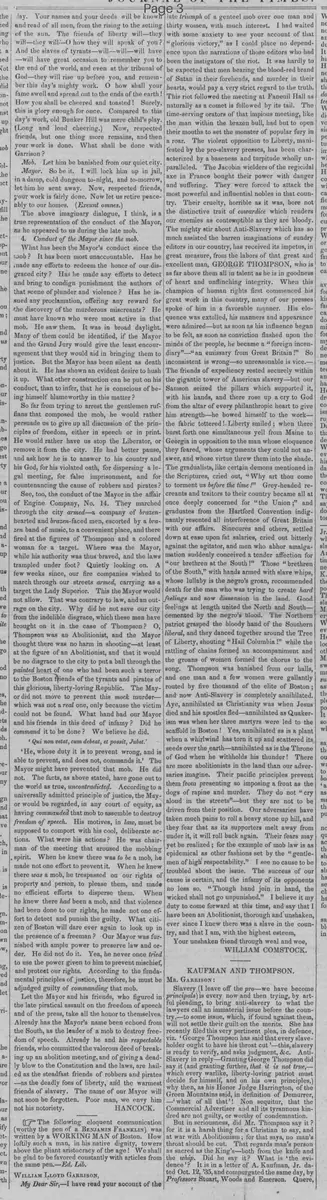
WILLIAM LLOYD GARRISON
My Dear Sir,—I have read your account of the late triumph of a genteel mob over one man and thirty women, with much interest. I had waited with some anxiety to see your account of that "glorious victory," as I could place no dependence upon the narrations of those editors who had been the instigators of the riot. It was hardly to be expected that men bearing the blood-red brand of Satan in their foreheads, and murder in their hearts, would pay a very strict regard to the truth. This riot followed the meeting at Faneuil Hall as naturally as a comet is followed by its tail. The time-serving orators of that impious meeting, like the man within the brazen bull, had but to open their mouths to set the monster of popular fury in a roar. The violent opposition to Liberty, manifested by the pro-slavery presses, has been characterized by a baseness and turpitude wholly unparalleled. The Jacobin wielders of the regicidal axe in France bought their power with danger and suffering. They were forced to attack the most powerful and influential nobles in that country. Their cruelty, horrible as it was, bore not the distinctive trait of cowardice which renders our enemies as contemptible as they are bloody. The mighty stir about Anti-Slavery which has so much assisted the barren imaginations of sundry editors in our country, has received its impetus, in great measure, from the labors of that great and excellent man, GEORGE THOMPSON, who is as far above them all in talent as he is in goodness of heart and unflinching integrity. When this champion of human rights first commenced his great work in this country, many of our presses spoke of him in a favorable manner. His eloquence was extolled, his manners and appearance were admired—but as soon as his influence began to be felt, as soon as conviction flashed upon the minds of the people, he became a "foreign incendiary"—an emissary from Great Britain! So inconsistent is wrong—so unreasonable is vice.—The friends of expediency rested securely within the gigantic tower of American slavery—but our Samson seized the pillars which supported it with his hands, and there rose up a cry to God from the altar of every philanthropic heart to give him strength—he bowed himself to the work—the fabric tottered! Liberty smiled; when there burst forth one simultaneous yell from Maine to Georgia in opposition to the man whose eloquence they feared, whose arguments they could not answer, and whose virtue threw them into the shade. The gradualists, like certain demons mentioned in the Scriptures, cried out, "Why art thou come to torment us before the time!" Grey-headed recreants and traitors to their country became all at once deeply concerned for "the Union:" and graduates from the Hartford Convention indignantly resented all interference of Great Britain with our affairs. Sinecures and others, settled down at ease upon fat salaries, cried out bitterly against the agitator, and men who abhor amalgamation suddenly conceived a tender affection for "our brethren at the South!" Those "brethren of the South," with hands armed with slave whips, whose lullaby is the negro's groan, recommended death for the man who was trying to create hard feelings and sow dissension in the land. Good feelings at length united the North and South—cemented by the negro's blood. The Northern patriot grasped the bloody hand of the Southern liberal, and they danced together around the Tree of Liberty, shouting "Hail Columbia!" while the rattling of chains formed an accompaniment and the groans of women formed the chorus to the song. Thompson was banished from our halls, and one man and a few women were gallantly routed by five thousand of the elite of Boston; and now Anti-Slavery is completely annihilated. Aye, annihilated as Christianity was when Jesus died and his apostles fled—annihilated as Quakerism was when her three martyrs were led to the scaffold in Boston! Yes, annihilated as is a plant when a whirlwind has torn it up and scattered its seeds over the earth—annihilated as is the Throne of God when he withholds his thunder! There are more abolitionists in the land than our adversaries imagine. Their pacific principles prevent them from presenting so imposing a front as the dogs of rapine and murder. They do not "cry aloud in the streets"—but they are not to be driven from their position. Our adversaries have taken much pains to roll a heavy stone up hill, and they fear that as its supporters melt away from under it, it will roll back again. Their fears may yet be realized; for the example of mob law is as epidemical as other fashions set by the "gentlemen of high respectability." I see no cause to be troubled about the issue. The success of our cause is certain, and the infamy of its opponents no less so. "Though hand join in hand, the wicked shall not go unpunished." I believe it my duty to come forward at this time, and say that I have been an Abolitionist, thorough and unshaken, ever since I knew there was a slave in the country, and that I am, with the highest esteem,
Your unshaken friend through weal and woe,
WILLIAM COMSTOCK.
What sub-type of article is it?
What themes does it cover?
What keywords are associated?
What entities or persons were involved?
Letter to Editor Details
Author
William Comstock
Recipient
William Lloyd Garrison
Main Argument
the writer defends the anti-slavery cause against recent mob violence in boston, praises george thompson's role in awakening public sentiment, criticizes pro-slavery hypocrisy and violence, and affirms his lifelong, unshaken commitment to immediate abolitionism, predicting ultimate success.
Notable Details