Thank you for visiting SNEWPapers!
Sign up free
The Home Journal
Winchester, Franklin County, Tennessee
What is this article about?
Two neighboring farmers, Mr. Babcock and Mr. Small, feud over repairing a shared boundary fence. Miss Letitia Gill tricks them into settling by having each assess damages from the other's escaped livestock on her property, forcing them to agree to jointly build a new fence and end their strife.
Clipping
OCR Quality
Full Text
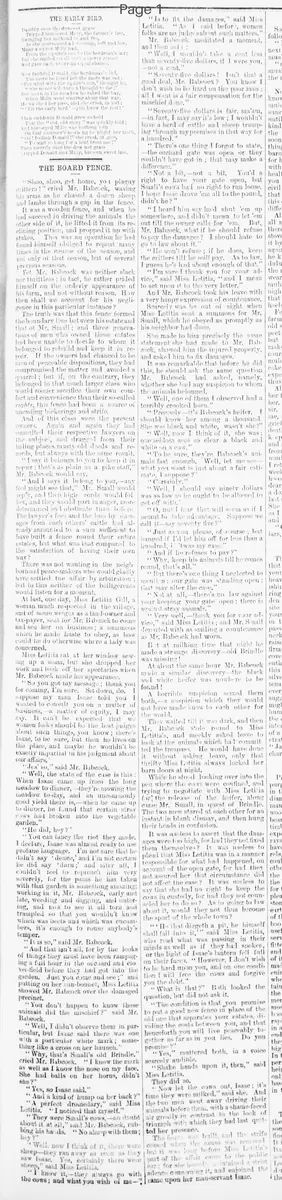
"Shoo, shoo, get home, you plaguy critters!" cried Mr. Babcock, waving his arms as he chased a dozen sheep and lambs through a gap in the fence.
It was a wooden fence, and when he had succeeded in driving the animals the other side of it, he lifted it from its reclining position, and propped it up with stakes. This was an operation he had found himself obliged to repeat many times in the course of the season, and not only of that season, but of several previous seasons.
Yet Mr. Babcock was neither slack nor thriftless; in fact, he rather prided himself on the orderly appearance of his farm, and not without reason. How then shall we account for his negligence in this particular instance?
The truth was that this fence formed the boundary line between his estate and that of Mr. Small; and three generations of men who owned these estates had been unable to decide to whom it belonged to rebuild and keep it in repair. If the owners had chanced to be men of peaceable dispositions, they had compromised the matter and avoided a quarrel; but if, on the contrary, they belonged to that much larger class who would sooner sacrifice their own comfort and convenience than their so-called rights, this fence had been a source of unending bickerings and strife.
And of this class were the present owners. Again and again they had consulted their respective lawyers on the subject, and dragged from their hiding places musty old deeds and records, but always with the same result.
"I say it belongs to you to keep it in repair; that's as plain as a pike staff," Mr. Babcock would say.
"And I says it belong to you,-any fool might see that," Mr. Small would reply, and then high words would follow, and they would part in anger, more determined and obstinate than before.
The lawyer's fees and the loss by damages from each others' cattle had already amounted to a sum sufficient to have built a fence round their entire estates, but what was that compared to the satisfaction of having their own way?
There was not wanting in the neighborhood peace-makers who would gladly have settled the affair by arbitration; but to this neither of the belligerents would listen for a moment.
At last, one day, Miss Letitia Gill, a woman much respected in the village, and of some weight as a land-owner and tax-payer, sent for Mr. Babcock to come and see her on business; a summons which he made haste to obey, as how could he do otherwise where a lady was concerned.
Miss Letitia sat at her window sewing up a seam, but she dropped her work and took off her spectacles when Mr. Babcock made his appearance.
"So you got my message; thank you for coming, I'm sure. Sit down, do. I suppose my man Isaac told you I wanted to consult you on a matter of business,-a matter of equity, I may say. It can't be expected that we women folks should be the best judges about such things, you know; there's Isaac, to be sure, but then he lives on the place, and maybe he wouldn't be exactly impartial in his judgment about our affairs."
"Jes' so," said Mr. Babcock.
"Well, the state of the case is this: When Isaac came up from the long meadow to dinner,-they're mowing the meadow to-day, and an uncommonly good yield there is,-when he came up to dinner, he found that certain stray cows had broken into the vegetable garden."
"He did, hey?"
"You can fancy the riot they made. I declare, Isaac was almost ready to use profane language. I'm not sure that he didn't say 'deuce,' and I'm not certain he did say 'darn;' and after all, I couldn't feel to reproach him very severely, for the pains he has taken with that garden is something amazing; working in it, Mr. Babcock, early and late, weeding and digging, and watering, and how to see it all torn and trampled so that you wouldn't know which was beets and which was cucumbers, it's enough to rouse anybody's temper."
"It is so," said Mr. Babcock.
"And that isn't all, for by the looks of things they must have been rampaging a full hour in the orchard and clover-field before they had got into the garden. Just you come and see;" and putting on her sun-bonnet, Miss Letitia showed Mr. Babcock over the damaged precinct.
"You don't happen to know those animals did the mischief?" said Mr. Babcock.
"Well, I didn't observe them in particular, but Isaac said there was one with a particular white mark; something like a cross on her haunch."
"Why, that's Small's old Brindle," cried Mr. Babcock. "I know the mark as well as I know the nose on my face. She had balls on her horns, didn't she?"
"Yes, so Isaac said."
"And a kind of hump on her back?"
"A perfect dromedary," said Miss Letitia. "I noticed that myself."
"They were Small's cows,-no doubt about it at all," said Mr. Babcock, rubbing his hands. "No sheep with them; hey?"
"Well, now I think of it, there were sheep-they ran away as soon as they saw Isaac. Yes, certainly there were sheep," said Miss Letitia.
"I know it,-they always go with the cows; and what you wish of me-"
"Is to fix the damages," said Miss Letitia. "As I said before, women folks are no judges about such matters."
Mr. Babcock meditated a moment, and then said:
"Well, I wouldn't take a cent less than seventy-five dollars, if I were you,-not a cent."
"Seventy-five dollars! Isn't that a good deal, Mr. Babcock? You know I don't wish to be hard on the poor man: all I want is a fair compensation for the mischief done."
"Seventy-five dollars is fair, ma'am.-in fact, I may say it's low; I wouldn't have a herd of cattle and sheep tramping through my premises in that way for a hundred."
"There's one thing I forgot to state,-the orchard gate was open or they couldn't have got in: that may make a difference."
"Not a bit,-not a bit. You'd a right to have your gate open, but Small's cows had no right to run loose. I hope Isaac drove 'em all to the pound, didn't he?"
"I heard him say he'd shut 'em up somewhere, and didn't mean to let 'em out till the owner calls for 'em. But, Mr. Babcock, what if he should refuse to pay the damages? I should hate to go to law about it."
"He won't refuse; if he does, keep the critters till he will pay. As to law, I guess he's had about enough of that."
"I'm sure I thank you for your advice," said Miss Letitia, "and I mean to act upon it to the very letter."
And Mr. Babcock took his leave with a very happy expression of countenance.
Scarcely was he out of sight when Miss Letitia sent a summons for Mr. Small, which he obeyed as promptly as his neighbor had done.
She made to him precisely the same statement she had made to Mr. Babcock, showed him the injured property, and asked him to fix damages.
It was remarkable that before he did this, he should ask the same question Mr. Babcock had asked, namely, whether she had any suspicion to whom the animals belonged.
"Well, one of them I observed had a terribly crooked horn."
"Precisely-it's Babcock's heifer. I should know her among a thousand. She was black and white, wasn't she?"
"Well, now I think of it, she was: one seldom sees so clear a black and white on a cow."
"To be sure. They're Babcock's animals fast enough. Well, let me see, what you want is just about a fair estimate, I suppose?"
"Certainly."
"Well, I should say ninety dollars was as low as he ought to be allowed to get off with."
"O, but I fear that will seem as if I meant to take advantage. Suppose we call it-say seventy five?"
"Just as you please, of course; but hanged if I'd let him off for less than a hundred, if 'twas my case."
"And if he refuses to pay?"
"Why, keep his animals till he comes round, that's all."
"But there's one thing I neglected to mention: our gate was standing open: that may alter the case."
"Not at all,-there's no law against your keeping your gate open: there is against stray animals."
"Very well,-thank you for your advice," said Miss Letitia: and Mr. Small departed with as smiling a countenance as Mr. Babcock had worn.
But at milking time that night he made a strange discovery-old Brindle was missing!
At about the same hour Mr. Babcock made a similar discovery-the black and white heifer was nowhere to be found!
A horrible suspicion seized them both,-a suspicion which they would not have made known to each other for the world.
They waited till it was dark, and then Mr. Babcock stole round to Miss Letitia's, and meekly asked leave to look at the animals which had committed the trespass. He would have done it without asking leave, only that thrifty Miss Letitia always locked her barn doors at night.
While he stood looking over into the pen where the cows were confined, and trying to negotiate with Miss Letitia for the release of the heifer, along came Mr. Small, in quest of Brindle.
The two men stared at each other for an instant in blank dismay, and then hung their heads in confusion.
It was useless to assert that the damages were too high, for had they not fixed them themselves? It was useless to plead that Miss Letitia was in a manner responsible for what had happened, on account of the open gate, for had they not assured her that circumstance did not affect the case? It was useless to say that she had no right to keep the cows in custody, for had they not counseled her to do so? As to going to law about it, would they not thus become the sport of the whole town?
"He that diggeth a pit, he himself shall fall into it," said Miss Letitia, who read what was passing in their minds as well as if they had spoken, or the light of Isaac's lantern fell full on their faces. "However, I don't wish to be hard upon you, and on one condition I will free the cows and forgive you the debt."
"What is that?" Both looked the question, but did not ask it.
"The condition is that you promise to put a good new fence in place of the old one that separates your estates, dividing the costs between you, and that henceforth you will live peaceably together as far as in you lies. Do you promise?"
"Yes," muttered both, in a voice scarcely audible.
"Shake hands upon it, then," said Miss Letitia.
They did so.
"Now let the cows out, Isaac: it's time they were milked," said she. And the animals before them, with a shame-faced air greatly in contrast to the look of triumph with which they had last quit her presence.
The feud was buried, and the strife ceased when the fence was built, but it was long before Miss Letitia's part of the affair came to the public ear; for she honorably maintained a discreet silence concerning it, and enjoined the same upon her man-servant Isaac.
What sub-type of article is it?
What themes does it cover?
What keywords are associated?
What entities or persons were involved?
Where did it happen?
Story Details
Key Persons
Location
Village Neighborhood Farms
Story Details
Long-standing feud between neighbors Mr. Babcock and Mr. Small over repairing a shared boundary fence escalates when their animals damage Miss Letitia Gill's property. She tricks each into identifying the other's livestock as culprits and advising high damages, then confronts them together, forcing a promise to jointly build a new fence and end hostilities in exchange for releasing the animals and forgiving the debt.