Thank you for visiting SNEWPapers!
Sign up free
Gazette Of The United States
New York, New York County, New York
What is this article about?
Proceedings of the U.S. House of Representatives in Philadelphia from November 4-8, 1791, including debates on prisoner privileges in federal jails, arrivals of new members, referral of Treasury estimates, Senate amendments on South Carolina census, and discussions on petitions for pensions and compensation for Revolutionary War officers and agents, plus updates on public debt reduction.
Merged-components note: Continuation of the congressional proceedings report across pages.
Clippings
1 of 2
OCR Quality
Full Text
PHILADELPHIA.
HOUSE OF REPRESENTATIVES,
FRIDAY, NOVEMBER 4, 1791.
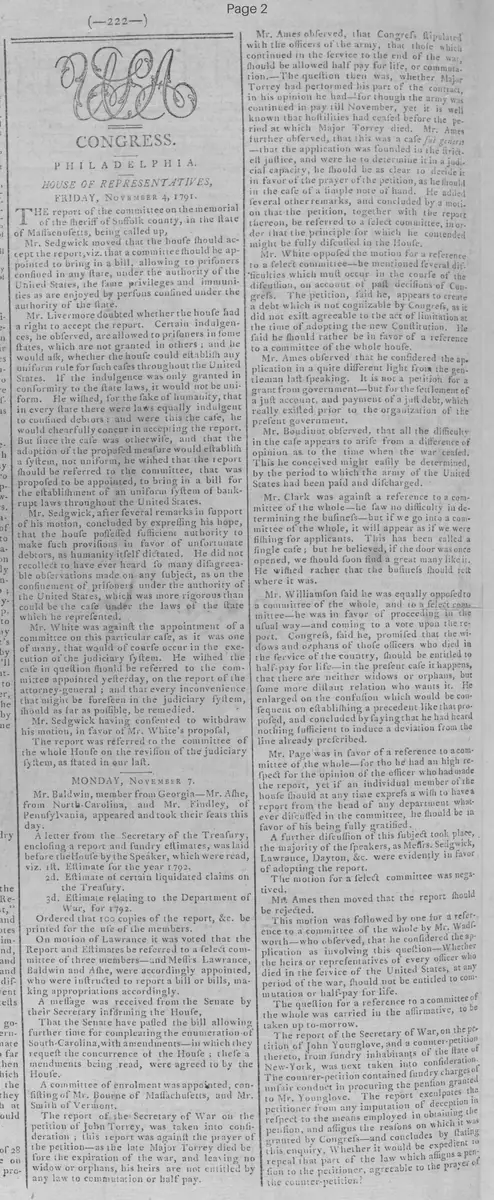
The report of the committee on the memorial of the sheriff of Suffolk county, in the state of Massachusetts, being called up, Mr. Sedgwick moved that the house should accept the report, viz. that a committee should be appointed to bring in a bill, allowing to prisoners confined in any jail, under the authority of the United States, the same privileges and immunities as are enjoyed by persons confined under the authority of the state. Mr. Livermore doubted whether the house had a right to accept the report. Certain indulgences, he observed, are allowed to prisoners in some states, which are not granted in others; and he would ask, whether the house could establish any uniform rule for such cases throughout the United States. If the indulgence was only granted in conformity to the state laws, it would not be uniform. He wished, for the sake of humanity, that in every state there were laws equally indulgent to confined debtors: and were this the case, he would cheerfully concur in accepting the report. But since the case was otherwise, and that the adoption of the proposed measure would establish a system, not uniform, he wished that the report should be referred to the committee, that was proposed to be appointed, to bring in a bill for the establishment of an uniform system of bankrupt laws throughout the United States. Mr. Sedgwick, after several remarks in support of his motion, concluded by expressing his hope, that the house possessed sufficient authority to make such provisions in favor of unfortunate debtors, as humanity itself dictated. He did not recollect to have ever heard so many disagreeable observations made on any subject, as on the confinement of prisoners under the authority of the United States, which was more rigorous than could be the case under the laws of the state which he represented. Mr. White was against the appointment of a committee on this particular case, as it was one of many, that would of course occur in the execution of the judiciary system. He wished the case in question should be referred to the committee appointed yesterday, on the report of the attorney-general; and that every inconvenience that might be foreseen in the judiciary system, should as far as possible, be remedied. Mr. Sedgwick having consented to withdraw his motion, in favor of Mr. White's proposal, The report was referred to the committee of the whole House on the revision of the judiciary system, as stated in our last.
MONDAY, NOVEMBER 7.
Mr. Baldwin, member from Georgia—Mr. Ashe, from North-Carolina, and Mr. Findley, of Pennsylvania, appeared and took their Seats this day. A letter from the Secretary of the Treasury, enclosing a report and sundry estimates, was laid before the House by the Speaker, which were read, viz. 1st. Estimate for the year 1792. 2d. Estimate of certain liquidated claims on the Treasury. 3d. Estimate relating to the Department of War, for 1792. Ordered that 100 copies of the report, &c. be printed for the use of the members. On motion of Lawrence it was voted that the Report and Estimates be referred to a select committee of three members—and Messrs Lawrence, Baldwin and Ashe, were accordingly appointed, who were instructed to report a bill or bills, making appropriations accordingly. A message was received from the Senate by their Secretary informing the House, That the Senate have passed the bill allowing further time for completing the enumeration of South-Carolina, with amendments—in which they request the concurrence of the House; these amendments being read, were agreed to by the House. A committee of enrolment was appointed, consisting of Mr. Bourne of Massachusetts, and Mr. Smith of Vermont. The report of the Secretary of War on the petition of John Torrey, was taken into consideration; this report was against the prayer of the petition—as the late Major Torrey died before the expiration of the war, and leaving no widow or orphans, his heirs are not entitled by any law to commutation or half pay. Mr. Ames observed, that Congress stipulated with the officers of the army, that those which continued in the service to the end of the war, should be allowed half pay for life, or commutation.—The question then was, whether Major Torrey had performed his part of the contract, in his opinion he had—for though the army was continued in pay till November, yet it is well known that hostilities had ceased before the period at which Major Torrey died. Mr. Ames further observed, that this was a case sui generis—that the application was founded in the strictest justice, and were he to determine it in a judicial capacity, he should be as clear to decide it in favor of the prayer of the petition, as he should in the case of a simple note of hand. He added several other remarks, and concluded by a motion that the petition, together with the report thereon, be referred to a select committee, in order that the principle for which he contended might be fully discussed in the House. Mr. White opposed the motion for a reference to a select committee—he mentioned several difficulties which must occur in the course of the discussion, on account of past decisions of Congress. The petition, said he, appears to create a debt which is not cognizable by Congress, as it did not exist agreeable to the act of limitation at the time of adopting the new Constitution. He said he should rather be in favor of a reference to a committee of the whole house. Mr. Ames observed that he considered the application in a quite different light from the gentleman last speaking. It is not a petition for a grant from government—but for the settlement of a just account, and payment of a just debt, which really existed prior to the organization of the present government. Mr. Boudinot observed, that all the difficulty in the case appears to arise from a difference of opinion as to the time when the war ceased. This he conceived might easily be determined, by the period to which the army of the United States had been paid and discharged. Mr. Clark was against a reference to a committee of the whole—he saw no difficulty in determining the business—but if we go into a committee of the whole, it will appear as if we were fishing for applicants. This has been called a single case; but he believed, if the door was once opened, we should soon find a great many like it. He wished rather that the business should rest where it was. Mr. Williamson said he was equally opposed to a committee of the whole, and to a select committee—he was in favor of proceeding in the usual way—and coming to a vote upon the report. Congress, said he, promised that the widows and orphans of those officers who died in the service of the country, should be entitled to half-pay for life—in the present case it happens, that there are neither widows or orphans, but some more distant relation who wants it. He enlarged on the confusion which would be consequent on establishing a precedent like that proposed, and concluded by saying that he had heard nothing sufficient to induce a deviation from the line already prescribed. Mr. Page was in favor of a reference to a committee of the whole—for tho he had an high respect for the opinion of the officer who had made the report, yet if an individual member of the house should at any time express a wish to have a report from the head of any department whatever discussed in the committee, he should be in favor of his being fully gratified. A further discussion of this subject took place, the majority of the speakers, as Messrs. Sedgwick, Lawrence, Dayton, &c. were evidently in favor of adopting the report. The motion for a select committee was negatived. Mr. Ames then moved that the report should be rejected. This motion was followed by one for a reference to a committee of the whole by Mr. Wadsworth—who observed, that he considered the application as involving this question—Whether the heirs or representatives of every officer who died in the service of the United States, at any period of the war, should not be entitled to commutation or half-pay for life. The question for a reference to a committee of the whole was carried in the affirmative, to be taken up to-morrow. The report of the Secretary of War, on the petition of John Younglove, and a counter-petition thereto, from sundry inhabitants of the state of New-York, was next taken into consideration. The counter-petition contained sundry charges of unfair conduct in procuring the pension granted to Mr. Younglove. The report exculpates the petitioner from any imputation of deception in respect to the means employed in obtaining the pension, and assigns the reasons on which it was granted by Congress—and concludes by stating this enquiry, Whether it would be expedient to repeal that part of the law which assigns a pension to the petitioner, agreeable to the prayer of the counter-petition?
Mr. Lawrance moved the following resolution,
That it would be inexpedient to repeal that part
of the law on which the pension to John Younglove
above was founded. Some discussion of the subject
took place in consequence of this motion, which
was eventually superseded by a motion offered
by Mr. Benson, to this effect--That the prayer
of the petition of sundry persons in the state of
New-York, that so much of a law of the United
States as grants a pension to John Younglove,
may be repealed, cannot be granted.
This motion was laid on the table, and the further
consideration of the subject postponed.
On motion of Mr. Thatcher, the report of the
Secretary of War made to the first Congress on
the petition of Joseph Tucker and others, praying
compensation as agents to certain regiments,
last war, was taken into consideration. This report
was against the petition. The same being
read, Mr. Thatcher moved that the report be rejected
by the house—and that there be allowed
to the said Joseph Tucker and others, the sum of
one per cent. on the amount received and paid
by them respectively, including the sums granted
by the state of Massachusetts.
Mr. Boudinot objected to this motion—he supposed
the proper question before the house was,
Whether the report of the Secretary should be
agreed to, or not?—The motion, he said, involved
a partial decision on a case which was by no
means singular, as similar applications had been
made to Congress. He moved that the report
should be agreed to by the house.
Mr. Smith (N.H.) enquired whether the amount
of the sums received by those agents from the
public, had been all paid over by them to the
uses for which they were received, and what was
the actual amount of their commissions on the
sums paid.
The amount of the sums received was only
mentioned in the Secretary's report.
Mr. Sedgwick observed, that the accounts of
the petitioners, it appears, have been settled by
the legislature of Massachusetts—and should the
motion be agreed to, it would lead to a revision
of all the accounts which had been settled at that
period on similar principles.
Mr. Thatcher, in reply, said that his colleague
was mistaken in respect to the accounts being settled,
as some of the parties had informed him
that they never acquiesced in such settlement,
and would not receive the certificate tendered
them as compensation for their services, as its intrinsic
value was much less than their just demand.
The motion for agreeing to the report of the
secretary of War being put, was carried in the
affirmative—and Mr. Thatcher's motion was superseded
of course.
The Speaker laid before the house a report
from the commissioners appointed pursuant to
the act providing for the reduction of the public
debt—which was read and laid on the table.—
This report stated the progress made in that business
since the last account laid before Congress—
by which it appears that the whole amount purchased
is one million, one hundred and thirty-one
thousand, three hundred and sixty-four dollars
and seventy-six cents—for which, the sum of six
hundred and ninety-nine thousand, one hundred
and sixty-three dollars and thirty-eight cents, in
specie, has been paid—
A message was received from the Senate, informing
the house of their concurrence in the
vote for appointing a committee on enrolled bills,
and have appointed Mr. Rutherfurd on their part.
Adjourned.
TUESDAY, NOVEMBER 8.
Mr. Gregg, member for Pennsylvania appeared, was qualified,
and took his seat.
Mr. Lawrance presented the petition of — M'Elroy, who
had been a soldier in the light dragoons of the United States;
praying to receive the pay due to him for his services,—laid on
the table.
Several petitions praying the renewal of certificates lost and destroyed,
were read, and referred to the committee appointed to
report a bill on that subject.
Mr. Bourne, of the joint committee of enrolment, reported the
bill for allowing further time for making returns of the enumeration
of the inhabitants of South Carolina, as duly enrolled—the
Speaker affixed his signature to the same.
In committee of the whole, on the petition of John Torrey
and the report of the Secretary of War thereon—Mr. Muhlenberg
in the chair—The petition and report being read, it was moved
that the report be accepted :
This gave rise to a debate ; the motion was opposed by Mr.
Ames and Mr. Wayne—and was supported by Mr. Boudinot,
Mr. Lawrance, Mr. Williamson, Mr. Hillhouse, Mr. Wadsworth,
Mr. Dayton and Mr. Clark, and was finally determined in the
affirmative by a large majority ; the committee then rose and reported
accordingly.
The House took up the report— which on motion of Mr. White,
was amended by adding these words, " and that therefore the
prayer of the petition cannot be granted”—the report, as thus
amended, was further discussed in the House---and then accepted.
A message was received from the President of the United States,
by Mr. Secretary Lear, informing the House, that he had this day
approved and signed the act allowing further time for making returns
of the enumeration of the inhabitants of South-Carolina.
On motion of Mr. Steele, the details of the purchases accompanying
the report of the commissioners, appointed pursuant to the
law making provision for the reduction of the public debt, were
read—and two copies ordered to be printed.
Adjourned.
It should have been noted in the proceedings of Friday
last, that Mr. Bealou took his seat that day.
What sub-type of article is it?
What keywords are associated?
What entities or persons were involved?
Where did it happen?
Domestic News Details
Primary Location
Philadelphia
Event Date
November 4 8, 1791
Key Persons
Outcome
various motions referred, reports accepted or rejected, petitions laid on table or postponed, public debt purchases reported at $1,131,364.76 for $699,163.38 in specie; torrey petition denied; younglove pension debate postponed; tucker compensation denied.
Event Details
The House debated and referred a report on privileges for federal prisoners to the judiciary revision committee. New members Baldwin, Ashe, Findley, Gregg, and Bealou took seats. Treasury estimates for 1792 referred to select committee. Senate amendments on South Carolina census agreed to and signed by President. Debates on Torrey heirs' pension claim for Revolutionary War service led to acceptance of report denying it. Younglove pension counter-petition discussion postponed. Tucker and others' compensation claim rejected in favor of Secretary's report. Report on public debt reduction laid on table.