Thank you for visiting SNEWPapers!
Sign up free
The Monroe Journal
Monroe, Union County, North Carolina
What is this article about?
C. W. Laney writes enthusiastically about the east coast of Florida, promoting its agricultural profits, natural beauty, waterways, and winter resorts. He describes Seminole Indians, shares an anecdote, and critiques political agitators, monopolies, and economic inequality, dated March 29, 1908.
Clipping
OCR Quality
Full Text
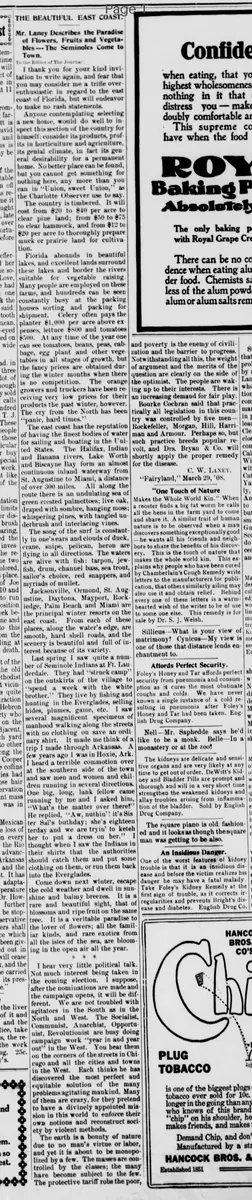
Mr. Laney Describes the Paradise of Flowers, Fruits and Vegetables.—The Seminoles Come to Town.
To the Editor of The Journal
I thank you for your kind invitation to write again, and fear that you may consider me a trifle over-enthusiastic in regard to the east coast of Florida, but will endeavor to make no rash statements.
Anyone contemplating selecting a new home, would do well to inspect this section of the country for himself: consider its products, profits in horticulture and agriculture, its genial climate, in fact its general desirability for a permanent home. No better place can be found, but you cannot get something for nothing here, any more than you can in "Union, sweet Union," as the Charlotte Observer used to say.
The country is timbered. It will cost from $20 to $40 per acre to clear pine land: from 50 to 75 to clear hammock, and from $12 to $20 per acre to thoroughly prepare muck or prairie land for cultivation.
Florida abounds in beautiful lakes, and excellent lands surround these lakes and border the rivers suitable for vegetable raising. Many people are employed on these farms, and hundreds can be seen constantly busy at the packing houses sorting and packing for shipment. Celery often pays the planter $1,000 per acre above expenses, lettuce $500 and tomatoes $500. At any time of the year one can see tomatoes, beans, peas, cabbage, egg plant and other vegetables in all stages of growth, but the fancy prices are obtained during the winter months when there is no competition. The orange growers and truckers have been receiving very low prices for their products the past winter, however. The cry from the North has been "panic, hard times."
The east coast has the reputation of having the finest bodies of water for sailing and boating in the United States. The Halifax, Indian and Banana rivers, Lake Worth and Biscayne Bay form an almost continuous inland waterway from St. Augustine to Miami, a distance of over 300 miles. All along the route there is an undulating sea of green crested palmettoes; live oak, draped with sombre, hanging moss; whispering pines, with tangled underbrush and interlacing vines. The song of the surf is constantly in one's ears and clouds of duck, crane, snipe, pelican, heron are flying in all directions. The waters are alive with fish: tarpon, jewfish, drum, channel bass, sea trout, sailor's choice, red snappers, and myriads of mullet.
Jacksonville, Ormond, St. Augustine, Daytona, Mayport, Rockledge, Palm Beach and Miami are the principal winter resorts on the east coast. From each of these places, along the water's edge, are smooth, hard shell roads, and the scenery is beautiful and full of interest because of its variety.
Last spring I saw quite a number of Seminole Indians at Ft. Lauderdale. They had "struck camp" on the outskirts of the village to "spend a week with the white brother." They live by fishing and hunting in the Everglades, selling hides, plumes, game, etc. I saw several magnificent specimens of manhood walking along the streets with no clothing on save an ordinary shirt. It made me think of a trip I made through Arkansas. A few years ago I was in Hoxie, Ark. I heard a terrible commotion over at the southern side of the town and saw men and women and children running in several directions. One big, long, lank fellow came running by me and I asked him, "What's the matter over there?" He replied, "Aw, nuthin'! it's Sister Sal's birthday: she's eighteen terdav and we are tryin' to ketch her to put a dress on her." I thought when I saw the Indians in their shirts that the authorities should catch them and put some clothing on them, or run them back into the Everglades.
Come down next winter, escape the cold weather and dwell in sunshine and balmy breezes. It is a rare and beautiful sight, that of blossoms and ripe fruit on the same tree. It is a veritable paradise to the lover of flowers; all the familiar kinds, and rare exotics from all the isles of the sea, are blooming in the open air all the year.
I hear very little political talk. Not much interest being taken in the coming election. I suppose, after the nominations are made and the campaign opens, it will be different. We are not troubled with agitators in the South as in the North and West. The Socialist, Communist, Anarchist, Opportunist, Revolutionist are busy doing campaign work "year in and year out" in the West. You hear them on the corners of the streets in Chicago and all the cities and towns in the West. Each thinks he has discovered the most perfect and equitable solution of the many problems agitating mankind. Many of them are crazy, for they pretend to have a divinely appointed mission in this world to enforce their own notions and reconstruct society by violent methods.
The earth is a bounty of nature due to no man's virtue or labor, and yet it is about to be monopolized by a few. The masses are controlled by the classes; the many have become subject to the few. The protective tariff robs the poor, and poverty is the enemy of civilization and the barrier to progress.
Notwithstanding all this, the weight of argument and the merits of the question are clearly on the side of the optimist. The people are waking up to their interests. There is an increasing demand for fair play. Bourke Cochran said that practically all legislation in this country was controlled by five men—Rockefeller, Morgan, Hill, Harriman and Armour. Perhaps so, but such practice breeds popular revolt, and Drs. Bryan & Co. will shortly apply the proper remedy for the disease.
C. W. LANEY.
"Fairyland," March 29, '08.
What sub-type of article is it?
What themes does it cover?
What keywords are associated?
What entities or persons were involved?
Letter to Editor Details
Author
C. W. Laney
Recipient
To The Editor Of The Journal
Main Argument
the east coast of florida offers exceptional opportunities in agriculture and horticulture, a genial climate, natural beauty, and desirable living conditions, making it an ideal permanent home despite costs; it also contrasts with northern political agitation by highlighting optimism amid economic inequalities.
Notable Details