Thank you for visiting SNEWPapers!
Sign up free
Editorial
May 10, 1886
The Sun
New York, New York County, New York
What is this article about?
An editorial urges Governor Hill to veto the new aqueduct bill passed in 1883, arguing it stems from a political deal to remove vigilant Mayor Grace and Comptroller Myers from the Aqueduct Commission, enabling contractor corruption and wasting millions on New York's water infrastructure project.
Clipping
OCR Quality
98%
Excellent
Full Text
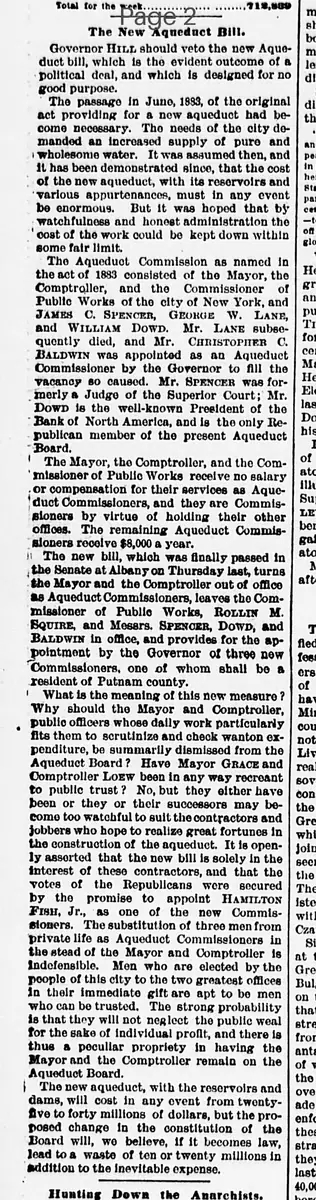
The New Aqueduct Bill.
Governor Hill should veto the new aqueduct bill, which is the evident outcome of a political deal, and which is designed for no good purpose.
The passage in June, 1883, of the original act providing for a new aqueduct had become necessary. The needs of the city demanded an increased supply of pure and wholesome water. It was assumed then, and it has been demonstrated since, that the cost of the new aqueduct, with its reservoirs and various appurtenances, must in any event be enormous. But it was hoped that by watchfulness and honest administration the cost of the work could be kept down within some fair limit.
The Aqueduct Commission as named in the act of 1883 consisted of the Mayor, the Comptroller, and the Commissioner of Public Works of the city of New York, and James C. Spencer, George W. Lane, and William Dowd. Mr. Lane subsequently died, and Mr. Christopher C. Baldwin was appointed as an Aqueduct Commissioner by the Governor to fill the vacancy so caused. Mr. Spencer was formerly a Judge of the Superior Court; Mr. Dowd is the well-known President of the Bank of North America, and is the only Republican member of the present Aqueduct Board.
The Mayor, the Comptroller, and the Commissioner of Public Works receive no salary or compensation for their services as Aqueduct Commissioners, and they are Commissioners by virtue of holding their other offices. The remaining Aqueduct Commissioners receive $5,000 a year.
The new bill, which was finally passed in the Senate at Albany on Thursday last, turns the Mayor and the Comptroller out of office as Aqueduct Commissioners, leaves the Commissioner of Public Works, Rollin M. Squire, and Messrs. Spencer, Dowd, and Baldwin in office, and provides for the appointment by the Governor of three new Commissioners, one of whom shall be a resident of Putnam county.
What is the meaning of this new measure? Why should the Mayor and Comptroller, public officers whose daily work particularly fits them to scrutinize and check wanton expenditure, be summarily dismissed from the Aqueduct Board? Have Mayor Grace and Comptroller Myers been in any way recreant to public trust? No, but they either have been or they or their successors may become too watchful to suit the contractors and jobbers who hope to realize great fortunes in the construction of the aqueduct. It is openly asserted that the new bill is solely in the interest of these contractors, and that the votes of the Republicans were secured by the promise to appoint Hamilton Fish, Jr., as one of the new Commissioners. The substitution of three men from private life as Aqueduct Commissioners in the stead of the Mayor and Comptroller is indefensible. Men who are elected by the people of this city to the two greatest offices in their immediate gift are apt to be men who can be trusted. The strong probability is that they will not neglect the public weal for the sake of individual profit, and there is thus a peculiar propriety in having the Mayor and the Comptroller remain on the Aqueduct Board.
The new aqueduct, with the reservoirs and dams, will cost in any event from twenty-five to forty millions of dollars, but the proposed change in the constitution of the Board will, we believe, if it becomes law, lead to a waste of ten or twenty millions in addition to the inevitable expense.
Governor Hill should veto the new aqueduct bill, which is the evident outcome of a political deal, and which is designed for no good purpose.
The passage in June, 1883, of the original act providing for a new aqueduct had become necessary. The needs of the city demanded an increased supply of pure and wholesome water. It was assumed then, and it has been demonstrated since, that the cost of the new aqueduct, with its reservoirs and various appurtenances, must in any event be enormous. But it was hoped that by watchfulness and honest administration the cost of the work could be kept down within some fair limit.
The Aqueduct Commission as named in the act of 1883 consisted of the Mayor, the Comptroller, and the Commissioner of Public Works of the city of New York, and James C. Spencer, George W. Lane, and William Dowd. Mr. Lane subsequently died, and Mr. Christopher C. Baldwin was appointed as an Aqueduct Commissioner by the Governor to fill the vacancy so caused. Mr. Spencer was formerly a Judge of the Superior Court; Mr. Dowd is the well-known President of the Bank of North America, and is the only Republican member of the present Aqueduct Board.
The Mayor, the Comptroller, and the Commissioner of Public Works receive no salary or compensation for their services as Aqueduct Commissioners, and they are Commissioners by virtue of holding their other offices. The remaining Aqueduct Commissioners receive $5,000 a year.
The new bill, which was finally passed in the Senate at Albany on Thursday last, turns the Mayor and the Comptroller out of office as Aqueduct Commissioners, leaves the Commissioner of Public Works, Rollin M. Squire, and Messrs. Spencer, Dowd, and Baldwin in office, and provides for the appointment by the Governor of three new Commissioners, one of whom shall be a resident of Putnam county.
What is the meaning of this new measure? Why should the Mayor and Comptroller, public officers whose daily work particularly fits them to scrutinize and check wanton expenditure, be summarily dismissed from the Aqueduct Board? Have Mayor Grace and Comptroller Myers been in any way recreant to public trust? No, but they either have been or they or their successors may become too watchful to suit the contractors and jobbers who hope to realize great fortunes in the construction of the aqueduct. It is openly asserted that the new bill is solely in the interest of these contractors, and that the votes of the Republicans were secured by the promise to appoint Hamilton Fish, Jr., as one of the new Commissioners. The substitution of three men from private life as Aqueduct Commissioners in the stead of the Mayor and Comptroller is indefensible. Men who are elected by the people of this city to the two greatest offices in their immediate gift are apt to be men who can be trusted. The strong probability is that they will not neglect the public weal for the sake of individual profit, and there is thus a peculiar propriety in having the Mayor and the Comptroller remain on the Aqueduct Board.
The new aqueduct, with the reservoirs and dams, will cost in any event from twenty-five to forty millions of dollars, but the proposed change in the constitution of the Board will, we believe, if it becomes law, lead to a waste of ten or twenty millions in addition to the inevitable expense.
What sub-type of article is it?
Infrastructure
Partisan Politics
What keywords are associated?
Aqueduct Bill
Veto Recommendation
Political Corruption
New York Water Supply
Aqueduct Commission
Public Expenditure
Contractors
Republican Influence
What entities or persons were involved?
Governor Hill
Mayor Grace
Comptroller Myers
Aqueduct Commission
James C. Spencer
William Dowd
Christopher C. Baldwin
Rollin M. Squire
Hamilton Fish Jr.
Republicans
Editorial Details
Primary Topic
Opposition To The New Aqueduct Bill
Stance / Tone
Strongly Urging Veto Due To Political Corruption
Key Figures
Governor Hill
Mayor Grace
Comptroller Myers
Aqueduct Commission
James C. Spencer
William Dowd
Christopher C. Baldwin
Rollin M. Squire
Hamilton Fish Jr.
Republicans
Key Arguments
The New Aqueduct Bill Is The Outcome Of A Political Deal Designed For No Good Purpose.
It Removes The Mayor And Comptroller From The Aqueduct Board, Who Are Best Positioned To Check Expenditures.
The Change Benefits Contractors And Jobbers Seeking Fortunes From The Project.
Republican Votes Were Secured By Promising To Appoint Hamilton Fish Jr. As A New Commissioner.
Substitution Of Private Individuals For Elected Officials Is Indefensible.
The Project Will Cost 25 40 Million Dollars, With The Bill Likely Causing Additional Waste Of 10 20 Million.