Thank you for visiting SNEWPapers!
Sign up free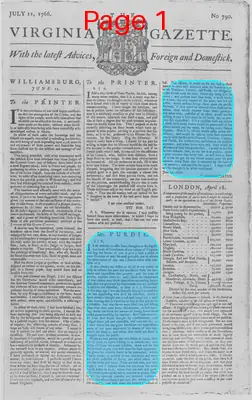
The Virginia Gazette
Richmond, Williamsburg, Richmond County, Virginia
What is this article about?
A Virginia colonist argues that the colony's tithable law unfairly burdens the poor by listing free persons as tithables while allowing slave owners to conceal young slaves. Proposes adopting Carolina's system of taxing all slaves from birth to shift levies to estate owners, reduce insolvency and fraud, and prevent officers from distressing impoverished families. Dated June 25, 1766.
Clipping
OCR Quality
Full Text
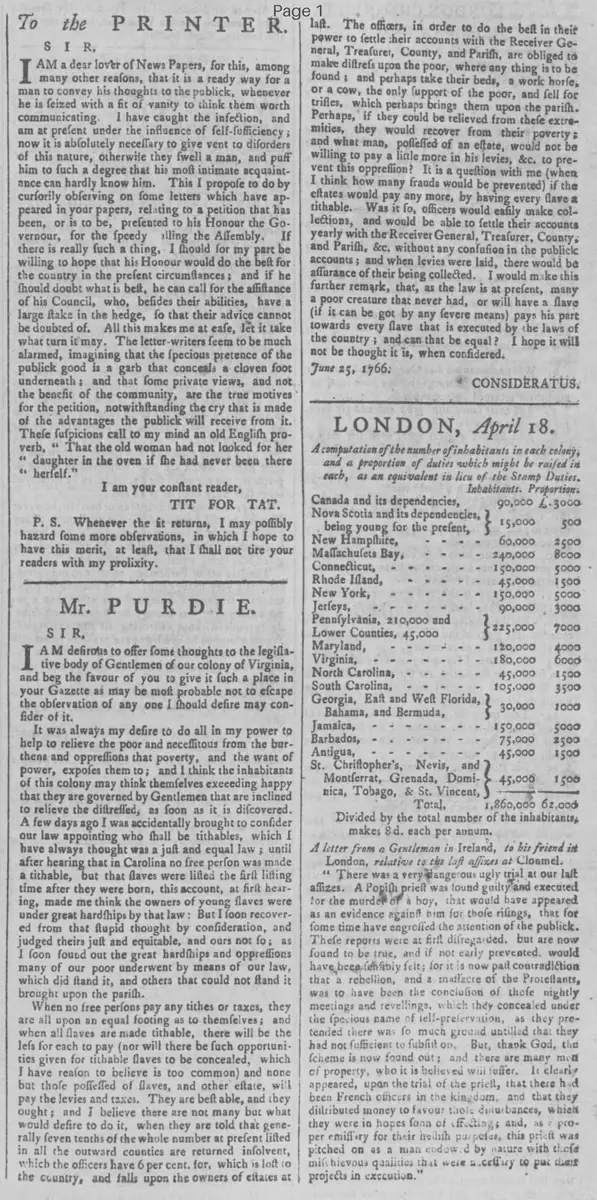
SIR,
I AM desirous to offer some thoughts to the legislative body of Gentlemen of our colony of Virginia, and beg the favour of you to give it such a place in your Gazette as may be most probable not to escape the observation of any one I should desire may consider of it.
It was always my desire to do all in my power to help to relieve the poor and necessitous from the burthens and oppressions that poverty, and the want of power, exposes them to; and I think the inhabitants of this colony may think themselves exceeding happy that they are governed by Gentlemen that are inclined to relieve the distressed; as soon as it is discovered.
A few days ago I was accidentally brought to consider our law appointing who shall be tithables, which I have always thought was a just and equal law; until after hearing that in Carolina no free person was made a tithable, but that slaves were listed the first listing time after they were born, this account, at first hearing, made me think the owners of young slaves were under great hardships by that law: But I soon recovered from that stupid thought by consideration, and judged theirs just and equitable, and ours not so; as I soon found out the great hardships and oppressions many of our poor underwent by means of our law, which did stand it, and others that could not stand it brought upon the parish.
When no free persons pay any tithes or taxes, they are all upon an equal footing as to themselves; and when all slaves are made tithable, there will be the less for each to pay (nor will there be such opportunities given for tithable slaves to be concealed, which I have reason to believe is too common) and none but those possessed of slaves, and other estate, will pay the levies and taxes. They are best able, and they ought; and I believe there are not many but what would desire to do it, when they are told that generally seven tenths of the whole number at present listed in all the outward counties are returned insolvent, which the officers have 6 per cent. for, which is lost to the country, and falls upon the owners of estates at last.
The officers, in order to do the best in their power to settle their accounts with the Receiver General, Treasurer, County, and Parish, are obliged to make distresses upon the poor, where any thing is to be found; and perhaps take their beds, a work horse, or a cow, the only support of the poor, and sell for trifles, which perhaps brings them upon the parish. Perhaps, if they could be relieved from these extremities, they would recover from their poverty; and what man, possessed of an estate, would not be willing to pay a little more in his levies, &c. to prevent this oppression? It is a question with me (when I think how many frauds would be prevented) if the estates would pay any more, by having every slave a tithable.
Was it so, officers would easily make collections, and would be able to settle their accounts yearly with the Receiver General, Treasurer, County, and Parish, &c. without any confusion in the publick accounts; and when levies were laid, there would be assurance of their being collected. I would make this further remark, that, as the law is at present, many a poor creature that never had, or will have a slave (if it can be got by any honest means) pays his part towards every slave that is executed by the laws of the country; and can that be equal? I hope it will not be thought it is, when considered.
June 25, 1766.
CONSIDERATUS.
What sub-type of article is it?
What themes does it cover?
What keywords are associated?
What entities or persons were involved?
Letter to Editor Details
Author
Consideratus.
Recipient
Mr. Purdie.
Main Argument
virginia's tithable law oppresses the poor by listing free persons while allowing concealment of young slaves; proposes making all slaves tithable from birth like in carolina to shift burdens to estate owners, prevent fraud, reduce insolvency, and ease distress on the impoverished.
Notable Details