Thank you for visiting SNEWPapers!
Sign up free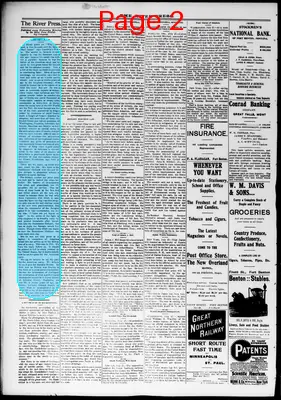
Story
August 2, 1905
The River Press
Fort Benton, Chouteau County, Montana
What is this article about?
Biographical tribute to John Paul Jones, celebrating his rise from humble origins to father of the American Navy, his legendary battle with the Serapis, and lasting influence on naval commanders like Nelson and Farragut.
Clipping

OCR Quality
98%
Excellent
Full Text
JOHN PAUL JONES
A friend asked us, "Why should such a fuss be made over the body of Paul Jones?" says Goodwin's Weekly. The answer is, because in some regards he was the foremost man of his age: because his career was without a parallel: because he was the father of the American navy, and because he won great honor for himself and for his adopted country. Note a few of the steps up which he mounted to everlasting fame. Born of menial parentage, no education save how to read and write at an humble parish school; sent to sea at twelve years of age in the roughest company; what would be looked for in the career of a child like that? But see: He was a mate at seventeen; captain at twenty: slave trader, East Indiaman and Virginian planter before he reached the age of twenty-six: naval lieutenant at twenty-eight; captain at twenty-nine; commodore at thirty-two; at thirty-three the ocean hero of the Old World and the New: the most famous sea victor of his time; patronized by kings; petted by duchesses of royal blood: made a knight of France: thanked by congress, and more than all these, the trusted friend and valued associate of Washington, Franklin, Jefferson, Lafayette, Hamilton and Morris: at thirty-three selected as special envoy to the most aristocratic of courts, charged with the most delicate, difficult and intricate of missions-the adjustment and collection of international claims -without any guide of precedent or any commonly recognized code of procedure: at forty voted a gold medal by congress: at forty-one a vice-admiral in the navy of an empire: at forty-three a prominent figure in the overture of that tremendous drama, the French Revolution, and dead at forty-five!
These are the stairs up which history leads his life. His fight in the Bonhomme Richard with the new 44-gun Serapis is altogether without a parallel in naval fighting.
The Serapis pushed her prow over his deck and he lashed the ships together. His battery of 12-pounders was silent and abandoned: his 18-pounders did no service. Two or three of them burst at the first fire and killed almost all the men stationed to manage them: he had only three 9-pounders with which to continue the fight: his flag was shot away: his ship was on fire and sinking: most of his crew were panic-stricken, but when the commander of the Serapis asked if he had surrendered, his reply was, "I have not yet begun to fight." In the midst of the fight a ship supposed to be friendly came by and poured broadside after broadside into the Bonhomme Richard, but late at night the Serapis struck her colors. Though every effort was made to save the Bonhomme Richard, she went down next day.
But he was not only great as a fighter. A committee of congress asked him for advice as to the formation of a navy. This was in 1775. We have his reply before us. It should be printed in full in every journal in the United States, for it shows exactly how he set the pace for the American navy.
We say we believe he set the pace for the American navy. We believe he set it also for Horatio Nelson. He died just as Nelson was forging to the front as a great naval commander. He was the inspiration of Farragut: his description of what a perfect naval commander should be is a pen picture of Admiral Dewey. Beginning his sea life at twelve years of age, unknown, lowborn, without friends or name, what he accomplished in his brief life is one of the marvels of history. We are glad that his body is to have final sepulchre in our national mausoleum.
A friend asked us, "Why should such a fuss be made over the body of Paul Jones?" says Goodwin's Weekly. The answer is, because in some regards he was the foremost man of his age: because his career was without a parallel: because he was the father of the American navy, and because he won great honor for himself and for his adopted country. Note a few of the steps up which he mounted to everlasting fame. Born of menial parentage, no education save how to read and write at an humble parish school; sent to sea at twelve years of age in the roughest company; what would be looked for in the career of a child like that? But see: He was a mate at seventeen; captain at twenty: slave trader, East Indiaman and Virginian planter before he reached the age of twenty-six: naval lieutenant at twenty-eight; captain at twenty-nine; commodore at thirty-two; at thirty-three the ocean hero of the Old World and the New: the most famous sea victor of his time; patronized by kings; petted by duchesses of royal blood: made a knight of France: thanked by congress, and more than all these, the trusted friend and valued associate of Washington, Franklin, Jefferson, Lafayette, Hamilton and Morris: at thirty-three selected as special envoy to the most aristocratic of courts, charged with the most delicate, difficult and intricate of missions-the adjustment and collection of international claims -without any guide of precedent or any commonly recognized code of procedure: at forty voted a gold medal by congress: at forty-one a vice-admiral in the navy of an empire: at forty-three a prominent figure in the overture of that tremendous drama, the French Revolution, and dead at forty-five!
These are the stairs up which history leads his life. His fight in the Bonhomme Richard with the new 44-gun Serapis is altogether without a parallel in naval fighting.
The Serapis pushed her prow over his deck and he lashed the ships together. His battery of 12-pounders was silent and abandoned: his 18-pounders did no service. Two or three of them burst at the first fire and killed almost all the men stationed to manage them: he had only three 9-pounders with which to continue the fight: his flag was shot away: his ship was on fire and sinking: most of his crew were panic-stricken, but when the commander of the Serapis asked if he had surrendered, his reply was, "I have not yet begun to fight." In the midst of the fight a ship supposed to be friendly came by and poured broadside after broadside into the Bonhomme Richard, but late at night the Serapis struck her colors. Though every effort was made to save the Bonhomme Richard, she went down next day.
But he was not only great as a fighter. A committee of congress asked him for advice as to the formation of a navy. This was in 1775. We have his reply before us. It should be printed in full in every journal in the United States, for it shows exactly how he set the pace for the American navy.
We say we believe he set the pace for the American navy. We believe he set it also for Horatio Nelson. He died just as Nelson was forging to the front as a great naval commander. He was the inspiration of Farragut: his description of what a perfect naval commander should be is a pen picture of Admiral Dewey. Beginning his sea life at twelve years of age, unknown, lowborn, without friends or name, what he accomplished in his brief life is one of the marvels of history. We are glad that his body is to have final sepulchre in our national mausoleum.
What sub-type of article is it?
Biography
Historical Event
Personal Triumph
What themes does it cover?
Bravery Heroism
Triumph
Fortune Reversal
What keywords are associated?
John Paul Jones
American Navy
Bonhomme Richard
Serapis Battle
Naval Hero
Revolutionary War
Vice Admiral
What entities or persons were involved?
John Paul Jones
Washington
Franklin
Jefferson
Lafayette
Hamilton
Morris
Horatio Nelson
Farragut
Admiral Dewey
Where did it happen?
On The High Seas
Story Details
Key Persons
John Paul Jones
Washington
Franklin
Jefferson
Lafayette
Hamilton
Morris
Horatio Nelson
Farragut
Admiral Dewey
Location
On The High Seas
Event Date
1775
Story Details
John Paul Jones rises from menial birth to naval hero, advises Congress on navy formation in 1775, wins epic battle against Serapis with Bonhomme Richard despite heavy losses, influences future admirals, dies at 45.