Thank you for visiting SNEWPapers!
Sign up free
Litchfield Enquirer
Litchfield, Litchfield County, Connecticut
What is this article about?
In 1835 letters, David Crockett declines a sham presidential nomination from Mississippi, endorses Martin Van Buren to unify Democrats for the 1836 election, and maneuvers for his own future candidacy from the South-West.
Merged-components note: These two components form a continuous satirical letter by David Crockett on politics, split due to parsing; merged into single domestic news item.
Clipping
OCR Quality
Full Text
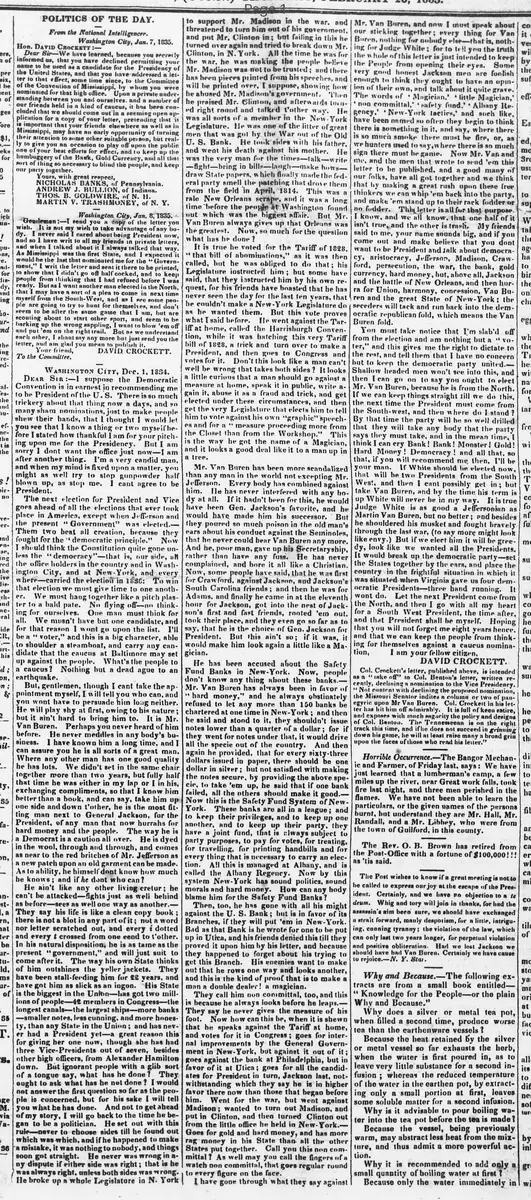
From the National Intelligencer.
Washington City, Jan. 7, 1835.
Hon. David Crockett:
Dear Sir—We have learned, because you secretly
informed us, that you have declined permitting your
name to be used as a candidate for the Presidency of
the United States, and that you have addressed a let-
ter to that effect, some time since, to the Committee
of the Convention of Mississippi, by whom you were
nominated for that high office. Upon a private under-
standing between you and ourselves, and a number of
our friends held in a kind of caucus, it has been con-
cluded that we should come out in a seeming open ap-
plication for a copy of your letter, pretending that it
is important that your friends elsewhere as well as in
Mississippi, may have an early opportunity of turning
their attention to some other suitable person, but real-
ly to give you an occasion to play off upon the public
one of your best efforts for effect, and to keep up the
humbuggery of the Bank, Gold Currency, and all that
sort of thing so necessary to blind the people, and keep
our party together.
Yours, with great respect,
NICHOLAS BANKS, of Pennsylvania.
ANDREW J. BULLION, of Indiana.
THOS. B. GOLDWIRE, of N. H.
MARTIN V. TRASHMONEY, of N. Y.
Washington City, Jan. 8, 1835.
Gentlemen:—I send you a copy of the letter you
wish. It is not my wish to take advantage of any bo-
dy. I never said I cared about being President now,
and so I have writ to all my friends in private letters,
and when I talked about it I always talked that way.
As Mississippi was the first State, and I expected it
would be the last that nominated me for the 'Govern-
ment,' I writ the letter and sent it there to be printed,
to show that I didn't go off half cocked, and to keep
people from thinking that I had refused before I was
ready. But as I want another man elected in the North,
that I may have a sort of a plea to come in next time
myself from the South-West, and as I see some peo-
ple are going to try to hunt for themselves, and don't
seem to be after the same game that I am, but are
scouting about to start other sport, and seem to be
barking up the wrong sapling, I want to blow 'em off
and put 'em on the right trail. But as we understand
each other, I shan't say any more but just send you the
letter, and am glad you mean to publish it.
Your friend,
DAVID CROCKETT.
To the Committee.
Washington City, Dec. 1, 1834.
Dear Sir:—I suppose the Democratic
Convention is in earnest in recommending me
to be President of the U. S. There is so much
trickery about that thing now a days, and so
many sham nominations, just to make people
shew their hands, that I thought I would let
you see that I know a thing or two myself be-
fore I stated how thankful I am for your pitch-
ing upon me for the Presidency. But I am
sorry I dont want the office just now—I am
after another thing. I'm a very candid man,
and when my mind is fixed upon a matter, you
might as well try to stop gunpowder half
blown up, as stop me. I cant agree to be
President.
The next election for President and Vice
goes ahead of all the elections that ever took
place in America, except when Jefferson and
the present 'Government' was elected.
Them two beat all creation, because they
fought for the 'democratic principle.' Now
I should think the Constitution quite gone un-
less the 'democracy'—that is, our side, all
the office holders in the country and in Wash-
ington City, and at New-York, and every
where—carried the election in 1836. To win
that election we must give time to one anoth-
er. We must hang together like a pitch plas-
ter to a bald pate. No flying off—no think-
ing for ourselves. One man must think for
all. We musn't have but one candidate, and
for that reason I wont go upon the list. I'll
be a 'voter,' and this is a big character, able
to shoulder a steamboat, and carry any can-
didate that the caucus at Baltimore may set
up against the people. What's the people to
a caucus? Nothing but a dead ague to an
earthquake.
But, gentlemen, though I cant take the ap-
pointment myself, I will tell you who can, and
you wont have to persuade him long neither.
He will play shy at first, owing to his nature;
but it ain't hard to bring him to. It is Mr.
Van Buren. Perhaps you never heard of him
before. He never meddles in any body's bu-
siness. I have known him a long time, and I
can assure you he is all sorts of a great man.
Where any other man has one good quality
he has lots. We didn't set in the same chair
together more than two years, but fully half
that time he was either in my lap or I in his,
exchanging compliments, so that I know him
better than a book, and can say, take him up
one side and down t'other, he is the most fit-
ting man next to General Jackson, for the
President, of any man that now hurrahs for
hard money and the people. The way he is
a Democrat is a caution all over. He is dyed
in the wool, through and through, and comes
as near to the red britches of Mr. Jefferson as
a new patch upon an old garment can be made.
As to ability, he himself dont know how much
he knows; and if he dont who can?
He ain't like any other living cretur; he
can't be attacked—sits just as well behind
as before—sees as well one way as another.
They say his life is like a clean copy book;
there is not a blot in any part of it; not a word
nor letter scratched out, and every i dotted
and every t crossed from one end to t'other.
In his natural disposition, he is as tame as the
present 'government,' and will just suit to
come after it. The way his own State thinks
of him outshines the yeller jackets. They
have been stall-feeding him for 22 years, and
have got him as slick as an ingon. His State
is the biggest in the Union—has got two mill-
ions of people—42 members in Congress—the
longest canals—the largest ships—more banks
—smaller notes, less cunning, and more hones-
ty, than any State in the Union; and has nev-
er had a President yet—a great reason this
for giving her one now, though she has had
three Vice-Presidents out of seven, besides
other high officers, from Alexander Hamilton
down. But ignorant people with a glib sort
of a tongue say, what has he done? They
ought to ask what has he not done? I would
not answer the first question so far as the peo-
ple is concerned, but for his sake I will tell
you what he has done. And not to get ahead
of my story, I will go back to the time he be-
gan to be a politician. He set out with this
rule—never to choose sides till he found out
which was—which, and if he happened to make
a mistake, it was nothing to nobody, and things
soon got straight. He never was wrong in a-
ny dispute if either side was right; that is he
was always right, unless both sides was wrong.
He broke up a whole Legislature in N. York
to support Mr. Madison in the war, and
threatened to turn him out of his government.
and put Mr. Clinton in; but failing in this he
turned over again and tried to break down Mr.
Clinton, in N. York. All the time he was for
the war, he was making the people believe
Mr. Madison was not to be trusted; and there
has been pieces printed from his speeches, and
will be printed over, I suppose, showing how
he abused Mr. Madison's government. Then
he praised Mr. Clinton, and afterwards turn-
ed right round and talked t'other way. He
was all sorts of a member in the New York
Legislature. He was one of the litter of great
men that was got by the War out of the Old
U. S. Bank. He took sides with his father,
and went his death against his mother. He
was the very man for the times—talk—write
—fight—bring in bills—laugh—make bows—
draw State papers, which hardly made the fed-
eral party smell the patching that drove them
from the field in April, 1814. This was a
real New Orleans scrape, and it was a long
time before the people at Washington found
out which was the biggest affair. But Mr.
Van Buren always gives up that Orleans was
the greatest. Now, so much for the question
what has he done?
It is true he voted for the Tariff of 1828.
' that bill of abominations,' as it was then
called, but he was obliged to do that; his
Legislature instructed him; but some have
said, that they instructed him by his own re-
quest, for his friends have boasted that he has
never seen the day for the last ten years, that
he couldn't make a New-York Legislature do
as he wanted them. But this vote proves
what I said before. He went against the Tar-
iff at home, called the Harrisburg Conven-
tion, while it was hatching this very Tariff
bill of 1828, a trick and turn over to make a
President, and then goes to Congress and
votes for it. Don't this look like a man can't
well be wrong that takes both sides? It looks
a little curious that a man should go against a
measure at home, speak it in public, write a-
gain it, abuse it as a fraud and trick, and get
elected under these circumstances, and then
get the very Legislature that elects him to tell
him to vote against his own 'graphic' speech-
es and for a 'measure proceeding more from
the Closet than from the Workshop.' This
is the way he got the name of a Magician,
and it looks a good deal like it to a man up in
a tree.
Mr. Van Buren has been more scandalized
than any man in the world not excepting Mr.
Jefferson. Every body has combined against
him. He has never interfered with any bo-
dy at all. If it hadn't been for this, he would
have been Gen. Jackson's favorite, and he
would have made him his successor. But
they poured so much poison in the old man's
ears about his conduct against the Seminoles,
that he never could bear Van Buren any more.
And he, poor man, gave up his Secretaryship,
rather than have any fuss. He has never
complained, and bore it all like a Christian.
Now, some people have said, that he was first
for Crawford, against Jackson, and Jackson's
South Carolina friends; and then he was for
Adams, and finally he came in at the eleventh
hour for Jackson, got into the nest of Jack-
son's first and fast friends, rooted 'em out.
took their place, and they even go so far as to
say, that he is the choice of Geo. Jackson for
President. But this ain't so; if it was, it
would make him look again a little like a Ma-
gician.
He has been accused about the Safety
Fund Banks in New-York. Now, people
don't know any thing about these banks.
Mr. Van Buren has always been in favor of
' hard money,' and he always obstinately
refused to let any more than 150 banks be
chartered at one time in New-York ; and then
he said and stood to it, they shouldn't issue
notes lower than a quarter of a dollar ; for if
they went for notes under that, it would drive
all the specie out of the country. And then
again he provided, that for every sixty-three
dollars issued in paper, there should be one
dollar in silver; but not satisfied with making
the notes secure by providing the above spe-
cie, to take 'em up, he said that if one bank
failed, all the others should make it good.
Now this is the Safety Fund System of New-
York. These banks are all in a league; and
to keep their privileges, and to keep up one
another, and to keep up their party, they
have a joint fund, that is always subject to
party purposes, to pay for votes, for treating.
for travelling, for printing handbills and for
every thing that is necessary to carry an elec-
tion. All this is managed at Albany, and is
called the Albany Regency. Now by this
system New-York has sound politics, sound
morals and hard money. How can any body
blame him for the Safety Fund Banks?
Then, too, he has gone with all his might
against the U. S. Bank; but is in favor of its
Branches, if they will put 'em in New-York.
Bad as that Bank is he wrote for one to be put
up in Utica, and his friends denied this till they
proved it upon him by his letter, and because
they happened to forget about his trying to
get this Branch. His enemies want to make
out that he rows one way and looks another,
and this is the kind of proof that is to make a
man a double dealer! a magician.
They call him non committal, too, and this
is because he always looks before he leaps.—
They say he never gives the measure of his
foot. Now how can this be, when it is shewn
that he speaks against the Tariff at home,
and votes for it in Congress; goes for inter-
nal improvements by the General Govern-
ment in New-York, but against it out of it;
goes against the bank at Philadelphia, but in
favor of it at Utica; goes for all the candid-
ates for President in turn, Jackson last, not-
withstanding which they say he is in higher
favor there now than those that began before
him. Went for the war, but went against
Madison; wanted to turn out Madison, and
put in Clinton, and then turned Clinton out
from the little office he held in New-York.—
Goes for gold and hard money, and has more
rag money in his State than all the other
States put together. Call you this non com-
mittal? As well may you call the fingers of a
watch non committal, that goes regular round
to every figure on the face.
I have gone through what they say against
Mr. Van Buren, and now I must speak about
our sticking together; every thing for Van
Buren, nothing for nobody else—that is, noth-
ing for Judge White; for to tell you the truth
the whole of this letter is just intended to keep
the People from opening their eyes. Some
very good honest Jackson men are foolish
enough to think they ought to have an opin-
ion of their own, and talk about it quite grave.
The words of 'Magician,' little Magician,
'non committal,' 'safety fund,' Albany Re-
gency,' New-York tactics,' and such like,
have been named so often they begin to think
there is something in it, and say, where there
is so much smoke there must be fire, or, as
we hunters used to say, where there is so much
sign there must be game. Now Mr. Van and
me, and the men that wrote to send 'em this
letter to be published, and a good many of
our folks, have all got together and we think
that by making a great rush upon these free
thinkers we can whip 'em back into the party.
and make 'em stand up to their rack odder or
no fudder. This letter is all for that purpose.
I know, and we all know, that one half of it
isn't true, and the other is trash. My friends
said to me, your name sounds big, and if you
come out and make believe that you dont
want to be President and talk about democra-
cy, aristocracy, Jefferson, Madison, Craw-
ford, persecution, the war, the bank, gold
currency, hard money, but, above all, Jackson
and the battle of New Orleans, and then hur-
ra for Union, harmony, concession, Van Bu-
ren and the great State of New-York; the
seceders will tack and run back into the dem-
ocratic republican fold, which means the Van
Buren fold.
You must take notice that I'm slabbed off
from the election and am nothing but a ' vo-
ter,' and this gives me the right to dictate to
the rest, and tell them that I have no concern
but to keep the democratic party united.—
Shallow headed men won't see into this, and
then I can go on to say you ought to elect
Mr. Van Buren, because he is from the North.
If we can keep things straight till we do this,
the next time the President must come from
the South-west, and then where do I stand?
By that time the party will be so well drilled
that they will take any body that the party
says they must take, and in the mean time, I
think I can cry Bank! Bank! Monster! Gold!
Hard Money! Democracy! and all that. so
that, if you will recommend me then, I'll be
your man. If White should be elected now,
that will be two Presidents from the South
West, and then I cant possibly get in; but
take Van Buren, and by the time his term is
up White will never be in my way. It is true
Judge White is as good a Jeffersonian as
Martin Van Buren, but no better; and besides
he shouldered his musket and fought bravely
through the last war, (to say more might look
like envy.) But if we elect him it will be gree-
dy, look like we wanted all the Presidents.
It would break up the democratic party—set
the States together by the ears, and place the
country in the frightful situation in which it
was situated when Virginia gave us four dem-
ocratic Presidents three hand running. It
wont do. Let the next President come from
the North, and then I go with all my heart
for a South West President, the time after,
and that President shall be myself. Hoping
that you will not forget me eight years hence.
and that we can keep the people from think-
ing for themselves against a caucus nomina-
tion,
I am your fellow citizen.
DAVID CROCKETT.
What sub-type of article is it?
What keywords are associated?
What entities or persons were involved?
Where did it happen?
Domestic News Details
Primary Location
Washington City
Event Date
Dec. 1, 1834 To Jan. 8, 1835
Key Persons
Outcome
david crockett declines presidential nomination from mississippi convention and endorses martin van buren as candidate to maintain party unity and position for future candidacy.
Event Details
Exchange of letters where Crockett, prompted by party associates, publicly declines his nomination for President, explains his strategy to support Van Buren for 1836 election to keep the Democratic party united, and positions himself for a future run from the South-West.