Thank you for visiting SNEWPapers!
Sign up free
Gazette Of The United States
New York, New York County, New York
What is this article about?
Letter from Marquis de Cascaux to the Paris Journal editor, dated August 30, arguing for the Royal Negative as a check on power in the French monarchy. It posits the people as sovereign, with the King and National Assembly as representatives, and stresses the inviolability of both and the free press to prevent abuse.
Clipping
OCR Quality
Full Text
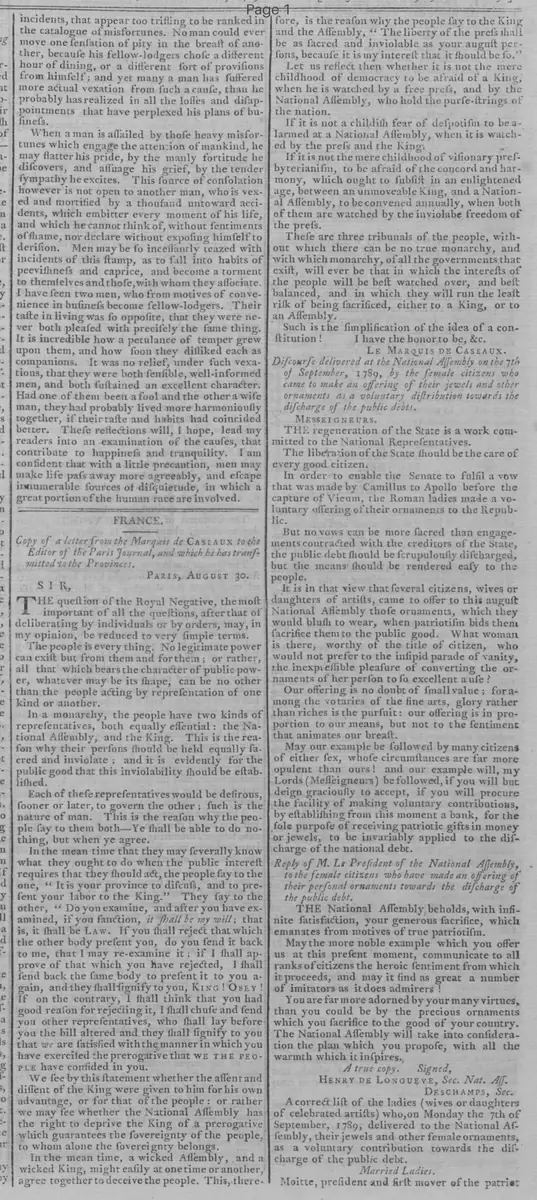
Copy of a letter from the Marquis de Cascaux to the Editor of the Paris Journal, and which he has transmitted to the Provinces.
PARIS, AUGUST 30.
SIR,
The question of the Royal Negative, the most important of all the questions, after that of deliberating by individuals or by orders, may, in my opinion, be reduced to very simple terms.
The people is every thing. No legitimate power can exist but from them and for them; or rather, all that which bears the character of public power, whatever may be its shape, can be no other than the people acting by representation of one kind or another.
In a monarchy, the people have two kinds of representatives, both equally essential: the National Assembly, and the King. This is the reason why their persons should be held equally sacred and inviolate; and it is evidently for the public good that this inviolability should be established.
Each of these representatives would be desirous, sooner or later, to govern the other; such is the nature of man. This is the reason why the people say to them both—Ye shall be able to do nothing, but when ye agree.
In the mean time that they may severally know what they ought to do when the public interest requires that they should act, the people say to the one, "It is your province to discuss, and to present your labor to the King." They say to the other, "Do you examine, and after you have examined, if you sanction, it shall be my will; that is, it shall be LAW. If you shall reject that which the other body present you, do you send it back to me, that I may re-examine it; if I shall approve of that which you have rejected, I shall send back the same body to present it to you again, and they shall signify to you, KING! OBEY! If on the contrary, I shall think that you had good reason for rejecting it, I shall choose and send you other representatives, who shall lay before you the bill altered and they shall signify to you that we are satisfied with the manner in which you have exercised the prerogative that WE THE PEOPLE have confided in you."
We see by this statement whether the assent and dissent of the King were given to him for his own advantage, or for that of the people: or rather we may see whether the National Assembly has the right to deprive the King of a prerogative which guarantees the sovereignty of the people, to whom alone the sovereignty belongs.
In the mean time, a wicked Assembly, and a wicked King, might easily at one time or another, agree together to deceive the people. This, therefore, is the reason why the people say to the King and the Assembly, "The liberty of the press shall be as sacred and inviolable as your august persons, because it is my interest that it should be so."
Let us reflect then whether it is not the mere childhood of democracy to be afraid of a King, when he is watched by a free press, and by the National Assembly, who hold the purse-strings of the nation.
If it is not a childish fear of despotism to be alarmed at a National Assembly, when it is watched by the press and the King.
If it is not the mere childhood of visionary presbyterianism, to be afraid of the concord and harmony, which ought to subsist in an enlightened age, between an unmoveable King, and a National Assembly, to be convened annually, when both of them are watched by the inviolable freedom of the press.
These are three tribunals of the people, without which there can be no true monarchy, and with which monarchy, of all the governments that exist, will ever be that in which the interests of the people will be best watched over, and best balanced, and in which they will run the least risk of being sacrificed, either to a King, or to an Assembly.
Such is the simplification of the idea of a constitution!
I have the honor to be, &c.
LE MARQUIS DE CASCAUX.
What sub-type of article is it?
What keywords are associated?
What entities or persons were involved?
Where did it happen?
Foreign News Details
Primary Location
Paris
Event Date
August 30
Key Persons
Event Details
The Marquis de Cascaux writes a letter simplifying the question of the Royal Negative in the French constitution. He argues that the people are sovereign, represented by the National Assembly and the King, both inviolable. The Royal Negative serves as a check, with the people able to override via re-examination or new representatives. He emphasizes the liberty of the press as a safeguard against abuse by either the King or Assembly, proposing a balanced monarchy watched by these three tribunals.