Thank you for visiting SNEWPapers!
Sign up free
Editorial
January 2, 1810
The Enquirer
Richmond, Henrico County, Virginia
What is this article about?
Editorial urges public support for the US Executive's dismissal of British minister Mr. Jackson after failed negotiations, warning that opposition would lead to national humiliation, loss of confidence in government, and vulnerability to British aggression. Criticizes partisan efforts to discredit the action amid tensions over Chesapeake and commerce.
Clipping
OCR Quality
98%
Excellent
Full Text
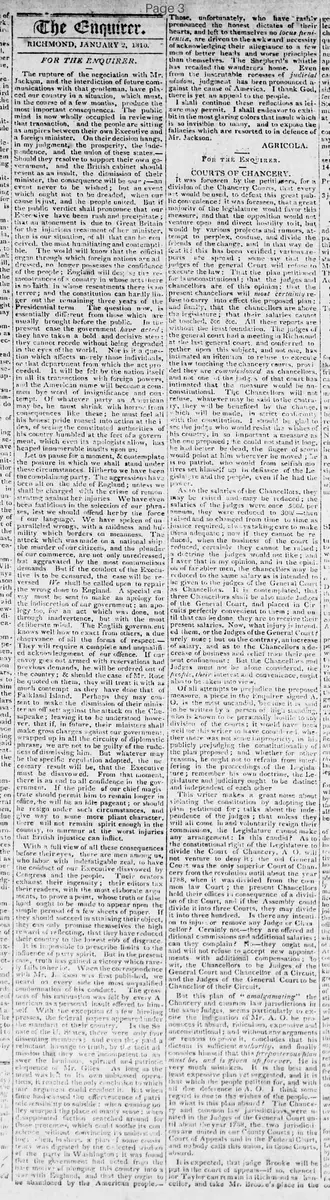
The Enquirer.
RICHMOND, JANUARY 2, 1810.
FOR THE ENQUIRER.
The rupture of the negociation with Mr. Jackson, and the interdiction of future communications with that gentleman, have placed our country in a situation, which must, in the course of a few months, produce the most important consequences. The public mind is now wholly occupied in reviewing that transaction, and the people are sitting as umpires between their own Executive and a foreign minister. On their decision hangs, in my judgment, the prosperity, the independence, and the union of these states.
Should they resolve to support their own government, and the British cabinet should resent as an insult, the dismission of their minister, the consequence will be war; an event never to be wished; but an event which ought not to be dreaded, when our cause is just, and the people united. But if the public verdict shall pronounce that our Executive have been rash and precipitate; that an atonement is due to Great Britain for the injurious treatment of her minister, then is our situation, of all that can be conceived, the most humiliating and contemptible. The world will know that the official organ through which foreign nations are addressed, no longer possesses the confidence of the people; England will despise the remonstrances of a country in whose acts there is no faith, in whose resentments there is no terror; and the constitution can hardly linger out the remaining three years of the Presidential term.
The question now, is essentially different from those which are usually brought before the public. In the present case the government have acted; they have taken a bold and decisive step; they cannot recede without being degraded in the eyes of the world. Nor is it a question which affects merely those individuals, or that department from which the act proceeded. It will be felt by the nation itself in all its transactions with foreign powers, and the American name will become a common by-word of insignificance and contempt. Of whatever party an American may be, he must shrink with horror from consequences like these: he must feel all his honest pride roused into action at the idea, of seeing the constituted authorities of his country humbled at the feet of a government, which even its apologists allow, has heaped innumerable insults upon us.
Let us pause for a moment, & contemplate the posture in which we shall stand under these circumstances. Hitherto we have been the complaining party. The aggressions have been all on the side of England; unless we shall be charged with the crime of remonstrating against her injuries. We have even been fastidious in the selection of our phrases, lest we should offend her by the force of our language. We have spoken of unparalleled wrongs, with a mildness and humility which borders on meanness. The attack which was made on a national ship, the murder of our citizens, and the plunder of our commerce, are not only unredressed, but aggravated by the most contumelious demands. But if the conduct of the Executive is to be censured, the case will be reversed. We shall be called upon to repair the wrong done to England. A special envoy must be sent to make an apology for the indiscretion of our government: an apology too, for an act which was done, not through inadvertence, but with the most deliberate mind. The English government knows well how to exact from others, a due observance of all the forms of respect. They will require a complete and unqualified acknowledgment of our offence. If our envoy goes out armed with reservations and previous demands, he will be ordered out of the country: & should the case of Mr. Rose be quoted on them, they will treat it with as much contempt as they have done that of Falkland Island. Perhaps they may consent to make the dismission of their minister an off-set against the attack on the Chesapeake; leaving it to be understood however, that if, in future, their ministers shall make gross charges against our government, wrapped up in all the circuity of diplomatic phrase, we are not to be guilty of the rudeness of dismissing him. But whatever may be the specific regulation adopted, the necessary result will be, that the Executive must be disavowed. From that moment there is an end to all confidence in the government. If the pride of our chief magistrate should permit him to remain longer in office, he will be an idle pageant; or should he resign under such circumstances, and give way to some more pliant character, there will not remain spirit enough in the country, to murmur at the worst injuries that British injustice can inflict.
With a full view of all these consequences before their eyes, there are men among us, who labor with indefatigable zeal, to have the conduct of our Executive disavowed by Congress and the people. Their orators exhaust their ingenuity: their editors tax their readers, with the most elaborate arguments, to prove a point, whose truth or falsehood ought to be made to appear upon the simple perusal of a few sheets of paper. If they should succeed in attaining their object, they can only promise themselves the high reward of reflecting, that they have reduced their country to the lowest ebb of disgrace.
It is impossible to prescribe limits to the influence of party spirit. But in the present case, truth has gained a victory which rarely fails to her. When the correspondence with Mr. Jackson was first published, we heard on every side the most unqualified condemnation of his conduct. The grossness of his insinuation was felt by every American as a personal insult offered to himself. With no exception of a few hireling presses, the federal papers appeared under the standard of their country. In the Senate of the U. States, there were only four dissenting members: and even they paid a reluctant homage to truth, by the tacit admission that they were incompetent to answer the luminous, spirited and patriotic eloquence of Mr. Giles. As long as the mind was left to its own unbiased operations, it reached the only conclusion to which fair argument could conduct it. But when once had caused the effervescence of patriotic sensibility to subside: when cunning policy usurped the place of manly sense: when disappointed faction searched around for those pretences, which could soothe its conscience without convincing its understanding: then, in short, a plan in some consistence was digested by the collected wisdom of the party in Washington; it was found that the government had acted from the base motive of plunging this country into a war with England, and that they ought to be abandoned by the American people.
Those, unfortunately, who have rashly pronounced the honest dictates of their hearts, and left to themselves no locus penitentiae, are driven to the awkward necessity of acknowledging their allegiance to a few men of better heads and worse principles than themselves. The Shepherd's whistle has recalled the wanderers home.
Even from the inscrutable recesses of judicial wisdom, judgment has been pronounced against the cause of America. I thank God, there is yet an appeal to the people.
I shall continue these reflections as leisure may permit. I shall endeavor to exhibit in the most glaring colors that insult which is so invisible to many, and to expose the fallacies which are resorted to in defence of Mr. Jackson.
AGRICOLE.
RICHMOND, JANUARY 2, 1810.
FOR THE ENQUIRER.
The rupture of the negociation with Mr. Jackson, and the interdiction of future communications with that gentleman, have placed our country in a situation, which must, in the course of a few months, produce the most important consequences. The public mind is now wholly occupied in reviewing that transaction, and the people are sitting as umpires between their own Executive and a foreign minister. On their decision hangs, in my judgment, the prosperity, the independence, and the union of these states.
Should they resolve to support their own government, and the British cabinet should resent as an insult, the dismission of their minister, the consequence will be war; an event never to be wished; but an event which ought not to be dreaded, when our cause is just, and the people united. But if the public verdict shall pronounce that our Executive have been rash and precipitate; that an atonement is due to Great Britain for the injurious treatment of her minister, then is our situation, of all that can be conceived, the most humiliating and contemptible. The world will know that the official organ through which foreign nations are addressed, no longer possesses the confidence of the people; England will despise the remonstrances of a country in whose acts there is no faith, in whose resentments there is no terror; and the constitution can hardly linger out the remaining three years of the Presidential term.
The question now, is essentially different from those which are usually brought before the public. In the present case the government have acted; they have taken a bold and decisive step; they cannot recede without being degraded in the eyes of the world. Nor is it a question which affects merely those individuals, or that department from which the act proceeded. It will be felt by the nation itself in all its transactions with foreign powers, and the American name will become a common by-word of insignificance and contempt. Of whatever party an American may be, he must shrink with horror from consequences like these: he must feel all his honest pride roused into action at the idea, of seeing the constituted authorities of his country humbled at the feet of a government, which even its apologists allow, has heaped innumerable insults upon us.
Let us pause for a moment, & contemplate the posture in which we shall stand under these circumstances. Hitherto we have been the complaining party. The aggressions have been all on the side of England; unless we shall be charged with the crime of remonstrating against her injuries. We have even been fastidious in the selection of our phrases, lest we should offend her by the force of our language. We have spoken of unparalleled wrongs, with a mildness and humility which borders on meanness. The attack which was made on a national ship, the murder of our citizens, and the plunder of our commerce, are not only unredressed, but aggravated by the most contumelious demands. But if the conduct of the Executive is to be censured, the case will be reversed. We shall be called upon to repair the wrong done to England. A special envoy must be sent to make an apology for the indiscretion of our government: an apology too, for an act which was done, not through inadvertence, but with the most deliberate mind. The English government knows well how to exact from others, a due observance of all the forms of respect. They will require a complete and unqualified acknowledgment of our offence. If our envoy goes out armed with reservations and previous demands, he will be ordered out of the country: & should the case of Mr. Rose be quoted on them, they will treat it with as much contempt as they have done that of Falkland Island. Perhaps they may consent to make the dismission of their minister an off-set against the attack on the Chesapeake; leaving it to be understood however, that if, in future, their ministers shall make gross charges against our government, wrapped up in all the circuity of diplomatic phrase, we are not to be guilty of the rudeness of dismissing him. But whatever may be the specific regulation adopted, the necessary result will be, that the Executive must be disavowed. From that moment there is an end to all confidence in the government. If the pride of our chief magistrate should permit him to remain longer in office, he will be an idle pageant; or should he resign under such circumstances, and give way to some more pliant character, there will not remain spirit enough in the country, to murmur at the worst injuries that British injustice can inflict.
With a full view of all these consequences before their eyes, there are men among us, who labor with indefatigable zeal, to have the conduct of our Executive disavowed by Congress and the people. Their orators exhaust their ingenuity: their editors tax their readers, with the most elaborate arguments, to prove a point, whose truth or falsehood ought to be made to appear upon the simple perusal of a few sheets of paper. If they should succeed in attaining their object, they can only promise themselves the high reward of reflecting, that they have reduced their country to the lowest ebb of disgrace.
It is impossible to prescribe limits to the influence of party spirit. But in the present case, truth has gained a victory which rarely fails to her. When the correspondence with Mr. Jackson was first published, we heard on every side the most unqualified condemnation of his conduct. The grossness of his insinuation was felt by every American as a personal insult offered to himself. With no exception of a few hireling presses, the federal papers appeared under the standard of their country. In the Senate of the U. States, there were only four dissenting members: and even they paid a reluctant homage to truth, by the tacit admission that they were incompetent to answer the luminous, spirited and patriotic eloquence of Mr. Giles. As long as the mind was left to its own unbiased operations, it reached the only conclusion to which fair argument could conduct it. But when once had caused the effervescence of patriotic sensibility to subside: when cunning policy usurped the place of manly sense: when disappointed faction searched around for those pretences, which could soothe its conscience without convincing its understanding: then, in short, a plan in some consistence was digested by the collected wisdom of the party in Washington; it was found that the government had acted from the base motive of plunging this country into a war with England, and that they ought to be abandoned by the American people.
Those, unfortunately, who have rashly pronounced the honest dictates of their hearts, and left to themselves no locus penitentiae, are driven to the awkward necessity of acknowledging their allegiance to a few men of better heads and worse principles than themselves. The Shepherd's whistle has recalled the wanderers home.
Even from the inscrutable recesses of judicial wisdom, judgment has been pronounced against the cause of America. I thank God, there is yet an appeal to the people.
I shall continue these reflections as leisure may permit. I shall endeavor to exhibit in the most glaring colors that insult which is so invisible to many, and to expose the fallacies which are resorted to in defence of Mr. Jackson.
AGRICOLE.
What sub-type of article is it?
Foreign Affairs
Partisan Politics
War Or Peace
What keywords are associated?
Jackson Affair
Us British Relations
Executive Support
Partisan Opposition
Chesapeake Attack
Foreign Negotiations
National Honor
What entities or persons were involved?
Mr. Jackson
British Cabinet
Executive
Congress
Mr. Giles
England
Great Britain
Editorial Details
Primary Topic
Support For Executive's Rupture With British Minister Jackson
Stance / Tone
Strongly Supportive Of Us Government Against British Minister And Partisan Opposition
Key Figures
Mr. Jackson
British Cabinet
Executive
Congress
Mr. Giles
England
Great Britain
Key Arguments
Public Support For Government Prevents War Or Humiliation
Dismissal Of Jackson Was Justified Response To Insults
Opposition Driven By Party Spirit Ignores Truth
Disavowing Executive Would Undermine National Confidence And Invite British Contempt
Initial Public Condemnation Of Jackson Was Unanimous