Thank you for visiting SNEWPapers!
Sign up free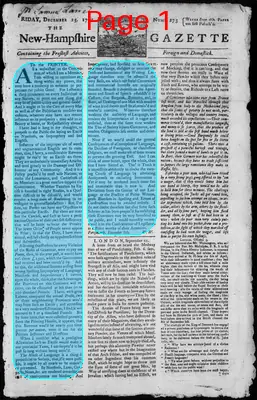
Letter to Editor
December 25, 1761
The New Hampshire Gazette
Portsmouth, Rockingham County, New Hampshire
What is this article about?
A writer proposes an excise tax on nonsense, impropriety, and bad English in print to generate significant revenue for the provinces while improving language use and societal ties. He argues this would alleviate taxes, prevent misinterpretations in laws and commerce, and recommends it to legislators. Signed W. W. from Portsmouth, December 8th.
Clipping
OCR Quality
98%
Excellent
Full Text
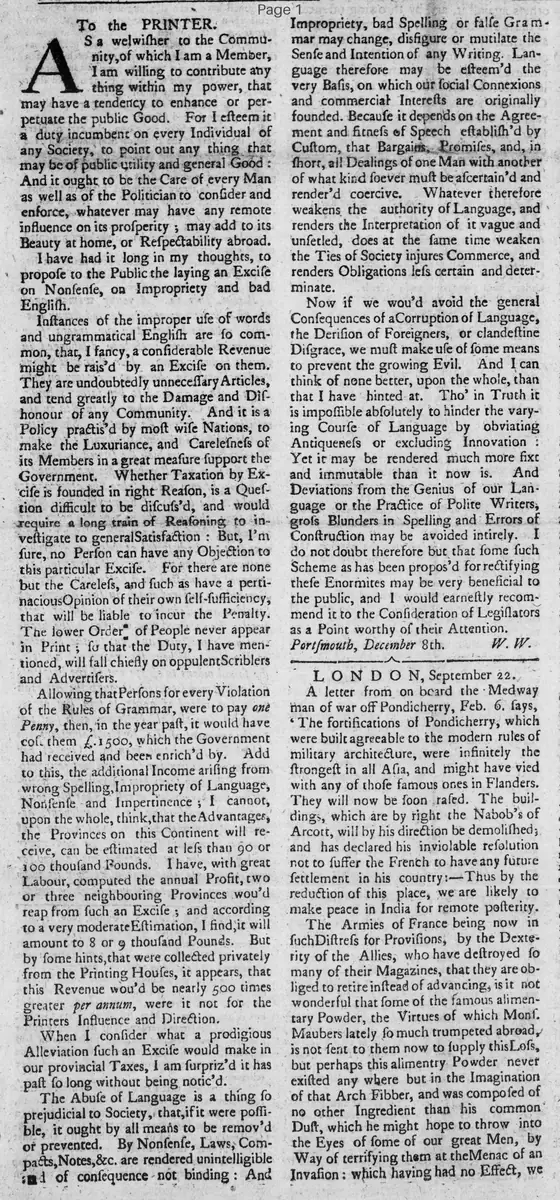
To the PRINTER.
As a wellwisher to the Community, of which I am a Member, I am willing to contribute any thing within my power, that may have a tendency to enhance or perpetuate the public Good. For I esteem it a duty incumbent on every Individual of any Society, to point out any thing that may be of public utility and general Good: And it ought to be the Care of every Man as well as of the Politician to consider and enforce whatever may have any remote influence on its prosperity; may add to its Beauty at home, or Respectability abroad.
I have had it long in my thoughts, to propose to the Public the laying an Excise on Nonsense, on Impropriety and bad English. Instances of the improper use of words and ungrammatical English are so common, that, I fancy, a considerable Revenue might be rais'd by an Excise on them. They are undoubtedly unnecessary Articles, and tend greatly to the Damage and Dishonour of any Community. And it is a Policy practis'd by most wise Nations, to make the Luxuriance, and Carelessness of its Members in a great measure support the Government. Whether Taxation by Excise is founded in right Reason, is a Question difficult to be discuss'd, and would require a long train of Reasoning to investigate to general Satisfaction: But I'm sure, no Person can have any Objection to this particular Excise. For there are none but the Careless, and such as have a pertinacious Opinion of their own self-sufficiency, that will be liable to incur the Penalty. The lower Orders of People never appear in Print: so that the Duty, I have mentioned, will fall chiefly on opulent Scriblers and Advertisers.
Allowing that Persons for every Violation of the Rules of Grammar, were to pay one Penny, then, in the year past, it would have cost them £.1500, which the Government had received and been enrich'd by. Add to this, the additional Income arising from wrong Spelling, Impropriety of Language, Nonsense and Impertinence; I cannot, upon the whole, think, that the Advantages, the Provinces on this Continent will receive, can be estimated at less than 50 or 100 thousand Pounds. I have, with great Labour, computed the annual Profit, two or three neighbouring Provinces wou'd reap from such an Excise; and according to a very moderate Estimation, I find, it will amount to 8 or 9 thousand Pounds. But by some hints, that were collected privately from the Printing Houses, it appears, that this Revenue wou'd be nearly 500 times greater per annum, were it not for the Printers Influence and Direction.
When I consider what a prodigious Alleviation such an Excise would make in our provincial Taxes, I am surpriz'd it has past so long without being notic'd. The Abuse of Language is a thing so prejudicial to Society, that, if it were possible, it ought by all means to be remov'd or prevented. By Nonsense, Laws, Compacts, Notes, &c. are rendered unintelligible and of consequence not binding: And Impropriety, bad Spelling or false Grammar may change, disfigure or mutilate the Sense and Intention of any Writing. Language therefore may be esteem'd the very Basis, on which our social Connexions and commercial Interests are originally founded. Because it depends on the Agreement and fitness of Speech establish'd by Custom, that Bargains, Promises, and, in Short, all Dealings of one Man with another of what kind soever must be ascertain'd and render'd coercive. Whatever therefore weakens the authority of Language, and renders the Interpretation of it vague and unsettled, does at the same time weaken the Ties of Society, injures Commerce, and renders Obligations less certain and determinate.
Now if we wou'd avoid the general Consequences of a Corruption of Language, the Derision of Foreigners, or clandestine Disgrace, we must make use of some means to prevent the growing Evil. And I can think of none better, upon the whole, than that I have hinted at. Tho' in Truth it is impossible absolutely to hinder the varying Course of Language by obviating Antiqueness or excluding Innovation: Yet it may be rendered much more fixt and immutable than it now is. And Deviations from the Genius of our Language or the Practice of Polite Writers, gross Blunders in Spelling and Errors of Construction may be avoided intirely. I do not doubt therefore but that some such Scheme as has been propos'd for rectifying these Enormities may be very beneficial to the public, and I would earnestly recommend it to the Consideration of Legislators as a Point worthy of their Attention.
Portsmouth, December 8th.
W. W.
As a wellwisher to the Community, of which I am a Member, I am willing to contribute any thing within my power, that may have a tendency to enhance or perpetuate the public Good. For I esteem it a duty incumbent on every Individual of any Society, to point out any thing that may be of public utility and general Good: And it ought to be the Care of every Man as well as of the Politician to consider and enforce whatever may have any remote influence on its prosperity; may add to its Beauty at home, or Respectability abroad.
I have had it long in my thoughts, to propose to the Public the laying an Excise on Nonsense, on Impropriety and bad English. Instances of the improper use of words and ungrammatical English are so common, that, I fancy, a considerable Revenue might be rais'd by an Excise on them. They are undoubtedly unnecessary Articles, and tend greatly to the Damage and Dishonour of any Community. And it is a Policy practis'd by most wise Nations, to make the Luxuriance, and Carelessness of its Members in a great measure support the Government. Whether Taxation by Excise is founded in right Reason, is a Question difficult to be discuss'd, and would require a long train of Reasoning to investigate to general Satisfaction: But I'm sure, no Person can have any Objection to this particular Excise. For there are none but the Careless, and such as have a pertinacious Opinion of their own self-sufficiency, that will be liable to incur the Penalty. The lower Orders of People never appear in Print: so that the Duty, I have mentioned, will fall chiefly on opulent Scriblers and Advertisers.
Allowing that Persons for every Violation of the Rules of Grammar, were to pay one Penny, then, in the year past, it would have cost them £.1500, which the Government had received and been enrich'd by. Add to this, the additional Income arising from wrong Spelling, Impropriety of Language, Nonsense and Impertinence; I cannot, upon the whole, think, that the Advantages, the Provinces on this Continent will receive, can be estimated at less than 50 or 100 thousand Pounds. I have, with great Labour, computed the annual Profit, two or three neighbouring Provinces wou'd reap from such an Excise; and according to a very moderate Estimation, I find, it will amount to 8 or 9 thousand Pounds. But by some hints, that were collected privately from the Printing Houses, it appears, that this Revenue wou'd be nearly 500 times greater per annum, were it not for the Printers Influence and Direction.
When I consider what a prodigious Alleviation such an Excise would make in our provincial Taxes, I am surpriz'd it has past so long without being notic'd. The Abuse of Language is a thing so prejudicial to Society, that, if it were possible, it ought by all means to be remov'd or prevented. By Nonsense, Laws, Compacts, Notes, &c. are rendered unintelligible and of consequence not binding: And Impropriety, bad Spelling or false Grammar may change, disfigure or mutilate the Sense and Intention of any Writing. Language therefore may be esteem'd the very Basis, on which our social Connexions and commercial Interests are originally founded. Because it depends on the Agreement and fitness of Speech establish'd by Custom, that Bargains, Promises, and, in Short, all Dealings of one Man with another of what kind soever must be ascertain'd and render'd coercive. Whatever therefore weakens the authority of Language, and renders the Interpretation of it vague and unsettled, does at the same time weaken the Ties of Society, injures Commerce, and renders Obligations less certain and determinate.
Now if we wou'd avoid the general Consequences of a Corruption of Language, the Derision of Foreigners, or clandestine Disgrace, we must make use of some means to prevent the growing Evil. And I can think of none better, upon the whole, than that I have hinted at. Tho' in Truth it is impossible absolutely to hinder the varying Course of Language by obviating Antiqueness or excluding Innovation: Yet it may be rendered much more fixt and immutable than it now is. And Deviations from the Genius of our Language or the Practice of Polite Writers, gross Blunders in Spelling and Errors of Construction may be avoided intirely. I do not doubt therefore but that some such Scheme as has been propos'd for rectifying these Enormities may be very beneficial to the public, and I would earnestly recommend it to the Consideration of Legislators as a Point worthy of their Attention.
Portsmouth, December 8th.
W. W.
What sub-type of article is it?
Satirical
Persuasive
Social Critique
What themes does it cover?
Social Issues
Commerce Trade
Economic Policy
What keywords are associated?
Excise On Nonsense
Bad English
Language Abuse
Grammar Penalties
Public Revenue
Provincial Taxes
Portsmouth
What entities or persons were involved?
W. W.
The Printer
Letter to Editor Details
Author
W. W.
Recipient
The Printer
Main Argument
the writer proposes an excise tax on nonsense, impropriety, bad english, and grammatical errors in print to raise substantial revenue for the provinces while discouraging poor language use that harms society, commerce, and legal clarity.
Notable Details
Estimated Revenue Of £1500 From Grammar Violations Alone In The Past Year
Potential Total Benefits Of 50 100 Thousand Pounds For Provinces
Computed Annual Profit Of 8 9 Thousand Pounds For Neighboring Provinces, Potentially 500 Times Greater Without Printers' Influence
Language As Basis Of Social Connections And Commercial Interests