Thank you for visiting SNEWPapers!
Sign up free
Editorial
February 13, 1945
The Daily Alaska Empire
Juneau, Juneau County, Alaska
What is this article about?
Drew Pearson's column details the postponement of the Big Three Conference from November 1944 to January 1945. Reasons include Stalin's refusal to leave Russia, Roosevelt's mediation concerns and post-election rest needs. Churchill was frustrated, straining relations; later, Roosevelt eagerly prepared to depart post-inauguration.
Merged-components note: Continuation of the same editorial across pages.
Clippings
1 of 2
OCR Quality
85%
Good
Full Text
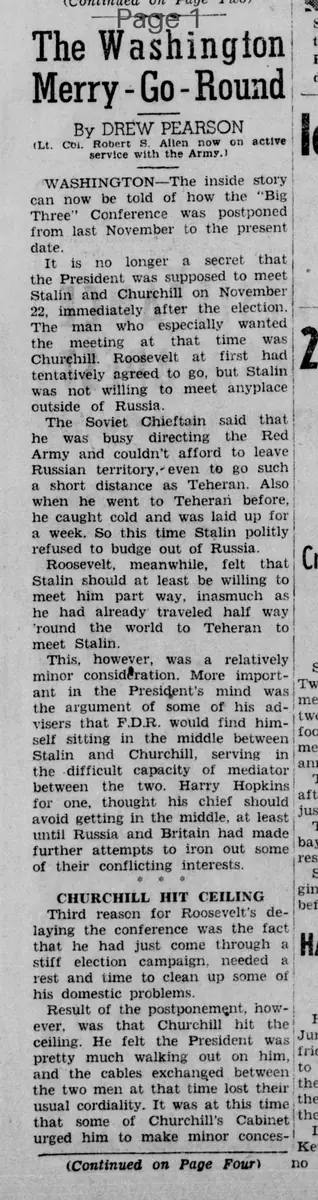
The Washington Merry-Go-Round
By DREW PEARSON
(Lt. Col. Robert S. Allen now on active service with the Army.)
WASHINGTON-The inside story can now be told of how the "Big Three" Conference was postponed from last November to the present date.
It is no longer a secret that the President was supposed to meet Stalin and Churchill on November 22, immediately after the election.
The man who especially wanted the meeting at that time was Churchill. Roosevelt at first had tentatively agreed to go, but Stalin was not willing to meet anyplace outside of Russia.
The Soviet Chieftain said that he was busy directing the Red Army and couldn't afford to leave Russian territory, even to go such a short distance as Teheran. Also when he went to Teheran before, he caught cold and was laid up for a week. So this time Stalin politely refused to budge out of Russia.
Roosevelt, meanwhile, felt that Stalin should at least be willing to meet him part way, inasmuch as he had already traveled half way 'round the world to Teheran to meet Stalin.
This, however, was a relatively minor consideration. More important in the President's mind was the argument of some of his advisers that F.D.R. would find himself sitting in the middle between Stalin and Churchill, serving in the difficult capacity of mediator between the two. Harry Hopkins for one, thought his chief should avoid getting in the middle, at least until Russia and Britain had made further attempts to iron out some of their conflicting interests.
CHURCHILL HIT CEILING
Third reason for Roosevelt's delaying the conference was the fact that he had just come through a stiff election campaign, needed a rest and time to clean up some of his domestic problems.
Result of the postponement, however, was that Churchill hit the ceiling. He felt the President was pretty much walking out on him, and the cables exchanged between the two men at that time lost their usual cordiality. It was at this time that some of Churchill's Cabinet urged him to make minor concessions
(Continued on Page Four)
Washington
Merry-
Go-Round
(Continued from Page One)
concessions at the conference in order to avoid a deadlock with the United States. But he refused, and the conference ended in partial deadlock.
Later, things drifted from bad to worse as far as British policy in Greece and Italy was concerned. So that just before his inauguration, the President became eager and restless to leave immediately for the Big Three Conference in order to solve these problems.
In fact he was so restless that he proposed to his naval and military leaders that they depart on Saturday afternoon, January 20, just an hour or two after he was inaugurated. They replied that they could not possibly get the proper traveling facilities ready by that time, so in the end, the President departed a little later.
By DREW PEARSON
(Lt. Col. Robert S. Allen now on active service with the Army.)
WASHINGTON-The inside story can now be told of how the "Big Three" Conference was postponed from last November to the present date.
It is no longer a secret that the President was supposed to meet Stalin and Churchill on November 22, immediately after the election.
The man who especially wanted the meeting at that time was Churchill. Roosevelt at first had tentatively agreed to go, but Stalin was not willing to meet anyplace outside of Russia.
The Soviet Chieftain said that he was busy directing the Red Army and couldn't afford to leave Russian territory, even to go such a short distance as Teheran. Also when he went to Teheran before, he caught cold and was laid up for a week. So this time Stalin politely refused to budge out of Russia.
Roosevelt, meanwhile, felt that Stalin should at least be willing to meet him part way, inasmuch as he had already traveled half way 'round the world to Teheran to meet Stalin.
This, however, was a relatively minor consideration. More important in the President's mind was the argument of some of his advisers that F.D.R. would find himself sitting in the middle between Stalin and Churchill, serving in the difficult capacity of mediator between the two. Harry Hopkins for one, thought his chief should avoid getting in the middle, at least until Russia and Britain had made further attempts to iron out some of their conflicting interests.
CHURCHILL HIT CEILING
Third reason for Roosevelt's delaying the conference was the fact that he had just come through a stiff election campaign, needed a rest and time to clean up some of his domestic problems.
Result of the postponement, however, was that Churchill hit the ceiling. He felt the President was pretty much walking out on him, and the cables exchanged between the two men at that time lost their usual cordiality. It was at this time that some of Churchill's Cabinet urged him to make minor concessions
(Continued on Page Four)
Washington
Merry-
Go-Round
(Continued from Page One)
concessions at the conference in order to avoid a deadlock with the United States. But he refused, and the conference ended in partial deadlock.
Later, things drifted from bad to worse as far as British policy in Greece and Italy was concerned. So that just before his inauguration, the President became eager and restless to leave immediately for the Big Three Conference in order to solve these problems.
In fact he was so restless that he proposed to his naval and military leaders that they depart on Saturday afternoon, January 20, just an hour or two after he was inaugurated. They replied that they could not possibly get the proper traveling facilities ready by that time, so in the end, the President departed a little later.
What sub-type of article is it?
Foreign Affairs
What keywords are associated?
Big Three Conference
Roosevelt
Stalin
Churchill
Postponement
Teheran
Diplomatic Tensions
Yalta Preparations
What entities or persons were involved?
Roosevelt
Stalin
Churchill
Harry Hopkins
Editorial Details
Primary Topic
Postponement Of The Big Three Conference
Stance / Tone
Informative Disclosure Of Diplomatic Tensions
Key Figures
Roosevelt
Stalin
Churchill
Harry Hopkins
Key Arguments
Stalin Refused To Leave Russia Due To Military Duties And Health Concerns
Roosevelt Concerned About Mediating Between Stalin And Churchill
Roosevelt Needed Rest After Election And Time For Domestic Issues
Postponement Frustrated Churchill, Straining Us Uk Relations
Roosevelt Later Eager To Hold Conference To Address British Policies In Greece And Italy