Thank you for visiting SNEWPapers!
Sign up free
Editorial
February 8, 1792
Gazette Of The United States
New York, New York County, New York
What is this article about?
Editorial defends US government's military actions against Indian aggressions on the frontier, arguing justice is on the US side, Congress acted rightly to protect citizens, and emphasizes the people's trust in and duty to support free government.
Clipping
OCR Quality
98%
Excellent
Full Text
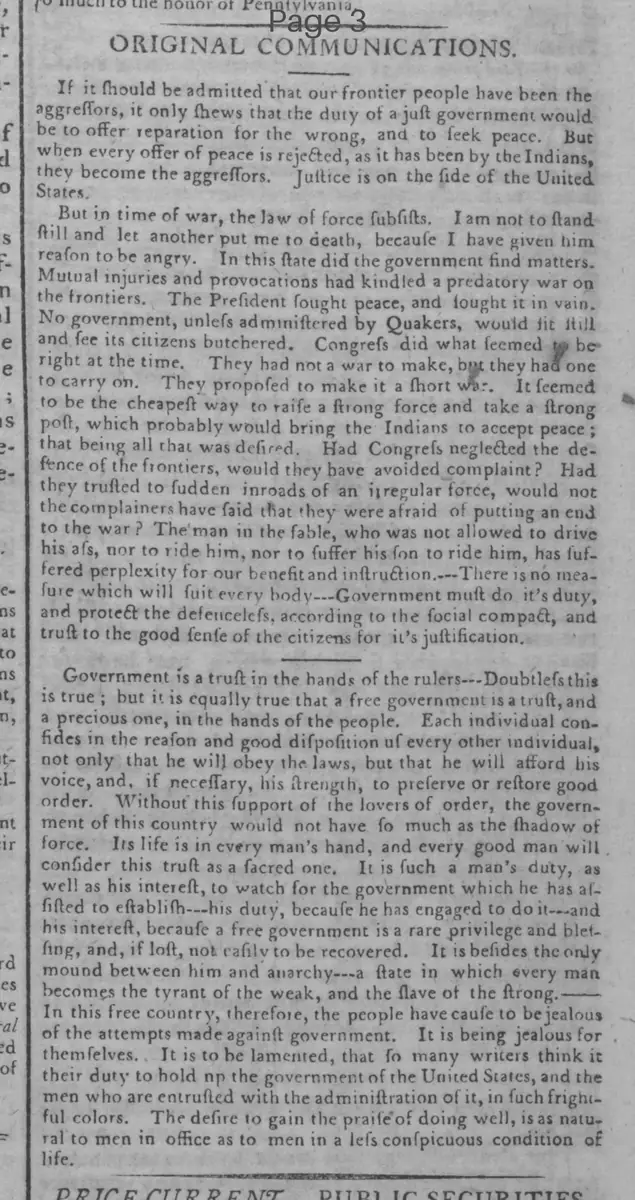
ORIGINAL COMMUNICATIONS.
If it should be admitted that our frontier people have been the aggressors, it only shows that the duty of a just government would be to offer reparation for the wrong, and to seek peace. But when every offer of peace is rejected, as it has been by the Indians, they become the aggressors. Justice is on the side of the United States.
But in time of war, the law of force subsists. I am not to stand still and let another put me to death, because I have given him reason to be angry. In this state did the government find matters. Mutual injuries and provocations had kindled a predatory war on the frontiers. The President sought peace, and sought it in vain. No government, unless administered by Quakers, would sit still and see its citizens butchered. Congress did what seemed to be right at the time. They had not a war to make, but they had one to carry on. They proposed to make it a short war. It seemed to be the cheapest way to raise a strong force and take a strong post, which probably would bring the Indians to accept peace; that being all that was desired. Had Congress neglected the defense of the frontiers, would they have avoided complaint? Had they trusted to sudden inroads of an irregular force, would not the complainers have said that they were afraid of putting an end to the war? The man in the fable, who was not allowed to drive his ass, nor to ride him, nor to suffer his son to ride him, has suffered perplexity for our benefit and instruction.—There is no measure which will suit every body—Government must do it's duty, and protect the defenseless, according to the social compact, and trust to the good sense of the citizens for it's justification.
Government is a trust in the hands of the rulers—Doubtless this is true; but it is equally true that a free government is a trust, and a precious one, in the hands of the people. Each individual confides in the reason and good disposition of every other individual, not only that he will obey the laws, but that he will afford his voice, and, if necessary, his strength, to preserve or restore good order. Without this support of the lovers of order, the government of this country would not have so much as the shadow of force. Its life is in every man's hand, and every good man will consider this trust as a sacred one. It is such a man's duty, as well as his interest, to watch for the government which he has assisted to establish—his duty, because he has engaged to do it—and his interest, because a free government is a rare privilege and blessing, and, if lost, not easily to be recovered. It is besides the only mound between him and anarchy—a state in which every man becomes the tyrant of the weak, and the slave of the strong.
In this free country, therefore, the people have cause to be jealous of the attempts made against government. It is being jealous for themselves. It is to be lamented, that so many writers think it their duty to hold up the government of the United States, and the men who are entrusted with the administration of it, in such frightful colors. The desire to gain the praise of doing well, is as natural to men in office as to men in a less conspicuous condition of life.
If it should be admitted that our frontier people have been the aggressors, it only shows that the duty of a just government would be to offer reparation for the wrong, and to seek peace. But when every offer of peace is rejected, as it has been by the Indians, they become the aggressors. Justice is on the side of the United States.
But in time of war, the law of force subsists. I am not to stand still and let another put me to death, because I have given him reason to be angry. In this state did the government find matters. Mutual injuries and provocations had kindled a predatory war on the frontiers. The President sought peace, and sought it in vain. No government, unless administered by Quakers, would sit still and see its citizens butchered. Congress did what seemed to be right at the time. They had not a war to make, but they had one to carry on. They proposed to make it a short war. It seemed to be the cheapest way to raise a strong force and take a strong post, which probably would bring the Indians to accept peace; that being all that was desired. Had Congress neglected the defense of the frontiers, would they have avoided complaint? Had they trusted to sudden inroads of an irregular force, would not the complainers have said that they were afraid of putting an end to the war? The man in the fable, who was not allowed to drive his ass, nor to ride him, nor to suffer his son to ride him, has suffered perplexity for our benefit and instruction.—There is no measure which will suit every body—Government must do it's duty, and protect the defenseless, according to the social compact, and trust to the good sense of the citizens for it's justification.
Government is a trust in the hands of the rulers—Doubtless this is true; but it is equally true that a free government is a trust, and a precious one, in the hands of the people. Each individual confides in the reason and good disposition of every other individual, not only that he will obey the laws, but that he will afford his voice, and, if necessary, his strength, to preserve or restore good order. Without this support of the lovers of order, the government of this country would not have so much as the shadow of force. Its life is in every man's hand, and every good man will consider this trust as a sacred one. It is such a man's duty, as well as his interest, to watch for the government which he has assisted to establish—his duty, because he has engaged to do it—and his interest, because a free government is a rare privilege and blessing, and, if lost, not easily to be recovered. It is besides the only mound between him and anarchy—a state in which every man becomes the tyrant of the weak, and the slave of the strong.
In this free country, therefore, the people have cause to be jealous of the attempts made against government. It is being jealous for themselves. It is to be lamented, that so many writers think it their duty to hold up the government of the United States, and the men who are entrusted with the administration of it, in such frightful colors. The desire to gain the praise of doing well, is as natural to men in office as to men in a less conspicuous condition of life.
What sub-type of article is it?
Indian Affairs
Military Affairs
Constitutional
What keywords are associated?
Indian Aggressors
Frontier War
Government Duty
Congress Defense
Social Compact
Free Government
People's Trust
What entities or persons were involved?
United States Government
Congress
President
Indians
Quakers
Editorial Details
Primary Topic
Defense Of Us Actions In Indian Frontier War
Stance / Tone
Supportive Of Government And Military Response
Key Figures
United States Government
Congress
President
Indians
Quakers
Key Arguments
Frontier People May Have Aggressed But Indians Rejected Peace Offers Making Them Aggressors
Justice Is On The Side Of The United States
In War, Law Of Force Applies; Government Must Defend Citizens
President Sought Peace In Vain; Congress Raised Force To End War Quickly
No Action Would Invite Complaints; Government Must Protect Per Social Compact
Free Government Is A Trust In The People Who Must Support It Against Anarchy
Critics Unfairly Portray Us Government In Frightful Colors