Thank you for visiting SNEWPapers!
Sign up free
Letter to Editor
July 29, 1796
Gazette Of The United States, & Philadelphia Daily Advertiser
Philadelphia, Philadelphia County, Pennsylvania
What is this article about?
Letter No. III advocates for public schools to ensure equal access to education, rooted in constitutional principles of equality. It criticizes the monopoly of learning that creates social disparities and the legislature's failure to act on education after two sessions.
Clipping
OCR Quality
98%
Excellent
Full Text
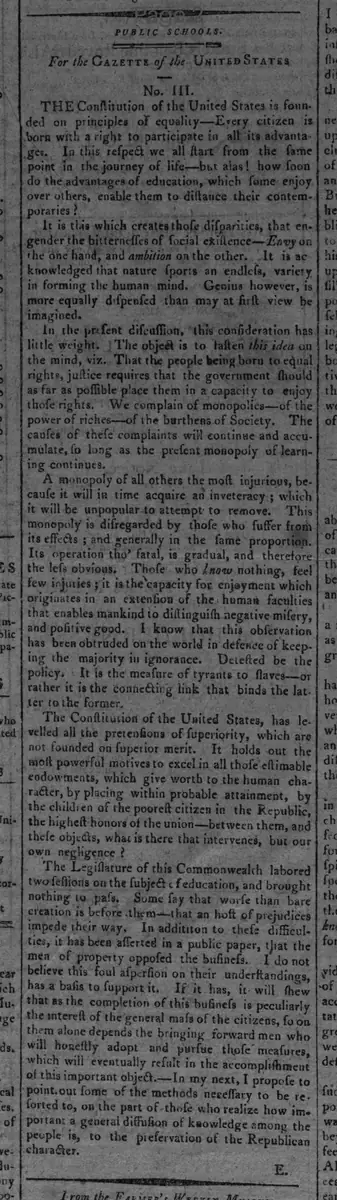
PUBLIC SCHOOLS.
For the GAZETTE of the United STATES
No. III.
THE Constitution of the United States is founded on principles of equality--Every citizen is born with a right to participate in all its advantages. In this respect we all start from the same point in the journey of life--but alas! how soon do the advantages of education, which some enjoy over others, enable them to distance their contemporaries?
'It is this which creates those disparities, that engender the bitterness of social existence--Envy on the one hand, and ambition on the other.' It is acknowledged that nature sports an endless variety in forming the human mind. Genius however, is more equally dispensed than may at first view be imagined.
In the present discussion, this consideration has little weight. The object is to fasten this idea on the mind, viz. That the people being born to equal rights, justice requires that the government should as far as possible place them in a capacity to enjoy those rights. We complain of monopolies--of the power of riches--of the burthens of Society. The causes of these complaints will continue and accumulate, so long as the present monopoly of learning continues.
A monopoly of all others the most injurious, because it will in time acquire an inveteracy; which it will be unpopular to attempt to remove. This monopoly is disregarded by those who suffer from its effects; and generally in the same proportion. Its operation tho' fatal, is gradual, and therefore the less obvious. Those who know nothing, feel few injuries; it is the capacity for enjoyment which originates in an extension of the human faculties that enables mankind to distinguish negative misery, and positive good. I know that this observation has been obtruded on the world in defence of keeping the majority in ignorance. Detested be the policy. It is the measure of tyrants to slaves--or rather it is the connecting link that binds the latter to the former.
The Constitution of the United States, has levelled all the pretensions of superiority, which are not founded on superior merit. It holds out the most powerful motives to excel in all those estimable endowments, which give worth to the human character, by placing within probable attainment, by the children of the poorest citizen in the Republic, the highest honors of the union--between them, and these objects, what is there that intervenes, but our own negligence?
The Legislature of this Commonwealth labored two sessions on the subject of education, and brought nothing to pass. Some say that worse than bare creation is before them that an host of prejudices impede their way, In addition to these difficulties, it has been asserted in a public paper, that the men of property opposed the business. I do not believe this foul aspersion on their understandings, has a basis to support it. If it has, it will shew that as the completion of this business is peculiarly the interest of the general mass of the citizens, so on them alone depends the bringing forward men who will honestly adopt and pursue those measures, which will eventually result in the accomplishment of this important object.--In my next, I propose to point out some of the methods necessary to be resorted to, on the part of--those who realize how important a general diffusion of knowledge among the people is, to the preservation of the Republican character.
E.
For the GAZETTE of the United STATES
No. III.
THE Constitution of the United States is founded on principles of equality--Every citizen is born with a right to participate in all its advantages. In this respect we all start from the same point in the journey of life--but alas! how soon do the advantages of education, which some enjoy over others, enable them to distance their contemporaries?
'It is this which creates those disparities, that engender the bitterness of social existence--Envy on the one hand, and ambition on the other.' It is acknowledged that nature sports an endless variety in forming the human mind. Genius however, is more equally dispensed than may at first view be imagined.
In the present discussion, this consideration has little weight. The object is to fasten this idea on the mind, viz. That the people being born to equal rights, justice requires that the government should as far as possible place them in a capacity to enjoy those rights. We complain of monopolies--of the power of riches--of the burthens of Society. The causes of these complaints will continue and accumulate, so long as the present monopoly of learning continues.
A monopoly of all others the most injurious, because it will in time acquire an inveteracy; which it will be unpopular to attempt to remove. This monopoly is disregarded by those who suffer from its effects; and generally in the same proportion. Its operation tho' fatal, is gradual, and therefore the less obvious. Those who know nothing, feel few injuries; it is the capacity for enjoyment which originates in an extension of the human faculties that enables mankind to distinguish negative misery, and positive good. I know that this observation has been obtruded on the world in defence of keeping the majority in ignorance. Detested be the policy. It is the measure of tyrants to slaves--or rather it is the connecting link that binds the latter to the former.
The Constitution of the United States, has levelled all the pretensions of superiority, which are not founded on superior merit. It holds out the most powerful motives to excel in all those estimable endowments, which give worth to the human character, by placing within probable attainment, by the children of the poorest citizen in the Republic, the highest honors of the union--between them, and these objects, what is there that intervenes, but our own negligence?
The Legislature of this Commonwealth labored two sessions on the subject of education, and brought nothing to pass. Some say that worse than bare creation is before them that an host of prejudices impede their way, In addition to these difficulties, it has been asserted in a public paper, that the men of property opposed the business. I do not believe this foul aspersion on their understandings, has a basis to support it. If it has, it will shew that as the completion of this business is peculiarly the interest of the general mass of the citizens, so on them alone depends the bringing forward men who will honestly adopt and pursue those measures, which will eventually result in the accomplishment of this important object.--In my next, I propose to point out some of the methods necessary to be resorted to, on the part of--those who realize how important a general diffusion of knowledge among the people is, to the preservation of the Republican character.
E.
What sub-type of article is it?
Persuasive
Ethical Moral
Political
What themes does it cover?
Education
Constitutional Rights
Politics
What keywords are associated?
Public Schools
Education Equality
Constitutional Rights
Monopoly Of Learning
Legislative Inaction
Republican Character
What entities or persons were involved?
E.
Gazette Of The United States
Letter to Editor Details
Author
E.
Recipient
Gazette Of The United States
Main Argument
the u.s. constitution's principles of equality require government-provided public education to enable all citizens, especially the poor, to enjoy their rights and prevent a harmful monopoly of learning that fosters social disparities.
Notable Details
References Constitution's Equality
Criticizes Legislature's Two Session Inaction On Education
Mentions Opposition From Men Of Property
Promises Methods In Next Letter For Diffusing Knowledge To Preserve Republican Character