Thank you for visiting SNEWPapers!
Sign up free
Story
September 30, 1876
Public Ledger
Memphis, Shelby County, Tennessee
What is this article about?
Account of severe Aztec laws punishing drunkenness among ancient Mexicans, including beating to death, stoning, enslavement, public humiliation, and social exclusion, with stricter penalties for nobles, as described by H. H. Bancroft.
Clipping
OCR Quality
88%
Good
Full Text
Punishment of Drunkard, In Old Mexico.
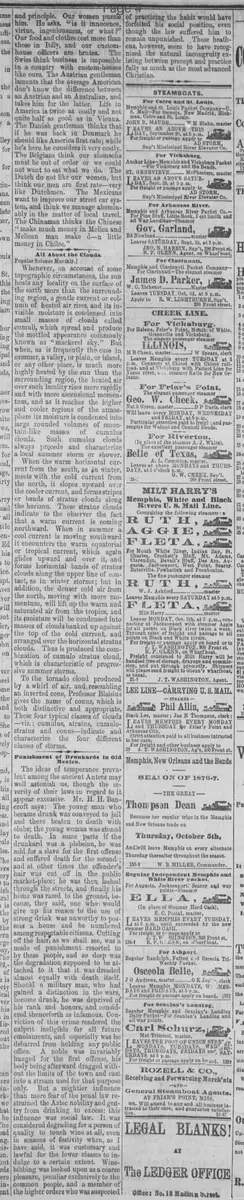
The ideas of temperance prevalent among the ancient Aztecs may well astonish us, though the severity of their laws in regard to it appear excessive. Mr. H. H. Bancroft says: The young man who became drunk was conveyed to jail and there beaten to death with clubs; the young woman was stoned to death. "In some parts if the drunkard was a plebeian, he was sold for a slave for the first offense and suffered death for the second." His hair was cut off, in the public square he was paraded through the streets, and finally his home was razed to the ground, because, they said, one who would give up his reason to the use of strong drink was unworthy to possess house and be numbered among respectable citizens. Cutting off the hair, as we shall see, was a mode of punishment resorted to by these people, and so deep was the degradation supposed to be attached to it that it was dreaded almost equally with death itself. Should a military man, who had gained a distinction in the wars, become drunk, he was deprived of his rank and honors, and considered thenceforth as infamous. Conviction of this crime rendered the culprit ineligible for all future emoluments, and especially was he debarred from holding any public office. A noble was invariably hanged for the first offense, his body being afterward dragged without the limits of the town and cast into a stream used for that purpose only. But a mightier influence than mere fear of the penal law restrained the Aztec nobility and gentry from drinking to excess; this influence was social law. It was considered degrading for a person of quality to touch wine at all, even in seasons of festivity when, as I have said, it was customary and lawful for the lower classes to indulge to a certain extent. Wine-bibbing was looked upon as a coarse pleasure, peculiar exclusively to the common people, and a member of the upper classes guilty of practicing the habit would have forfeited his social position, even though the law suffered him to remain unpunished. These heathens, however, seem to have recognized the natural incongruity existing between precept and practice fully as much as the most advanced Christian.
The ideas of temperance prevalent among the ancient Aztecs may well astonish us, though the severity of their laws in regard to it appear excessive. Mr. H. H. Bancroft says: The young man who became drunk was conveyed to jail and there beaten to death with clubs; the young woman was stoned to death. "In some parts if the drunkard was a plebeian, he was sold for a slave for the first offense and suffered death for the second." His hair was cut off, in the public square he was paraded through the streets, and finally his home was razed to the ground, because, they said, one who would give up his reason to the use of strong drink was unworthy to possess house and be numbered among respectable citizens. Cutting off the hair, as we shall see, was a mode of punishment resorted to by these people, and so deep was the degradation supposed to be attached to it that it was dreaded almost equally with death itself. Should a military man, who had gained a distinction in the wars, become drunk, he was deprived of his rank and honors, and considered thenceforth as infamous. Conviction of this crime rendered the culprit ineligible for all future emoluments, and especially was he debarred from holding any public office. A noble was invariably hanged for the first offense, his body being afterward dragged without the limits of the town and cast into a stream used for that purpose only. But a mightier influence than mere fear of the penal law restrained the Aztec nobility and gentry from drinking to excess; this influence was social law. It was considered degrading for a person of quality to touch wine at all, even in seasons of festivity when, as I have said, it was customary and lawful for the lower classes to indulge to a certain extent. Wine-bibbing was looked upon as a coarse pleasure, peculiar exclusively to the common people, and a member of the upper classes guilty of practicing the habit would have forfeited his social position, even though the law suffered him to remain unpunished. These heathens, however, seem to have recognized the natural incongruity existing between precept and practice fully as much as the most advanced Christian.
What sub-type of article is it?
Historical Event
Curiosity
Crime Story
What themes does it cover?
Crime Punishment
Moral Virtue
Social Manners
What keywords are associated?
Aztec Punishment
Drunkenness Laws
Temperance
Social Degradation
Historical Customs
Where did it happen?
Old Mexico
Story Details
Location
Old Mexico
Story Details
Ancient Aztecs enforced strict temperance laws: young men beaten to death, women stoned; plebeians enslaved then killed; public shaming, hair cutting, home destruction; military men stripped of rank; nobles hanged; social stigma prevented excess among upper classes.