Thank you for visiting SNEWPapers!
Sign up free
Story
February 3, 1939
Glacier County Chief
Browning, Glacier County, Montana
What is this article about?
Old 1869-1871 documents found in Fort Benton, Montana, reveal high pioneer-era prices like $5/gallon whisky as cheapest item, buffalo trading profits, and $50 monthly gambling licenses, donated to Mint collection by Ezra L. Crane.
Clipping
OCR Quality
98%
Excellent
Full Text
Whisky Was
One of Cheapest "Foods"
In Montana Stores
During Early 1870's
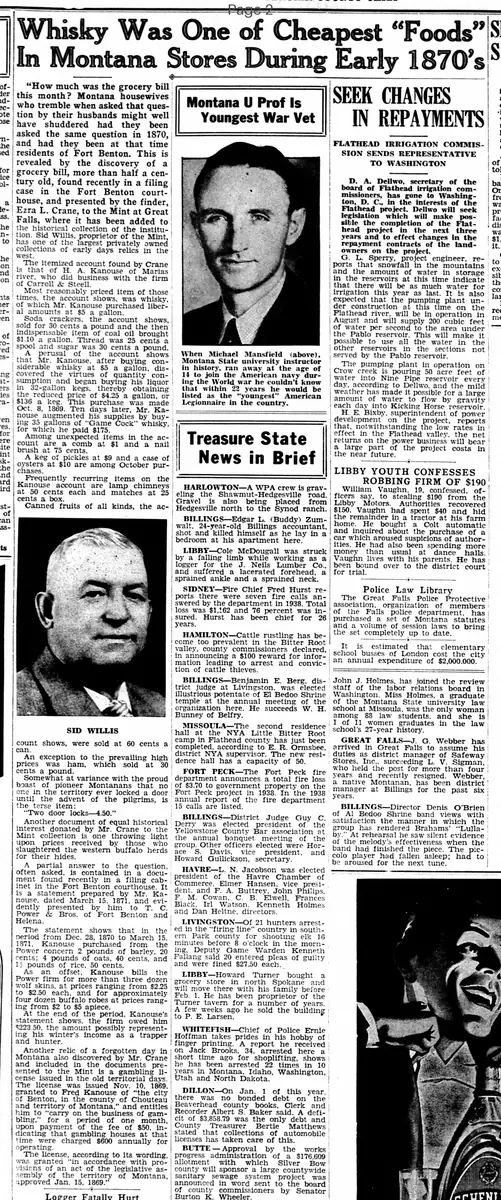
"How much was the grocery bill this month?" Montana housewives who tremble when asked that question by their husbands might well have shuddered had they been asked the same question in 1870, and had they been at that time residents of Fort Benton. This is revealed by the discovery of a grocery bill, more than half a century old, found recently in a filing case in the Fort Benton courthouse, and presented by the finder, Ezra L. Crane, to the Mint at Great Falls, where it has been added to the historical collection of the institution. Sid Willis, proprietor of the Mint, has one of the largest privately owned collections of early days relics in the west.
The itemized account found by Crane is that of H. A. Kanouse of Marias river, who did business with the firm of Carroll & Steell.
Most reasonably priced item of those times, the account shows, was whisky, of which Mr. Kanouse purchased liberal amounts at $5 a gallon.
Soda crackers, the account shows, sold for 30 cents a pound and the then indispensable item of coal oil brought $1.10 a gallon. Thread was 25 cents a spool and sugar was 30 cents a pound.
A perusal of the account shows that Mr. Kanouse, after buying considerable whisky at $5 a gallon, discovered the virtues of quantity consumption and began buying his liquor in 32-gallon kegs, thereby obtaining the reduced price of $4.25 a gallon, or $136 a keg. This purchase was made Oct. 8, 1869. Ten days later, Mr. Kanouse augmented his supplies by buying 35 gallons of "Game Cock" whisky, for which he paid $175.
Among unexpected items in the account are a comb at $1 and a nail brush at 75 cents.
A keg of pickles at $9 and a case of oysters at $10 are among October purchases.
Frequently recurring items on the Kanouse account are lamp chimneys at 50 cents each and matches at 25 cents a box.
Canned fruits of all kinds, the count shows, were sold at 60 cents a can.
An exception to the prevailing high prices was ham, which sold at 30 cents a pound.
Somewhat at variance with the proud boast of pioneer Montanans that no one in the territory ever locked a door until the advent of the pilgrims, is the terse item:
"Two door locks—$4.50."
Another document of equal historical interest donated by Mr. Crane to the Mint collection is one throwing light upon prices received by those who slaughtered the western buffalo herds for their hides.
A partial answer to the question, often asked, is contained in a document found recently in a filing cabinet in the Fort Benton courthouse. It is a statement prepared by Mr. Kanouse, dated March 15, 1871, and evidently presented by him to T. C. Power & Bros. of Fort Benton and Helena.
The statement shows that in the period from Dec. 28, 1870 to March 15, 1871, Kanouse purchased from the Power concern 2 pounds of barley, 20 cents; 4 pounds of oats, 40 cents, and 1 pound of rice, 50 cents.
As an offset, Kanouse bills the Power firm for more than three dozen wolf skins, at prices ranging from $2.25 to $2.50 each, and for approximately four dozen buffalo robes at prices ranging from $2 to $5 apiece.
At the end of the period, Kanouse's statement shows, the firm owed him $223.50, the amount possibly representing his winter's income as a trapper and hunter.
Another relic of a forgotten day in Montana also discovered by Mr. Crane and included in the documents presented to the Mint is a gambling license issued in the old territorial days.
The license was issued Nov. 10, 1869, granted to Fred Kanouse of "the city of Benton, in the county of Chouteau and territory of Montana," and entitles him to "carry on the business of gambling," for a period of one month, upon payment of the fee of $50, indicating that gambling houses at that time were charged $600 annually for operating.
The license, according to its wording, was granted "in accordance with provisions of an act of the legislative assembly of the territory of Montana, approved Jan. 15, 1869."
One of Cheapest "Foods"
In Montana Stores
During Early 1870's
"How much was the grocery bill this month?" Montana housewives who tremble when asked that question by their husbands might well have shuddered had they been asked the same question in 1870, and had they been at that time residents of Fort Benton. This is revealed by the discovery of a grocery bill, more than half a century old, found recently in a filing case in the Fort Benton courthouse, and presented by the finder, Ezra L. Crane, to the Mint at Great Falls, where it has been added to the historical collection of the institution. Sid Willis, proprietor of the Mint, has one of the largest privately owned collections of early days relics in the west.
The itemized account found by Crane is that of H. A. Kanouse of Marias river, who did business with the firm of Carroll & Steell.
Most reasonably priced item of those times, the account shows, was whisky, of which Mr. Kanouse purchased liberal amounts at $5 a gallon.
Soda crackers, the account shows, sold for 30 cents a pound and the then indispensable item of coal oil brought $1.10 a gallon. Thread was 25 cents a spool and sugar was 30 cents a pound.
A perusal of the account shows that Mr. Kanouse, after buying considerable whisky at $5 a gallon, discovered the virtues of quantity consumption and began buying his liquor in 32-gallon kegs, thereby obtaining the reduced price of $4.25 a gallon, or $136 a keg. This purchase was made Oct. 8, 1869. Ten days later, Mr. Kanouse augmented his supplies by buying 35 gallons of "Game Cock" whisky, for which he paid $175.
Among unexpected items in the account are a comb at $1 and a nail brush at 75 cents.
A keg of pickles at $9 and a case of oysters at $10 are among October purchases.
Frequently recurring items on the Kanouse account are lamp chimneys at 50 cents each and matches at 25 cents a box.
Canned fruits of all kinds, the count shows, were sold at 60 cents a can.
An exception to the prevailing high prices was ham, which sold at 30 cents a pound.
Somewhat at variance with the proud boast of pioneer Montanans that no one in the territory ever locked a door until the advent of the pilgrims, is the terse item:
"Two door locks—$4.50."
Another document of equal historical interest donated by Mr. Crane to the Mint collection is one throwing light upon prices received by those who slaughtered the western buffalo herds for their hides.
A partial answer to the question, often asked, is contained in a document found recently in a filing cabinet in the Fort Benton courthouse. It is a statement prepared by Mr. Kanouse, dated March 15, 1871, and evidently presented by him to T. C. Power & Bros. of Fort Benton and Helena.
The statement shows that in the period from Dec. 28, 1870 to March 15, 1871, Kanouse purchased from the Power concern 2 pounds of barley, 20 cents; 4 pounds of oats, 40 cents, and 1 pound of rice, 50 cents.
As an offset, Kanouse bills the Power firm for more than three dozen wolf skins, at prices ranging from $2.25 to $2.50 each, and for approximately four dozen buffalo robes at prices ranging from $2 to $5 apiece.
At the end of the period, Kanouse's statement shows, the firm owed him $223.50, the amount possibly representing his winter's income as a trapper and hunter.
Another relic of a forgotten day in Montana also discovered by Mr. Crane and included in the documents presented to the Mint is a gambling license issued in the old territorial days.
The license was issued Nov. 10, 1869, granted to Fred Kanouse of "the city of Benton, in the county of Chouteau and territory of Montana," and entitles him to "carry on the business of gambling," for a period of one month, upon payment of the fee of $50, indicating that gambling houses at that time were charged $600 annually for operating.
The license, according to its wording, was granted "in accordance with provisions of an act of the legislative assembly of the territory of Montana, approved Jan. 15, 1869."
What sub-type of article is it?
Curiosity
Historical Event
What themes does it cover?
Social Manners
What keywords are associated?
Grocery Prices
Historical Documents
Montana History
Buffalo Robes
Gambling License
Wolf Skins
What entities or persons were involved?
Ezra L. Crane
H. A. Kanouse
Sid Willis
Fred Kanouse
T. C. Power & Bros.
Carroll & Steell
Where did it happen?
Fort Benton, Montana
Story Details
Key Persons
Ezra L. Crane
H. A. Kanouse
Sid Willis
Fred Kanouse
T. C. Power & Bros.
Carroll & Steell
Location
Fort Benton, Montana
Event Date
1869 1871
Story Details
Discovery of old documents in Fort Benton courthouse revealing high grocery prices in 1870s Montana, including cheap whisky at $5/gallon; a trading statement for wolf skins and buffalo robes netting $223.50; and a $50 monthly gambling license issued in 1869.