Thank you for visiting SNEWPapers!
Sign up free
Editorial
April 26, 1819
Alexandria Gazette & Daily Advertiser
Alexandria, Virginia
What is this article about?
Editorial from Alexandria, April 26, 1819, condemns duelling as an irredeemable crime, rejecting regulation as a solution. Argues it unjustly equates lives of virtue and vice, using analogies to adultery and poison, and recounts an anecdote involving Lord Longford to highlight its absurdity.
Clipping
OCR Quality
95%
Excellent
Full Text
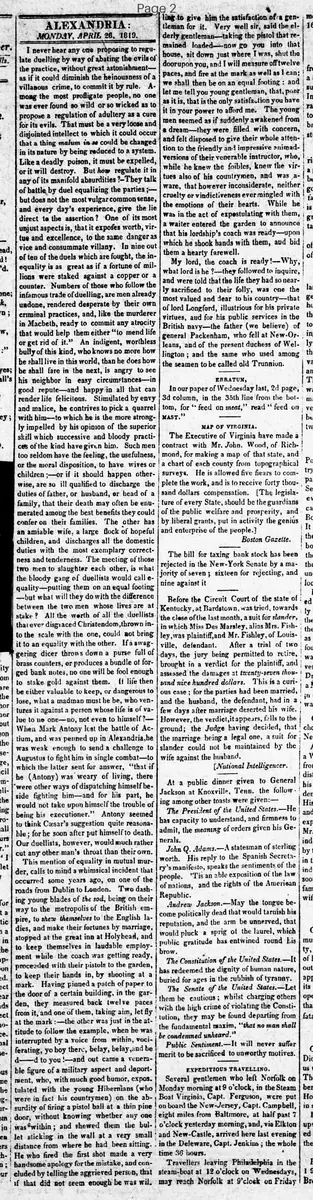
ALEXANDRIA:
MONDAY, APRIL 26, 1819.
I never hear any one proposing to regulate duelling by way of abating the evils of the practice, without great astonishment—as if it could diminish the heinousness of a villanous crime, to commit it by rule. Among the most profligate people, no one was ever found so wild or so wicked as to propose a regulation of adultery as a cure for its evils. That must be a very loose and disjointed intellect to which it could occur that a thing malum in se could be changed in its nature by being reduced to a system. Like a deadly poison, it must be expelled, or it will destroy. But how regulate it in any of its manifold absurdities? They talk of battle by duel equalizing the parties; but does not the most vulgar common sense, and every day's experience, give the lie direct to the assertion? One of its most unjust aspects is, that it exposes worth, virtue and excellence, to the same danger as vice and consummate villany. In nine out of ten of the duels which are fought, the inequality is as great as if a fortune of millions were staked against a copper or a counter. Numbers of those who follow the infamous trade of duelling, are men already undone, rendered desperate by their own criminal practices, and, like the murderer in Macbeth, ready to commit any atrocity that would help them either "to mend life or get rid of it." An indigent, worthless bully of this kind, who knows no more how he shall live in this world, than he does how he shall fare in the next, is angry to see his neighbor in easy circumstances—in good repute—and happy in all that can render life felicitous. Stimulated by envy and malice, he contrives to pick a quarrel with him—to which he is the more strongly impelled by his opinion of the superior skill which successive and bloody practices of the kind have given him. Such men too seldom have the feeling, the usefulness, or the moral disposition, to have wives or children;—or if it should happen otherwise, are so ill qualified to discharge the duties of father, or husband, or head of a family, that their death may often be enumerated among the best benefits they could confer on their families. The other has an amiable wife, a large flock of hopeful children, and discharges all the domestic duties with the most exemplary correctness and tenderness. The meeting of those two men to slaughter each other, is what the bloody gang of duellists would call equality—putting them on an equal footing—but what will they do with the difference between the two men whose lives are at stake? All the worth of all the duellists that ever disgraced Christendom, thrown into the scale with the one, could not bring it to an equality with the other. If a swaggering dicer throws down a purse full of brass counters, or produces a bundle of forged bank notes, no one will be fool enough to stake gold against them. If life then be either valuable to keep, or dangerous to lose, what a madman must he be, who ventures it against a person whose life is of value to no one—no, not even to himself?—
When Mark Antony lost the battle of Actium, and was penned up in Alexandria, he was weak enough to send a challenge to Augustus to fight him in single combat—to which the latter sent for answer, "that if he (Antony) was weary of living, there were other ways of dispatching himself beside fighting him—and on his part, he would not take upon himself the trouble of being his executioner." Antony seemed to think Caesar's suggestion quite reasonable; for he soon after put himself to death. Our duellists, however, would much rather cut any other man's throat than their own.
This mention of equality in mutual murder, calls to mind a whimsical incident that occurred some years ago, on one of the roads from Dublin to London. Two dashing young blades of the sod, being on their way to the metropolis of the British empire, to shew themselves to the English ladies, and make their fortunes by marriage, stopped at the great inn at Holyhead, and to keep themselves in laudable employment while the coach was getting ready, proceeded with their pistols to the garden, to keep their hands in, by shooting at a mark. Having pinned a patch of paper to the door of a certain building, in the garden, they measured back twelve paces from it, and one of them, taking aim, let fly at the mark:—the other was just in the attitude to follow the example, when he was interrupted by a voice from within, vociferating, "you boy there, belay, belay, and be d---d to you!"—and out came a venerable figure of a military aspect and deportment, who, with much good humor, expostulated with the young Hibernians (who were in fact his countrymen) on the absurdity of firing a pistol ball at a thin pine door, without knowing whether any one was within; and shewed them the bullet sticking in the wall at a very small distance from where he had been sitting. He who fired the first shot made a very handsome apology for the mistake, and concluded by telling the aggrieved person, that if that did not seem enough he was willing to give him the satisfaction of a gentleman for it. Very well sir, said the elderly gentleman—taking the pistol that remained loaded—now go you into that house, sit down just where I was, shut the door upon you, and I will measure off twelve paces, and fire at the mark as well as I can; we shall then be on an equal footing: and let me tell you young gentleman, that, poor as it is, that is the only satisfaction you have it in your power to afford me. The young men seemed as if suddenly awakened from a dream—they were filled with concern, and felt disposed to give their whole attention to the friendly and impressive animadversions of their venerable instructor, who, while he knew the foibles, knew the virtues also of his countrymen, and was aware, that however inconsiderate, neither cruelty or vindictiveness ever mingled with the emotions of their hearts. While he was in the act of expostulating with them, a waiter entered the garden to announce that his lordship's coach was ready—upon which he shook hands with them, and bid them a hearty farewell.
My lord, the coach is ready!—Why, what lord is he?—they followed to inquire, and were told that the life they had so nearly sacrificed to their folly, was one the most valued and dear to his country—that of lord Longford, illustrious for his private virtues, and for his public services in the British navy—the father (we believe) of general Pakenham, who fell at New-Orleans, and of the present duchess of Wellington; and the same who used among the seamen to be called old Trunnion.
MONDAY, APRIL 26, 1819.
I never hear any one proposing to regulate duelling by way of abating the evils of the practice, without great astonishment—as if it could diminish the heinousness of a villanous crime, to commit it by rule. Among the most profligate people, no one was ever found so wild or so wicked as to propose a regulation of adultery as a cure for its evils. That must be a very loose and disjointed intellect to which it could occur that a thing malum in se could be changed in its nature by being reduced to a system. Like a deadly poison, it must be expelled, or it will destroy. But how regulate it in any of its manifold absurdities? They talk of battle by duel equalizing the parties; but does not the most vulgar common sense, and every day's experience, give the lie direct to the assertion? One of its most unjust aspects is, that it exposes worth, virtue and excellence, to the same danger as vice and consummate villany. In nine out of ten of the duels which are fought, the inequality is as great as if a fortune of millions were staked against a copper or a counter. Numbers of those who follow the infamous trade of duelling, are men already undone, rendered desperate by their own criminal practices, and, like the murderer in Macbeth, ready to commit any atrocity that would help them either "to mend life or get rid of it." An indigent, worthless bully of this kind, who knows no more how he shall live in this world, than he does how he shall fare in the next, is angry to see his neighbor in easy circumstances—in good repute—and happy in all that can render life felicitous. Stimulated by envy and malice, he contrives to pick a quarrel with him—to which he is the more strongly impelled by his opinion of the superior skill which successive and bloody practices of the kind have given him. Such men too seldom have the feeling, the usefulness, or the moral disposition, to have wives or children;—or if it should happen otherwise, are so ill qualified to discharge the duties of father, or husband, or head of a family, that their death may often be enumerated among the best benefits they could confer on their families. The other has an amiable wife, a large flock of hopeful children, and discharges all the domestic duties with the most exemplary correctness and tenderness. The meeting of those two men to slaughter each other, is what the bloody gang of duellists would call equality—putting them on an equal footing—but what will they do with the difference between the two men whose lives are at stake? All the worth of all the duellists that ever disgraced Christendom, thrown into the scale with the one, could not bring it to an equality with the other. If a swaggering dicer throws down a purse full of brass counters, or produces a bundle of forged bank notes, no one will be fool enough to stake gold against them. If life then be either valuable to keep, or dangerous to lose, what a madman must he be, who ventures it against a person whose life is of value to no one—no, not even to himself?—
When Mark Antony lost the battle of Actium, and was penned up in Alexandria, he was weak enough to send a challenge to Augustus to fight him in single combat—to which the latter sent for answer, "that if he (Antony) was weary of living, there were other ways of dispatching himself beside fighting him—and on his part, he would not take upon himself the trouble of being his executioner." Antony seemed to think Caesar's suggestion quite reasonable; for he soon after put himself to death. Our duellists, however, would much rather cut any other man's throat than their own.
This mention of equality in mutual murder, calls to mind a whimsical incident that occurred some years ago, on one of the roads from Dublin to London. Two dashing young blades of the sod, being on their way to the metropolis of the British empire, to shew themselves to the English ladies, and make their fortunes by marriage, stopped at the great inn at Holyhead, and to keep themselves in laudable employment while the coach was getting ready, proceeded with their pistols to the garden, to keep their hands in, by shooting at a mark. Having pinned a patch of paper to the door of a certain building, in the garden, they measured back twelve paces from it, and one of them, taking aim, let fly at the mark:—the other was just in the attitude to follow the example, when he was interrupted by a voice from within, vociferating, "you boy there, belay, belay, and be d---d to you!"—and out came a venerable figure of a military aspect and deportment, who, with much good humor, expostulated with the young Hibernians (who were in fact his countrymen) on the absurdity of firing a pistol ball at a thin pine door, without knowing whether any one was within; and shewed them the bullet sticking in the wall at a very small distance from where he had been sitting. He who fired the first shot made a very handsome apology for the mistake, and concluded by telling the aggrieved person, that if that did not seem enough he was willing to give him the satisfaction of a gentleman for it. Very well sir, said the elderly gentleman—taking the pistol that remained loaded—now go you into that house, sit down just where I was, shut the door upon you, and I will measure off twelve paces, and fire at the mark as well as I can; we shall then be on an equal footing: and let me tell you young gentleman, that, poor as it is, that is the only satisfaction you have it in your power to afford me. The young men seemed as if suddenly awakened from a dream—they were filled with concern, and felt disposed to give their whole attention to the friendly and impressive animadversions of their venerable instructor, who, while he knew the foibles, knew the virtues also of his countrymen, and was aware, that however inconsiderate, neither cruelty or vindictiveness ever mingled with the emotions of their hearts. While he was in the act of expostulating with them, a waiter entered the garden to announce that his lordship's coach was ready—upon which he shook hands with them, and bid them a hearty farewell.
My lord, the coach is ready!—Why, what lord is he?—they followed to inquire, and were told that the life they had so nearly sacrificed to their folly, was one the most valued and dear to his country—that of lord Longford, illustrious for his private virtues, and for his public services in the British navy—the father (we believe) of general Pakenham, who fell at New-Orleans, and of the present duchess of Wellington; and the same who used among the seamen to be called old Trunnion.
What sub-type of article is it?
Crime Or Punishment
Moral Or Religious
Social Reform
What keywords are associated?
Duelling
Moral Reform
Equality In Combat
Lord Longford
Crime Regulation
Vice And Virtue
What entities or persons were involved?
Lord Longford
Mark Antony
Augustus
General Pakenham
Duchess Of Wellington
Editorial Details
Primary Topic
Opposition To Duelling And Its Regulation
Stance / Tone
Strong Moral Condemnation
Key Figures
Lord Longford
Mark Antony
Augustus
General Pakenham
Duchess Of Wellington
Key Arguments
Regulating Duelling Cannot Reduce Its Evils, As It Is A Heinous Crime Like Adultery Or Poison.
Duelling Falsely Claims To Equalize Parties But Exposes Virtuous Lives To Desperate Villains.
Many Duellists Are Worthless Bullies Driven By Envy, Whose Deaths Benefit Society.
Historical Example: Antony's Challenge Rejected By Augustus As Unnecessary Suicide.
Anecdote Of Young Irishmen Nearly Shooting Lord Longford, Who Teaches Them The Absurdity Of 'Equality' In Duelling.