Thank you for visiting SNEWPapers!
Sign up free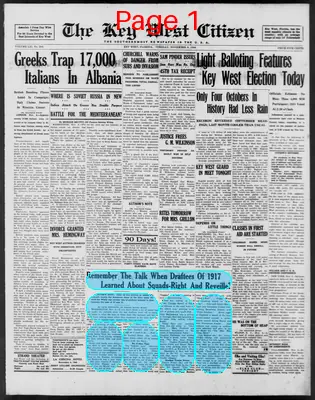
Story
November 5, 1940
The Key West Citizen
Key West, Monroe County, Florida
What is this article about?
Jack Stinnett's nostalgic article recalls the American scene in summer and fall 1917, as WWI draftees entered camps, covering World Series victory, stock market plunge, Russian Revolution, cultural trends in fashion, music, film, theater, and military shortages.
Clipping
OCR Quality
98%
Excellent
Full Text
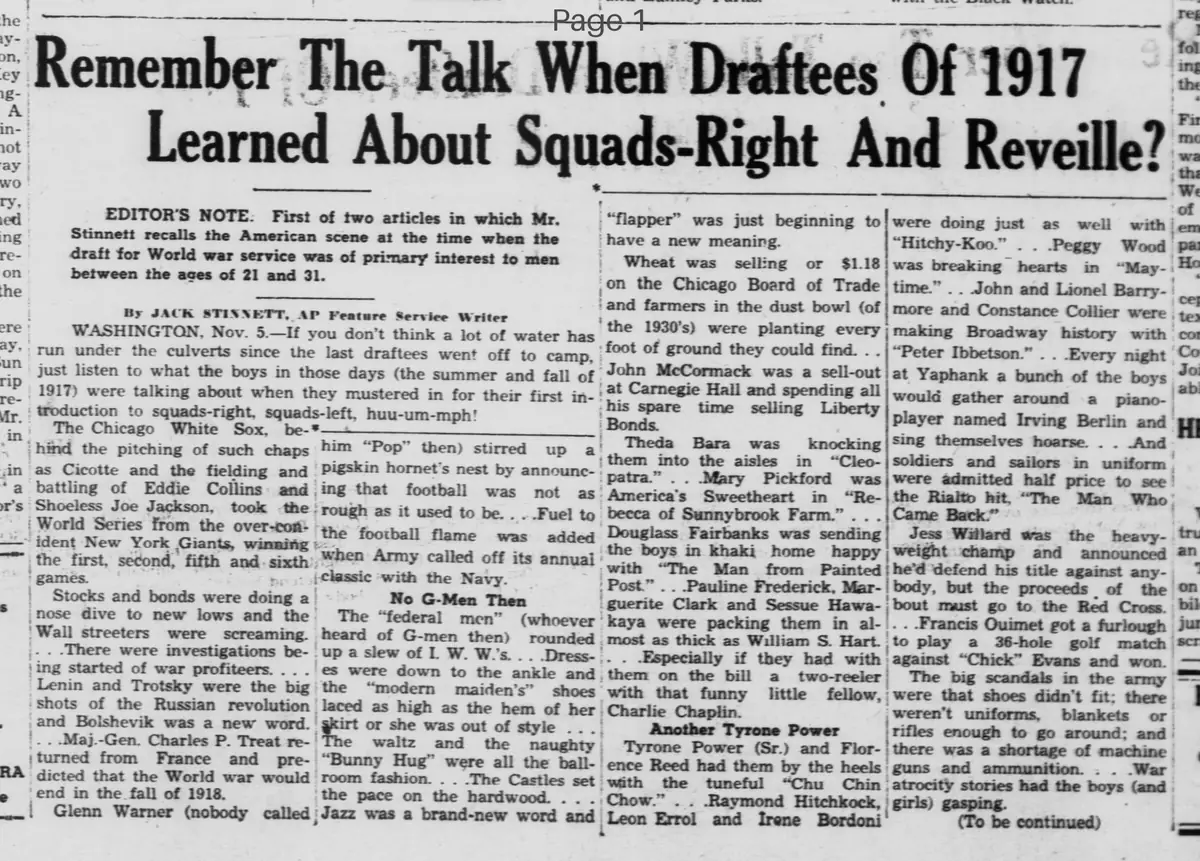
Remember The Talk When Draftees Of 1917 Learned About Squads-Right And Reveille?
EDITOR'S NOTE. First of two articles in which Mr. Stinnett recalls the American scene at the time when the draft for World war service was of primary interest to men between the ages of 21 and 31.
By JACK STINNETT, AP Feature Service Writer
WASHINGTON, Nov. 5.-If you don't think a lot of water has run under the culverts since the last draftees went off to camp, just listen to what the boys in those days (the summer and fall of 1917) were talking about when they mustered in for their first introduction to squads-right, squads-left, huu-um-mph!
The Chicago White Sox, behind the pitching of such chaps as Cicotte and the fielding and battling of Eddie Collins and Shoeless Joe Jackson, took the World Series from the over-confident New York Giants, winning the first, second, fifth and sixth games.
Stocks and bonds were doing a nose dive to new lows and the Wall Streeters were screaming.
...There were investigations being started of war profiteers. . . .
Lenin and Trotsky were the big shots of the Russian revolution and Bolshevik was a new word.
... Maj.-Gen. Charles P. Treat returned from France and predicted that the World war would end in the fall of 1918.
Glenn Warner (nobody called him "Pop" then) stirred up a pigskin hornet's nest by announcing that football was not as rough as it used to be. . . . Fuel to the football flame was added when Army called off its annual classic with the Navy.
No G.Men Then
The "federal men (whoever heard of G-men then) rounded up a slew of I. W. W.'s. . . . Dresses were down to the ankle and the modern maiden's shoes laced as high as the hem of her skirt or she was out of style . . .
The waltz and the naughty "Bunny Hug" were all the ball-room fashion. . . . The Castles set the pace on the hardwood. . .
Jazz was a brand-new word and "flapper" was just beginning to have a new meaning.
Wheat was selling at $1.18 on the Chicago Board of Trade and farmers in the dust bowl (of the 1930's) were planting every foot of ground they could find. . .
John McCormack was a sell-out at Carnegie Hall and spending all his spare time selling Liberty Bonds.
Theda Bara was knocking them into the aisles in "Cleopatra." . . . Mary Pickford was America's Sweetheart in "Rebecca of Sunnybrook Farm."
Douglas Fairbanks was sending the boys in khaki home happy with "The Man from Painted Post ". Pauline Frederick, Marguerite Clark and Sessue Hayakawa were packing them in almost as thick as William S. Hart.
Especially if they had with them on the bill a two-reeler with that funny little fellow, Charlie Chaplin.
Another Tyrone Power
Tyrone Power (Sr.) and Florence Reed had them by the heels with the tuneful "Chu Chin Chow.". . . Raymond Hitchcock, Leon Errol and Irene Bordoni were doing just as well with "Hitchy-Koo." . . . Peggy Wood was breaking hearts in "Maytime."...
John and Lionel Barrymore and Constance Collier were making Broadway history with "Peter Ibbetson.
...Every night at Yaphank a bunch of the boys would gather around a piano-player named Irving Berlin and sing themselves hoarse. . . And soldiers and sailors in uniform were admitted half price to see the Rialto hit, The Man Who Came Back."
Jess Willard was the heavy-weight champ and announced he'd defend his title against anybody, but the proceeds of the bout must go to the Red Cross.
...Francis Ouimet got a furlough to play a 36-hole golf match against "Chick" Evans and won.
The big scandals in the army were that shoes didn't fit: there weren't uniforms, blankets or rifles enough to go around; and there was a shortage of machine guns and ammunition. . . . War atrocity stories had the boys (and girls) gasping.
(To be continued)
EDITOR'S NOTE. First of two articles in which Mr. Stinnett recalls the American scene at the time when the draft for World war service was of primary interest to men between the ages of 21 and 31.
By JACK STINNETT, AP Feature Service Writer
WASHINGTON, Nov. 5.-If you don't think a lot of water has run under the culverts since the last draftees went off to camp, just listen to what the boys in those days (the summer and fall of 1917) were talking about when they mustered in for their first introduction to squads-right, squads-left, huu-um-mph!
The Chicago White Sox, behind the pitching of such chaps as Cicotte and the fielding and battling of Eddie Collins and Shoeless Joe Jackson, took the World Series from the over-confident New York Giants, winning the first, second, fifth and sixth games.
Stocks and bonds were doing a nose dive to new lows and the Wall Streeters were screaming.
...There were investigations being started of war profiteers. . . .
Lenin and Trotsky were the big shots of the Russian revolution and Bolshevik was a new word.
... Maj.-Gen. Charles P. Treat returned from France and predicted that the World war would end in the fall of 1918.
Glenn Warner (nobody called him "Pop" then) stirred up a pigskin hornet's nest by announcing that football was not as rough as it used to be. . . . Fuel to the football flame was added when Army called off its annual classic with the Navy.
No G.Men Then
The "federal men (whoever heard of G-men then) rounded up a slew of I. W. W.'s. . . . Dresses were down to the ankle and the modern maiden's shoes laced as high as the hem of her skirt or she was out of style . . .
The waltz and the naughty "Bunny Hug" were all the ball-room fashion. . . . The Castles set the pace on the hardwood. . .
Jazz was a brand-new word and "flapper" was just beginning to have a new meaning.
Wheat was selling at $1.18 on the Chicago Board of Trade and farmers in the dust bowl (of the 1930's) were planting every foot of ground they could find. . .
John McCormack was a sell-out at Carnegie Hall and spending all his spare time selling Liberty Bonds.
Theda Bara was knocking them into the aisles in "Cleopatra." . . . Mary Pickford was America's Sweetheart in "Rebecca of Sunnybrook Farm."
Douglas Fairbanks was sending the boys in khaki home happy with "The Man from Painted Post ". Pauline Frederick, Marguerite Clark and Sessue Hayakawa were packing them in almost as thick as William S. Hart.
Especially if they had with them on the bill a two-reeler with that funny little fellow, Charlie Chaplin.
Another Tyrone Power
Tyrone Power (Sr.) and Florence Reed had them by the heels with the tuneful "Chu Chin Chow.". . . Raymond Hitchcock, Leon Errol and Irene Bordoni were doing just as well with "Hitchy-Koo." . . . Peggy Wood was breaking hearts in "Maytime."...
John and Lionel Barrymore and Constance Collier were making Broadway history with "Peter Ibbetson.
...Every night at Yaphank a bunch of the boys would gather around a piano-player named Irving Berlin and sing themselves hoarse. . . And soldiers and sailors in uniform were admitted half price to see the Rialto hit, The Man Who Came Back."
Jess Willard was the heavy-weight champ and announced he'd defend his title against anybody, but the proceeds of the bout must go to the Red Cross.
...Francis Ouimet got a furlough to play a 36-hole golf match against "Chick" Evans and won.
The big scandals in the army were that shoes didn't fit: there weren't uniforms, blankets or rifles enough to go around; and there was a shortage of machine guns and ammunition. . . . War atrocity stories had the boys (and girls) gasping.
(To be continued)
What sub-type of article is it?
Historical Event
Curiosity
What themes does it cover?
Social Manners
Misfortune
What keywords are associated?
World War I Draft
1917 Culture
World Series
Russian Revolution
Silent Films
Broadway Shows
Military Shortages
What entities or persons were involved?
Jack Stinnett
Lenin
Trotsky
Maj. Gen. Charles P. Treat
Glenn Warner
John Mccormack
Theda Bara
Mary Pickford
Douglas Fairbanks
Charlie Chaplin
Irving Berlin
Jess Willard
Where did it happen?
United States
Story Details
Key Persons
Jack Stinnett
Lenin
Trotsky
Maj. Gen. Charles P. Treat
Glenn Warner
John Mccormack
Theda Bara
Mary Pickford
Douglas Fairbanks
Charlie Chaplin
Irving Berlin
Jess Willard
Location
United States
Event Date
Summer And Fall Of 1917
Story Details
Recollection of 1917 news and culture including World Series win, economic downturn, Russian Revolution, fashion trends, popular films and theater, and WWI draft challenges.