Thank you for visiting SNEWPapers!
Sign up free
The Hillsborough Recorder
Hillsboro, Orange County, North Carolina
What is this article about?
Confederate commentary explains Gen. Lovell's retreat in New Orleans upon Union gunboats passing Forts Jackson and St. Phillip, citing the city's vulnerability to naval bombardment. Compares to Gen. Jackson's 1815 victory and predicts similar fates for Mobile and other seaports, emphasizing need for iron-clads.
Clipping
OCR Quality
Full Text
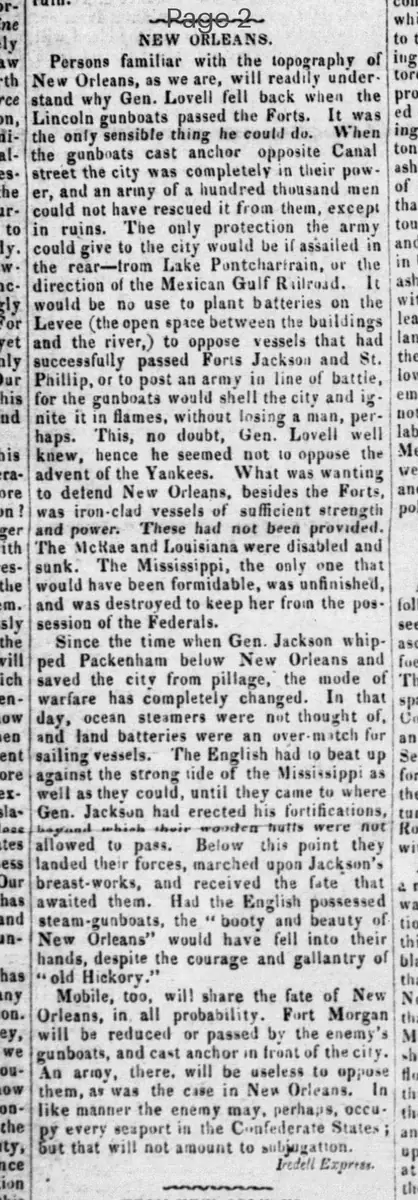
Persons familiar with the topography of New Orleans, as we are, will readily understand why Gen. Lovell fell back when the Lincoln gunboats passed the Forts. It was the only sensible thing he could do. When the gunboats cast anchor opposite Canal street the city was completely in their power, and an army of a hundred thousand men could not have rescued it from them, except in ruins. The only protection the army could give to the city would be if assailed in the rear from Lake Pontchartrain, or the direction of the Mexican Gulf Railroad. It would be no use to plant batteries on the Levee (the open space between the buildings and the river,) to oppose vessels that had successfully passed Forts Jackson and St. Phillip, or to post an army in line of battle, for the gunboats would shell the city and ignite it in flames, without losing a man, perhaps. This, no doubt, Gen. Lovell well knew, hence he seemed not to oppose the advent of the Yankees. What was wanting to defend New Orleans, besides the Forts, was iron-clad vessels of sufficient strength and power. These had not been provided. The McRae and Louisiana were disabled and sunk. The Mississippi, the only one that would have been formidable, was unfinished, and was destroyed to keep her from the possession of the Federals.
Since the time when Gen. Jackson whipped Packenham below New Orleans and saved the city from pillage, the mode of warfare has completely changed. In that day, ocean steamers were not thought of, and land batteries were an over-match for sailing vessels. The English had to beat up against the strong tide of the Mississippi as well as they could, until they came to where Gen. Jackson had erected his fortifications, beyond which their wooden hulls were not allowed to pass. Below this point they landed their forces, marched upon Jackson's breast-works, and received the fate that awaited them. Had the English possessed steam-gunboats, the 'booty and beauty of New Orleans' would have fell into their hands, despite the courage and gallantry of 'old Hickory.'
Mobile, too, will share the fate of New Orleans, in all probability. Fort Morgan will be reduced or passed by the enemy's gunboats, and cast anchor in front of the city. An army, there, will be useless to oppose them, as was the case in New Orleans. In like manner the enemy may, perhaps, occupy every seaport in the Confederate States; but that will not amount to subjugation.
Iredell Express.
What sub-type of article is it?
What keywords are associated?
What entities or persons were involved?
Where did it happen?
Domestic News Details
Primary Location
New Orleans
Key Persons
Outcome
city in power of gunboats; mcrae and louisiana disabled and sunk; mississippi unfinished and destroyed.
Event Details
Gen. Lovell fell back as Lincoln gunboats passed Forts Jackson and St. Phillip, leaving New Orleans vulnerable to shelling; iron-clads lacking; historical comparison to Gen. Jackson's defense; predictions for Mobile and other seaports.