Thank you for visiting SNEWPapers!
Sign up free
Daily National Intelligencer
Washington, District Of Columbia
What is this article about?
An article from the Buenos-Ayres Gazette justifies the independence struggle of the United Provinces of the South against Spain, citing events from the French invasion of Spain in 1810 to the proclamation of independence on July 9, 1816, emphasizing self-defense and rejection of Spanish reconquest attempts.
Clipping
OCR Quality
Full Text
From the Buenos-Ayres Gazette.
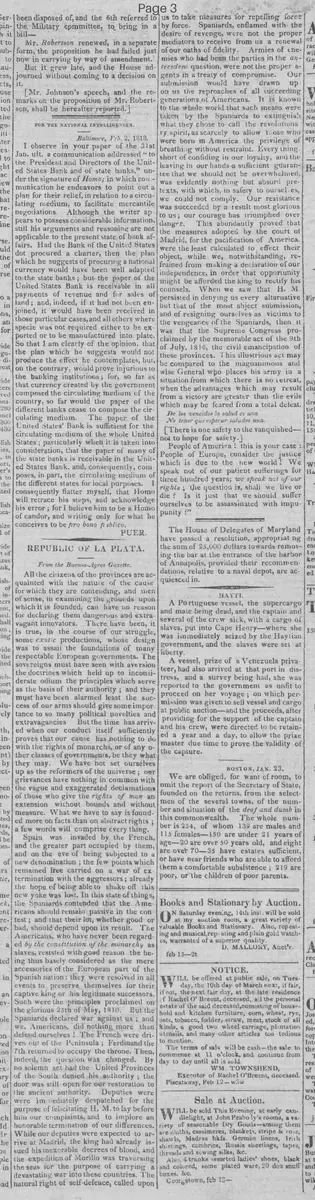
All the citizens of the provinces are acquainted with the nature of the cause for which they are contending, and men of sense, in examining the grounds upon which it is founded, can have no reason for declaring them dangerous and extravagant innovators. There have been, it is true, in the course of our struggle, some exotic productions, whose design was to assail the foundations of many respectable European governments. The sovereigns must have seen with aversion the doctrines which held up to inconsiderate odium the principles which serve as the basis of their authority; and they must have been alarmed least the success of our arms should give some importance to so many political novelties and extravagancies. But the time has arrived when our conduct itself sufficiently proves that our cause has nothing to do with the rights of monarchs, or of any other classes of governments, be they what they may. We have not set ourselves up as the reformers of the universe; our grievances have nothing in common with the vague and exaggerated declamations of those who give the rights of man an extension without bounds and without measure. What we have to say is founded more on facts than on abstract rights; a few words will comprise every thing.
Spain was invaded by the French, and the greater part occupied by them, and on the eve of being subjected to a new denomination; the few points which remained free carried on a war of extermination with the aggressors; already the hope of being able to shake off this new yoke was lost. In this state of things, the Spaniards contended that the Americans should remain passive in the contest; and that their lot, whether good or bad, should depend upon its result. The Americans, who have never been regarded by the constitution of the monarchy as slaves, resisted with good reason the being thus basely considered as the mere accessories of the European part of the Spanish nation: they were resolved in all events to preserve themselves for their captive king or his legitimate successors. Such were the principles proclaimed on the glorious 25th of May, 1810. But the Spaniards declared war against us; and we, Americans, did nothing more than defend ourselves! The French were driven out of the Peninsula; Ferdinand the 7th returned to occupy the throne. Then, indeed, the question was changed. By no solemn act had the United Provinces of the South denied his authority; the door was still open for our restoration to the ancient authority. Deputies were immediately despatched for the purpose of felicitating H. M. to lay before him our complaints, and to implore an honorable termination of our differences. While our deputies were expected to arrive at Madrid, the king had already issued his inexorable decrees of blood, and the expedition of Morillo was traversing the seas for the purpose of carrying a devastating war into these countries. The natural right of self-defence, called upon us to take measures for repelling force by force. Spaniards, enflamed with the desire of revenge, were not the proper mediators to receive from us a renewal of our oaths of fidelity. Armies of enemies who had been the parties in the antecedent question, were not the proper agents in a treaty of compromise. Our submission would have drawn upon us the reproaches of all succeeding generations of Americans. It is known to the whole world that such means were taken by the Spaniards to extinguish what they chose to call the revolutionary spirit, as scarcely to allow those who were born in America the privilege of breathing without restraint. Every thing, short of confiding in our loyalty, and the leaving in our hands a sufficient guarantee that we should not be overwhelmed, was evidently nothing but absurd pretexts, with which, in safety to ourselves, we could not comply. Our resistance was succeeded by a result most glorious to us; our courage has triumphed over danger. This abundantly proved that the measures adopted by the court of Madrid, for the pacification of America, were the least calculated to effect their object, while we, notwithstanding, refrained from making a declaration of our independence, in order that opportunity might be afforded the king to rectify his counsels. When we saw that H. M. persisted in denying us every alternative but that of the most abject submission, and of resigning ourselves as victims to the vengeance of the Spaniards, then it was that the Supreme Congress proclaimed by the memorable act of the 9th of July, 1816, the civil emancipation of these provinces. This illustrious act may be compared to the magnanimous and wise General who places his army in a situation from which there is no retreat, when the advantages which may result from a victory are greater than the evils which may be feared from a total defeat.
De los vencidos la salud es una
No tenor que esperar salud.
There is one safety to the vanquished—not to hope for safety.
People of America! this is your case: People of Europe, consider the justice which is due to the new world! We speak not of our patient sufferings for three hundred years; we speak not of our rights; the question is, shall we live or die? Is it just that we should suffer ourselves to be assassinated with impunity?
What sub-type of article is it?
What keywords are associated?
What entities or persons were involved?
Where did it happen?
Foreign News Details
Primary Location
Republic Of La Plata
Event Date
9th Of July, 1816
Key Persons
Outcome
proclamation of civil emancipation by the supreme congress; triumph over danger through resistance.
Event Details
The article defends the independence movement, recounting Spanish demands for passivity during French invasion, the May 25, 1810 proclamation, Spanish war declaration, failed diplomacy, and the July 9, 1816 independence act after rejecting abject submission.