Thank you for visiting SNEWPapers!
Sign up free
Editorial
October 19, 1793
National Gazette
Philadelphia, Philadelphia County, Pennsylvania
What is this article about?
This editorial praises the republican government of the United States as the ideal system based on liberty, equality, and virtue, contrasting it with the corrupt principles of monarchy and aristocracy in Europe, particularly England. It urges Americans to cultivate virtue against aristocratic influences, drawing on historical revolutions in England and France.
Clipping
OCR Quality
88%
Good
Full Text
From the Baltimore Evening Post.
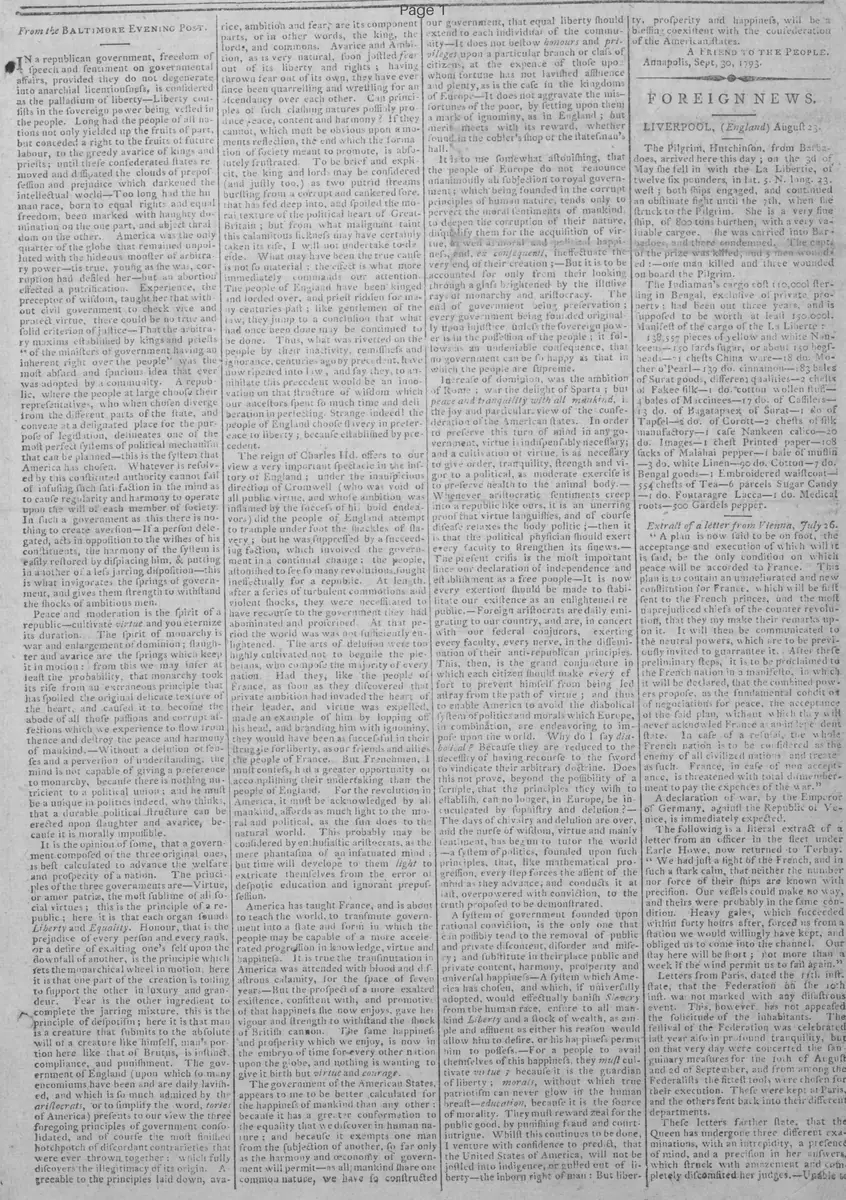
In a republican government, freedom of speech and sentiment on governmental affairs, provided they do not degenerate into anarchical licentiousness, is considered as the palladium of liberty—Liberty consists in the sovereign power being vested in the people. Long had the people of all nations not only yielded up the fruits of past, but conceded a right to the fruits of future labour, to the greedy avarice of kings and priests; until these confederated states removed and dissipated the clouds of prepossession and prejudice which darkened the intellectual world—Too long had the human race, born to equal rights and equal freedom, been marked with haughty domination on the one part, and abject thraldom on the other. America was the only quarter of the globe that remained unpolluted with the hideous monster of arbitrary power—'tis true, young as she was, corruption had defiled her—but an abortion effected a putrefaction. Experience, the preceptor of wisdom, taught her that without civil government to check vice and protect virtue, there could be no true and solid criterion of justice—That the arbitrary maxims established by kings and priests 'of the ministers of government having an inherent right over the people' was the most absurd and spurious idea that ever was adopted by a community. A republic, where the people at large choose their representatives, who when chosen diverge from the different parts of the state, and convene at a designated place for the purpose of legislation, delineates one of the most perfect systems of political mechanism that can be planned—this is the system that America has chosen. Whatever is resolved by this constituted authority cannot fail of infusing such satisfaction in the mind as to cause regularity and harmony to operate upon the will of each member of society. In such a government as this there is nothing to create aversion—If a person delegated, acts in opposition to the wishes of his constituents, the harmony of the system is easily restored by displacing him, & putting in another of a less jarring disposition—this is what invigorates the springs of government, and gives them strength to withstand the shocks of ambitious men. Peace and moderation is the spirit of a republic—cultivate virtue and you eternize its duration. The spirit of monarchy is war and enlargement of dominion; slaughter and avarice are the springs which keep it in motion: from this we may infer at least the probability, that monarchy took its rise from an extraneous principle that has spoiled the original delicate texture of the heart, and caused it to become the abode of all those passions and corrupt affections which we experience to flow from thence and destroy the peace and harmony of mankind.—Without a delusion of senses and a perversion of understanding, the mind is not capable of giving a preference to monarchy, because there is nothing nutritious to a political union; and he must be a novice in politics indeed, who thinks, that a durable political structure can be erected upon slaughter and avarice, because it is morally impossible. It is the opinion of some, that a government composed of the three original ones, is best calculated to advance the welfare and prosperity of a nation. The principles of the three governments are—Virtue, or amor patriae, the most sublime of all social virtues; this is the principle of a republic; here it is that each organ sounds Liberty and Equality. Honour, that is the prejudice of every person and every rank, or a desire of exalting one's self upon the downfall of another, is the principle which sets the monarchical wheel in motion, here it is that one part of the creation is toiling to support the other in luxury and grandeur. Fear is the other ingredient to complete the jarring mixture, this is the principle of despotism; here it is that man is a creature that submits to the absolute will of a creature like himself, man's portion here like that of Brutus, is instinctive compliance, and punishment. The government of England (upon which so many encomiums have been and are daily lavished, and which is so much admired by the aristocrats, or to simplify the word, tories of America) presents to our view the three foregoing principles of government consolidated. and of course the most finished hotchpotch of discordant contrarieties that were ever thrown together: which fully discovers the illegitimacy of its origin. Agreeable to the principles laid down, avarice, ambition and fear, are its component parts, or in other words, the king, the lords, and commons. Avarice and Ambition, as is very natural, soon jostled fear out of its liberty and rights; having thrown fear out of its own, they have ever since been quarrelling and wrestling for an ascendancy over each other. Can principles of such clashing natures possibly produce peace, content and harmony? If they cannot, which must be obvious upon a moment's reflection, the end which the formation of society meant to promote, is absolutely frustrated. To be brief and explicit, the king and lord may be considered (and justly too,) as two putrid streams bursting from a corrupt and cankered sore, that has fed deep into, and spoiled the moral texture of the political heart of Great-Britain; but from what malignant taint this calamitous sickness may have certainly taken its rise, I will not undertake to decide. What may have been the true cause is not so material; the effect is what more immediately commands our attention. The people of England have been kinged and lorded over, and priest riddled for many centuries past; like gentlemen of the law, they jump to a conclusion that what has once been done may be continued to be done. Thus, what was rivetted on the people by their inactivity, remissness and ignorance, centuries ago by precedent, have now ripened into law, and say they, to annihilate this precedent would be an innovation on that structure of wisdom which our ancestors spent so much time and deliberation in perfecting. Strange indeed! the people of England choose slavery in preference to liberty; because established by precedent. The reign of Charles II. offers to our view a very important spectacle in the history of England; under the inauspicious direction of Cromwell (who was void of all public virtue, and whose ambition was inflamed by the success of his bold endeavours) did the people of England attempt to trample under foot the shackles of slavery; but he was suppressed by a succeeding faction, which involved the government in a continual change: the people, astonished to see so many revolutions, fought ineffectually for a republic. At length, after a series of turbulent commotions and violent shocks, they were necessitated to have recourse to the government they had abominated and proscribed. At this period the world was not sufficiently enlightened. The arts of delusion were too highly cultivated not to beguile the plebeians, who compose the majority of every nation. Had they, like the people of France, as soon as they discovered that private ambition had invaded the heart of their leader, and virtue was expelled, made an example of him by lopping off his head, and branding him with ignominy, they would have been as successful in their struggle for liberty, as our friends and allies the people of France. But Frenchmen, I must confess, had a greater opportunity of accomplishing their undertaking than the people of England. For the revolution in America, it must be acknowledged by all mankind, affords as much light to the moral and political, as the sun does to the natural world. This probably may be considered by enthusiastic aristocrats, as the mere phantasm of an infatuated mind; but time will develope to them light to extricate themselves from the error of despotic education and ignorant prepossession. America has taught France, and is about to teach the world, to transmute government into a state and form in which the people may be capable of a more accelerated progression in knowledge, virtue and happiness. It is true the transmutation in America was attended with blood and disastrous calamity, for the space of seven years—But the prospect of a more exalted existence, consistent with, and promotive of that happiness she now enjoys, gave her vigour and strength to withstand the shock of British cannon. The same happiness and prosperity which we enjoy, is now in the embryo of time for every other nation upon the globe, and nothing is wanting to give it birth but virtue and courage. The government of the American States, appears to me to be better calculated for the happiness of mankind than any other: because it has a great conformation to the equality that we discover in human nature; and because it exempts one man from the subjection of another, so far only as the harmony and oeconomy of government will permit—as all mankind share one common nature, we have so constructed our government, that equal liberty should extend to each individual of the community—It does not bestow honours and privileges upon a particular branch or class of citizens, at the expense of those upon whom fortune has not lavished affluence and plenty, as is the case in the kingdoms of Europe—It does not aggravate the misfortunes of the poor, by setting upon them a mark of ignominy, as in England; but merit meets with its reward, whether found in the cobbler's shop or the statesman's hall. It is to me somewhat astonishing, that the people of Europe do not renounce unanimously all subjection to royal government; which being founded in the corrupt principles of human nature, tends only to pervert the moral sentiments of mankind, to deepen the corruption of their nature, disqualify them for the acquisition of virtue, wed us moral and political happiness, and, ex consequent, ineffectuate the very end of their creation;—But it is to be accounted for only from their looking through a glass brightened by the illusive rays of monarchy and aristocracy. The end of government being preservation; every government being founded originally upon injustice unless the sovereign power is in the possession of the people; it follows as an undeniable consequence, that no government can be so happy as that in which the people are supreme. Increase of dominion, was the ambition of Rome; war the delight of Sparta; but peace and tranquility with all mankind, is the joy and particular view of the confederation of the American states. In order to preserve this turn of mind in any government, virtue is indispensably necessary; and a cultivation of virtue, is as necessary to give order, tranquility, strength and vigour to a political, as moderate exercise is to preserve health to the animal body.—Whenever aristocratic sentiments creep into a republic like ours, it is an unerring proof that virtue languishes, and of course disease relaxes the body politic;—then it is that the political physician should exert every faculty to strengthen its sinews.—The present crisis is the most important since our declaration of independence and establishment as a free people—It is now every exertion should be made to stabilize our existence as an enlightened republic.—Foreign aristocrats are daily emigrating to our country, and are, in concert with our federal conjurors, exerting every faculty, every nerve, in the dissemination of their anti-republican principles. This, then, is the grand conjuncture in which each citizen should make every effort to prevent himself from being led astray from the path of virtue; and thus to enable America to avoid the diabolical system of politics and morals which Europe, in combination, are endeavoring to impose upon the world. Why do I say diabolical? Because they are reduced to the necessity of having recourse to the sword to vindicate their arbitrary doctrine. Does this not prove, beyond the possibility of a scruple, that the principles they wish to establish, can no longer, in Europe, be inculcated by sophistry and delusion?—The days of chivalry and delusion are over, and the nurse of wisdom, virtue and manly contentment, has begun to tutor the world—a system of politics, founded upon such principles, that, like mathematical progression, every step forces the assent of the mind as they advance, and conducts it at last, overpowered with conviction, to the truth proposed to be demonstrated. A system of government founded upon rational conviction, is the only one that can possibly tend to the removal of public and private discontent, disorder and misery; and substitute in their place public and private content, harmony, prosperity and universal happiness—A system which America has chosen, and which, if universally adopted, would effectually banish Slavery from the human race, ensure to all mankind Liberty and a stock of wealth, as ample and affluent as either his reason would allow him to desire, or his happiness permit him to possess.—For a people to avail themselves of this happiness, they must cultivate virtue; because it is the guardian of liberty; morals, without which true patriotism can never glow in the human breast—education, because it is the source of morality. They must reward zeal for the public good, by punishing fraud and court intrigue. Whilst this continues to be done, I venture with confidence to predict, that the United States of America, will not be jostled into indigence, or gulled out of liberty—the inborn right of man: But liberty, prosperity and happiness, will be a blessing coexistent with the confederation of the American states.
A FRIEND TO THE PEOPLE.
Annapolis, Sept. 30, 1793.
In a republican government, freedom of speech and sentiment on governmental affairs, provided they do not degenerate into anarchical licentiousness, is considered as the palladium of liberty—Liberty consists in the sovereign power being vested in the people. Long had the people of all nations not only yielded up the fruits of past, but conceded a right to the fruits of future labour, to the greedy avarice of kings and priests; until these confederated states removed and dissipated the clouds of prepossession and prejudice which darkened the intellectual world—Too long had the human race, born to equal rights and equal freedom, been marked with haughty domination on the one part, and abject thraldom on the other. America was the only quarter of the globe that remained unpolluted with the hideous monster of arbitrary power—'tis true, young as she was, corruption had defiled her—but an abortion effected a putrefaction. Experience, the preceptor of wisdom, taught her that without civil government to check vice and protect virtue, there could be no true and solid criterion of justice—That the arbitrary maxims established by kings and priests 'of the ministers of government having an inherent right over the people' was the most absurd and spurious idea that ever was adopted by a community. A republic, where the people at large choose their representatives, who when chosen diverge from the different parts of the state, and convene at a designated place for the purpose of legislation, delineates one of the most perfect systems of political mechanism that can be planned—this is the system that America has chosen. Whatever is resolved by this constituted authority cannot fail of infusing such satisfaction in the mind as to cause regularity and harmony to operate upon the will of each member of society. In such a government as this there is nothing to create aversion—If a person delegated, acts in opposition to the wishes of his constituents, the harmony of the system is easily restored by displacing him, & putting in another of a less jarring disposition—this is what invigorates the springs of government, and gives them strength to withstand the shocks of ambitious men. Peace and moderation is the spirit of a republic—cultivate virtue and you eternize its duration. The spirit of monarchy is war and enlargement of dominion; slaughter and avarice are the springs which keep it in motion: from this we may infer at least the probability, that monarchy took its rise from an extraneous principle that has spoiled the original delicate texture of the heart, and caused it to become the abode of all those passions and corrupt affections which we experience to flow from thence and destroy the peace and harmony of mankind.—Without a delusion of senses and a perversion of understanding, the mind is not capable of giving a preference to monarchy, because there is nothing nutritious to a political union; and he must be a novice in politics indeed, who thinks, that a durable political structure can be erected upon slaughter and avarice, because it is morally impossible. It is the opinion of some, that a government composed of the three original ones, is best calculated to advance the welfare and prosperity of a nation. The principles of the three governments are—Virtue, or amor patriae, the most sublime of all social virtues; this is the principle of a republic; here it is that each organ sounds Liberty and Equality. Honour, that is the prejudice of every person and every rank, or a desire of exalting one's self upon the downfall of another, is the principle which sets the monarchical wheel in motion, here it is that one part of the creation is toiling to support the other in luxury and grandeur. Fear is the other ingredient to complete the jarring mixture, this is the principle of despotism; here it is that man is a creature that submits to the absolute will of a creature like himself, man's portion here like that of Brutus, is instinctive compliance, and punishment. The government of England (upon which so many encomiums have been and are daily lavished, and which is so much admired by the aristocrats, or to simplify the word, tories of America) presents to our view the three foregoing principles of government consolidated. and of course the most finished hotchpotch of discordant contrarieties that were ever thrown together: which fully discovers the illegitimacy of its origin. Agreeable to the principles laid down, avarice, ambition and fear, are its component parts, or in other words, the king, the lords, and commons. Avarice and Ambition, as is very natural, soon jostled fear out of its liberty and rights; having thrown fear out of its own, they have ever since been quarrelling and wrestling for an ascendancy over each other. Can principles of such clashing natures possibly produce peace, content and harmony? If they cannot, which must be obvious upon a moment's reflection, the end which the formation of society meant to promote, is absolutely frustrated. To be brief and explicit, the king and lord may be considered (and justly too,) as two putrid streams bursting from a corrupt and cankered sore, that has fed deep into, and spoiled the moral texture of the political heart of Great-Britain; but from what malignant taint this calamitous sickness may have certainly taken its rise, I will not undertake to decide. What may have been the true cause is not so material; the effect is what more immediately commands our attention. The people of England have been kinged and lorded over, and priest riddled for many centuries past; like gentlemen of the law, they jump to a conclusion that what has once been done may be continued to be done. Thus, what was rivetted on the people by their inactivity, remissness and ignorance, centuries ago by precedent, have now ripened into law, and say they, to annihilate this precedent would be an innovation on that structure of wisdom which our ancestors spent so much time and deliberation in perfecting. Strange indeed! the people of England choose slavery in preference to liberty; because established by precedent. The reign of Charles II. offers to our view a very important spectacle in the history of England; under the inauspicious direction of Cromwell (who was void of all public virtue, and whose ambition was inflamed by the success of his bold endeavours) did the people of England attempt to trample under foot the shackles of slavery; but he was suppressed by a succeeding faction, which involved the government in a continual change: the people, astonished to see so many revolutions, fought ineffectually for a republic. At length, after a series of turbulent commotions and violent shocks, they were necessitated to have recourse to the government they had abominated and proscribed. At this period the world was not sufficiently enlightened. The arts of delusion were too highly cultivated not to beguile the plebeians, who compose the majority of every nation. Had they, like the people of France, as soon as they discovered that private ambition had invaded the heart of their leader, and virtue was expelled, made an example of him by lopping off his head, and branding him with ignominy, they would have been as successful in their struggle for liberty, as our friends and allies the people of France. But Frenchmen, I must confess, had a greater opportunity of accomplishing their undertaking than the people of England. For the revolution in America, it must be acknowledged by all mankind, affords as much light to the moral and political, as the sun does to the natural world. This probably may be considered by enthusiastic aristocrats, as the mere phantasm of an infatuated mind; but time will develope to them light to extricate themselves from the error of despotic education and ignorant prepossession. America has taught France, and is about to teach the world, to transmute government into a state and form in which the people may be capable of a more accelerated progression in knowledge, virtue and happiness. It is true the transmutation in America was attended with blood and disastrous calamity, for the space of seven years—But the prospect of a more exalted existence, consistent with, and promotive of that happiness she now enjoys, gave her vigour and strength to withstand the shock of British cannon. The same happiness and prosperity which we enjoy, is now in the embryo of time for every other nation upon the globe, and nothing is wanting to give it birth but virtue and courage. The government of the American States, appears to me to be better calculated for the happiness of mankind than any other: because it has a great conformation to the equality that we discover in human nature; and because it exempts one man from the subjection of another, so far only as the harmony and oeconomy of government will permit—as all mankind share one common nature, we have so constructed our government, that equal liberty should extend to each individual of the community—It does not bestow honours and privileges upon a particular branch or class of citizens, at the expense of those upon whom fortune has not lavished affluence and plenty, as is the case in the kingdoms of Europe—It does not aggravate the misfortunes of the poor, by setting upon them a mark of ignominy, as in England; but merit meets with its reward, whether found in the cobbler's shop or the statesman's hall. It is to me somewhat astonishing, that the people of Europe do not renounce unanimously all subjection to royal government; which being founded in the corrupt principles of human nature, tends only to pervert the moral sentiments of mankind, to deepen the corruption of their nature, disqualify them for the acquisition of virtue, wed us moral and political happiness, and, ex consequent, ineffectuate the very end of their creation;—But it is to be accounted for only from their looking through a glass brightened by the illusive rays of monarchy and aristocracy. The end of government being preservation; every government being founded originally upon injustice unless the sovereign power is in the possession of the people; it follows as an undeniable consequence, that no government can be so happy as that in which the people are supreme. Increase of dominion, was the ambition of Rome; war the delight of Sparta; but peace and tranquility with all mankind, is the joy and particular view of the confederation of the American states. In order to preserve this turn of mind in any government, virtue is indispensably necessary; and a cultivation of virtue, is as necessary to give order, tranquility, strength and vigour to a political, as moderate exercise is to preserve health to the animal body.—Whenever aristocratic sentiments creep into a republic like ours, it is an unerring proof that virtue languishes, and of course disease relaxes the body politic;—then it is that the political physician should exert every faculty to strengthen its sinews.—The present crisis is the most important since our declaration of independence and establishment as a free people—It is now every exertion should be made to stabilize our existence as an enlightened republic.—Foreign aristocrats are daily emigrating to our country, and are, in concert with our federal conjurors, exerting every faculty, every nerve, in the dissemination of their anti-republican principles. This, then, is the grand conjuncture in which each citizen should make every effort to prevent himself from being led astray from the path of virtue; and thus to enable America to avoid the diabolical system of politics and morals which Europe, in combination, are endeavoring to impose upon the world. Why do I say diabolical? Because they are reduced to the necessity of having recourse to the sword to vindicate their arbitrary doctrine. Does this not prove, beyond the possibility of a scruple, that the principles they wish to establish, can no longer, in Europe, be inculcated by sophistry and delusion?—The days of chivalry and delusion are over, and the nurse of wisdom, virtue and manly contentment, has begun to tutor the world—a system of politics, founded upon such principles, that, like mathematical progression, every step forces the assent of the mind as they advance, and conducts it at last, overpowered with conviction, to the truth proposed to be demonstrated. A system of government founded upon rational conviction, is the only one that can possibly tend to the removal of public and private discontent, disorder and misery; and substitute in their place public and private content, harmony, prosperity and universal happiness—A system which America has chosen, and which, if universally adopted, would effectually banish Slavery from the human race, ensure to all mankind Liberty and a stock of wealth, as ample and affluent as either his reason would allow him to desire, or his happiness permit him to possess.—For a people to avail themselves of this happiness, they must cultivate virtue; because it is the guardian of liberty; morals, without which true patriotism can never glow in the human breast—education, because it is the source of morality. They must reward zeal for the public good, by punishing fraud and court intrigue. Whilst this continues to be done, I venture with confidence to predict, that the United States of America, will not be jostled into indigence, or gulled out of liberty—the inborn right of man: But liberty, prosperity and happiness, will be a blessing coexistent with the confederation of the American states.
A FRIEND TO THE PEOPLE.
Annapolis, Sept. 30, 1793.
What sub-type of article is it?
Constitutional
Moral Or Religious
Partisan Politics
What keywords are associated?
Republican Government
Liberty
Virtue
Monarchy Criticism
Aristocracy
American Revolution
European Politics
Political Equality
What entities or persons were involved?
America
England
France
Kings And Priests
Tories
Aristocrats
Cromwell
Charles Ii
Editorial Details
Primary Topic
Superiority Of Republican Government Over Monarchy
Stance / Tone
Strongly Pro Republican And Anti Monarchical
Key Figures
America
England
France
Kings And Priests
Tories
Aristocrats
Cromwell
Charles Ii
Key Arguments
Republican Government Vests Sovereign Power In The People, Ensuring Liberty And Equality.
Monarchy Is Based On Avarice, Ambition, And Fear, Leading To Corruption And Disharmony.
England's Mixed Government Combines Discordant Principles, Resulting In Illegitimacy And Conflict.
America's Revolution Provides A Model For Global Liberty And Virtue.
Cultivating Virtue Is Essential To Preserve The Republic Against Aristocratic Influences.
Education And Morals Are Key To Patriotism And Preventing Fraud.
European Aristocrats Threaten American Republicanism.
Universal Adoption Of Republicanism Would Banish Slavery And Ensure Happiness.