Thank you for visiting SNEWPapers!
Sign up free
Virginia Argus
Richmond, Virginia
What is this article about?
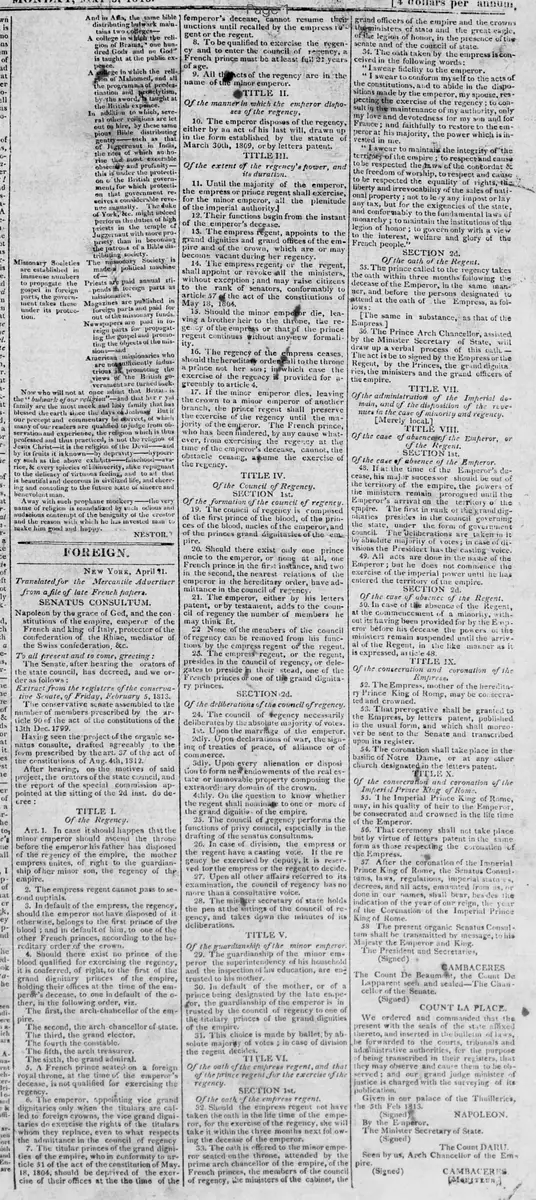
Translation from French papers of a Senatus Consultum issued by Napoleon on February 5, 1813, detailing provisions for imperial regency if his minor son ascends the throne, including the Empress's role, council formation, oaths, powers, and coronation procedures.
Merged-components note: Continuation of the French Senatus Consultum decree across pages.
Clipping
OCR Quality
Full Text
New York, April 21.
Translated for the Mercantile Advertiser from a file of late French papers.
SENATUS CONSULTUM.
Napoleon by the grace of God, and the constitutions of the empire, emperor of the French and king of Italy, protector of the confederation of the Rhine, mediator of the Swiss confederation. &c.
To all present and to come, greeting:
The Senate, after hearing the orators of the state council, has decreed, and we order as follows:
Extract from the registers of the conservative Senate, of Friday, February 5, 1813.
The conservative senate assembled to the number of members prescribed by the article 90 of the act of the constitutions of the 13th Dec. 1799.
Having seen the project of the organic senatus consulte, drafted agreeably to the form prescribed by the art. 37 of the act of the constitutions of Aug. 4th, 1802.
After hearing, on the motives of said project, the orators of the state council, and the report of the special commission appointed at the sitting of the 2d inst. do decree:
TITLE I.
Of the Regency.
Art. 1. In case it should happen that the minor emperor should ascend the throne before the emperor his father has disposed of the regency of the empire, the mother empress unites, of right to the guardianship of her minor son, the regency of the empire.
2. The empress regent cannot pass to second nuptials.
3. In default of the empress, the regency, should the emperor not have disposed of it otherwise, belongs to the first prince of the blood; and in default of him, to one of the other French princes, according to the hereditary order of the crown.
4. Should there exist no prince of the blood qualified for exercising the regency, it is conferred, of right, to the first of the grand dignitary princes of the empire, holding their offices at the time of the emperor's decease, to one in default of the other, in the following order, viz.
The first, the arch-chancellor of the empire.
The second, the arch-chancellor of state.
The third, the grand elector.
The fourth the constable.
The fifth, the arch treasurer.
The sixth, the grand admiral.
5. A French prince seated on a foreign royal throne, at the time of the emperor's decease, is not qualified for exercising the regency.
6. The emperor, appointing vice grand dignitaries only when the titulars are called to foreign crowns, the vice grand dignitaries do exercise the rights of the titulars whom they replace, even to what respects the admittance in the council of regency
7. The titular princes of the grand dignities of the empire, who in conformity to article 51 of the act of the constitution of May. 18, 1804, should be deprived of the exercise of their offices at the time of the emperor's decease, cannot resume their functions until recalled by the empress regent or the regent.
8. To be qualified to exercise the regency and to enter the council of regency, a French prince must be at least full 25 years of age.
9. All the acts of the regency are in the name of the minor emperor.
TITLE II.
Of the manner in which the emperor disposes of the regency,
10. The emperor disposes of the regency, either by an act of his last will, drawn up in the form established by the statute of March 30th, 1809, or by letters patent.
TITLE III.
Of the extent of the regency's power, and its duration.
11. Until the majority of the emperor, the empress or prince regent shall exercise, for the minor emperor, all the plenitude of the imperial authority.
12. Their functions begin from the instant of the emperor's decease.
13. The empress regent, appoints to the grand dignities and grand offices of the empire and of the crown, which are or may become vacant during her regency.
14. The empress regent; or the regent, shall appoint or revoke all the ministers, without exception; and may raise citizens to the rank of senators, conformably to article 57 of the act of the constitutions of May 18, 1804.
15. Should the minor emperor die, leaving a brother heir to the throne, the regency of the empress or that of the prince regent continues without any new formality.
16. The regency of the empress ceases, should the hereditary order call to the throne a prince not her son; in which case the exercise of the regency is provided for agreeably to article 4.
17. If the minor emperor dies, leaving the crown to a minor emperor of another branch, the prince regent shall preserve the exercise of the regency until the majority of the emperor. The French prince, who has been hindered, by any cause whatever, from exercising the regency at the time of the emperor's decease, cannot, the obstacle ceasing, assume the exercise of the regency.
TITLE IV.
Of the Council of Regency.
SECTION 1st.
Of the formation of the council of regency.
19. The council of regency is composed of the first prince of the blood, of the princes of the blood, uncles of the emperor, and of the princes grand dignitaries of the empire.
20. Should there exist only one prince uncle to the emperor, or none at all, one French prince in the first instance, and two in the second, the nearest relations of the emperor in the hereditary order, have admittance in the council of regency.
21. The emperor, either by his letters patent, or by testament, adds to the council of regency the number of members he may think fit.
22 None of the members of the council of regency can be removed from his functions by the empress regent or the regent.
23. The empress regent, or the regent, presides in the council of regency, or delegates to preside in their stead, one of the French princes or one of the grand dignitary princes.
SECTION 2d.
Of the deliberations of the council of regency.
24. The council of regency necessarily deliberates by the absolute majority of votes.
1st. Upon the marriage of the emperor.
2dly. Upon declarations of war, the signing of treaties of peace, of alliance or of commerce.
3dly. Upon every alienation or disposition to form new endowments of the real estate or immovable property composing the extraordinary domain of the crown.
4thly. On the question to know whether the regent shall nominate to one or more of the grand dignities of the empire.
25. The council of regency performs the functions of privy council, especially in the drafting of the senatus consultums.
26. In case of division, the empress or the regent have a casting vote. If the regency be exercised by deputy, it is reserved for the empress or the regent to decide.
27. Upon all other affairs referred to its examination, the council of regency has no more than a consultative voice
28. The minister secretary of state holds the pen at the sittings of the Council of regency, and takes down the minutes of its deliberations.
TITLE V.
Of the guardianship of the minor emperor.
29. The guardianship of the minor emperor the superintendency of his household and the inspection of his education, are entrusted to his mother.
30. In default of the mother, or of a prince being designated by the late emperor, the guardianship of the emperor is entrusted by the council of regency to one of the titular princes of the grand dignities of the empire.
31. This choice is made by ballot; by absolute majority of votes; in case of division the regent decides.
TITLE VI.
Of the oath of the empress regent, and that of the prince regent for the exercise of the regency.
SECTION 1st.
Of the oath of the empress regent.
32. Should the empress regent not have taken the oath in the life time of the emperor, for the exercise of the regency, she will take it within the three months next following the decease of the emperor.
33. The oath is offered to the minor emperor seated on the throne, attended by the prime arch chancellor of the empire, of the French princes, the members of the council of regency, the ministers of the cabinet, the grand officers of the empire and the crown's the ministers of state and the great eagle, of the legion of honor. in the presence of the senate and of the council of state.
34. The oath taken by the empress is conceived in the following words:
"I swear fidelity to the emperor.
"I swear to conform myself to the acts of the constitutions, and to abide in the dispositions made by the emperor, my spouse. respecting the exercise of the regency; to consult in the maintenance of my authority, only my love and devotedness for my son and for France; and faithfully to restore to the emperor at his majority, the power which is invested in me.
"I swear to maintain the integrity of the territory of the empire; to respect and cause to be respected the laws of the concordat & the freedom of worship, to respect and cause to be respected the equality of rights, the. liberty and irrevocability of the sales of national property; not to levy any impost or lay any tax, but for the exigencies of the state, and conformably to the fundamental laws of monarchy; to maintain the institutions of the legion of honor; to govern only with a view to the interest, welfare and glory of the French people."
SECTION 2d.
Of the oath of the Regent.
35. The prince called to the regency takes the oath within three months following the decease of the Emperor, in the same manner, and before the persons designated to attend at the oath of the Empress, as follows:
[The same in substance, as that of the Empress.]
36. The Prince Arch Chancellor, assisted by the Minister Secretary of State, will draw up a verbal process of this oath.-
The act is to be signed by the Empress or the Regent, by the Princes, the grand dignitaries, the ministers and the grand officers of the empire.
TITLE VII.
Of the administration of the Imperial domain, and of the disposition of the revenues in the case of minority and regency.
[Merely local.]
TITLE VIII.
Of the case of absence of the Emperor, or of the Regent.
SECTION 1st.
Of the case of absence of the Emperor.
48. If at the time of the Emperor's decease, his major successor should be out of the territory of the empire, the powers of the ministers remain prorogued until the Emperor's arrival in the territory of the empire. The first in rank or the grand dignitaries presides in the council governing the state, under the form of government council. The deliberations are taken in it by absolute majority of votes; in case of divisions the President has the casting voice.
49. All acts are done in the name of the Emperor; but he does not commence the exercise of the imperial power until he has entered the territory of the empire.
SECTION 2d.
Of the case of absence of the Regent.
50. In case of the absence of the Regent, at the commencement of a minority, without its having been provided for by the Emperor before his decease the powers of the ministers remain suspended until the arrival of the Regent, in the like manner as it is expressed, article 48.
TITLE IX.
Of the consecration and coronation of the Empress.
52. The Empress, mother of the hereditary Prince King of Rome, may be consecrated and crowned.
53. That prerogative shall be granted to the Empress, by letters patent, published in the usual form, and which shall moreover be sent to the Senate and transcribed upon its register.
54. The coronation shall take place in the basilica of Notre Dame, or at any other church designated in the letters patent.
TITLE X.
Of the consecration and coronation of the Imperial Prince King of Rome.
55. The Imperial Prince King of Rome, may, in his quality of heir to the Emperor, be consecrated and crowned in the life time of the Emperor.
56. That ceremony shall not take place but by virtue of letters patent in the same form as those respecting the coronation of the Empress.
57 After the coronation of the Imperial Prince King of Rome, the Senatus Consultums, laws, regulations, imperial decrees, and all acts, emanated from us, or done in our names, shall bear, besides the indication of the year of our reign, the year of the Coronation of the Imperial Prince King of Rome.
58 The present organic Senatus Consultum shall be transmitted by message, to his Majesty the Emperor and King.
The President and Secretaries,
(Signed)
CAMBACERES
The Count De Beaumont, the Count De Lapparent seen and sealed-The Chancellor of the Senate.
(Signed)
COUNT LA PLACE.
We ordered and commanded that the present with the seals of the state affixed thereto, and inserted in the bulletin of laws, be forwarded to the courts, tribunals and administrative authorities, for the purpose of being transcribed in their registers, that they may observe and cause them to be observed: and our grand judge minister of justice is charged with the surveying of its publication.
Given in our palace of the Thuilleries, the 5th Feb 1813.
(Signed)
NAPOLEON.
By the Emperor.
The Minister Secretary of State.
(Signed)
The Count DARU
Seen by us, Arch Chancellor of the Empire.
(Signed)
CAMBACERES
MONITEUR
What sub-type of article is it?
What keywords are associated?
What entities or persons were involved?
Where did it happen?
Foreign News Details
Primary Location
France
Event Date
1813 02 05
Key Persons
Outcome
establishes comprehensive rules for regency, guardianship, council operations, oaths, and coronations in the event of the emperor's death and a minor successor.
Event Details
The Senatus Consultum outlines the structure and powers of the regency for the French Empire if Napoleon dies and his minor son, the King of Rome, ascends the throne. It specifies the Empress's automatic regency role, succession of regents, formation and functions of the Council of Regency, required oaths, guardianship, administration during absence, and provisions for consecration and coronation of the Empress and the Imperial Prince.