Thank you for visiting SNEWPapers!
Sign up free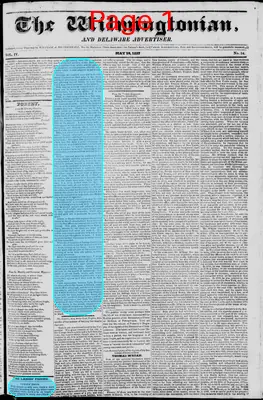
Story
May 10, 1827
The Wilmingtonian, And Delaware Advertiser
Wilmington, New Castle County, Delaware
What is this article about?
Historical fashion advice for women on choosing dress colors suited to different complexions (fair, florid, brunette, ruddy) and figures, emphasizing black's universality, specifics for pink, blue, yellow, green, and recommendations for modesty in multi-color and form-fitting attire.
Clipping
OCR Quality
92%
Excellent
Full Text
THE
LADIES' FRIEND.
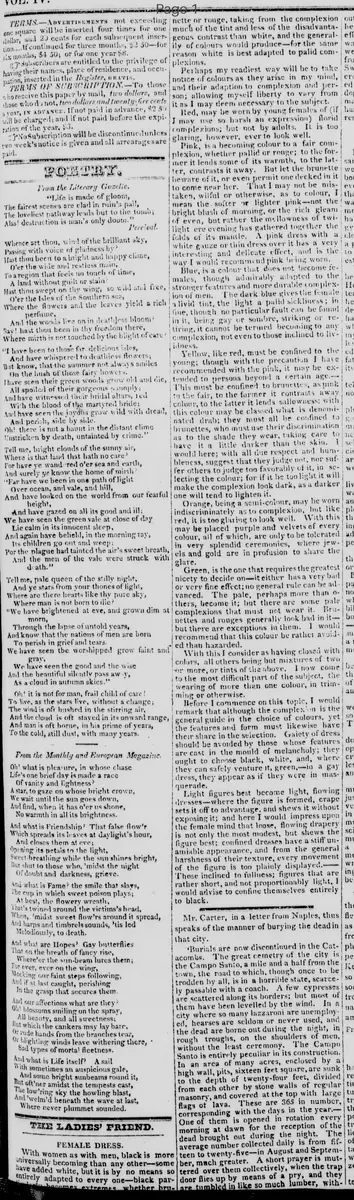
FEMALE DRESS.
With women as with men, black is more universally becoming than any other—some have added white, but it is by no means so entirely adapted to every one—black, brunette or rouge, taking from the complexion much of the tint and less of the disadvantageous contrast than white, and the generality of colours would produce—for the same reason white is best adapted to pallid complexions.
Perhaps my readiest way will be to take notice of colours as they arise in my mind, and their adaptation to complexion and person; allowing myself liberty to vary from it as I may deem necessary to the subject.
Red, may be worn by young females of (if I may use so harsh an expression) florid complexions; but not by adults. It is too glaring, however, ever to look well.
Pink, is a becoming colour to a fair complexion, whether pallid or rouge; to the former it lends some of its warmth. to the latter, contrasts it away. But let the brunette beware of it, or even permit one decked in it to come near her. That I may not be mistaken, wilful or otherwise, as to colour, I mean the softer or lighter pink—not the bright blush of morning, or the rich gleam of even, but rather the mellowness of twilight ere evening has gathered together the folds of its mantle. A pink dress with a white gauze or thin dress over it has a very interesting and delicate effect, and is the way I would recommend pink being worn.
Blue, is a colour that does not become females, though admirably adapted to the stronger features and more durable complexion of men. The dark blue gives the female a livid tint, the light a pallid sickliness; in fine, though no particular fault can be found in it, being gay or sombre, striking or retiring, it cannot be termed becoming to any complexion, not even to those inclined to lividness.
Yellow, like red, must be confined to the young; though with the precaution I have recommended with the pink, it may be extended to persons beyond a certain age.— This must be confined to brunettes, as pink to the fair, to the former it contrasts away colour, to the latter it lends sallowness: with this colour may be classed what is denominated drab; they must all be confined to brunettes, who must use their discrimination as to the shade they wear, taking care to have it a little darker than the skin. I would here, with all due respect and humbleness, suggest that they judge not, nor suffer others to judge too favorably of it, in selecting the colour: for if it be too light it will make the complexion look dark, as a darker one will tend to lighten it.
Orange, being a semi-colour, may be worn indiscriminately as to complexion, but like red, it is too glaring to look well. With this may be placed purple and velvets of every colour, all of which, are only to be tolerated in very splendid ceremonies, where jewels and gold are in profusion to share the glare.
Green, is the one that requires the greatest nicety to decide on—it either has a very bad or very fine effect; no general rule can be advanced. The pale, perhaps more than others, become it; but there are some pale complexions that must not wear it. Brunettes and rouges generally look bad in it— but there are exceptions in them. I would recommend that this colour be rather avoided than hazarded.
With this I consider as having closed with colors, all others being but mixtures of two or more, or tints of the above. I now come to the most difficult part of the subject. the wearing of more than one colour, in trimming or otherwise.
Before I commence on this topic, I would remark that although the complexion is the general guide in the choice of colours, yet the features and form must likewise have their share in the selection. Gaiety of dress should be avoided by those whose features are cast in the mould of melancholy; they ought to choose black, white, and, where they can safely venture it, green,—in a gay dress, they appear as if they were in masquerade.
Light figures best become light, flowing dresses—where the figure is formed, crape sets it off to advantage, and shews it without exposing it; and here I would impress upon the female mind that loose, flowing drapery is not only the most modest, but shews the figure best; confined dresses have a stiff unamiable appearance, and from the general harshness of their texture, every movement of the figure is too plainly displayed.—
Those inclined to fullness; figures that are rather short, and not proportionably light, I would advise to confine themselves entirely to black.
LADIES' FRIEND.
FEMALE DRESS.
With women as with men, black is more universally becoming than any other—some have added white, but it is by no means so entirely adapted to every one—black, brunette or rouge, taking from the complexion much of the tint and less of the disadvantageous contrast than white, and the generality of colours would produce—for the same reason white is best adapted to pallid complexions.
Perhaps my readiest way will be to take notice of colours as they arise in my mind, and their adaptation to complexion and person; allowing myself liberty to vary from it as I may deem necessary to the subject.
Red, may be worn by young females of (if I may use so harsh an expression) florid complexions; but not by adults. It is too glaring, however, ever to look well.
Pink, is a becoming colour to a fair complexion, whether pallid or rouge; to the former it lends some of its warmth. to the latter, contrasts it away. But let the brunette beware of it, or even permit one decked in it to come near her. That I may not be mistaken, wilful or otherwise, as to colour, I mean the softer or lighter pink—not the bright blush of morning, or the rich gleam of even, but rather the mellowness of twilight ere evening has gathered together the folds of its mantle. A pink dress with a white gauze or thin dress over it has a very interesting and delicate effect, and is the way I would recommend pink being worn.
Blue, is a colour that does not become females, though admirably adapted to the stronger features and more durable complexion of men. The dark blue gives the female a livid tint, the light a pallid sickliness; in fine, though no particular fault can be found in it, being gay or sombre, striking or retiring, it cannot be termed becoming to any complexion, not even to those inclined to lividness.
Yellow, like red, must be confined to the young; though with the precaution I have recommended with the pink, it may be extended to persons beyond a certain age.— This must be confined to brunettes, as pink to the fair, to the former it contrasts away colour, to the latter it lends sallowness: with this colour may be classed what is denominated drab; they must all be confined to brunettes, who must use their discrimination as to the shade they wear, taking care to have it a little darker than the skin. I would here, with all due respect and humbleness, suggest that they judge not, nor suffer others to judge too favorably of it, in selecting the colour: for if it be too light it will make the complexion look dark, as a darker one will tend to lighten it.
Orange, being a semi-colour, may be worn indiscriminately as to complexion, but like red, it is too glaring to look well. With this may be placed purple and velvets of every colour, all of which, are only to be tolerated in very splendid ceremonies, where jewels and gold are in profusion to share the glare.
Green, is the one that requires the greatest nicety to decide on—it either has a very bad or very fine effect; no general rule can be advanced. The pale, perhaps more than others, become it; but there are some pale complexions that must not wear it. Brunettes and rouges generally look bad in it— but there are exceptions in them. I would recommend that this colour be rather avoided than hazarded.
With this I consider as having closed with colors, all others being but mixtures of two or more, or tints of the above. I now come to the most difficult part of the subject. the wearing of more than one colour, in trimming or otherwise.
Before I commence on this topic, I would remark that although the complexion is the general guide in the choice of colours, yet the features and form must likewise have their share in the selection. Gaiety of dress should be avoided by those whose features are cast in the mould of melancholy; they ought to choose black, white, and, where they can safely venture it, green,—in a gay dress, they appear as if they were in masquerade.
Light figures best become light, flowing dresses—where the figure is formed, crape sets it off to advantage, and shews it without exposing it; and here I would impress upon the female mind that loose, flowing drapery is not only the most modest, but shews the figure best; confined dresses have a stiff unamiable appearance, and from the general harshness of their texture, every movement of the figure is too plainly displayed.—
Those inclined to fullness; figures that are rather short, and not proportionably light, I would advise to confine themselves entirely to black.
What sub-type of article is it?
Fashion Advice
What themes does it cover?
Social Manners
What keywords are associated?
Female Dress
Color Selection
Complexion Advice
Fashion Guide
Modest Attire
Brunette Fashion
Figure Types
Story Details
Story Details
Detailed guidance on selecting dress colors and styles for women, tailored to complexion types (pallid, fair, florid, brunette, rouge) and figure shapes, promoting modesty and harmony in appearance through recommendations like black for universality, pink for fair complexions, and flowing drapery over tight fits.