Thank you for visiting SNEWPapers!
Sign up free
Story
July 22, 1959
The Nome Nugget
Nome, Nome County, Alaska
What is this article about?
President Eisenhower sees no tax cut possible in his remaining 18 months but no increase planned; reluctant on Taft-Hartley for steel strike; could back Rockefeller or Nixon for GOP nomination.
Clipping
OCR Quality
98%
Excellent
Full Text
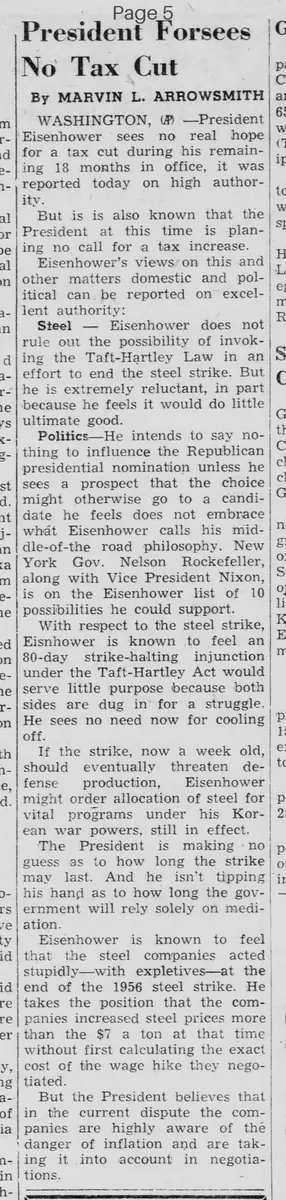
President Foresees
No Tax Cut
By MARVIN L. ARROWSMITH
WASHINGTON, (P) — President Eisenhower sees no real hope for a tax cut during his remaining 18 months in office, it was reported today on high authority.
But it is also known that the President at this time is planning no call for a tax increase.
Eisenhower's views on this and other matters domestic and political can be reported on excellent authority:
Steel — Eisenhower does not rule out the possibility of invoking the Taft-Hartley Law in an effort to end the steel strike. But he is extremely reluctant, in part because he feels it would do little ultimate good.
Politics He intends to say nothing to influence the Republican presidential nomination unless he sees a prospect that the choice might otherwise go to a candidate he feels does not embrace what Eisenhower calls his middle-of-the road philosophy. New York Gov. Nelson Rockefeller, along with Vice President Nixon, is on the Eisenhower list of 10 possibilities he could support.
With respect to the steel strike, Eisenhower is known to feel an 80-day strike-halting injunction under the Taft-Hartley Act would serve little purpose because both sides are dug in for a struggle. He sees no need now for cooling off.
If the strike, now a week old, should eventually threaten defense production, Eisenhower might order allocation of steel for vital programs under his Korean war powers, still in effect.
The President is making no guess as to how long the strike may last. And he isn't tipping his hand as to how long the government will rely solely on mediation.
Eisenhower is known to feel that the steel companies acted stupidly—with expletives—at the end of the 1956 steel strike. He takes the position that the companies increased steel prices more than the $7 a ton at that time without first calculating the exact cost of the wage hike they negotiated.
But the President believes that in the current dispute the companies are highly aware of the danger of inflation and are taking it into account in negotiations.
No Tax Cut
By MARVIN L. ARROWSMITH
WASHINGTON, (P) — President Eisenhower sees no real hope for a tax cut during his remaining 18 months in office, it was reported today on high authority.
But it is also known that the President at this time is planning no call for a tax increase.
Eisenhower's views on this and other matters domestic and political can be reported on excellent authority:
Steel — Eisenhower does not rule out the possibility of invoking the Taft-Hartley Law in an effort to end the steel strike. But he is extremely reluctant, in part because he feels it would do little ultimate good.
Politics He intends to say nothing to influence the Republican presidential nomination unless he sees a prospect that the choice might otherwise go to a candidate he feels does not embrace what Eisenhower calls his middle-of-the road philosophy. New York Gov. Nelson Rockefeller, along with Vice President Nixon, is on the Eisenhower list of 10 possibilities he could support.
With respect to the steel strike, Eisenhower is known to feel an 80-day strike-halting injunction under the Taft-Hartley Act would serve little purpose because both sides are dug in for a struggle. He sees no need now for cooling off.
If the strike, now a week old, should eventually threaten defense production, Eisenhower might order allocation of steel for vital programs under his Korean war powers, still in effect.
The President is making no guess as to how long the strike may last. And he isn't tipping his hand as to how long the government will rely solely on mediation.
Eisenhower is known to feel that the steel companies acted stupidly—with expletives—at the end of the 1956 steel strike. He takes the position that the companies increased steel prices more than the $7 a ton at that time without first calculating the exact cost of the wage hike they negotiated.
But the President believes that in the current dispute the companies are highly aware of the danger of inflation and are taking it into account in negotiations.
What sub-type of article is it?
Historical Event
Biography
What themes does it cover?
Fortune Reversal
What keywords are associated?
Tax Cut
Steel Strike
Taft Hartley Law
Republican Nomination
Eisenhower Views
What entities or persons were involved?
President Eisenhower
Nelson Rockefeller
Vice President Nixon
Where did it happen?
Washington
Story Details
Key Persons
President Eisenhower
Nelson Rockefeller
Vice President Nixon
Location
Washington
Story Details
President Eisenhower expresses no hope for tax cuts in his remaining term but no plans for increases; reluctant to use Taft-Hartley in steel strike; may support Rockefeller or Nixon for Republican nomination if needed.