Thank you for visiting SNEWPapers!
Sign up free
Gazette Of The United States, & Philadelphia Daily Advertiser
Philadelphia, Philadelphia County, Pennsylvania
What is this article about?
An anonymous letter signed 'UNION' defends John Adams's 'Defence of the American Constitutions' against misrepresentations, explaining its advocacy for balanced republican governments with checks and balances inspired by but improving upon the English model. It accuses anti-federal critics, particularly in Virginia papers like the Aurora, of slandering Adams during the 1796 election to undermine the federal government. From Eastern Shore, Maryland, October 26, 1796.
Clipping
OCR Quality
Full Text
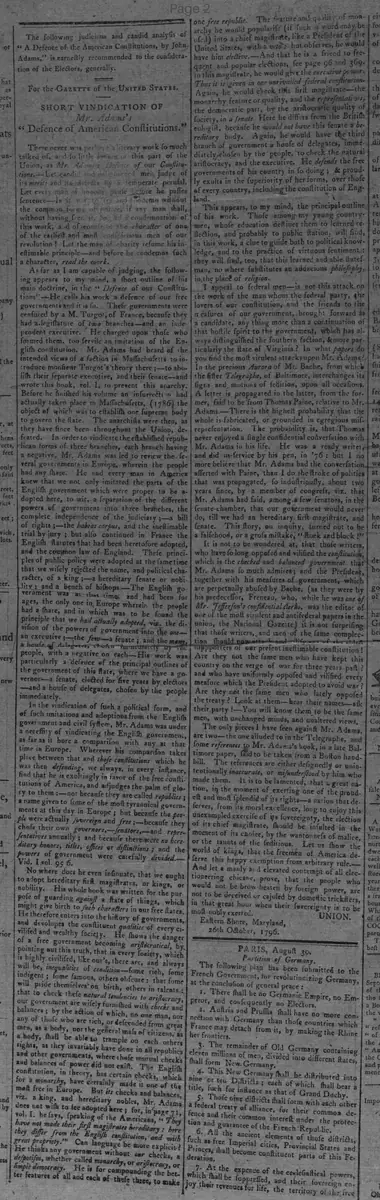
"A Defence of the American Constitutions, by John
Adams," is earnestly recommended to the considera-
tion of the Electors, generally.
For the GAZETTE of the UNITED STATES.
SHORT VINDICATION OF
Mr. Adams's
"Defence of American Constitutions."
There never was perhaps a literary work so much
talked of, and so little known in this part of the
Union, as Mr. Adams's Defence of our Consti-
tutions.-Let candid and enlightened men judge of
its merits and its defects in a temperate perusal.
Let every man of honor pause before he passes
sentence-Is it right to try and condemn without
the common forms of justice, if any man shall,
without having even it, or read a condemnation of
this work, and of course of the character of one
of the earliest and most conspicuous men of our
revolution! Let the man of charity resume his in-
etimable principle-and before he condemns such
a character, read the work.
As far as I am capable of judging, the follow-
ing appears to my mind, a short outline of his
main doctrine, in the "Defence of our Consti-
tutions" He calls his work a defence of our free
governments and it is so. These governments were
censured by a M. Turgot, of France, because they
had a legislature of two branches-and an inde-
pendent executive. He charged upon those who
formed them. too servile an imitation of the En-
glish constitution. Mr. Adams had heard of the
intended views of a faction in Massachusetts to in-
troduce monsieur Turgot's theory there ;-to abo-
lish their separate executive, and their senate-and
wrote this book, vol. I, to prevent this anarchy.
Before he finished his volume an insurrection had
actually taken place in Massachusetts, (1786) the
object of which was to establish one supreme body
to govern the state. The anarchists were then, as
they have since been throughout the Union, de-
feated. In order to vindicate the established repub-
lican forms of three branches, each branch having
a negative, Mr. Adams was led to review the, e-
veral governments in Europe, wherein the people
had any Share. He and every man in America
knew that we not only imitated the parts of the
English government which were proper to be a-
dopted here, to wit, a separation of the different
powers of government into three branches, the
complete independence of the judiciary ;-a bill
of rights ;-the habeas corpus, and the inestimable
trial by jury ; but also continued in force the
English statutes that had been heretofore adopted,
and the common law of England. These princi-
ples of public policy were adopted at the same time
that we wisely rejected the name, and political cha-
racter, of a king -a hereditary senate or nobi-
lity: and a bench of bishops.-The English go-
vernment was at that time. and had been for
ages, the only one in Europe wherein the people
had a share, and in which was to be found the
principle that we had actually adopted, viz. the di-
vision of the powers of government into the one-
an executive ;--the few-a senate; and the many,
a house of delegates chosen immediately by the
people, with a negative on each-His work was
particularly a defence of the principal outlines of
the government of this state, where we have a go-
vernor-a senate, elected for five years by electors
--and a house of delegates, chosen by the people
immediately.
In the vindication of such a political form, and
of such imitations and adoptions from the English
government and civil system, Mr. Adams was under
a necessity of vindicating the English government,
as far as it bore a comparison with any at that
time in Europe. Wherever his comparison takes
place between that and those constitutions which he
was then defending, we always, in every instance,
find that he is exultingly in favor of the free conti-
tutions of America, and adjudges the palm of glo-
ry to them :-not because they are called republics;
a name given to some of the most tyrannical govern-
ments at this day. in Europe ; but because the peo-
ple were actually sovereign and free;-because they
chose their own governors,senators,--and repre-
entatives annually; and because there were no hereditary honors, titles, offices' or distinctions; and the powers of government were carefully divided.-
Vid. I vol. 95 6.
No where does he even insinuate, that we ought
to adopt hereditary first magistrates, or kings, or
nobility. His whole book was written for the pur-
pose of guarding against a state of things, which
might give birth to such characters in our free states.
He therefore enters into the history of governments,
and develops the constituent qualities of every ci-
vilized and wealthy society. He shows the danger
of a free government becoming aristocratical, by.
pointing out this truth, that in every society, which
is highly civilized, like ours, there are, and always
will be, inequalities of condition--some rich, some
indigent ; some famous, others obscure: that some
will pride themselves on birth, others in talents :
that to check these natural tendencies to aristocracy,
our governments are wisely furnished with checks and
balances; by the action of which, no one man, nor
any of those who are rich, or descended from great
men, as a body, nor the general mass of citizens, as
a body, shall be able to trample on each others
rights, as they invariably have done in all republics
and other governments, where those mutual checks
and balances of power did not exist. The English
constitution, in theory, has certain checks, which
for a monarchy, have certainly made it one of the
most free in Europe. But its checks and balances,
viz. a king, and hereditary nobles, Mr. Adams
does not wish to see adopted here; for, in page 71,
vol. I. he says, speaking of the Americans, " They
have not made their first magistrates hereditary : here
they differ from the English constitution, and with
great propriety." Can language be more explicit?
He thinks any government without our checks, a
despotism, whether called monarchy, or aristocracy, or
simple democracy. He is for compounding the bet-
ter features of all and each of these three, to make
one free republic. The measure and quality of mon-
archy he would popularize (if such a word may be
used) into a chief magistrate, like a President of the
United States, with a veto ; but observes, he would
have him elective.—And that he is a friend to fre-
quent and popular elections, see page 96 and 369.
to this magistrate, he would give the executive power.
Thus it is given in one unrivalled federal constitution.
Again, he would check this first magistrate-the
monarchy feature or quality, and the representatives,
the democratic part, by the aristocratic quality of
society, in a Senate Here he differs from the British
constitution, because he would not have this senate a he-
reditary body. Again, he would have the third
branch of government a house of delegates, imme-
diately chosen by the people, to check the natural
aristocracy, and the executive. He defends the free
governments of his country in so doing ; & proud-
ly exults in the superiority of her forms, over those
of every country, including the constitution of Eng-
land.
This appears, to my mind, the principal outline
of his work. Those among my young country-
men, whose education destines them to learned re-
seCtion, and probably to public station, will find,
in this work, a clue to guide both to political know-
ledge, and to the practice of virtuous sentiment, :
they will find, too, that this learned and able state-
man, no where substitutes an audacious philosophy,
in the place of religion.
I appeal to federal men-is not this attack on
the work of the man whom the federal party, the
lovers of our constitution, and the friends to the
measures of our government, brought forward as
a candidate, any thing more than a continuation of
that hostile spirit to the government, which has al-
ways distinguished the southern faction, &more par-
ticularly the state of Virginia? In what papers do
you find the most virulent attacks upon Mr. Adams?,
In the precious Aurora of Mr. Bache, from which
the sister Telegraphe, of Baltimore, interchanges its
signs and motions of edition, upon all occasions.
A letter is propagated in the latter, from the for-
mer, said to be from Thomas Paine, relative to Mr.
Adams.-There is the highest probability that the
whole is fabricated, or grounded in egregious mi-
representation. The probability is, that Thomas
never enjoyed a single confidential conversation wich
Mr. Adams in his life. He was a ready writer,
and did us service by his pen, in '76 : but I no
more believe that Mr. Adams had the conversation
asserted with Paine, than I do the stroke of politics
that was propagated, so industriously, about two
years since, by a member of congress, viz. that
Mr. Adams had said, among a few senators, in the
senate-chamber, that our government would never
do, till we had an hereditary first magistrate, and
senate. This story, on inquiry, turned out to be
a falsehood, or a gross mistake, "stock and block !"
It is not to be wondered at, that those writers,
who have so long opposed and vilified the constitution,
which is the checked and balanced government that
Mr. Adams so much admires; and the President,
together with his measures of government, which
are perpetually abused by Bache, (as they were by
his predecessor, Freneau, who, while he was one of
Mr. Jefferson's confidential clerks, was the editor of
one of the most virulent and antifederal papers in the
union, the National Gazette) it is not surprising
that those writers, and men of the same complec-
tion should now attack and vilify one of the oldest
supporters of our present inestimable constitution!
Are they not the same men who have kept this
country on the verge of war for three years past ?
and who have uniformly opposed and vilified every
measure which the President adopted to avoid war?
Are they not the same men who lately opposed
the treaty ? Look at them-hear their names-ask
their party !-You will know them to be the same
men, with unchanged minds, and unaltered views.
The only pieces I have seen against Mr. Adams,
are two-the one alluded to in the Telegraphe, and
some references to Mr. Adams's book, in a late Bal-
timore paper, said to be taken from a Boston hand-
bill. The references are either designedly or unin-
tentionally inaccurate, or misunderstood by him who
made them. It is to be lamented, that a great na-
tion, in the moment of exerting one of the proud-
est and most splendid of its rights-a nation that de-
serves, from its moral excellence, long to enjoy this
unexampled exercise of its sovereignty, the election
of its chief magistrate, should be insulted in the
moment of its choice, by the wantonness of malice,
or the taunts of the seditious, Let us show the
world of kings, that the freemen of America de-
serve this happy exemption from arbitrary rule.-
And let a manly and elevated contempt of all elec-
tioneering chicane, prove, that the people who
would not be brow-beaten by foreign power, are
not to be deceived or cajoled by domestic tricksters,
in that great hour when their sovereignty is to be
most nobly exerted.
UNION.
Eastern-Shore, Maryland,
26th October, 1796.
What sub-type of article is it?
What themes does it cover?
What keywords are associated?
What entities or persons were involved?
Letter to Editor Details
Author
Union
Recipient
Gazette Of The United States
Main Argument
john adams's 'defence of the american constitutions' defends balanced republican governments with separated powers and checks against anarchy and aristocracy, improving on the english model without hereditary elements; critics misrepresent it to attack federalists and the constitution during the 1796 election.
Notable Details