Thank you for visiting SNEWPapers!
Sign up free
Editorial
July 9, 1863
Weekly National Intelligencer
Washington, District Of Columbia
What is this article about?
On the 87th anniversary of U.S. Independence in 1863, amid the Civil War, the editorial laments the conflict, honors the founders' legacy, and argues that secessionists cannot justify rebellion using the Declaration of Independence. It emphasizes the Constitution's provisions for peaceful amendments, citing Jefferson and Calhoun to oppose violence.
Clipping
OCR Quality
98%
Excellent
Full Text
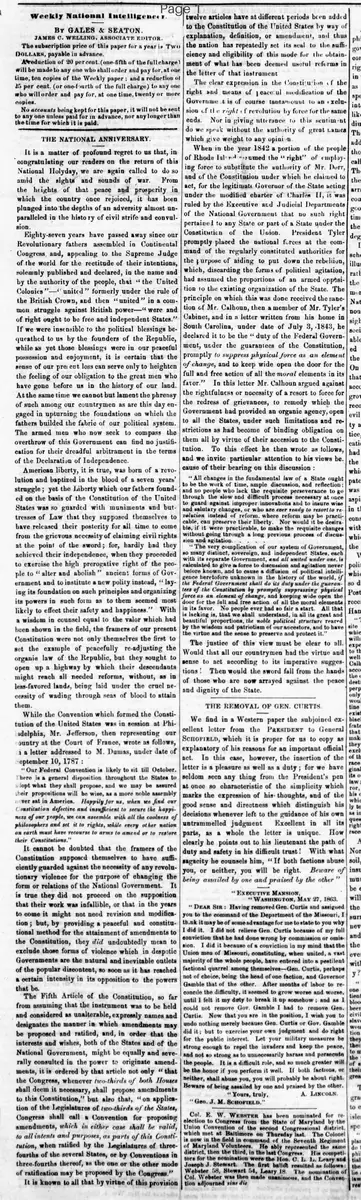
THE NATIONAL ANNIVERSARY
It is a matter of profound regret to us that, in congratulating our readers on the return of this National Holyday, we are again called to do so amid the sights and sounds of war. From the heights of that peace and prosperity in which the country once rejoiced, it has been plunged into the depths of an adversity almost unparalleled in the history of civil strife and convulsion.
Eighty-seven years have passed away since our Revolutionary fathers assembled in Continental Congress, and, appealing to the Supreme Judge of the world for the rectitude of their intentions, solemnly published and declared, in the name and by the authority of the people, that "the United Colonies", united formerly under the rule of the British Crown, and then "united" in a common struggle against British power—were and of right ought to be free and independent States."
If we were insensible to the political blessings bequeathed to us by the founders of the Republic, while as yet those blessings were in our peaceful possession and enjoyment, it is certain that the sense of our present loss can serve only to heighten the feeling of our obligation to the great men who have gone before us in the history of our land.
At the same time we cannot but lament the phrensy of such among our countrymen as are this day engaged in upturning the foundations on which the fathers builded the fabric of our political system.
The armed men who now seek to compass the overthrow of this Government can find no justification for their dreadful arbitrament in the terms of the Declaration of Independence.
American liberty, it is true, was born of a revolution and baptized in the blood of a seven years' struggle; yet the Liberty which our fathers founded on the basis of the Constitution of the United States was so guarded with muniments and buttresses of Law that they supposed themselves to have released their posterity for all time to come from the grievous necessity of claiming civil rights at the point of the sword; for, hardly had they achieved their independence, when they proceeded to exercise the high prerogative right of the people to "alter and abolish" ancient forms of Government and to institute a new polity instead, "laying its foundation on such principles and organizing its powers in such form as to them seemed most likely to effect their safety and happiness." With a wisdom in counsel equal to the valor which had been shown in the field, the framers of our present Constitution were not only themselves the first to set the example of peacefully re-adjusting the organic law of the Republic, but they sought to open up a highway by which their descendants might reach all needed reforms, without, as in less-favored lands, being laid under the cruel necessity of wading through seas of blood to attain them.
While the Convention which formed the Constitution of the United States was in session at Philadelphia, Mr. Jefferson, then representing our country at the Court of France, wrote as follows, in a letter addressed to M. Dumas, under date of September 10, 1787:
"Our Federal Convention is likely to sit till October. There is a general disposition throughout the States to adopt what they shall propose, and we may be assured their propositions will be wise, as a more noble assembly never sat in America. Happily for us, when we find our Constitution defective and insufficient to secure the happiness of our people, we can assemble with all the coolness of philosophers and set it to rights, while every other nation on earth must have recourse to arms to amend or to restore their Constitutions."
It cannot be doubted that the framers of the Constitution supposed themselves to have sufficiently guarded against the necessity of any revolutionary violence for the purpose of changing the form or relations of the National Government. It is true they did not proceed on the supposition that their work was infallible, or that in the years to come it might not need revision and modification; but, by providing a peaceful and constitutional method for the attainment of amendments to the Constitution, they did undoubtedly mean to exclude those forms of violence which in despotic Governments are the natural and inevitable outlets of the popular discontent, so soon as it has reached a certain intensity in its opposition to the powers that be.
The Fifth Article of the Constitution, so far from assuming that the instrument was to be held and considered as unalterable, expressly names and designates the manner in which amendments may be proposed and ratified, and, in order that the interests and wishes, both of the States and of the National Government, might be equally and severally consulted in the power to originate amendments, it is ordered by that article not only "that the Congress, whenever two-thirds of both Houses shall deem it necessary, shall propose amendments to this Constitution," but also that, "on application of the Legislatures of two-thirds of the States, Congress shall call a Convention for proposing amendments, which, in either case, shall be valid, to all intents and purposes, as parts of this Constitution, when ratified by the Legislatures of three-fourths of the several States, or by Conventions in three-fourths thereof, as the one or the other mode of ratification may be proposed by the Congress."
It is known to all that by virtue of this provision twelve articles have at different periods been added to the Constitution of the United States by way of explanation, definition, or amendment, and thus the nation has repeatedly set its seal to the sufficiency and eligibility of this mode for the obtainment of what has been deemed useful reforms in the letter of that instrument.
The clear expression in the Constitution of the right and means of peaceful modification of the Government is of course tantamount to an exclusion of the right of revolution by force for the same ends. Nor in giving utterance to this sentiment do we speak without the authority of great names which give weight to any opinion.
When in the year 1842 a portion of the people of Rhode Island assumed the "right" of employing force to substitute the authority of Mr. Dorr, and of the Constitution under which he claimed to act, for the legitimate Governor of the State acting under the modified charter of Charles II, it was ruled by the Executive and Judicial Departments of the National Government that no such right pertained to any State or part of a State under the Constitution of the Union. President Tyler promptly placed the national forces at the command of the regularly constituted authorities for the purpose of aiding to put down the rebellion, which, discarding the forms of political agitation, had assumed the proportions of an armed opposition to the existing organization of the State. The principle on which this was done received the sanction of Mr. Calhoun, then a member of Mr. Tyler's Cabinet, and in a letter written from his home in South Carolina, under date of July 3, 1843, he declared it to be the "duty of the Federal Government, under the guarantees of the Constitution, promptly to suppress physical force as an element of change, and to keep wide open the door for the full and free action of all the moral elements in its favor." In this letter Mr. Calhoun argued against the rightfulness or necessity of a resort to force for the redress of grievances, to remedy which the Government had provided an organic agency, open to all the States, under such limitations and restrictions as had become of binding obligation on them all by virtue of their accession to the Constitution. To this effect he then wrote as follows, and we invite particular attention to his views because of their bearing on this discussion:
"All changes in the fundamental law of a State ought to be the work of time, ample discussion, and reflection; and no people who lack the requisite perseverance to go through the slow and difficult process necessary at once to guard against improper innovations and to insure wise and salutary changes, or who are ever ready to resort to revolution instead of reform, where reform may be practicable, can preserve their liberty. Nor would it be desirable, if it were practicable, to make the requisite changes without going through a long previous process of discussion and agitation.
"The very complication of our system of Government, so many distinct, sovereign, and independent States, each with its separate Government, and all united under one, is calculated to give a force to discussion and agitation never before known, and to cause a diffusion of political intelligence heretofore unknown in the history of the world, if the Federal Government shall do its duty under the guarantees of the Constitution by promptly suppressing physical force as an element of change, and keeping wide open the door for the full and free action of all the moral elements in its favor. No people ever had so fair a start. All that is lacking is, that we shall understand, in all its great and beautiful proportions, the noble political structure reared by the wisdom and patriotism of our ancestors, and to have the virtue and the sense to preserve and protect it."
The justice of this view must be clear to all. Would that all our countrymen had the virtue and sense to act according to its imperative suggestions! Then would the sword fall from the hands of those who are now arrayed against the peace and dignity of the State.
It is a matter of profound regret to us that, in congratulating our readers on the return of this National Holyday, we are again called to do so amid the sights and sounds of war. From the heights of that peace and prosperity in which the country once rejoiced, it has been plunged into the depths of an adversity almost unparalleled in the history of civil strife and convulsion.
Eighty-seven years have passed away since our Revolutionary fathers assembled in Continental Congress, and, appealing to the Supreme Judge of the world for the rectitude of their intentions, solemnly published and declared, in the name and by the authority of the people, that "the United Colonies", united formerly under the rule of the British Crown, and then "united" in a common struggle against British power—were and of right ought to be free and independent States."
If we were insensible to the political blessings bequeathed to us by the founders of the Republic, while as yet those blessings were in our peaceful possession and enjoyment, it is certain that the sense of our present loss can serve only to heighten the feeling of our obligation to the great men who have gone before us in the history of our land.
At the same time we cannot but lament the phrensy of such among our countrymen as are this day engaged in upturning the foundations on which the fathers builded the fabric of our political system.
The armed men who now seek to compass the overthrow of this Government can find no justification for their dreadful arbitrament in the terms of the Declaration of Independence.
American liberty, it is true, was born of a revolution and baptized in the blood of a seven years' struggle; yet the Liberty which our fathers founded on the basis of the Constitution of the United States was so guarded with muniments and buttresses of Law that they supposed themselves to have released their posterity for all time to come from the grievous necessity of claiming civil rights at the point of the sword; for, hardly had they achieved their independence, when they proceeded to exercise the high prerogative right of the people to "alter and abolish" ancient forms of Government and to institute a new polity instead, "laying its foundation on such principles and organizing its powers in such form as to them seemed most likely to effect their safety and happiness." With a wisdom in counsel equal to the valor which had been shown in the field, the framers of our present Constitution were not only themselves the first to set the example of peacefully re-adjusting the organic law of the Republic, but they sought to open up a highway by which their descendants might reach all needed reforms, without, as in less-favored lands, being laid under the cruel necessity of wading through seas of blood to attain them.
While the Convention which formed the Constitution of the United States was in session at Philadelphia, Mr. Jefferson, then representing our country at the Court of France, wrote as follows, in a letter addressed to M. Dumas, under date of September 10, 1787:
"Our Federal Convention is likely to sit till October. There is a general disposition throughout the States to adopt what they shall propose, and we may be assured their propositions will be wise, as a more noble assembly never sat in America. Happily for us, when we find our Constitution defective and insufficient to secure the happiness of our people, we can assemble with all the coolness of philosophers and set it to rights, while every other nation on earth must have recourse to arms to amend or to restore their Constitutions."
It cannot be doubted that the framers of the Constitution supposed themselves to have sufficiently guarded against the necessity of any revolutionary violence for the purpose of changing the form or relations of the National Government. It is true they did not proceed on the supposition that their work was infallible, or that in the years to come it might not need revision and modification; but, by providing a peaceful and constitutional method for the attainment of amendments to the Constitution, they did undoubtedly mean to exclude those forms of violence which in despotic Governments are the natural and inevitable outlets of the popular discontent, so soon as it has reached a certain intensity in its opposition to the powers that be.
The Fifth Article of the Constitution, so far from assuming that the instrument was to be held and considered as unalterable, expressly names and designates the manner in which amendments may be proposed and ratified, and, in order that the interests and wishes, both of the States and of the National Government, might be equally and severally consulted in the power to originate amendments, it is ordered by that article not only "that the Congress, whenever two-thirds of both Houses shall deem it necessary, shall propose amendments to this Constitution," but also that, "on application of the Legislatures of two-thirds of the States, Congress shall call a Convention for proposing amendments, which, in either case, shall be valid, to all intents and purposes, as parts of this Constitution, when ratified by the Legislatures of three-fourths of the several States, or by Conventions in three-fourths thereof, as the one or the other mode of ratification may be proposed by the Congress."
It is known to all that by virtue of this provision twelve articles have at different periods been added to the Constitution of the United States by way of explanation, definition, or amendment, and thus the nation has repeatedly set its seal to the sufficiency and eligibility of this mode for the obtainment of what has been deemed useful reforms in the letter of that instrument.
The clear expression in the Constitution of the right and means of peaceful modification of the Government is of course tantamount to an exclusion of the right of revolution by force for the same ends. Nor in giving utterance to this sentiment do we speak without the authority of great names which give weight to any opinion.
When in the year 1842 a portion of the people of Rhode Island assumed the "right" of employing force to substitute the authority of Mr. Dorr, and of the Constitution under which he claimed to act, for the legitimate Governor of the State acting under the modified charter of Charles II, it was ruled by the Executive and Judicial Departments of the National Government that no such right pertained to any State or part of a State under the Constitution of the Union. President Tyler promptly placed the national forces at the command of the regularly constituted authorities for the purpose of aiding to put down the rebellion, which, discarding the forms of political agitation, had assumed the proportions of an armed opposition to the existing organization of the State. The principle on which this was done received the sanction of Mr. Calhoun, then a member of Mr. Tyler's Cabinet, and in a letter written from his home in South Carolina, under date of July 3, 1843, he declared it to be the "duty of the Federal Government, under the guarantees of the Constitution, promptly to suppress physical force as an element of change, and to keep wide open the door for the full and free action of all the moral elements in its favor." In this letter Mr. Calhoun argued against the rightfulness or necessity of a resort to force for the redress of grievances, to remedy which the Government had provided an organic agency, open to all the States, under such limitations and restrictions as had become of binding obligation on them all by virtue of their accession to the Constitution. To this effect he then wrote as follows, and we invite particular attention to his views because of their bearing on this discussion:
"All changes in the fundamental law of a State ought to be the work of time, ample discussion, and reflection; and no people who lack the requisite perseverance to go through the slow and difficult process necessary at once to guard against improper innovations and to insure wise and salutary changes, or who are ever ready to resort to revolution instead of reform, where reform may be practicable, can preserve their liberty. Nor would it be desirable, if it were practicable, to make the requisite changes without going through a long previous process of discussion and agitation.
"The very complication of our system of Government, so many distinct, sovereign, and independent States, each with its separate Government, and all united under one, is calculated to give a force to discussion and agitation never before known, and to cause a diffusion of political intelligence heretofore unknown in the history of the world, if the Federal Government shall do its duty under the guarantees of the Constitution by promptly suppressing physical force as an element of change, and keeping wide open the door for the full and free action of all the moral elements in its favor. No people ever had so fair a start. All that is lacking is, that we shall understand, in all its great and beautiful proportions, the noble political structure reared by the wisdom and patriotism of our ancestors, and to have the virtue and the sense to preserve and protect it."
The justice of this view must be clear to all. Would that all our countrymen had the virtue and sense to act according to its imperative suggestions! Then would the sword fall from the hands of those who are now arrayed against the peace and dignity of the State.
What sub-type of article is it?
Constitutional
War Or Peace
What keywords are associated?
National Anniversary
Civil War
Declaration Of Independence
Us Constitution
Amendments
Secession
Union Preservation
Thomas Jefferson
John C Calhoun
What entities or persons were involved?
Continental Congress
Revolutionary Fathers
Thomas Jefferson
John C. Calhoun
President Tyler
Mr. Dorr
Editorial Details
Primary Topic
Upholding Constitutional Methods Over Violent Rebellion During Civil War On Independence Day
Stance / Tone
Pro Union, Anti Secession, Advocacy For Peaceful Constitutional Reform
Key Figures
Continental Congress
Revolutionary Fathers
Thomas Jefferson
John C. Calhoun
President Tyler
Mr. Dorr
Key Arguments
Eighty Seven Years Since Declaration Of Independence
Civil War Plunges Nation Into Adversity
Secessionists Cannot Justify Actions Via Declaration
Constitution Provides Peaceful Amendment Process
Jefferson Praised Ability To Amend Without Arms
Fifth Article Details Amendment Procedures
Twelve Amendments Added Peacefully
Calhoun Opposed Force For Change In 1843
Dorr's Rebellion Suppressed Constitutionally
Reforms Should Come Through Discussion, Not Violence