Thank you for visiting SNEWPapers!
Sign up free
Editorial
April 5, 1844
Vermont Watchman And State Journal
Montpelier, Washington County, Vermont
What is this article about?
A Whig editorial critiques the Vermont Patriot's support for the Democratic 'Locofoco' tariff bill of 1844, arguing it reduces protection for wool and manufactures compared to the 1842 Whig tariff. It defends higher duties, cites Henry Clay's positions, and highlights benefits to Vermont farmers and consumers.
Clipping
OCR Quality
95%
Excellent
Full Text
THE PATRIOT ON THE TARIFF
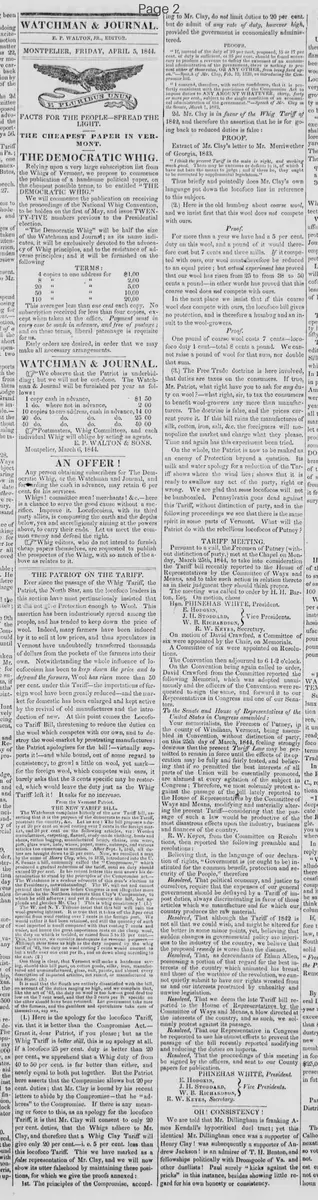
Ever since the passage of the Whig Tariff, the Patriot, the North Star, and the locofoco leaders in this section have most pertinaciously insisted that it did not give Protection enough to Wool. This assertion has been industriously spread among the people, and has tended to keep down the price of wool. Indeed, many farmers have been induced by it to sell at low prices, and thus speculators in Vermont have undoubtedly transferred thousands of dollars from the pockets of the farmers into their own. Notwithstanding the whole influence of locofocoism has been to keep down the price and to defraud the farmers, Wool has risen more than 50 per cent. under this Tariff—the importations of foreign wool have been greatly reduced—and the market for domestic has been enlarged and kept active by the revival of old manufactures and the introduction of new. At this point comes the Locofo-co Tariff Bill, threatening to reduce the duties on the wool which competes with our own, and to destroy the wool-market by prostrating manufactures: the Patriot apologises for the bill!—virtually supports it!—and while bound, out of some regard to consistency, to growl a little on wool, yet mark—for the foreign wool, which competes with ours, it barely asks that the 3 cents specific may be restored, which would leave the duty just as the Whig Tariff left it! It asks for no increase.
From the Vermont Patriot.
THE NEW TARIFF BILL.
The Watchman complains bitterly of the new Tariff bill, asserting that it is the purpose of the democrats to ruin the Tariff, prostrate the country, &c. Let us see: the bill proposes a duty of 30 per cent on wool costing over 7 cents in the foreign market, and 30 per cent on the following articles, viz: Woolen manufactures, carpeting, flannel, ready-made clothing, boots and shoes, cotton bagging, manufactured hemp, chains, iron ware, pins, glass ware, hats, wines, paper, mace, nutmegs, and various articles too numerous to mention. After Sept. 1, 1845, all duties are brought down to 20 per cent. Now, we recollect a man by the name of Henry Clay, who, in 1833, introduced into the U. S. Senate a bill, commonly called the "Compromise," which produced a gradual reduction of the tariff, until no duty should exceed 20 per cent. In his recent letters this man avows his determination to stand by the principles of the Compromise act.—The Watchman is a zealous advocate of this man's election to the Presidency, notwithstanding! The W. will not and cannot pretend that the bill now before Congress is not altogether more favorable to the Northern interests than Clay's Compromise, to which he still adheres; and yet it denounces the bill, but applauds and glorifies Mr. Clay! This is whig consistency! (1.)
The W. and N. Y. Tribune insist that this bill will ruin the wool-growing interest. It is true that it takes off the 3 per cent specific from wool costing over 7 cents in the foreign port. We would rather it had been retained, and still the quantity of such wool imported is small compared with that costing 7 cents and under, and hence the great importance rests on the cheap wool, the duty on which is trebled, or raised from 5 to 15 per cent.—This, however, we consider inadequate for revenue purposes—Although three times as high as the duty imposed by the whig tariff of '42, the duty on wool costing 7 cents would amount to but a trifle over one cent per lb., and so down along according to the cost. (2)
One thing is clear, that Vermont will make a handsome saving, should this bill pass, on cotton goods, silks, iron, manufactured and unmanufactured, glass, salt, paints, and almost every description of imported articles, not raised, or manufactured in this State. (3.)
It is said that the South are entirely dissatisfied with the bill on account of the duties running so high, and we complain that, like the act of '42, the duty on wool is too low—a good deal too low on the 7 cent wool, and that the 3 cents per lb specific on the other should have been retained. Let government take care of the farmers, and the gamblers and speculators take care of themselves, say we,
(1.) Here is the apology for the locofoco Tariff, viz. that it is better than the Compromise Act.—Grant it, dear Patriot, if you please; but as the Whig Tariff is better still, this is no apology at all. If a locofoco 25 per cent. duty is better than 20 per cent., we apprehend that a Whig duty of from 40 to 50 per cent. is far better than either, and nearly equal to both put together. But the Patriot here asserts that the Compromise allows but 20 per cent. duties; that Mr. Clay is bound by his recent letters to abide by the Compromise—that he "adheres" to the Compromise. If there is any meaning or force to this, as an apology for the locofoco Tariff, it is that Mr. Clay will consent to only 20 per cent. duties, that the Whigs adhere to Mr. Clay, and therefore that a Whig Clay Tariff will give only 20 per cent.—i. e. 5 per cent. less than this locofoco Tariff. This we have marked as a false representation of Mr. Clay, and we will now show its utter falsehood by maintaining these positions, for which we give the proofs annexed:
1st. The principles of the Compromise, according to Mr. Clay, do not limit duties to 20 per cent. but do admit of any rate of duty, however high, provided the government is economically administered.
PROOFS.
"If, instead of the duty of 20 per cent. proposed, 15 or 17 per cent, of duty is sufficient, or 25 per cent. should be found necessary to produce a revenue to defray the expenses of an economical administration of the government, there is nothing to prevent either of those rates, OR ANY OTHER, from being fixed upon."—Speech of Mr. Clay, Feb. 12, 1833, on introducing the Compromise bill.
"I contend, therefore, with entire confidence, that it is perfectly consistent with the provisions of the Compromise Act to impose duties to ANY AMOUNT WHATEVER, thirty, forty or more per cent., subject to the single condition of an economical administration of the government."—Speech of Mr. Clay in the Senate, March 1, 1842.
2d. Mr. Clay is in favor of the Whig Tariff of 1842, and therefore the assertion that he is for going back to reduced duties is false:
PROOF.
Extract of Mr. Clay's letter to Mr. Merriwether of Georgia, 1843.
"I think the present Tariff in the main is right, and working much good. There may be excesses or defects in it, of which I have not here the means to judge; and if there be, they ought to be corrected by supplemental legislation."
Thus briefly and pointedly does Mr. Clay's own language put down the locofoco lies in reference to this subject.
(2.) Here is the old humbug about coarse wool, and we insist first that this wool does not compete with ours.
Proof.
For more than a year we have had a 5 per cent. duty on this wool, and a pound of it would therefore cost but 7 cents and three mills. If it competed with ours, our wool must—therefore be reduced to an equal price; but actual experiment has proved that our wool has risen from 25 to from 38 to 50 cents a pound—in other words has proved that this coarse wool does not compete with ours.
In the next place we insist that if this coarse wool does compete with ours, the locofoco bill gives no protection, and is therefore a humbug and an insult to the wool-growers.
Proof.
One pound of coarse wool costs 7 cents—locofoco duty 1 cent—total 8 cents a pound. We cannot raise a pound of wool for that sum, nor double that sum.
(3.) The Free Trade doctrine is here involved, that duties are taxes on the consumers. If true, Mr. Patriot, what right have you to ask for any duty on wool?—what right, sir, to tax the consumers to benefit wool-growers any more than manufacturers. The doctrine is false, and the prices current prove it. If this bill ruins the manufactures of silk, cotton, iron, salt, &c. the foreigners will monopolize the market and charge what they please. Time and again has this experiment been tried.
On the whole, the Patriot is now to be ranked as an enemy of Protection beyond a question. Its milk and water apology for a reduction of the Tariff shows where the wind lies; shows that it is ready to swallow any act of the party, right or wrong. We are glad that some locofocos will not be bamboozled. Pennsylvania goes dead against this Tariff, without distinction of party, and in the following proceedings we see that there is the same spirit in some parts of Vermont. What will the Patriot do with the rebellious locofocos of Putney?
Ever since the passage of the Whig Tariff, the Patriot, the North Star, and the locofoco leaders in this section have most pertinaciously insisted that it did not give Protection enough to Wool. This assertion has been industriously spread among the people, and has tended to keep down the price of wool. Indeed, many farmers have been induced by it to sell at low prices, and thus speculators in Vermont have undoubtedly transferred thousands of dollars from the pockets of the farmers into their own. Notwithstanding the whole influence of locofocoism has been to keep down the price and to defraud the farmers, Wool has risen more than 50 per cent. under this Tariff—the importations of foreign wool have been greatly reduced—and the market for domestic has been enlarged and kept active by the revival of old manufactures and the introduction of new. At this point comes the Locofo-co Tariff Bill, threatening to reduce the duties on the wool which competes with our own, and to destroy the wool-market by prostrating manufactures: the Patriot apologises for the bill!—virtually supports it!—and while bound, out of some regard to consistency, to growl a little on wool, yet mark—for the foreign wool, which competes with ours, it barely asks that the 3 cents specific may be restored, which would leave the duty just as the Whig Tariff left it! It asks for no increase.
From the Vermont Patriot.
THE NEW TARIFF BILL.
The Watchman complains bitterly of the new Tariff bill, asserting that it is the purpose of the democrats to ruin the Tariff, prostrate the country, &c. Let us see: the bill proposes a duty of 30 per cent on wool costing over 7 cents in the foreign market, and 30 per cent on the following articles, viz: Woolen manufactures, carpeting, flannel, ready-made clothing, boots and shoes, cotton bagging, manufactured hemp, chains, iron ware, pins, glass ware, hats, wines, paper, mace, nutmegs, and various articles too numerous to mention. After Sept. 1, 1845, all duties are brought down to 20 per cent. Now, we recollect a man by the name of Henry Clay, who, in 1833, introduced into the U. S. Senate a bill, commonly called the "Compromise," which produced a gradual reduction of the tariff, until no duty should exceed 20 per cent. In his recent letters this man avows his determination to stand by the principles of the Compromise act.—The Watchman is a zealous advocate of this man's election to the Presidency, notwithstanding! The W. will not and cannot pretend that the bill now before Congress is not altogether more favorable to the Northern interests than Clay's Compromise, to which he still adheres; and yet it denounces the bill, but applauds and glorifies Mr. Clay! This is whig consistency! (1.)
The W. and N. Y. Tribune insist that this bill will ruin the wool-growing interest. It is true that it takes off the 3 per cent specific from wool costing over 7 cents in the foreign port. We would rather it had been retained, and still the quantity of such wool imported is small compared with that costing 7 cents and under, and hence the great importance rests on the cheap wool, the duty on which is trebled, or raised from 5 to 15 per cent.—This, however, we consider inadequate for revenue purposes—Although three times as high as the duty imposed by the whig tariff of '42, the duty on wool costing 7 cents would amount to but a trifle over one cent per lb., and so down along according to the cost. (2)
One thing is clear, that Vermont will make a handsome saving, should this bill pass, on cotton goods, silks, iron, manufactured and unmanufactured, glass, salt, paints, and almost every description of imported articles, not raised, or manufactured in this State. (3.)
It is said that the South are entirely dissatisfied with the bill on account of the duties running so high, and we complain that, like the act of '42, the duty on wool is too low—a good deal too low on the 7 cent wool, and that the 3 cents per lb specific on the other should have been retained. Let government take care of the farmers, and the gamblers and speculators take care of themselves, say we,
(1.) Here is the apology for the locofoco Tariff, viz. that it is better than the Compromise Act.—Grant it, dear Patriot, if you please; but as the Whig Tariff is better still, this is no apology at all. If a locofoco 25 per cent. duty is better than 20 per cent., we apprehend that a Whig duty of from 40 to 50 per cent. is far better than either, and nearly equal to both put together. But the Patriot here asserts that the Compromise allows but 20 per cent. duties; that Mr. Clay is bound by his recent letters to abide by the Compromise—that he "adheres" to the Compromise. If there is any meaning or force to this, as an apology for the locofoco Tariff, it is that Mr. Clay will consent to only 20 per cent. duties, that the Whigs adhere to Mr. Clay, and therefore that a Whig Clay Tariff will give only 20 per cent.—i. e. 5 per cent. less than this locofoco Tariff. This we have marked as a false representation of Mr. Clay, and we will now show its utter falsehood by maintaining these positions, for which we give the proofs annexed:
1st. The principles of the Compromise, according to Mr. Clay, do not limit duties to 20 per cent. but do admit of any rate of duty, however high, provided the government is economically administered.
PROOFS.
"If, instead of the duty of 20 per cent. proposed, 15 or 17 per cent, of duty is sufficient, or 25 per cent. should be found necessary to produce a revenue to defray the expenses of an economical administration of the government, there is nothing to prevent either of those rates, OR ANY OTHER, from being fixed upon."—Speech of Mr. Clay, Feb. 12, 1833, on introducing the Compromise bill.
"I contend, therefore, with entire confidence, that it is perfectly consistent with the provisions of the Compromise Act to impose duties to ANY AMOUNT WHATEVER, thirty, forty or more per cent., subject to the single condition of an economical administration of the government."—Speech of Mr. Clay in the Senate, March 1, 1842.
2d. Mr. Clay is in favor of the Whig Tariff of 1842, and therefore the assertion that he is for going back to reduced duties is false:
PROOF.
Extract of Mr. Clay's letter to Mr. Merriwether of Georgia, 1843.
"I think the present Tariff in the main is right, and working much good. There may be excesses or defects in it, of which I have not here the means to judge; and if there be, they ought to be corrected by supplemental legislation."
Thus briefly and pointedly does Mr. Clay's own language put down the locofoco lies in reference to this subject.
(2.) Here is the old humbug about coarse wool, and we insist first that this wool does not compete with ours.
Proof.
For more than a year we have had a 5 per cent. duty on this wool, and a pound of it would therefore cost but 7 cents and three mills. If it competed with ours, our wool must—therefore be reduced to an equal price; but actual experiment has proved that our wool has risen from 25 to from 38 to 50 cents a pound—in other words has proved that this coarse wool does not compete with ours.
In the next place we insist that if this coarse wool does compete with ours, the locofoco bill gives no protection, and is therefore a humbug and an insult to the wool-growers.
Proof.
One pound of coarse wool costs 7 cents—locofoco duty 1 cent—total 8 cents a pound. We cannot raise a pound of wool for that sum, nor double that sum.
(3.) The Free Trade doctrine is here involved, that duties are taxes on the consumers. If true, Mr. Patriot, what right have you to ask for any duty on wool?—what right, sir, to tax the consumers to benefit wool-growers any more than manufacturers. The doctrine is false, and the prices current prove it. If this bill ruins the manufactures of silk, cotton, iron, salt, &c. the foreigners will monopolize the market and charge what they please. Time and again has this experiment been tried.
On the whole, the Patriot is now to be ranked as an enemy of Protection beyond a question. Its milk and water apology for a reduction of the Tariff shows where the wind lies; shows that it is ready to swallow any act of the party, right or wrong. We are glad that some locofocos will not be bamboozled. Pennsylvania goes dead against this Tariff, without distinction of party, and in the following proceedings we see that there is the same spirit in some parts of Vermont. What will the Patriot do with the rebellious locofocos of Putney?
What sub-type of article is it?
Economic Policy
Partisan Politics
Trade Or Commerce
What keywords are associated?
Tariff Protection
Wool Industry
Whig Tariff
Locofoco Bill
Henry Clay
Vermont Farmers
What entities or persons were involved?
Vermont Patriot
Henry Clay
Watchman
N.Y. Tribune
Locofocos
Whigs
Editorial Details
Primary Topic
Defense Of Whig Tariff Against Locofoco Bill
Stance / Tone
Strongly Pro Protectionist, Anti Democratic Tariff Reduction
Key Figures
Vermont Patriot
Henry Clay
Watchman
N.Y. Tribune
Locofocos
Whigs
Key Arguments
Whig Tariff Of 1842 Has Raised Wool Prices Over 50% And Reduced Foreign Imports
Locofoco Bill Reduces Duties On Competing Foreign Wool, Threatening Domestic Market
Henry Clay Supports High Protective Duties Consistent With Compromise Act Principles
Coarse Foreign Wool Does Not Compete With Vermont Wool Under Current Duties
New Bill Provides Inadequate Protection For Wool Growers Despite Tripling Duty On Cheap Wool
Tariff Reductions Benefit Consumers But Risk Foreign Monopolization Of Markets