Thank you for visiting SNEWPapers!
Sign up free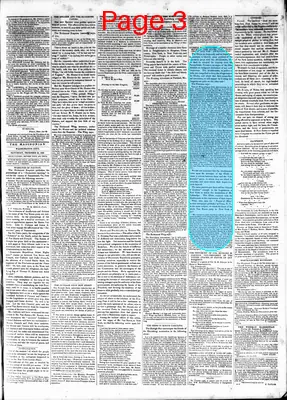
Editorial
December 21, 1839
The Madisonian
Washington, District Of Columbia
What is this article about?
Editorial from a Whig perspective criticizes the Globe newspaper for hypocritically accusing opposition of allying with abolitionists, while evidence shows Democrats gaining support from abolitionists in elections in Massachusetts, Vermont, and Rhode Island. Defends Judge Morton's anti-slavery record and opposes re-election of pro-slavery Senator Tallmadge in New York.
Clipping
OCR Quality
96%
Excellent
Full Text
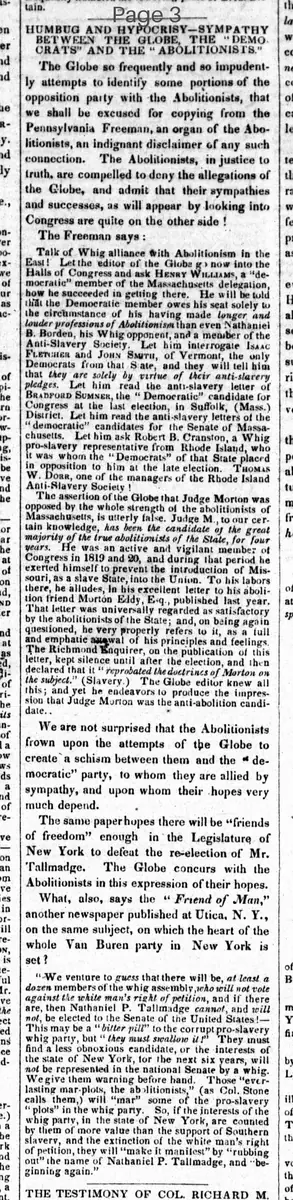
HUMBUG AND HYPOCRISY—SYMPATHY BETWEEN THE GLOBE, THE "DEMOCRATS" AND THE "ABOLITIONISTS."
The Globe so frequently and so impudently attempts to identify some portions of the opposition party with the Abolitionists, that we shall be excused for copying from the Pennsylvania Freeman, an organ of the Abolitionists, an indignant disclaimer of any such connection. The Abolitionists, in justice to truth, are compelled to deny the allegations of the Globe, and admit that their sympathies and successes, as will appear by looking into Congress are quite on the other side!
The Freeman says:
Talk of Whig alliance with Abolitionism in the East! Let the editor of the Globe go into the Halls of Congress and ask Henry Williams, a "democratic" member of the Massachusetts delegation, how he succeeded in getting there. He will be told that the Democratic member owes his seat solely to the circumstance of his having made longer and louder professions of Abolitionism than even Nathaniel B. Borden, his Whig opponent, and a member of the Anti-Slavery Society. Let him interrogate Isaac Fletcher and John Smith, of Vermont, the only Democrats from that State, and they will tell him that they are solely by virtue of their anti-slavery pledges. Let him read the anti-slavery letter of Bradford Sumner, the "Democratic" candidate for Congress at the last election, in Suffolk, (Mass.) District. Let him read the anti-slavery letters of the "democratic" candidates for the Senate of Massachusetts. Let him ask Robert B. Cranston, a Whig pro-slavery representative from Rhode Island, who it was whom the "Democrats" of that State placed in opposition to him at the late election. Thomas W. Dorr, one of the managers of the Rhode Island Anti-Slavery Society!
The assertion of the Globe that Judge Morton was opposed by the whole strength of the abolitionists of Massachusetts, is utterly false. Judge M., to our certain knowledge, has been the candidate of the great majority of the true abolitionists of the State, for four years. He was an active and vigilant member of Congress in 1819 and 20, and during that period he exerted himself to prevent the introduction of Missouri, as a slave State, into the Union. To his labors there, he alludes, in his excellent letter to his abolition friend Morton Eddy, Esq., published last year. That letter was universally regarded as satisfactory by the abolitionists of the State; and, on being again questioned, he very properly refers to it, as a full and emphatic avowal of his principles and feelings.
The Richmond Enquirer, on the publication of this letter, kept silence until after the election, and then declared that it "reprobated the doctrines of Morton on the subject." (Slavery.) The Globe editor knew all this; and yet he endeavors to produce the impression that Judge Morton was the anti-abolition candidate.
We are not surprised that the Abolitionists frown upon the attempts of the Globe to create a schism between them and the "democratic" party, to whom they are allied by sympathy, and upon whom their hopes very much depend.
The same paper hopes there will be "friends of freedom" enough in the Legislature of New York to defeat the re-election of Mr. Tallmadge. The Globe concurs with the Abolitionists in this expression of their hopes.
What, also, says the "Friend of Man," another newspaper published at Utica, N. Y., on the same subject, on which the heart of the whole Van Buren party in New York is set?
"We venture to guess that there will be, at least a dozen members of the Whig assembly, who will not vote against the white man's right of petition, and if there are, then Nathaniel P. Tallmadge cannot, and will not, be elected to the Senate of the United States! This may be a "bitter pill" to the corrupt pro-slavery Whig party, but "they must swallow it." They must find a less obnoxious candidate, or the interests of the state of New York, for the next six years, will not be represented in the national Senate by a Whig. We give them warning before hand. Those "everlasting mar-plots, the abolitionists," (as Col. Stone calls them,) will "mar" some of the pro-slavery "plots" in the Whig party. So, if the interests of the Whig party, in the state of New York, are counted by them of more value than the support of Southern slavery, and the extinction of the white man's right of petition, they will "make it manifest" by "rubbing out" the name of Nathaniel P. Tallmadge, and "beginning again."
The Globe so frequently and so impudently attempts to identify some portions of the opposition party with the Abolitionists, that we shall be excused for copying from the Pennsylvania Freeman, an organ of the Abolitionists, an indignant disclaimer of any such connection. The Abolitionists, in justice to truth, are compelled to deny the allegations of the Globe, and admit that their sympathies and successes, as will appear by looking into Congress are quite on the other side!
The Freeman says:
Talk of Whig alliance with Abolitionism in the East! Let the editor of the Globe go into the Halls of Congress and ask Henry Williams, a "democratic" member of the Massachusetts delegation, how he succeeded in getting there. He will be told that the Democratic member owes his seat solely to the circumstance of his having made longer and louder professions of Abolitionism than even Nathaniel B. Borden, his Whig opponent, and a member of the Anti-Slavery Society. Let him interrogate Isaac Fletcher and John Smith, of Vermont, the only Democrats from that State, and they will tell him that they are solely by virtue of their anti-slavery pledges. Let him read the anti-slavery letter of Bradford Sumner, the "Democratic" candidate for Congress at the last election, in Suffolk, (Mass.) District. Let him read the anti-slavery letters of the "democratic" candidates for the Senate of Massachusetts. Let him ask Robert B. Cranston, a Whig pro-slavery representative from Rhode Island, who it was whom the "Democrats" of that State placed in opposition to him at the late election. Thomas W. Dorr, one of the managers of the Rhode Island Anti-Slavery Society!
The assertion of the Globe that Judge Morton was opposed by the whole strength of the abolitionists of Massachusetts, is utterly false. Judge M., to our certain knowledge, has been the candidate of the great majority of the true abolitionists of the State, for four years. He was an active and vigilant member of Congress in 1819 and 20, and during that period he exerted himself to prevent the introduction of Missouri, as a slave State, into the Union. To his labors there, he alludes, in his excellent letter to his abolition friend Morton Eddy, Esq., published last year. That letter was universally regarded as satisfactory by the abolitionists of the State; and, on being again questioned, he very properly refers to it, as a full and emphatic avowal of his principles and feelings.
The Richmond Enquirer, on the publication of this letter, kept silence until after the election, and then declared that it "reprobated the doctrines of Morton on the subject." (Slavery.) The Globe editor knew all this; and yet he endeavors to produce the impression that Judge Morton was the anti-abolition candidate.
We are not surprised that the Abolitionists frown upon the attempts of the Globe to create a schism between them and the "democratic" party, to whom they are allied by sympathy, and upon whom their hopes very much depend.
The same paper hopes there will be "friends of freedom" enough in the Legislature of New York to defeat the re-election of Mr. Tallmadge. The Globe concurs with the Abolitionists in this expression of their hopes.
What, also, says the "Friend of Man," another newspaper published at Utica, N. Y., on the same subject, on which the heart of the whole Van Buren party in New York is set?
"We venture to guess that there will be, at least a dozen members of the Whig assembly, who will not vote against the white man's right of petition, and if there are, then Nathaniel P. Tallmadge cannot, and will not, be elected to the Senate of the United States! This may be a "bitter pill" to the corrupt pro-slavery Whig party, but "they must swallow it." They must find a less obnoxious candidate, or the interests of the state of New York, for the next six years, will not be represented in the national Senate by a Whig. We give them warning before hand. Those "everlasting mar-plots, the abolitionists," (as Col. Stone calls them,) will "mar" some of the pro-slavery "plots" in the Whig party. So, if the interests of the Whig party, in the state of New York, are counted by them of more value than the support of Southern slavery, and the extinction of the white man's right of petition, they will "make it manifest" by "rubbing out" the name of Nathaniel P. Tallmadge, and "beginning again."
What sub-type of article is it?
Slavery Abolition
Partisan Politics
What keywords are associated?
Abolitionists
Democrats
Whigs
Globe Newspaper
Judge Morton
Nathaniel Tallmadge
Anti Slavery Pledges
Congressional Elections
Right Of Petition
Massachusetts Politics
What entities or persons were involved?
Globe
Pennsylvania Freeman
Henry Williams
Nathaniel B. Borden
Isaac Fletcher
John Smith
Bradford Sumner
Robert B. Cranston
Thomas W. Dorr
Judge Morton
Morton Eddy
Richmond Enquirer
Nathaniel P. Tallmadge
Van Buren Party
Friend Of Man
Col. Stone
Editorial Details
Primary Topic
Hypocrisy Of Globe In Accusing Whigs Of Abolitionist Alliance While Democrats Benefit From It
Stance / Tone
Indignant Defense Of Whigs And Exposure Of Democratic Abolitionist Sympathies
Key Figures
Globe
Pennsylvania Freeman
Henry Williams
Nathaniel B. Borden
Isaac Fletcher
John Smith
Bradford Sumner
Robert B. Cranston
Thomas W. Dorr
Judge Morton
Morton Eddy
Richmond Enquirer
Nathaniel P. Tallmadge
Van Buren Party
Friend Of Man
Col. Stone
Key Arguments
Globe Falsely Identifies Opposition With Abolitionists
Democrats Like Henry Williams Elected Due To Stronger Abolitionist Professions Than Whigs
Vermont Democrats Isaac Fletcher And John Smith Elected On Anti Slavery Pledges
Democratic Candidates In Massachusetts Issued Anti Slavery Letters
Democrats In Rhode Island Nominated Thomas W. Dorr, Anti Slavery Leader, Against Whig
Judge Morton Supported By Majority Of Abolitionists For His Anti Slavery Record In 1819 20
Globe Misrepresents Morton As Anti Abolition Candidate
Abolitionists Allied With Democrats By Sympathy
Abolitionists And Globe Hope To Defeat Tallmadge's Re Election Over Petition Rights
Utica's Friend Of Man Warns Whigs To Replace Tallmadge Or Lose Senate Seat