Thank you for visiting SNEWPapers!
Sign up free
Daily Cincinnati Republican
Cincinnati, Hamilton County, Ohio
What is this article about?
Daniel O'Connell's ongoing campaign for Irish repeal of the Union persists under Tory ministry, with a declaration urging peaceful perseverance, meetings, and petitions to the Queen. Tory response labels it high treason and nonsense. Commentary highlights aristocratic tyranny fueling agitations in Britain and Ireland.
Clipping
OCR Quality
Full Text
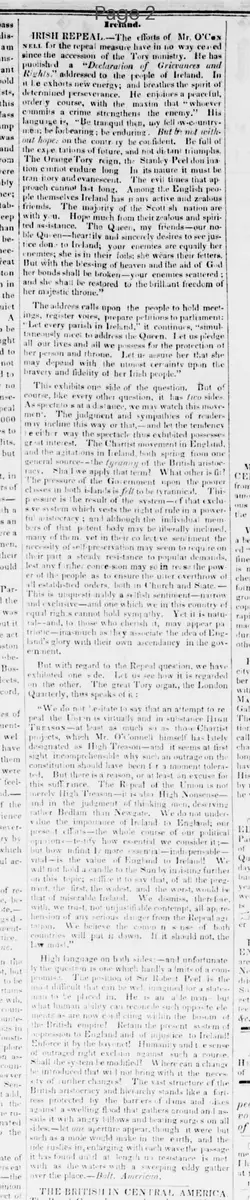
IRISH REPEAL.—The efforts of Mr. O'Connell for the repeal measure have in no way ceased since the accession of the Tory ministry. He has published a "Declaration of Grievances and Rights," addressed to the people of Ireland. In it he exhorts new energy; and breathes the spirit of determined perseverance. He enjoins a peaceful ordered course, with the maxim that "whoever commits a crime strengthens the enemy." His language is, "Be tranquil then, my fellow-countrymen: be forbearing; be enduring. But be not without hope: on the contrary be confident. Be full of the expectations of future, and not distant triumphs. The Orange Tory reign, the Stanley Peel domination cannot endure long. In its nature it must be transitory and evanescent. The evil times that approach cannot last long. Among the English people themselves Ireland has many active and zealous friends. The majority of the Scottish nation are with you. Hope much from their zealous and spirited assistance. The Queen, my friends—our noble Queen—heartily and sincerely desires to see justice done to Ireland; your enemies are equally her enemies; she is in their toils: she wears their fetters. But with the blessing of heaven and the aid of God her bonds shall be broken—your enemies scattered: and she shall be restored to the brilliant freedom of her majestic throne."
The address calls upon the people to hold meetings, register votes, prepare petitions to parliament: "Let every parish in Ireland," it continues, "simultaneously meet to address the Queen. Let us pledge all our lives and all we possess for the protection of her person and throne. Let us assure her that she may depend with the utmost certainty upon the bravery and fidelity of her Irish people."
This exhibits one side of the question, But of course, like every other question, it has two sides. As spectators at a distance, we may watch this movement. The judgment and sympathies of readers may incline this way or that,—and let the tendency be either way the spectacle thus exhibited possesses great interest. The Chartist movement in England, and the agitations in Ireland, both spring from one general source—the tyranny of the British aristocracy. Shall we apply that term? What other is fit? The pressure of the Government upon the poorer classes in both islands is felt to be tyrannical. This pressure is the result of the system—of that exclusive system which vests the right of rule in a powerful aristocracy; and although the individual members of that potent body may be liberally minded, many of them yet in their collective sentiment the necessity of self-preservation may seem to require on their part a steady resistance to popular demands, lest any further concession may so increase the power of the people as to ensure the utter overthrow of established orders, both in Church and State.
This is unquestionably a selfish sentiment—narrow and exclusive—and one which we in this country of equal rights cannot hold sympathy. Yet it is natural—and, to those who cherish it, may appear patriotic—inasmuch as they associate the idea of England's glory with their own ascendancy in the government.
But with regard to the Repeal question, we have exhausted one side. Let us see how it is regarded on the other. The great Tory organ, the London Quarterly, thus speaks of it:
"We do not hesitate to say that an attempt to repeal the Union is virtually and in substance High Treason—at least as much so as those Chartist projects, which Mr. O'Connell himself has lately designated as High Treason—and it seems at first sight wholly incomprehensible why such an outrageous constitutional conspiracy should have been for a moment tolerated. But there is a reason, or at least an excuse for this sufferance. The Repeal of the Union is not merely High Treason—it is also High Nonsense—and in the judgment of this kingdom, deserving rather Bedlam than Newgate. We do not undervalue the importance of Ireland to England; our present efforts—the whole course of our political policy—testify how essential we consider it:—but how infinitely more essential—and indispensable—with us is the value of England to Ireland! We will not hold a candle to the Sun by minutely dilating further on this topic; suffice it to say that, of all the pregnancies the first, the widest, and the worst, would be that of miserable Ireland. We dismiss, therefore, with, we trust, no unjustifiable contempt, all apprehension of any serious danger from the Repeal agitation. We believe the common sense of both countries will put it down. If it should not, the law must."
High language on both sides:—and unfortunately the question is one where hardly a hint of a compromise. The position of Sir Robert Peel is the most difficult that can be imagined for a statesman to be placed in. He is an able man but what human agency can reconcile such opposite elements as are now clashing within the bosom of the British empire? Retain the present system of oppression to England and of injustice to Ireland! Enforce it by the bayonet! Humanity and the sense of outraged right exclaim against such a course. Shall the system be modified? Where can a change be introduced that will not bring with it the necessity of further changes? The vast structure of the British aristocracy and hierarchy stands like a fortress protected by the barriers of custom and prejudice against a swelling flood that gathers around and assails it with angry billows and beating surges on all sides.—Let any aperture appear, though it were but such as a mole would make in the earth, and the rude rushes in, enlarging with each wave the passage it has found and at length no resistance is met with as the waters with a sweeping eddy gather over the place.—Balt. American.
What sub-type of article is it?
What keywords are associated?
What entities or persons were involved?
Where did it happen?
Foreign News Details
Primary Location
Ireland
Key Persons
Event Details
Mr. O'Connell publishes a Declaration of Grievances and Rights urging Irish people to peacefully agitate for repeal of the Union, hold meetings, register votes, and petition the Queen, expressing hope in her support and the transience of Tory rule. The London Quarterly denounces the repeal as high treason and nonsense, predicting its failure. Commentary from Baltimore American critiques British aristocratic tyranny fueling Irish and English agitations.