Thank you for visiting SNEWPapers!
Sign up free
Letter to Editor
March 2, 1842
The North Carolina Standard
Raleigh, Wake County, North Carolina
What is this article about?
A letter signed 'CUMBERLAND' rebuts an editorial's distortions of Mr. Henry's letter, arguing that Henry critiqued Whig dominance over North Carolina's state funds and boards, not individuals' honesty, and calls for factual investigation into current political control.
Clipping
OCR Quality
95%
Excellent
Full Text
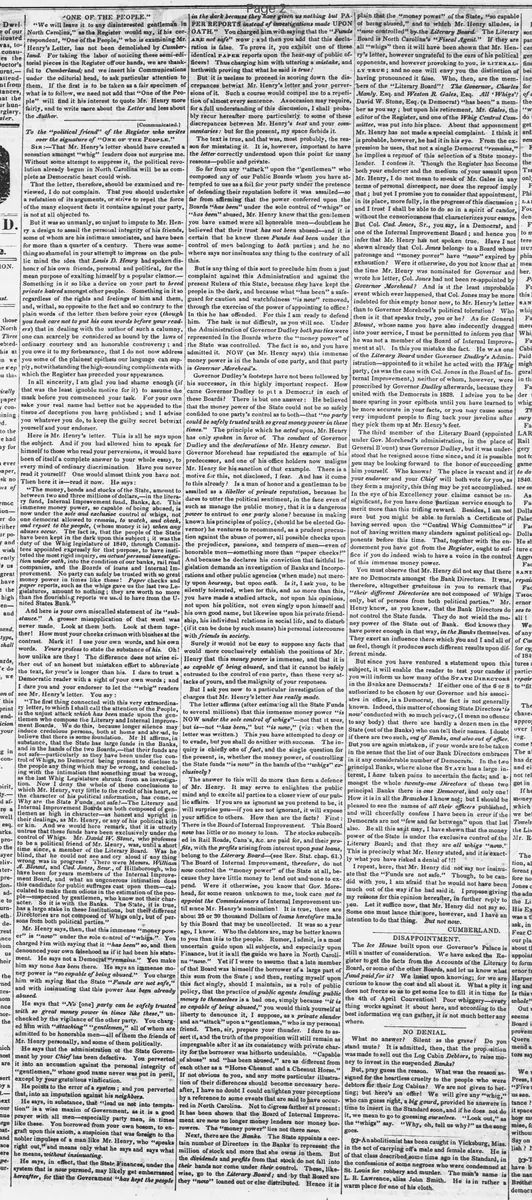
And here is your own miscalled statement of its "substance."
A grosser misapplication of that word was never made. Look at them both. Look at them together! How must your cheeks crimson with blushes at the contrast. Mark it! I use your own words, and his own words. Yours profess to state the substance of his.
Oh! how unlike are they! The difference does not arise either out of an honest but mistaken effort to abbreviate the text, for yours is longer than his. I dare to trust a Democratic reader with a sight of your own words; and I dare you and your endorser to let the "whig" readers see Mr. Henry's letter. You say:
"The first thing connected with this very extraordinary letter, to which I shall call the attention of the People, is the unjust attack which has been made upon the gentlemen who compose the Literary and Internal Improvement Boards. We do this, because longer silence may induce credulous persons, both at home and abroad, to believe that there is some foundation. Mr Henry affirms, in substance, that the State has large funds in the Banks, and in the hands of the two Boards,—that their funds are not safe—particularly as they have been under the control of Whigs, no Democrat being present to disclose to the people any thing which may be wrong, and concluding with the intimation that something must be wrong, as the last Whig Legislature shrunk from an investigation. Now I deny the whole of these conclusions to which Mr. Henry, very little to the credit of his heart, or the character of his political information, has come.
Why are the State Funds not safe? The Literary and Internal Improvement Boards are both composed of gentlemen as high in character—as honest and upright in their dealings, as Mr. Henry, or any of his political kith or kin. And we would here remark, that it is utterly untrue that these funds have been exclusively under the control of Whigs. Mr. David W. Stone, who professes to be a political friend of Mr. Henry, was, until a short time since, a member of the Literary Board. Was he blind, that he could not see and cry aloud if any thing wrong was in progress? There were Messrs. William A. Blount, and Cad. Jones, Senr., of Hillsborough, who have been for years members of the Internal Improvement Board, and what an ungenerous intimation does this candidate for public suffrages cast upon them—calculated to make them odious in the estimation of the people—suspected by gentlemen, who know not their character. So it is with the Banks. The State, it is true, has a large stake in these Institutions, but their different Directories are not composed of Whigs only, but of persons from both political parties."
Mr. Henry says, then, that this immense "money power" is now under the sole control of "whigs." You charged him with saying that it "has been" so, and then denounced your own falsehood as if it had been his statement. He says not a Democrat remains. You make him say none has been there. He says an immense money power is "so capable of being abused." You charge him with saying that the State "Funds are not safe," and with insinuating that this power has been already abused.
He says that "No [one] party can be safely trusted with so great money power in times like these," unchecked by the vigilance of the other party. You charged him with "attacking gentlemen," all of whom are admitted to be honorable men—all of them the friends of Mr. Henry personally, and some of them politically.
He says that the administration of the State Government by your Chief has been defective. You perverted it into an accusation against the personal integrity of "gentlemen," whose good name never was put in peril, except by your gratuitous vindication.
He points to the error of a system; and you perverted that, into an imputation against his neighbors.
He says, in substance, that "lead us not into temptation" is a wise maxim of Government, as it is a good prayer with all men—especially party men, in times like these. You borrowed from your own bosom, to engraft upon this axiom, a suspicion that was foreign to the nobler impulses of a man like Mr. Henry, who "speaks right out," and means only what he says and says what he means, without insinuating.
He says, in effect, that the State Finances, under the system that is now pursued, may likely get embarrassed hereafter, for that the Government "has kept the people in the dark because they have given us nothing but PAPER REPORTS instead of investigations made UPON OATH." You charged him with saying that the "Funds ARE not safe" now; and then you add that this declaration is false. To prove it, you exhibit one of these identical PAPER reports upon the hear-say of public officers! Thus charging him with uttering a mistake, and forthwith proving that what he said is true!
But it is useless to proceed in scoring down the discrepancies betwixt Mr. Henry's letter and your perversions of it. Such a course would compel me to a repetition of almost every sentence. As occasion may require, for a full understanding of this discussion, I shall probably recur hereafter more particularly to some of these discrepancies between Mr. Henry's text and your commentaries: but for the present, my space forbids it.
The text is true, and that was, most probably, the reason for misstating it. It is, however, important to have the letter correctly understood upon this point for many reasons—public and private.
So far from any "attack" upon the "gentlemen" who composed any of our Public Boards whom you have attempted to use as a foil for your party under the pretence of defending their reputation before it was assailed—so far from affirming that the power conferred upon the Boards "has been under the sole control of "whigs" or "has been" abused, Mr. Henry knew that the gentlemen you have named were all honorable men—doubtless he believed that their trust has not been abused—and it is certain that he knew these Funds had been under the control of men belonging to both parties; and he nowhere says nor insinuates any thing to the contrary of all this.
But is any thing of this sort to preclude him from a just complaint against this Administration and against the present Rulers of this State, because they have kept the people in the dark, and because what "has been a safe-guard for caution and watchfulness" is now "removed, through the exercise of the power of appointing to office?" In this he has offended. For this I am ready to defend him. The task is not difficult, as you will see. Under the Administration of Governor Dudley both parties were represented in the Boards where the "money power" of the State was controlled. The fact is so, and you have admitted it. Now (as Mr. Henry says) this immense money power is in the hands of one party, and that party is Governor Morehead's.
Governor Dudley's footsteps have not been followed by his successor, in this highly important respect. How came Governor Dudley to put a Democrat in each of these Boards? There is but one answer: He believed that the money power of the State could not be so safely confided to one party's control as to both—that "no party could be safely trusted with so great money power in these times."
The principle which he acted upon, Mr. Henry has only spoken in favor of. The conduct of Governor Dudley and the declarations of Mr. Henry concur. But Governor Morehead has repudiated the example of his predecessor, and one of his office holders now maligns Mr. Henry for his sanction of that example. There is a motive for this, not disclosed, I fear. And has it come to this already? Is a man of honor and a gentleman to be assailed as a libeller of private reputation, because he dares to utter the political sentiment, in the face even of such as manage the public money, that it is a dangerous power to entrust to one party alone? because in making known his principles of policy, (should he be elected Governor) he ventures to recommend, as a prudent precaution against the abuse of power, all possible checks upon the prejudices, passions, and tempers of men—even of honorable men—something more than "paper checks?"
And because he declares his conviction that faithful legislation demands an investigation of Banks and Incorporations and other public agencies (when made) not merely upon hearsay, but upon oath.
Is it, I ask you, to be silently tolerated, when for this, and no more than this, you have made a studied attack, not upon his opinions, not upon his politics, not even singly upon himself and his own good name, but likewise upon his private friendship, his individual relations in social life, and to disturb (if it can be done by such means) his personal intercourse with friends in society.
Surely it would not be easy to suppose any facts that would more conclusively establish the positions of Mr. Henry that this money power is immense, and that it is so capable of being abused, and that it cannot be safely entrusted to the control of one party, than these very attacks of yours, and the malignity of your responses.
But I ask you now to a particular investigation of the charges that Mr. Henry's letter has really made.
The letter affirms (after estimating all the State Funds to several millions) that this immense money power "is NOW under the sole control of whigs"—not that it was, but is—not "has been," but "is now," (viz: when the letter was written.)
This you have attempted to deny or to evade, but you shall do neither with success. The inquiry is chiefly one of fact, and the single question for the present, is, whether the money power, of controlling the State funds "is now" in the hands of the "whigs" exclusively?
The answer to this will do more than form a defence of Mr. Henry. It may serve to enlighten the public mind and to excite all parties to a closer view of our public affairs. If you are as ignorant as you pretend to be, it will surprise you—if you are not ignorant, it will expose your artifice to others. How then are the facts? First:
There is the Board of Internal Improvement. This Board now has little or no money to loan. The stocks subscribed in Rail Roads, Canals, &c. are paid for, and their profits, with the profits arising from interest upon past loans, belong to the Literary Board (see Rev. Stat. chap. 61.) The Board of Internal Improvement, therefore, do not now control the "money power" of the State at all, because they have little money to lend out and none to expend. Were it otherwise, you know that Gov. Morehead, for some reason unknown to me, took care not to appoint the Commissioners of Internal Improvement until since Mr. Henry's nomination! It is true, there are about 25 or 30 thousand Dollars of loans heretofore made by this Board that may be uncollected. It was so a year ago, I know. Who the debtors are, may be better known to you than it is to the people. Rumor, I admit, is a most uncertain guide upon all subjects, and especially upon Finance, but it is all the guide we have in North Carolina "now."
Yet if I were to assume that a late member of that Board was himself the borrower of a large part of this sum from the State; and then, resting myself upon this fact singly, should I maintain, as a rule of public policy, that the practice of public agents lending public money to themselves is a bad one, simply because "it is so capable of being abused," you would think yourself at liberty to denounce it, I suppose, as a private slander and an "attack" upon a "gentleman," who is my personal friend. Then, sir, prepare your thunder. I dare to assert it, and the truth of the proposition will still remain as impregnable after it as its consistency with private charity for the borrower was hitherto undeniable.
"Capable of abuse" and "has been abused," are as different from each other as a "Horse Chesnut and a Chesnut Horse."
If not obvious to you, and any more particular illustration of their differences should become necessary hereafter, I have no doubt I could enlighten your perceptions by a reference to some events that are said to have occurred in North Carolina. Not to digress farther at present:
It has been shown that the Board of Internal Improvement are now no longer money lenders nor money borrowers. The "money power" lies not there now.
Next, there are the Banks. The State appoints a certain number of Directors in the Banks to represent the million of stock and more that she owns in them. But the dividends and profits from that stock do not fall into their hands nor come under their control. These, likewise, go to the Literary Board; and by that Board are they "now loaned out or else distributed. Hence it is plain that the "money power" of the State, "so capable of being abused," and to which Mr. Henry alludes, is "now controlled" by the Literary Board. The Literary Board is North Carolina's "Fiscal Agent." If they are all "whigs" then it will have been shown that Mr. Henry's letter, however ungrateful to the ears of his political opponents, and however provoking to you, is LITERALLY TRUE; and no one will envy you the distinction of having pronounced it false. Who, then, are the members of the "Literary Board"? The Governor, Charles Manly, Esq. and Weston R. Gales, Esq. All 'Whigs'! David W. Stone, Esq. (a Democrat) "has been" a member as you say; but upon his retirement, Mr. Gales, the editor of the Register, and one of the Whig Central Committee, was put into his place. About that appointment Mr. Henry has not made a special complaint. I think it is probable, however, he had it in his eye. From the expression he uses, that not a single Democrat "remains," he implies a reproof of this selection of a State money-lender. I confess it. Though the Register has become both your endorser and the medium of your assault upon Mr. Henry, I do not mean to speak of Mr. Gales in any terms of personal disrespect, nor does the reproof imply that; but yet I promise you to consider that appointment, in its place, more fully, in the progress of this discussion; and I trust I shall be able to do so in a spirit of candor, without the censoriousness that characterizes your essays.
But Col. Cad. Jones, Sr., you say, is a Democrat, and one of the Internal Improvement Board; and hence you infer that Mr. Henry has not spoken true. Have I not shewn already that Col. Jones belongs to a Board whose patronage and "money power" is otherwise, do you not know that at the time Mr. Henry was nominated for Governor and wrote his letter, Col. Jones had not been re-appointed by Governor Morehead? And is it the least improbable event which ever happened, that Col. Jones may be more indebted for this empty honor now, to Mr. Henry's letter than to Governor Morehead's political toleration? Who then is it that speaks truly, you or he? As for General Blount, whose name you have also indecently dragged into your service, I must be permitted to inform you that he was not a member of the Board of Internal Improvement at all. In this you mistake the fact. He was one of the Literary Board under Governor Dudley's Administration—appointed to it whilst he acted with the Whig party, (as was the case with Col. Jones in the Board of Internal Improvement,) neither of whom, however, were proscribed by Governor Dudley afterwards, because they united with the Democrats in 1838. I advise you to be more sparing in your epithets until you have learned to be more accurate in your facts, or you may cause some very impudent people to fling back your javelins after they pick them up at Mr. Henry's feet.
The third member of the Literary Board (appointed under Gov. Morehead's administration, in the place of General Blount) was Governor Dudley, but it was understood that he resigned some time since, and it is possible you may be looking forward to the honor of succeeding him yourself. Who knows? The place is vacant and if your endorser and your Chief will both vote for you, as they form a majority, this thing may be yet accomplished. In the eye of his Excellency your claims cannot be insignificant, for you have done partizan service enough to merit more than this trifling reward. Besides, I am not sure but you might be able to furnish a Certificate of having served upon the "Central Whig Committee" if not of having written many slanders against political opponents before this time. That, together with the endorsement you have got from the Register, ought to suffice if you do indeed wish to have a voice in the control of this immense money power.
You must observe that Mr. Henry did not say that there are no Democrats amongst the Bank Directors. It was, therefore, altogether gratuitous in you to remark that "their different Directories are not composed of Whigs only, but of persons from both political parties." Mr. Henry knew, as you know, that the Bank Directors do not control the State funds. They do not wield the money power of the State out of Bank. God knows they have power enough in that way, in the Banks themselves. They exert an influence there which you and I and all of us feel, though it produces such different results upon different minds.
But since you have ventured a statement upon this subject, it will enable the reader to test your candor if you will inform us how many of the STATE Directors in the Banks are Democrats? If either one of the 6 or 8 authorized to be chosen by our Governor and his associates in office, is a Democrat, the fact is not generally known. Indeed, this matter of choosing State Directors is now conducted with so much privacy, (I mean no offence to any body) that there are hardly a dozen men in the State (out of the Banks) who can tell their names. I doubt if there are two such, out of Banks, and also out of office.
But you are again mistaken, if your words are to be taken in the sense that the list of our Bank Directors embraces in it any considerable number of Democrats. In the two principal Banks, where alone the State has a large interest, I have taken pains to ascertain the facts; and amongst the whole twenty-one Directors of these two principal Banks there is one Democrat, and only one! How it is in all the Branches I know not; but I should be pleased to see the names of all their officers published, and will cheerfully confess I have been in error if the Democrats are not "few and far between" upon that list also. Be all this as it may, I have shewn that the money power of the State is under the exclusive control of the Literary Board; and that they are all whigs now."
This is precisely what Mr. Henry stated, and it is exactly what you have risked a denial of !!!
I repeat, here, that Mr. Henry did not say nor insinuate that the "Funds are not safe." Though, to be candid with you, I am afraid that he would not have been much out of the way if he had said it. I propose giving my reasons for this opinion hereafter, in further reply to you. Let it suffice now, that Mr. Henry did not say so. Some one must lance this sore, however, and I have an intention to do that thing. But not now.
CUMBERLAND.
A grosser misapplication of that word was never made. Look at them both. Look at them together! How must your cheeks crimson with blushes at the contrast. Mark it! I use your own words, and his own words. Yours profess to state the substance of his.
Oh! how unlike are they! The difference does not arise either out of an honest but mistaken effort to abbreviate the text, for yours is longer than his. I dare to trust a Democratic reader with a sight of your own words; and I dare you and your endorser to let the "whig" readers see Mr. Henry's letter. You say:
"The first thing connected with this very extraordinary letter, to which I shall call the attention of the People, is the unjust attack which has been made upon the gentlemen who compose the Literary and Internal Improvement Boards. We do this, because longer silence may induce credulous persons, both at home and abroad, to believe that there is some foundation. Mr Henry affirms, in substance, that the State has large funds in the Banks, and in the hands of the two Boards,—that their funds are not safe—particularly as they have been under the control of Whigs, no Democrat being present to disclose to the people any thing which may be wrong, and concluding with the intimation that something must be wrong, as the last Whig Legislature shrunk from an investigation. Now I deny the whole of these conclusions to which Mr. Henry, very little to the credit of his heart, or the character of his political information, has come.
Why are the State Funds not safe? The Literary and Internal Improvement Boards are both composed of gentlemen as high in character—as honest and upright in their dealings, as Mr. Henry, or any of his political kith or kin. And we would here remark, that it is utterly untrue that these funds have been exclusively under the control of Whigs. Mr. David W. Stone, who professes to be a political friend of Mr. Henry, was, until a short time since, a member of the Literary Board. Was he blind, that he could not see and cry aloud if any thing wrong was in progress? There were Messrs. William A. Blount, and Cad. Jones, Senr., of Hillsborough, who have been for years members of the Internal Improvement Board, and what an ungenerous intimation does this candidate for public suffrages cast upon them—calculated to make them odious in the estimation of the people—suspected by gentlemen, who know not their character. So it is with the Banks. The State, it is true, has a large stake in these Institutions, but their different Directories are not composed of Whigs only, but of persons from both political parties."
Mr. Henry says, then, that this immense "money power" is now under the sole control of "whigs." You charged him with saying that it "has been" so, and then denounced your own falsehood as if it had been his statement. He says not a Democrat remains. You make him say none has been there. He says an immense money power is "so capable of being abused." You charge him with saying that the State "Funds are not safe," and with insinuating that this power has been already abused.
He says that "No [one] party can be safely trusted with so great money power in times like these," unchecked by the vigilance of the other party. You charged him with "attacking gentlemen," all of whom are admitted to be honorable men—all of them the friends of Mr. Henry personally, and some of them politically.
He says that the administration of the State Government by your Chief has been defective. You perverted it into an accusation against the personal integrity of "gentlemen," whose good name never was put in peril, except by your gratuitous vindication.
He points to the error of a system; and you perverted that, into an imputation against his neighbors.
He says, in substance, that "lead us not into temptation" is a wise maxim of Government, as it is a good prayer with all men—especially party men, in times like these. You borrowed from your own bosom, to engraft upon this axiom, a suspicion that was foreign to the nobler impulses of a man like Mr. Henry, who "speaks right out," and means only what he says and says what he means, without insinuating.
He says, in effect, that the State Finances, under the system that is now pursued, may likely get embarrassed hereafter, for that the Government "has kept the people in the dark because they have given us nothing but PAPER REPORTS instead of investigations made UPON OATH." You charged him with saying that the "Funds ARE not safe" now; and then you add that this declaration is false. To prove it, you exhibit one of these identical PAPER reports upon the hear-say of public officers! Thus charging him with uttering a mistake, and forthwith proving that what he said is true!
But it is useless to proceed in scoring down the discrepancies betwixt Mr. Henry's letter and your perversions of it. Such a course would compel me to a repetition of almost every sentence. As occasion may require, for a full understanding of this discussion, I shall probably recur hereafter more particularly to some of these discrepancies between Mr. Henry's text and your commentaries: but for the present, my space forbids it.
The text is true, and that was, most probably, the reason for misstating it. It is, however, important to have the letter correctly understood upon this point for many reasons—public and private.
So far from any "attack" upon the "gentlemen" who composed any of our Public Boards whom you have attempted to use as a foil for your party under the pretence of defending their reputation before it was assailed—so far from affirming that the power conferred upon the Boards "has been under the sole control of "whigs" or "has been" abused, Mr. Henry knew that the gentlemen you have named were all honorable men—doubtless he believed that their trust has not been abused—and it is certain that he knew these Funds had been under the control of men belonging to both parties; and he nowhere says nor insinuates any thing to the contrary of all this.
But is any thing of this sort to preclude him from a just complaint against this Administration and against the present Rulers of this State, because they have kept the people in the dark, and because what "has been a safe-guard for caution and watchfulness" is now "removed, through the exercise of the power of appointing to office?" In this he has offended. For this I am ready to defend him. The task is not difficult, as you will see. Under the Administration of Governor Dudley both parties were represented in the Boards where the "money power" of the State was controlled. The fact is so, and you have admitted it. Now (as Mr. Henry says) this immense money power is in the hands of one party, and that party is Governor Morehead's.
Governor Dudley's footsteps have not been followed by his successor, in this highly important respect. How came Governor Dudley to put a Democrat in each of these Boards? There is but one answer: He believed that the money power of the State could not be so safely confided to one party's control as to both—that "no party could be safely trusted with so great money power in these times."
The principle which he acted upon, Mr. Henry has only spoken in favor of. The conduct of Governor Dudley and the declarations of Mr. Henry concur. But Governor Morehead has repudiated the example of his predecessor, and one of his office holders now maligns Mr. Henry for his sanction of that example. There is a motive for this, not disclosed, I fear. And has it come to this already? Is a man of honor and a gentleman to be assailed as a libeller of private reputation, because he dares to utter the political sentiment, in the face even of such as manage the public money, that it is a dangerous power to entrust to one party alone? because in making known his principles of policy, (should he be elected Governor) he ventures to recommend, as a prudent precaution against the abuse of power, all possible checks upon the prejudices, passions, and tempers of men—even of honorable men—something more than "paper checks?"
And because he declares his conviction that faithful legislation demands an investigation of Banks and Incorporations and other public agencies (when made) not merely upon hearsay, but upon oath.
Is it, I ask you, to be silently tolerated, when for this, and no more than this, you have made a studied attack, not upon his opinions, not upon his politics, not even singly upon himself and his own good name, but likewise upon his private friendship, his individual relations in social life, and to disturb (if it can be done by such means) his personal intercourse with friends in society.
Surely it would not be easy to suppose any facts that would more conclusively establish the positions of Mr. Henry that this money power is immense, and that it is so capable of being abused, and that it cannot be safely entrusted to the control of one party, than these very attacks of yours, and the malignity of your responses.
But I ask you now to a particular investigation of the charges that Mr. Henry's letter has really made.
The letter affirms (after estimating all the State Funds to several millions) that this immense money power "is NOW under the sole control of whigs"—not that it was, but is—not "has been," but "is now," (viz: when the letter was written.)
This you have attempted to deny or to evade, but you shall do neither with success. The inquiry is chiefly one of fact, and the single question for the present, is, whether the money power, of controlling the State funds "is now" in the hands of the "whigs" exclusively?
The answer to this will do more than form a defence of Mr. Henry. It may serve to enlighten the public mind and to excite all parties to a closer view of our public affairs. If you are as ignorant as you pretend to be, it will surprise you—if you are not ignorant, it will expose your artifice to others. How then are the facts? First:
There is the Board of Internal Improvement. This Board now has little or no money to loan. The stocks subscribed in Rail Roads, Canals, &c. are paid for, and their profits, with the profits arising from interest upon past loans, belong to the Literary Board (see Rev. Stat. chap. 61.) The Board of Internal Improvement, therefore, do not now control the "money power" of the State at all, because they have little money to lend out and none to expend. Were it otherwise, you know that Gov. Morehead, for some reason unknown to me, took care not to appoint the Commissioners of Internal Improvement until since Mr. Henry's nomination! It is true, there are about 25 or 30 thousand Dollars of loans heretofore made by this Board that may be uncollected. It was so a year ago, I know. Who the debtors are, may be better known to you than it is to the people. Rumor, I admit, is a most uncertain guide upon all subjects, and especially upon Finance, but it is all the guide we have in North Carolina "now."
Yet if I were to assume that a late member of that Board was himself the borrower of a large part of this sum from the State; and then, resting myself upon this fact singly, should I maintain, as a rule of public policy, that the practice of public agents lending public money to themselves is a bad one, simply because "it is so capable of being abused," you would think yourself at liberty to denounce it, I suppose, as a private slander and an "attack" upon a "gentleman," who is my personal friend. Then, sir, prepare your thunder. I dare to assert it, and the truth of the proposition will still remain as impregnable after it as its consistency with private charity for the borrower was hitherto undeniable.
"Capable of abuse" and "has been abused," are as different from each other as a "Horse Chesnut and a Chesnut Horse."
If not obvious to you, and any more particular illustration of their differences should become necessary hereafter, I have no doubt I could enlighten your perceptions by a reference to some events that are said to have occurred in North Carolina. Not to digress farther at present:
It has been shown that the Board of Internal Improvement are now no longer money lenders nor money borrowers. The "money power" lies not there now.
Next, there are the Banks. The State appoints a certain number of Directors in the Banks to represent the million of stock and more that she owns in them. But the dividends and profits from that stock do not fall into their hands nor come under their control. These, likewise, go to the Literary Board; and by that Board are they "now loaned out or else distributed. Hence it is plain that the "money power" of the State, "so capable of being abused," and to which Mr. Henry alludes, is "now controlled" by the Literary Board. The Literary Board is North Carolina's "Fiscal Agent." If they are all "whigs" then it will have been shown that Mr. Henry's letter, however ungrateful to the ears of his political opponents, and however provoking to you, is LITERALLY TRUE; and no one will envy you the distinction of having pronounced it false. Who, then, are the members of the "Literary Board"? The Governor, Charles Manly, Esq. and Weston R. Gales, Esq. All 'Whigs'! David W. Stone, Esq. (a Democrat) "has been" a member as you say; but upon his retirement, Mr. Gales, the editor of the Register, and one of the Whig Central Committee, was put into his place. About that appointment Mr. Henry has not made a special complaint. I think it is probable, however, he had it in his eye. From the expression he uses, that not a single Democrat "remains," he implies a reproof of this selection of a State money-lender. I confess it. Though the Register has become both your endorser and the medium of your assault upon Mr. Henry, I do not mean to speak of Mr. Gales in any terms of personal disrespect, nor does the reproof imply that; but yet I promise you to consider that appointment, in its place, more fully, in the progress of this discussion; and I trust I shall be able to do so in a spirit of candor, without the censoriousness that characterizes your essays.
But Col. Cad. Jones, Sr., you say, is a Democrat, and one of the Internal Improvement Board; and hence you infer that Mr. Henry has not spoken true. Have I not shewn already that Col. Jones belongs to a Board whose patronage and "money power" is otherwise, do you not know that at the time Mr. Henry was nominated for Governor and wrote his letter, Col. Jones had not been re-appointed by Governor Morehead? And is it the least improbable event which ever happened, that Col. Jones may be more indebted for this empty honor now, to Mr. Henry's letter than to Governor Morehead's political toleration? Who then is it that speaks truly, you or he? As for General Blount, whose name you have also indecently dragged into your service, I must be permitted to inform you that he was not a member of the Board of Internal Improvement at all. In this you mistake the fact. He was one of the Literary Board under Governor Dudley's Administration—appointed to it whilst he acted with the Whig party, (as was the case with Col. Jones in the Board of Internal Improvement,) neither of whom, however, were proscribed by Governor Dudley afterwards, because they united with the Democrats in 1838. I advise you to be more sparing in your epithets until you have learned to be more accurate in your facts, or you may cause some very impudent people to fling back your javelins after they pick them up at Mr. Henry's feet.
The third member of the Literary Board (appointed under Gov. Morehead's administration, in the place of General Blount) was Governor Dudley, but it was understood that he resigned some time since, and it is possible you may be looking forward to the honor of succeeding him yourself. Who knows? The place is vacant and if your endorser and your Chief will both vote for you, as they form a majority, this thing may be yet accomplished. In the eye of his Excellency your claims cannot be insignificant, for you have done partizan service enough to merit more than this trifling reward. Besides, I am not sure but you might be able to furnish a Certificate of having served upon the "Central Whig Committee" if not of having written many slanders against political opponents before this time. That, together with the endorsement you have got from the Register, ought to suffice if you do indeed wish to have a voice in the control of this immense money power.
You must observe that Mr. Henry did not say that there are no Democrats amongst the Bank Directors. It was, therefore, altogether gratuitous in you to remark that "their different Directories are not composed of Whigs only, but of persons from both political parties." Mr. Henry knew, as you know, that the Bank Directors do not control the State funds. They do not wield the money power of the State out of Bank. God knows they have power enough in that way, in the Banks themselves. They exert an influence there which you and I and all of us feel, though it produces such different results upon different minds.
But since you have ventured a statement upon this subject, it will enable the reader to test your candor if you will inform us how many of the STATE Directors in the Banks are Democrats? If either one of the 6 or 8 authorized to be chosen by our Governor and his associates in office, is a Democrat, the fact is not generally known. Indeed, this matter of choosing State Directors is now conducted with so much privacy, (I mean no offence to any body) that there are hardly a dozen men in the State (out of the Banks) who can tell their names. I doubt if there are two such, out of Banks, and also out of office.
But you are again mistaken, if your words are to be taken in the sense that the list of our Bank Directors embraces in it any considerable number of Democrats. In the two principal Banks, where alone the State has a large interest, I have taken pains to ascertain the facts; and amongst the whole twenty-one Directors of these two principal Banks there is one Democrat, and only one! How it is in all the Branches I know not; but I should be pleased to see the names of all their officers published, and will cheerfully confess I have been in error if the Democrats are not "few and far between" upon that list also. Be all this as it may, I have shewn that the money power of the State is under the exclusive control of the Literary Board; and that they are all whigs now."
This is precisely what Mr. Henry stated, and it is exactly what you have risked a denial of !!!
I repeat, here, that Mr. Henry did not say nor insinuate that the "Funds are not safe." Though, to be candid with you, I am afraid that he would not have been much out of the way if he had said it. I propose giving my reasons for this opinion hereafter, in further reply to you. Let it suffice now, that Mr. Henry did not say so. Some one must lance this sore, however, and I have an intention to do that thing. But not now.
CUMBERLAND.
What sub-type of article is it?
Persuasive
Political
Investigative
What themes does it cover?
Politics
Economic Policy
Press Freedom
What keywords are associated?
Mr Henry Defense
State Funds Control
Whig Monopoly
Political Misrepresentation
Literary Board
Bank Directors
Governor Morehead
Oath Investigations
What entities or persons were involved?
Cumberland
The Printer
Letter to Editor Details
Author
Cumberland
Recipient
The Printer
Main Argument
the letter defends mr. henry against misrepresentations of his statements on state funds, clarifying that he criticized the exclusive whig control over immense money power and the lack of oath-based investigations, not the personal integrity of board members.
Notable Details
Quotes Mr. Henry's Letter Extensively
References Governors Dudley And Morehead
Discusses Literary Board And Internal Improvement Board Compositions
Highlights Bipartisan Representation Under Dudley Vs. Whig Exclusivity Under Morehead