Thank you for visiting SNEWPapers!
Sign up free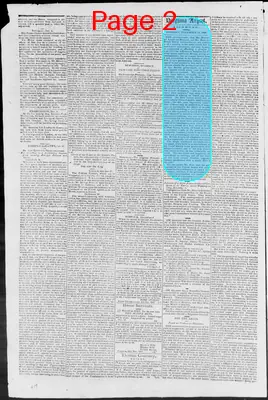
Editorial
December 15, 1807
Virginia Argus
Richmond, Virginia
What is this article about?
The Virginia Argus editorial criticizes the British King's proclamation allowing search and seizure of British-born seamen on American merchant vessels, despite their naturalization in the US. It warns that insistence on these principles in negotiations with envoys Monroe and Rose could lead to war, as the US will not tolerate such violations of sovereignty.
Clipping
OCR Quality
98%
Excellent
Full Text
VIRGINIA ARGUS.
RICHMOND:
TUESDAY, DECEMBER 15, 1807.
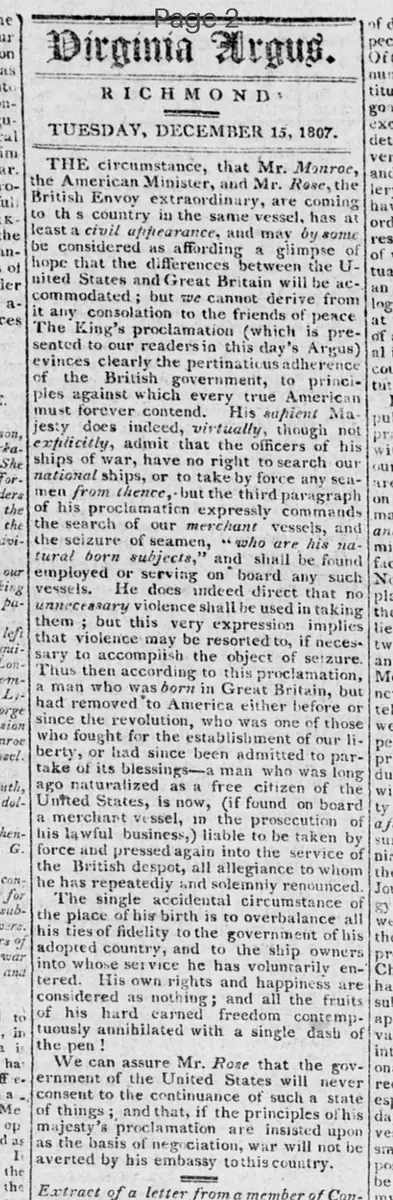
THE circumstance, that Mr. Monroe, the American Minister, and Mr. Rose, the British Envoy extraordinary, are coming to this country in the same vessel, has at least a civil appearance, and may by some be considered as affording a glimpse of hope that the differences between the United States and Great Britain will be accommodated; but we cannot derive from it any consolation to the friends of peace. The King's proclamation (which is presented to our readers in this day's Argus) evinces clearly the pertinacious adherence of the British government, to principles against which every true American must forever contend. His said Majesty does indeed, virtually, though not explicitly, admit that the officers of his ships of war, have no right to search our national ships, or to take by force any seamen from thence,—but the third paragraph of his proclamation expressly commands the search of our merchant vessels, and the seizure of seamen, "who are his natural born subjects," and shall be found employed or serving on board any such vessels. He does indeed direct that no unnecessary violence shall be used in taking them; but this very expression implies that violence may be resorted to, if necessary to accomplish the object of seizure.
Thus then according to this proclamation, a man who was born in Great Britain, but had removed to America either before or since the revolution, who was one of those who fought for the establishment of our liberty, or had since been admitted to partake of its blessings—a man who was long ago naturalized as a free citizen of the United States, is now, (if found on board a merchant vessel, in the prosecution of his lawful business,) liable to be taken by force and pressed again into the service of the British despot, all allegiance to whom he has repeatedly and solemnly renounced. The single accidental circumstance of the place of his birth is to overbalance all his ties of fidelity to the government of his adopted country, and to the ship owners into whose service he has voluntarily entered. His own rights and happiness are considered as nothing; and all the fruits of his hard earned freedom contemptuously annihilated with a single dash of the pen!
We can assure Mr. Rose that the government of the United States will never consent to the continuance of such a state of things; and that, if the principles of his majesty's proclamation are insisted upon as the basis of negociation, war will not be averted by his embassy to this country.
RICHMOND:
TUESDAY, DECEMBER 15, 1807.
THE circumstance, that Mr. Monroe, the American Minister, and Mr. Rose, the British Envoy extraordinary, are coming to this country in the same vessel, has at least a civil appearance, and may by some be considered as affording a glimpse of hope that the differences between the United States and Great Britain will be accommodated; but we cannot derive from it any consolation to the friends of peace. The King's proclamation (which is presented to our readers in this day's Argus) evinces clearly the pertinacious adherence of the British government, to principles against which every true American must forever contend. His said Majesty does indeed, virtually, though not explicitly, admit that the officers of his ships of war, have no right to search our national ships, or to take by force any seamen from thence,—but the third paragraph of his proclamation expressly commands the search of our merchant vessels, and the seizure of seamen, "who are his natural born subjects," and shall be found employed or serving on board any such vessels. He does indeed direct that no unnecessary violence shall be used in taking them; but this very expression implies that violence may be resorted to, if necessary to accomplish the object of seizure.
Thus then according to this proclamation, a man who was born in Great Britain, but had removed to America either before or since the revolution, who was one of those who fought for the establishment of our liberty, or had since been admitted to partake of its blessings—a man who was long ago naturalized as a free citizen of the United States, is now, (if found on board a merchant vessel, in the prosecution of his lawful business,) liable to be taken by force and pressed again into the service of the British despot, all allegiance to whom he has repeatedly and solemnly renounced. The single accidental circumstance of the place of his birth is to overbalance all his ties of fidelity to the government of his adopted country, and to the ship owners into whose service he has voluntarily entered. His own rights and happiness are considered as nothing; and all the fruits of his hard earned freedom contemptuously annihilated with a single dash of the pen!
We can assure Mr. Rose that the government of the United States will never consent to the continuance of such a state of things; and that, if the principles of his majesty's proclamation are insisted upon as the basis of negociation, war will not be averted by his embassy to this country.
What sub-type of article is it?
Foreign Affairs
War Or Peace
What keywords are associated?
Impressment
British Proclamation
Seamen Seizure
Us British Relations
Naval Searches
Naturalization Rights
What entities or persons were involved?
Mr. Monroe
Mr. Rose
King's Proclamation
British Government
United States Government
Editorial Details
Primary Topic
Critique Of British King's Proclamation On Impressment Of Seamen
Stance / Tone
Strongly Anti British, Pro American Sovereignty, Warning Of Potential War
Key Figures
Mr. Monroe
Mr. Rose
King's Proclamation
British Government
United States Government
Key Arguments
British Proclamation Allows Search Of American Merchant Vessels And Seizure Of Natural Born British Subjects
Impressment Violates Rights Of Naturalized Us Citizens Born In Britain
Us Will Not Accept These Principles In Negotiations
Insistence On Proclamation Could Lead To War
Proclamation Implies Use Of Violence If Necessary For Seizures