Thank you for visiting SNEWPapers!
Sign up free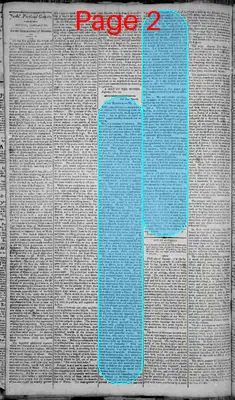
Letter to Editor
January 10, 1803
Jenks' Portland Gazette. Maine Advertiser
Portland, Cumberland County, Maine
What is this article about?
This letter from the 'The Reform' series praises benevolent figures like Rumford and Hawes, critiques infidel hypocrisy amid the French Revolution, and proposes a 'Friendly Society' in Portland for aiding the poor, strangers, and insane through philanthropy and annual events. Dated Portland, Jan. 1803.
Clipping
OCR Quality
95%
Excellent
Full Text
For this Gazette.
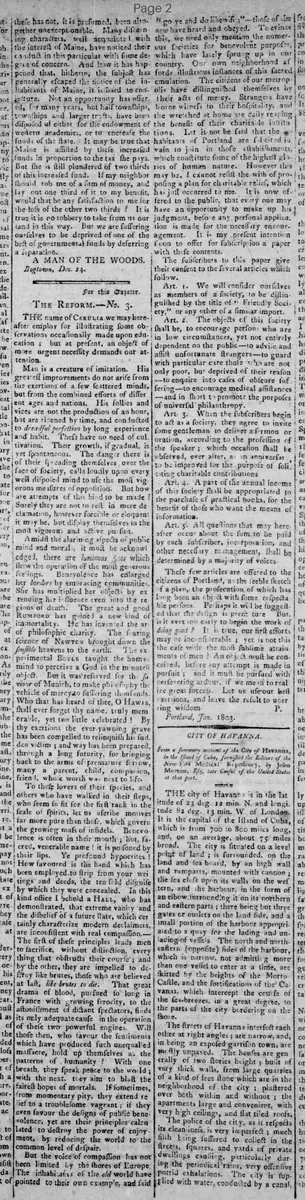
The Reform.-No. 3.
THE name of CERVILIA we may hereafter employ for illustrating some observations occasionally made upon education; but at present, an object of more urgent necessity demands our attention.
Man is a creature of imitation. His greatest improvements do not arise from the exertions of a few scattered minds, but from the combined efforts of different ages and nations. His follies and vices are not the production of an hour, but are ripened by time, and conducted to dreadful perfection by long experience and habit. These have no need of cultivation. Their growth, if gradual, is yet spontaneous. The danger there is of their spreading themselves over the face of society, calls loudly upon every well disposed mind to use the most vigorous measures of opposition. But how are attempts of this kind to be made? Surely they are not to rest in mere declamation, however forcible or eloquent it may be, but display themselves in the most vigorous and active pursuit.
Amidst the alarming aspects of public mind and morals, it must be acknowledged, there are luminous spots which show the operation of the most generous feelings. Benevolence has enlarged her borders by embracing communities. She has multiplied her objects by extending her influence even into the regions of death. The great and good Rumford has gained a new kind of immortality. He has invented the art of philosophic charity. The rising science of Newton brought down the sensible heavens to the earth. The experimental Boyle taught the human mind to perceive a God in the minutest object. But it was reserved for this prior of Munich, to make philosophy the vehicle of mercy to suffering thousands.
Who that has heard of thee, O Hawes, shall ever forget thy name, truly memorable, yet too little celebrated! By thy exertions the ever-yawning grave has been compelled to relinquish his rude victim: and way has been prepared, through a long futurity, for bringing back to the arms of premature sorrow, many a parent, child, companion, friend, whose worth was next to life.
To these lovers of their species, and others who have walked in their steps, who seem so fit for the first rank in the scale of spirits, let us ascribe motives far more pure than those, which govern the growing mass of infidels. Benevolence is often in their mouth; but, a sacred, venerable name! it is poisoned by their lips. Ye profound hypocrites! How favoured is the hand which has been employed to strip from your writings and deeds, the ten fold disguise by which they were concealed. In this kind office I behold a Hall, who has demonstrated, that extreme vanity and the disbelief of a future Fate, which certainly characterize modern declaimers, are inconsistent with real compassion.-- The first of these principles leads men to sacrifice, without distinction, every thing that obstructs their course; and by the other, they are impelled to destroy like brutes, those who are believed at last, like brutes to die. That great drama of blood, pursued so long in France with growing ferocity, to the astonishment of distant spectators, finds its only adequate cause in the operation of these two powerful engines. Will those then, who favour the sentiments which have produced such unequalled massacre, hold up themselves as the patterns of humanity? With one breath, they speak peace to the world; with the next, they aim to blast the fairest hopes of mortals. If sometimes, from momentary pity, they extend relief to a troublesome vagrant; if they even favour the designs of public benevolence, yet are their principles calculated to destroy the power of enjoyment, by reducing the world to the common level of despair.
But the voice of compassion has not been limited by the shores of Europe. The inhabitants of the old world have pointed to their own example, and said "go ye and do likewise;"--those of the new have heard and obeyed. To evince this, we need only mention the numerous societies for benevolent purposes, which have lately sprung up in our country. Our own neighborhood affords illustrious instances of this sacred emulation. The citizens of our metropolis have distinguished themselves by their acts of mercy. Strangers have borne witness to their hospitality. and the wretched at home are daily reaping the benefit of their charitable institutions. Let it not be said that the inhabitants of Portland are solicited in vain to join in those establishments, which constitute some of the highest glories of human nature. However this may be, I cannot resist the wish of proposing a plan for charitable relief, which has just occurred to me. It is now offered to the public, that every one may have an opportunity to make up his judgment, before any personal application is made for the necessary encouragement. It is my present intention soon to offer or subscription a paper with these contents.
The subscribers to this paper give their consent to the several articles which follow.
Art. 1. We will consider ourselves as members of a society, to be distinguished by the title of "Friendly Society," or any other of a similar import.
Art. 2. The objects of this society shall be, to encourage persons who are in low circumstances, yet not entirely dependent on the public--to advise and assist unfortunate strangers--to guard with particular care those who are not only poor, but deprived of their reason --to enquire into cases of obscure suffering--to encourage medical assistance--and in short to promote the purposes of universal philanthropy.
Art. 3. When the subscribers begin to act as a society, they agree to invite some gentleman to deliver a sermon or oration, according to the profession of the speaker; which occasion shall be observed, ever after, as an anniversary to be improved for the purpose of soliciting charitable contributions
Art. 4. A part of the annual income of this society shall be appropriated to the purchase of practical books, for the benefit of those who want the means of information.
Art. 5. All questions that may hereafter occur about the sum to be paid by each subscriber, incorporation, and other necessary management, shall be determined by a majority of voices--
These few articles are offered to the citizens of Portland, as the feeble sketch of a plan, the prosecution of which has long been an object with some respectable persons. Perhaps it will be suggested that the design is premature But, is it ever too early to begin the work of doing good? It is true, our first efforts may be inconsiderable; yet is not this the case with the most sublime attainments of men? An object must be conceived, before any attempt is made in pursuit; and it must be pursued with persevering ardour, if we mean to realize great success. Let us use our best exertions, and leave the result to unerring wisdom
P.
Portland, Jan. 1803.
The Reform.-No. 3.
THE name of CERVILIA we may hereafter employ for illustrating some observations occasionally made upon education; but at present, an object of more urgent necessity demands our attention.
Man is a creature of imitation. His greatest improvements do not arise from the exertions of a few scattered minds, but from the combined efforts of different ages and nations. His follies and vices are not the production of an hour, but are ripened by time, and conducted to dreadful perfection by long experience and habit. These have no need of cultivation. Their growth, if gradual, is yet spontaneous. The danger there is of their spreading themselves over the face of society, calls loudly upon every well disposed mind to use the most vigorous measures of opposition. But how are attempts of this kind to be made? Surely they are not to rest in mere declamation, however forcible or eloquent it may be, but display themselves in the most vigorous and active pursuit.
Amidst the alarming aspects of public mind and morals, it must be acknowledged, there are luminous spots which show the operation of the most generous feelings. Benevolence has enlarged her borders by embracing communities. She has multiplied her objects by extending her influence even into the regions of death. The great and good Rumford has gained a new kind of immortality. He has invented the art of philosophic charity. The rising science of Newton brought down the sensible heavens to the earth. The experimental Boyle taught the human mind to perceive a God in the minutest object. But it was reserved for this prior of Munich, to make philosophy the vehicle of mercy to suffering thousands.
Who that has heard of thee, O Hawes, shall ever forget thy name, truly memorable, yet too little celebrated! By thy exertions the ever-yawning grave has been compelled to relinquish his rude victim: and way has been prepared, through a long futurity, for bringing back to the arms of premature sorrow, many a parent, child, companion, friend, whose worth was next to life.
To these lovers of their species, and others who have walked in their steps, who seem so fit for the first rank in the scale of spirits, let us ascribe motives far more pure than those, which govern the growing mass of infidels. Benevolence is often in their mouth; but, a sacred, venerable name! it is poisoned by their lips. Ye profound hypocrites! How favoured is the hand which has been employed to strip from your writings and deeds, the ten fold disguise by which they were concealed. In this kind office I behold a Hall, who has demonstrated, that extreme vanity and the disbelief of a future Fate, which certainly characterize modern declaimers, are inconsistent with real compassion.-- The first of these principles leads men to sacrifice, without distinction, every thing that obstructs their course; and by the other, they are impelled to destroy like brutes, those who are believed at last, like brutes to die. That great drama of blood, pursued so long in France with growing ferocity, to the astonishment of distant spectators, finds its only adequate cause in the operation of these two powerful engines. Will those then, who favour the sentiments which have produced such unequalled massacre, hold up themselves as the patterns of humanity? With one breath, they speak peace to the world; with the next, they aim to blast the fairest hopes of mortals. If sometimes, from momentary pity, they extend relief to a troublesome vagrant; if they even favour the designs of public benevolence, yet are their principles calculated to destroy the power of enjoyment, by reducing the world to the common level of despair.
But the voice of compassion has not been limited by the shores of Europe. The inhabitants of the old world have pointed to their own example, and said "go ye and do likewise;"--those of the new have heard and obeyed. To evince this, we need only mention the numerous societies for benevolent purposes, which have lately sprung up in our country. Our own neighborhood affords illustrious instances of this sacred emulation. The citizens of our metropolis have distinguished themselves by their acts of mercy. Strangers have borne witness to their hospitality. and the wretched at home are daily reaping the benefit of their charitable institutions. Let it not be said that the inhabitants of Portland are solicited in vain to join in those establishments, which constitute some of the highest glories of human nature. However this may be, I cannot resist the wish of proposing a plan for charitable relief, which has just occurred to me. It is now offered to the public, that every one may have an opportunity to make up his judgment, before any personal application is made for the necessary encouragement. It is my present intention soon to offer or subscription a paper with these contents.
The subscribers to this paper give their consent to the several articles which follow.
Art. 1. We will consider ourselves as members of a society, to be distinguished by the title of "Friendly Society," or any other of a similar import.
Art. 2. The objects of this society shall be, to encourage persons who are in low circumstances, yet not entirely dependent on the public--to advise and assist unfortunate strangers--to guard with particular care those who are not only poor, but deprived of their reason --to enquire into cases of obscure suffering--to encourage medical assistance--and in short to promote the purposes of universal philanthropy.
Art. 3. When the subscribers begin to act as a society, they agree to invite some gentleman to deliver a sermon or oration, according to the profession of the speaker; which occasion shall be observed, ever after, as an anniversary to be improved for the purpose of soliciting charitable contributions
Art. 4. A part of the annual income of this society shall be appropriated to the purchase of practical books, for the benefit of those who want the means of information.
Art. 5. All questions that may hereafter occur about the sum to be paid by each subscriber, incorporation, and other necessary management, shall be determined by a majority of voices--
These few articles are offered to the citizens of Portland, as the feeble sketch of a plan, the prosecution of which has long been an object with some respectable persons. Perhaps it will be suggested that the design is premature But, is it ever too early to begin the work of doing good? It is true, our first efforts may be inconsiderable; yet is not this the case with the most sublime attainments of men? An object must be conceived, before any attempt is made in pursuit; and it must be pursued with persevering ardour, if we mean to realize great success. Let us use our best exertions, and leave the result to unerring wisdom
P.
Portland, Jan. 1803.
What sub-type of article is it?
Persuasive
Ethical Moral
Reflective
What themes does it cover?
Morality
Social Issues
What keywords are associated?
Benevolence
Charity
Friendly Society
Portland
Reform
Infidels
French Revolution
Philanthropy
What entities or persons were involved?
P.
For This Gazette
Letter to Editor Details
Author
P.
Recipient
For This Gazette
Main Argument
humanity must actively combat vices through imitation of virtues exemplified by figures like rumford and hawes; proposes a 'friendly society' in portland to aid the poor, strangers, and insane via advice, medical help, and philanthropy, countering infidel hypocrisy seen in the french revolution.
Notable Details
Praises Rumford For Philosophic Charity
Honors Hawes For Saving Lives From Grave
Critiques Infidels And French Revolution As Driven By Vanity And Disbelief
Outlines Five Articles For The Friendly Society