Thank you for visiting SNEWPapers!
Sign up free
Mcallen Daily Press
Mcallen, Hidalgo County, Texas
What is this article about?
Dr. Logan Clendening discusses the 1938 Federal Food, Drug, and Cosmetic Act, its extensions to cosmetics and devices, mandatory safety testing for new drugs post-sulfanilamide disaster, and his successful advocacy against industry opposition. Enforcement began immediately, seizing dangerous products.
Clipping
OCR Quality
Full Text
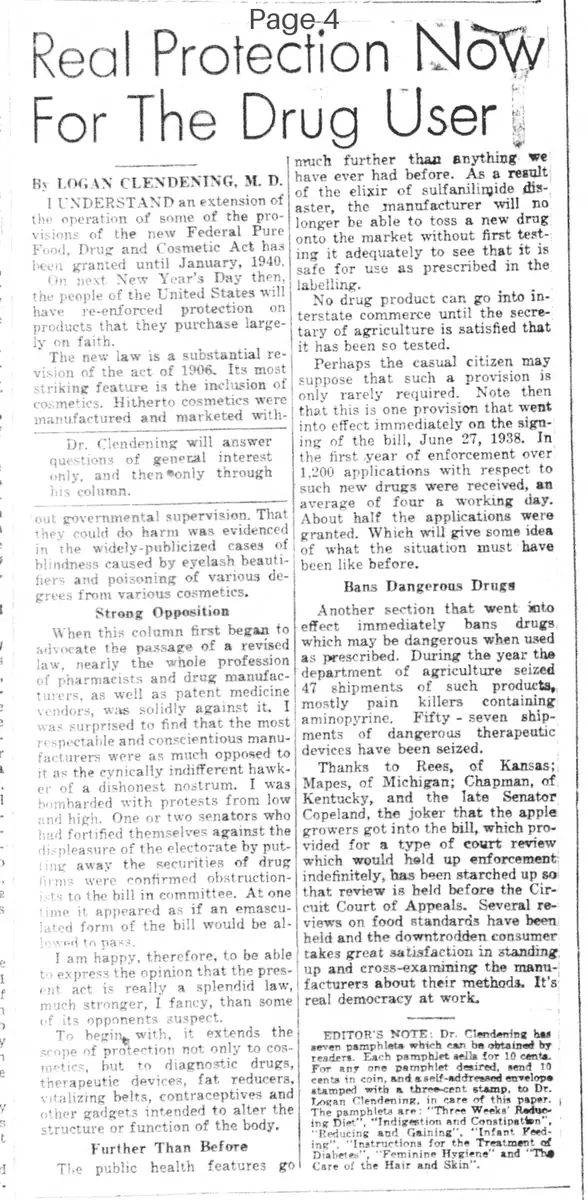
For The Drug User
By LOGAN CLENDENING, M. D.
I UNDERSTAND an extension of the operation of some of the provisions of the new Federal Pure Food, Drug and Cosmetic Act has been granted until January, 1940.
On next New Year's Day then, the people of the United States will have reinforced protection on products that they purchase largely on faith.
The new law is a substantial revision of the act of 1906. Its most striking feature is the inclusion of cosmetics. Hitherto cosmetics were manufactured and marketed without governmental supervision. That they could do harm was evidenced in the widely-publicized cases of blindness caused by eyelash beautifiers and poisoning of various degrees from various cosmetics.
Dr. Clendening will answer questions of general interest only, and then only through his column.
Strong Opposition
When this column first began to advocate the passage of a revised law, nearly the whole profession of pharmacists and drug manufacturers, as well as patent medicine vendors, was solidly against it. I was surprised to find that the most respectable and conscientious manufacturers were as much opposed to it as the cynically indifferent hawker of a dishonest nostrum. I was bombarded with protests from low and high. One or two senators who had fortified themselves against the displeasure of the electorate by putting away the securities of drug firms were confirmed obstructionists to the bill in committee. At one time it appeared as if an emasculated form of the bill would be allowed to pass.
I am happy, therefore, to be able to express the opinion that the present act is really a splendid law, much stronger, I fancy, than some of its opponents suspect.
To begin with, it extends the scope of protection not only to cosmetics, but to diagnostic drugs, therapeutic devices, fat reducers, vitalizing belts, contraceptives and other gadgets intended to alter the structure or function of the body.
much further than anything we have ever had before. As a result of the elixir of sulfanilimide disaster, the manufacturer will no longer be able to toss a new drug onto the market without first testing it adequately to see that it is safe for use as prescribed in the labelling.
No drug product can go into interstate commerce until the secretary of agriculture is satisfied that it has been so tested.
Perhaps the casual citizen may suppose that such a provision is only rarely required. Note then that this is one provision that went into effect immediately on the signing of the bill, June 27, 1938. In the first year of enforcement over 1,200 applications with respect to such new drugs were received, an average of four a working day.
About half the applications were granted. Which will give some idea of what the situation must have been like before.
Bans Dangerous Drugs
Another section that went into effect immediately bans drugs which may be dangerous when used as prescribed. During the year the department of agriculture seized 47 shipments of such products, mostly pain killers containing aminopyrine. Fifty-seven shipments of dangerous therapeutic devices have been seized.
Thanks to Rees, of Kansas; Mapes, of Michigan; Chapman, of Kentucky, and the late Senator Copeland, the joker that the apple growers got into the bill, which provided for a type of court review which would hold up enforcement indefinitely, has been starched up so that review is held before the Circuit Court of Appeals. Several reviews on food standards have been held and the downtrodden consumer takes great satisfaction in standing up and cross-examining the manufacturers about their methods. It's real democracy at work.
EDITOR'S NOTE: Dr. Clendening has seven pamphlets which can be obtained by readers. Each pamphlet sells for 10 cents. For any one pamphlet desired, send 10 cents in coin, and a self-addressed envelope stamped with a three-cent stamp, to Dr. Logan Clendening, in care of this paper. The pamphlets are: "Three Weeks' Reducing Diet", "Indigestion and Constipation" "Reducing and Gaining". "Infant Feeding", "Instructions for the Treatment of Diabetes", "Feminine Hygiene" and "The Care of the Hair and Skin".
What sub-type of article is it?
What themes does it cover?
What keywords are associated?
What entities or persons were involved?
Where did it happen?
Story Details
Key Persons
Location
United States
Event Date
June 27, 1938
Story Details
Dr. Clendening advocates for and celebrates the passage of the 1938 Federal Food, Drug, and Cosmetic Act, which revises the 1906 law to include cosmetics, require safety testing for new drugs following the sulfanilamide disaster, ban dangerous products, and extend protections to therapeutic devices, despite strong opposition from industry and some senators.