Thank you for visiting SNEWPapers!
Sign up free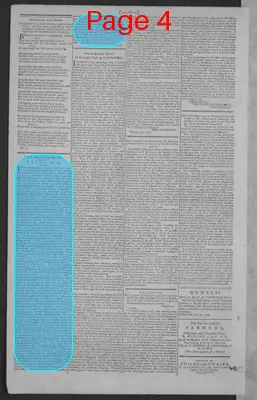
Editorial
February 6, 1792
National Gazette
Philadelphia, Philadelphia County, Pennsylvania
What is this article about?
Editorial by CAIUS critiques ministerial systems and aristocratic influences endangering republican principles in America. It highlights the constitutional violation of Congress members serving as bank directors, warns of precedents leading to corruption, and condemns imitation of British financial systems.
Clipping
OCR Quality
95%
Excellent
Full Text
From the American Daily Advertiser.
CAIUS,
No. III.
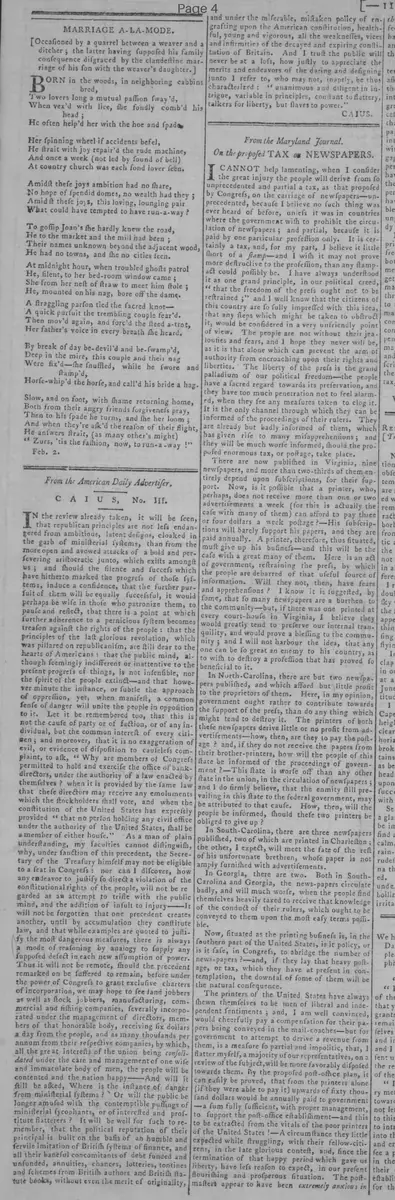
In the review already taken, it will be seen, that republican principles are not less endangered from ambitious, latent designs, cloaked in the garb of ministerial systems, than from the more open and avowed attacks of a bold and persevering aristocratic junto, which exists amongst us; and should the silence and success which have hitherto marked the progress of those systems, induce a confidence, that the further pursuit of them will be equally successful, it would perhaps be wise in those who patronize them, to pause and reflect, that there is a point at which further adherence to a pernicious system becomes treason against the rights of the people: that the principles of the last glorious revolution, which was pillared on republicanism, are still dear to the hearts of Americans: that the public mind, although seemingly indifferent or inattentive to the present progress of things, is not insensible, nor the spirit of the people extinct-and that however minute the instance, or subtle the approach of oppression, yet, when manifest, a common sense of danger will unite the people in opposition to it. Let it be remembered too, that this is not the cause of party or of faction, or of any individual, but the common interest of every citizen; and moreover, that it is no exaggeration of evil, or evidence of disposition to causeless complaint, to ask, "Why are members of Congress permitted to hold and exercise the office of bank-directors, under the authority of a law enacted by themselves? when it is provided by the same law that these directors may receive any emoluments which the stockholders shall vote, and when the constitution of the United States has expressly provided "that no person holding any civil office under the authority of the United States, shall be a member of either house." As a man of plain understanding, my faculties cannot distinguish, why, under sanction of this precedent, the Secretary of the Treasury himself may not be eligible to a seat in Congress: nor can I discover, how any endeavor to justify so direct a violation of the constitutional rights of the people, will not be regarded as an attempt to trifle with the public mind, and the addition of insult to injury--It will not be forgotten that one precedent creates another, until by accumulation they constitute law, and that while examples are quoted to justify the most dangerous measures, there is always a mode of reasoning by analogy to supply any supposed defect in each new assumption of power. Thus it will not be remote, should the precedent remarked on be suffered to remain, before under the power of Congress to grant exclusive charters of incorporation, we may hope to see land jobbers as well as stock jobbers, manufacturing, commercial and fishing companies, severally incorporated under the management of directors, members of that honorable body, receiving six dollars a day from the people, and as many thousands per annum from their respective companies, by which, all the great interests of the union being consolidated under the care and management of one wise and immaculate body of men, the people will be contented and the nation happy--And will it still be asked, Where is the instance of danger from ministerial systems? Or will the public be longer amused with the contemptible puffings of ministerial sycophants, or of interested and prostitute flatterers? It will be well for such to remember, that the political reputation of their principal is built on the basis of an humble and servile imitation of British systems of finance, and all their baneful concomitants of debt funded and unfunded, annuities, chances, lotteries, tontines and schemes from British authors and British statute books, without even the merit of originality, and under the miserable, mistaken policy of en-grafting upon the American constitution, healthful, young and vigorous, all the weaknesses, vices and infirmities of the decayed and expiring constitution of Britain. And I trust the public will never be at a loss, how justly to appreciate the merits and endeavors of the daring and designing junto I refer to, who may not, inaptly, be thus characterized: "unanimous and diligent in intrigue, variable in principles, constant to flattery, talkers for liberty, but slaves to power."
CAIUS.
CAIUS,
No. III.
In the review already taken, it will be seen, that republican principles are not less endangered from ambitious, latent designs, cloaked in the garb of ministerial systems, than from the more open and avowed attacks of a bold and persevering aristocratic junto, which exists amongst us; and should the silence and success which have hitherto marked the progress of those systems, induce a confidence, that the further pursuit of them will be equally successful, it would perhaps be wise in those who patronize them, to pause and reflect, that there is a point at which further adherence to a pernicious system becomes treason against the rights of the people: that the principles of the last glorious revolution, which was pillared on republicanism, are still dear to the hearts of Americans: that the public mind, although seemingly indifferent or inattentive to the present progress of things, is not insensible, nor the spirit of the people extinct-and that however minute the instance, or subtle the approach of oppression, yet, when manifest, a common sense of danger will unite the people in opposition to it. Let it be remembered too, that this is not the cause of party or of faction, or of any individual, but the common interest of every citizen; and moreover, that it is no exaggeration of evil, or evidence of disposition to causeless complaint, to ask, "Why are members of Congress permitted to hold and exercise the office of bank-directors, under the authority of a law enacted by themselves? when it is provided by the same law that these directors may receive any emoluments which the stockholders shall vote, and when the constitution of the United States has expressly provided "that no person holding any civil office under the authority of the United States, shall be a member of either house." As a man of plain understanding, my faculties cannot distinguish, why, under sanction of this precedent, the Secretary of the Treasury himself may not be eligible to a seat in Congress: nor can I discover, how any endeavor to justify so direct a violation of the constitutional rights of the people, will not be regarded as an attempt to trifle with the public mind, and the addition of insult to injury--It will not be forgotten that one precedent creates another, until by accumulation they constitute law, and that while examples are quoted to justify the most dangerous measures, there is always a mode of reasoning by analogy to supply any supposed defect in each new assumption of power. Thus it will not be remote, should the precedent remarked on be suffered to remain, before under the power of Congress to grant exclusive charters of incorporation, we may hope to see land jobbers as well as stock jobbers, manufacturing, commercial and fishing companies, severally incorporated under the management of directors, members of that honorable body, receiving six dollars a day from the people, and as many thousands per annum from their respective companies, by which, all the great interests of the union being consolidated under the care and management of one wise and immaculate body of men, the people will be contented and the nation happy--And will it still be asked, Where is the instance of danger from ministerial systems? Or will the public be longer amused with the contemptible puffings of ministerial sycophants, or of interested and prostitute flatterers? It will be well for such to remember, that the political reputation of their principal is built on the basis of an humble and servile imitation of British systems of finance, and all their baneful concomitants of debt funded and unfunded, annuities, chances, lotteries, tontines and schemes from British authors and British statute books, without even the merit of originality, and under the miserable, mistaken policy of en-grafting upon the American constitution, healthful, young and vigorous, all the weaknesses, vices and infirmities of the decayed and expiring constitution of Britain. And I trust the public will never be at a loss, how justly to appreciate the merits and endeavors of the daring and designing junto I refer to, who may not, inaptly, be thus characterized: "unanimous and diligent in intrigue, variable in principles, constant to flattery, talkers for liberty, but slaves to power."
CAIUS.
What sub-type of article is it?
Constitutional
Economic Policy
Partisan Politics
What keywords are associated?
Constitutional Violation
Bank Directorships
Ministerial Systems
Republican Principles
British Finance Imitation
Aristocratic Junto
What entities or persons were involved?
Congress
Bank Directors
Secretary Of The Treasury
Aristocratic Junto
Ministerial Sycophants
Editorial Details
Primary Topic
Constitutional Violation By Congress Members Serving As Bank Directors
Stance / Tone
Strongly Critical Of Ministerial Systems And Aristocratic Influences
Key Figures
Congress
Bank Directors
Secretary Of The Treasury
Aristocratic Junto
Ministerial Sycophants
Key Arguments
Republican Principles Endangered By Ambitious Ministerial Designs And Aristocratic Attacks
Members Of Congress Holding Bank Directorships Violates The Us Constitution
Such Precedents Could Lead To Further Corruption And Consolidation Of Power
Imitation Of British Financial Systems Undermines The American Constitution
Public Spirit Remains Vigilant Against Oppression