Thank you for visiting SNEWPapers!
Sign up free
Kentucky Gazette And General Advertiser
Lexington, Fayette County, Kentucky
What is this article about?
Conclusion of an investigation into the Kentucky Spanish Association conspiracy, providing evidence from letters between Washington and Marshall, and a 1806 letter from Fairfax, VA, implicating figures like Innes, Todd, Brown, and Nicholas in plots to separate Kentucky from the US and ally with Spain. The editors defend their impartiality amid backlash and suspend further narrative pending legal proceedings.
Clipping
OCR Quality
Full Text
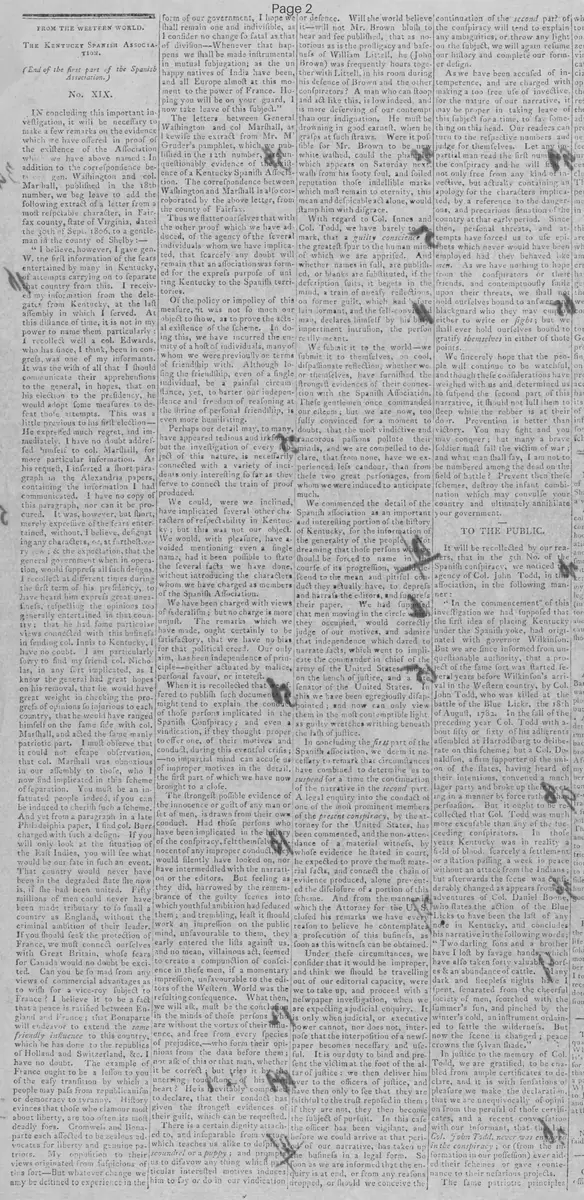
The Kentucky Spanish Association.
(End of the first part of the Spanish Association.)
No. XIX.
IN concluding this important investigation, it will be necessary to make a few remarks on the evidence which we have offered in proof of the existence of the Association which we have above named: In addition to the correspondence between Gen. Washington and Col. Marshall, published in the 18th number, we beg leave to add the following extract of a letter from a most respectable character in Fairfax county, state of Virginia, dated the 30th of Sept. 1806, to a gentleman in the county of Shelby: -
"I believe, however, I gave Gen. W. the first information of the fears entertained by many in Kentucky, of attempts carrying on to separate that country from this. I received my information from the delegates from Kentucky, at the last assembly in which I served. At this distance of time, it is not in my power to name them particularly: I recollect well a Col. Edwards, who has since, I think, been in congress, was one of my informants. It was the wish of all that I should communicate their apprehensions to the general, in hopes, that on his election to the presidency, he would adopt some measures to defeat those attempts. This was a little previous to his first election— He expressed much regret, and immediately, I have no doubt addressed himself to Col. Marshall, for more particular information. At his request, I inserted a short paragraph in the Alexandria papers, containing the information I had communicated. I have no copy of this paragraph, nor can it be procured. It was, however, but short, merely expressive of the fears entertained, without, I believe, designating any characters, or, at furthest, very few; & the expectation, that the general government when in operation, would suppress all such designs. I recollect at different times during the first term of his presidency, to have heard him express great uneasiness, respecting the opinions too generally entertained in that country; that he had some particular views connected with this business in sending Col. Innis to Kentucky, I have no doubt. I am particularly sorry to find my friend Col. Nicholas, in any sort implicated, as I know the general had great hopes on his removal, that he would have great weight in checking the progress of opinions so injurious to each country, that he would have ranged himself on the same side with Col. Marshall, and acted the same manly patriotic part. I must observe that it could not escape observation, that Col. Marshall was obnoxious in our assembly to those, who I now find implicated in this scheme of separation. You must be an infatuated people indeed, if you can be induced to cherish such a scheme. And yet from a paragraph in a late Philadelphia paper, I find Col. Burr charged with such a design. If you will only look at the situation of the East Indies, you will see what would be our fate in such an event. That country would never have been in the degraded state she now is, if she had been united. Fifty millions of men could never have been made tributary to so small a country as England, without the criminal ambition of their leader. If you should seek the protection of France, we must connect ourselves with Great Britain, whose fears for Canada would no doubt be excited. Can you be so mad from any views of commercial advantages as to wish for a vice-roy subject to France? I believe it to be a fact that a peace is ratified between England and France; that Bonaparte will endeavor to extend the same friendly influence to this country, which he has done to the republics of Holland and Switzerland, &c. I have no doubt. The example of France ought to be a lesson to you of the easy transition by which a people may pass from republicanism to tyranny. History evinces that those who clamour most about liberty, are too often its most deadly foes. Cromwell and Bonaparte each affected to be zealous advocates for liberty and genuine patriots. My opposition to their schemes originated from suspicions of this sort—But whatever change we may be destined to experience in the form of our government, I hope we shall remain one and indivisible, as I consider no change so fatal as that of division—Whenever that happens we shall be made instrumental in mutual subjugation; as the unhappy natives of India have been, and all Europe almost at this moment to the power of France. Hoping you will be on your guard, I now take leave of this subject."
The letters between General Washington and Col. Marshall, as likewise the extract from Mr. Madison's pamphlet, which we published in the 18th number, are unquestionably evidence of the existence of a Kentucky Spanish Association. The correspondence between Washington and Marshall is also corroborated by the above letter, from the county of Fairfax.
Thus we flatter ourselves that with the other proof which we have adduced, of the agency of the several individuals whom we have implicated, that scarcely any doubt will remain that an association was formed for the express purpose of uniting Kentucky to the Spanish territories.
Of the policy or impolicy of this measure, it was not so much our object to show, as to prove the actual existence of the scheme. In doing this, we have incurred the enmity of a host of individuals, many of whom we were previously on terms of friendship with. Although losing the friendship, even of a single individual, be a painful circumstance, yet, to barter our independence and freedom of reasoning at the shrine of personal friendship, is even more humiliating.
Perhaps our detail may, to many, have appeared tedious and irksome; but the investigation of every subject of this nature, is necessarily connected with a variety of incidents only interesting so far as they serve to connect the train of proof produced.
We could, were we inclined, have implicated several other characters of respectability in Kentucky; but this was not our object. We would, with pleasure, have avoided mentioning even a single name, had it been possible to state the several facts we have done, without introducing the characters whom we have charged as members of the Spanish Association.
We have been charged with views of federalism; but no charge is more unjust. The remarks which we have made, ought certainly to be satisfactory, that we have no bias for that political creed. Our only aim, has been independence of principle—neither actuated by malice, personal favour, or interest.
When it is recollected that we offered to publish such documents as might tend to explain the conduct of those persons implicated in the Spanish Conspiracy; and even a vindication, if they thought proper to offer one, of their motives and conduct, during this eventful crisis; -no impartial mind can accuse us of improper motives in the detail, the first part of which we have now brought to a close.
The strongest possible evidence of the innocence or guilt of any man or set of men, is drawn from their own conduct. Had those persons who have been implicated in the history of the conspiracy, felt themselves innocent of any improper conduct, they would silently have looked on, nor have intermeddled with the narration or the editors. But feeling as they did, harrowed by the remembrance of the guilty scenes into which youthful ambition had seduced them; and trembling, lest it should work an impression on the public mind, unfavourable to them, they early entered the lists against us, and no mean, villainous act, seemed to create a compunction of conscience in these men, if a momentary impression, unfavourable to the editors of the Western World was the resulting consequence. What then, we will ask, must be the conclusion in the minds of those persons who are without the vortex of their influence, and free from every species of prejudice,-who form their opinions from the data before them; nor ask of this or that man, whether it be correct; but tries it by the unerring touchstone of his own heart? He is inevitably compelled to declare, that their conduct has given the strongest evidences of their guilt, which can be requested.
There is a certain dignity attached to, and inseparable from virtue, which teaches us alike to despise a scoundrel or a puppy; and prompts us to disavow any thing which particular interested motives induces him to say or do in our vindication or defence.
Will the world believe it-will not Mr. Brown blush to hear and see published, that as notorious as is the profligacy and baseness of William Littell, he (John Brown) was frequently hours together with Littell, in his room during his defence of Brown and the other conspirators? A man who can stoop and act like this, is low indeed, and is more deserving of our contempt than our indignation. He must be drowning in good earnest, when he grasps at such straws. Were it possible for Mr. Brown to be new white washed, could the pamphlet which appears on Saturday next, wash from his sooty soul, and soiled reputation those indellible marks which must remain to eternity, this mean and despicable act alone, would stamp him with disgrace.
With regard to Col. Innes and Col. Todd, we have barely to remark, that a guilty conscience is the greatest spur to the human mind of which we are apprised. And whether names in full, are published, or blanks are substituted, if the description fits, it begets in the mind, a train of uneasy reflections, on former guilt, which had before lain dormant, and the self-convinced man, declares himself by his busy impertinent intrusion, the person really meant.
We submit it to the world-we submit it to themselves, on cool, dispassionate reflection, whether we, or themselves, have furnished the strongest evidences of their connection with the Spanish Association. These gentlemen once commanded our esteem; but we are now, too fully convinced for a moment to doubt, that the most vindictive and rancorous passions pollute their minds, and we are compelled to declare, that from none, have we experienced less candour, than from these two great personages, from whom we were induced to anticipate much.
We commenced the detail of the Spanish association as an important and interesting portion of the history of Kentucky, for the information of the generality of the people. Not dreaming that those persons who we should be forced to name in the course of its progression, would descend to the mean and pitiful conduct they actually have, to depress and harass the editors, and suppress their paper. We had supposed that men moving in the circle which they occupied, would correctly judge of our motives, and admire that independence which dared to narrate facts, which went to implicate the commander in chief of the army of the United States, judges on the bench of justice, and a late senator of the United States.
In this we have been egregiously disappointed; and now can only view them in the most contemptible light, as guilty wretches writhing beneath the lash of justice.
In concluding the first part of the Spanish association, we deem it necessary to remark that circumstances have combined to determine us to suspend for a time the continuation of the narrative in the second part. A legal enquiry into the conduct of one of the most prominent members of the present conspiracy, by the attorney for the United States, has been commenced, and the non-attendance of a material witness, by whose evidence he stated in court, he expected to prove the most material facts, and connect the chain of evidence produced, alone prevented the disclosure of a portion of this scheme. And from the manner in which the Attorney for the U. S. closed his remarks we have every reason to believe he contemplates a prosecution of this business, as soon as this witness can be obtained.
Under these circumstances, we consider that it would be improper, and think we should be travelling out of our editorial capacity, were we to take up, and proceed with a newspaper investigation, when we are expecting a judicial enquiry. It is only when judicial, or executive power cannot, nor does not, interpose that the interposition of a newspaper becomes necessary and useful. It is our duty to bind and present the victim at the foot of the altar of justice: we then deliver him over to the officers of justice, and have then only to see that they are faithful to the trust reposed in them; if they are not, they then become the subject of pursuit. In this case the officer has been vigilant, and before we could arrive at that period of our narrative, has taken up the business in a legal form. So soon as we are informed that the enquiry is at end, or from any reasons dropped, or should we conceive the continuation of the second part of the conspiracy will tend to explain any ambiguities, or throw any light on the subject, we will again resume our history and complete our former design.
As we have been accused of intemperance, and are charged with making a too free use of invective, for the nature of our narrative, it may be proper in taking leave of this subject for a time, to say something on this head. Our readers can turn to the respective numbers and judge for themselves. Let any impartial man read the first number of the conspiracy and he will find it not only free from any kind of invective, but actually containing an apology for the characters implicated, by a reference to the dangerous, and precarious situation of the country at that early period. Since then, personal threats, and attempts have forced us to use epithets which never would have been employed had they behaved like men. As we have nothing to hope from the conspirators or their friends, and contemptuously smile upon their threats, we shall not hold ourselves bound to answer any blackguard who they may employ either to write or fight; but we shall ever hold ourselves bound to gratify themselves in either of those points.
We sincerely hope that the people will continue to be watchful, and though these considerations have weighed with us and determined us to suspend the second part of this narrative, it should not lull them to sleep while the robber is at their door. Prevention is better than victory. You may fight and you may conquer; but many a brave soldier must fall the victim of war; and what man shall say, I am not to be numbered among the dead on the field of battle? Prevent then these schemes, destroy the infant combination which may convulse your country and ultimately annihilate your government.
What sub-type of article is it?
What themes does it cover?
What keywords are associated?
What entities or persons were involved?
Where did it happen?
Story Details
Key Persons
Location
Kentucky
Event Date
30th Of Sept. 1806
Story Details
Editors conclude investigation proving existence of Kentucky Spanish Association conspiracy to separate Kentucky and unite with Spanish territories, citing correspondences and a 1806 letter; implicate figures like Innes, Todd, Brown; defend motives amid backlash; suspend narrative pending legal inquiry.