Thank you for visiting SNEWPapers!
Sign up free
The Virginia Gazette
Richmond, Williamsburg, Richmond County, Virginia
What is this article about?
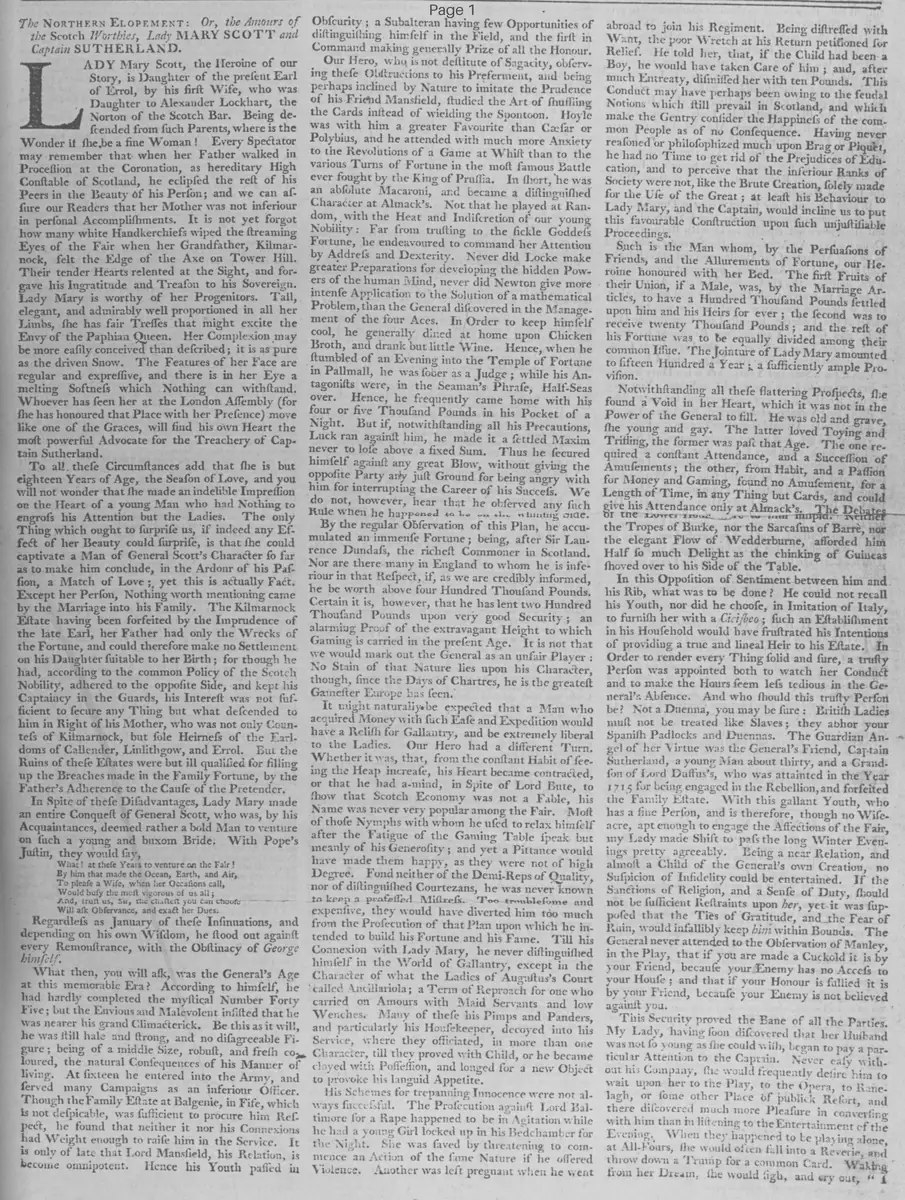
A scandalous narrative recounting the elopement of Lady Mary Scott, daughter of the Earl of Errol, with Captain Sutherland, amid her unhappy marriage to the elderly, gambling General Scott. Details family histories, the general's character, and the budding affair leading to their flight from Balgonie estate.
Merged-components note: These two components form a single serialized literary story titled 'The Northern Elopement: Or, the Amours of the Scotch Worthies', continued across pages with sequential reading order.
Clippings
1 of 2
OCR Quality
Full Text
Lady Mary Scott, the Heroine of our Story, is Daughter of the present Earl of Errol, by his first Wife, who was Daughter to Alexander Lockhart, the Baron of the Scotch Bar. Being descended from such Parents, where is the Wonder if she be a fine Woman! Every Spectator may remember that when her Father walked in Procession at the Coronation, as hereditary High Constable of Scotland, he eclipsed the rest of his Peers in the Beauty of his Person; and we can assure our Readers that her Mother was not inferior in personal Accomplishments. It is not yet forgot how many white Handkerchiefs wiped the streaming Eyes of the Fair when her Grandfather, Kilmarnock, felt the Edge of the Axe on Tower Hill. Their tender Hearts relented at the Sight, and forgave his Ingratitude and Treason to his Sovereign.
Lady Mary is worthy of her Progenitors. Tall, elegant, and admirably well proportioned in all her Limbs, she has fair Tresses that might excite the Envy of the Paphian Queen. Her Complexion may be more easily conceived than described; it is as pure as the driven Snow. The Features of her Face are regular and expressive, and there is in her Eye a melting Softness which Nothing can withstand. Whoever has seen her at the London Assembly (for she has honoured that Place with her Presence) move like one of the Graces, will find his own Heart the most powerful Advocate for the Treachery of Captain Sutherland.
To all these Circumstances add that she is but eighteen Years of Age, the Season of Love, and you will not wonder that she made an indelible Impression on the Heart of a young Man who had Nothing to engross his Attention but the Ladies. The only Thing which ought to surprise us, if indeed any Effect of her Beauty could surprise, is that he could captivate a Man of General Scott's Character so far as to make him conclude, in the Ardour of his Passion, a Match of Love; yet this is actually Fact.
Except her Person, Nothing worth mentioning came by the Marriage into his Family. The Kilmarnock Estate having been forfeited by the Imprudence of the late Earl, her Father had only the Wrecks of the Fortune, and could therefore make no Settlement on his Daughter suitable to her Birth; for though he had, according to the common Policy of the Scotch Nobility, adhered to the opposite Side, and kept his Captaincy in the Guards, his Interest was not sufficient to secure any Thing but what descended to him in Right of his Mother, who was not only Countess of Kilmarnock, but sole Heiress of the Earldoms of Callender, Linlithgow, and Errol. But the Ruins of these Estates were but ill qualified for filling up the Breaches made in the Family Fortune, by the Father's Adherence to the Cause of the Pretender.
In Spite of these Disadvantages, Lady Mary made an entire Conquest of General Scott, who was, by his Acquaintances, deemed rather a bold Man to venture on such a young and buxom Bride. With Pope's Justice, they would say,
What! at these Years to venture on the Fair!
By him that made the Ocean, Earth, and Air,
To please a Wife, when her Occasions call,
Would busy the most vigorous of us all;
And, trust us, Sir, the chastest you can choose
Will ask Observance, and exact her Dues.
Regardless as January of these Insinuations, and depending on his own Wisdom, he stood out against every Remonstrance, with the Obstinacy of George himself.
What then, you will ask, was the General's Age at this memorable Era? According to himself, he had hardly completed the mystical Number Forty Five: but the Envious and Malevolent insisted that he was nearer his grand Climacterick. Be this as it will, he was still hale and strong, and no disagreeable Figure; being of a middle Size, robust, and fresh coloured, the natural Consequences of his Manner of living. At sixteen he entered into the Army, and served many Campaigns as an inferior Officer.
Though the Family Estate at Balgenie, in Fife, which is not despicable, was sufficient to procure him Respect, he found that neither it nor his Connexions had Weight enough to raise him in the Service. It is only of late that Lord Mansfield, his Relation, is become omnipotent. Hence his Youth passed in Obscurity; a Subaltern having few Opportunities of distinguishing himself in the Field, and the first in Command making generally Prize of all the Honour.
Our Hero, who is not destitute of Sagacity, observing these Obstructions to his Preferment, and being perhaps inclined by Nature to imitate the Prudence of his Friend Mansfield, studied the Art of shuffling the Cards instead of wielding the Spontoon. Hoyle was with him a greater Favourite than Caesar or Polybius, and he attended with much more Anxiety to the Revolutions of a Game at Whist than to the various Turns of Fortune in the most famous Battle ever fought by the King of Prussia. In short, he was an absolute Macaroni, and became a distinguished Character at Almack's. Not that he played at Random, with the Heat and Indiscretion of our young Nobility: Far from trusting to the fickle Goddess Fortune, he endeavoured to command her Attention by Address and Dexterity. Never did Locke make greater Preparations for developing the hidden Powers of the human Mind, never did Newton give more intense Application to the Solution of a mathematical Problem, than the General discovered in the Management of the four Aces. In Order to keep himself cool, he generally dined at home upon Chicken Broth, and drank but little Wine. Hence, when he stumbled of an Evening into the Temple of Fortune in Pall Mall, he was sober as a Judge; while his Antagonists were, in the Sailor's Phrase, Half-Seas over. Hence, he frequently came home with his four or five Thousand Pounds in his Pocket of a Night. But if, notwithstanding all his Precautions, Luck ran against him, he made it a settled Maxim never to lose above a fixed Sum. Thus he secured himself against any great Blow, without giving the opposite Party any just Ground for being angry with him for interrupting the Career of his Success. We do not, however, hear that he observed any such Rule when he happened to be on the winning side.
By the regular Observation of this Plan, he accumulated an immense Fortune; being, after Sir Laurence Dundas, the richest Commoner in Scotland. Nor are there many in England to whom he is inferior in that Respect, if, as we are credibly informed, he be worth above four Hundred Thousand Pounds. Certain it is, however, that he has lent two Hundred Thousand Pounds upon very good Security; an alarming Proof of the extravagant Height to which Gaming is carried in the present Age. It is not that we would mark out the General as an unfair Player: No Stain of that Nature lies upon his Character, though, since the Days of Chartres, he is the greatest Gambler Europe has seen.
It might naturally be expected that a Man who acquired Money with such Ease and Expedition would have a Relish for Gallantry, and be extremely liberal to the Ladies. Our Hero had a different Turn. Whether it was, that, from the constant Habit of seeing the Heap increase, his Heart became contracted, or that he had a mind, in Spite of Lord Bute, to show that Scotch Economy was not a Fable, his Name was never very popular among the Fair. Most of those Nymphs with whom he used to relax himself after the Fatigue of the Gaming Table speak but meanly of his Generosity; and yet a Pittance would have made them happy, as they were not of high Degree. Fond neither of the Demi-Reps of Quality, nor of distinguished Courtezans, he was never known to keep a professed Mistress. Too troublesome and expensive, they would have diverted him too much from the Prosecution of that Plan upon which he intended to build his Fortune and his Fame. Till his Connexion with Lady Mary, he never distinguished himself in the World of Gallantry, except in the Character of what the Ladies of Augustus's Court called Ancillariola; a Term of Reproach for one who carried on Amours with Maid Servants and low Wenches. Many of these his Pimps and Panders, and particularly his Housekeeper, decoyed into his Service, where they officiated, in more than one Character, till they proved with Child, or he became cloyed with Possession, and longed for a new Object to provoke his languid Appetite.
His Schemes for trepanning Innocence were not always successful. The Prosecution against Lord Baltimore for a Rape happened to be in Agitation while he had a young Girl locked up in his Bedchamber for the Night. She was saved by threatening to commence an Action of the same Nature if he offered Violence. Another was left pregnant when he went abroad to join his Regiment. Being distressed with Want, the poor Wretch at his Return petitioned for Relief. He told her, that, if the Child had been a Boy, he would have taken Care of him; and, after much Entreaty, dismissed her with ten Pounds. This Conduct may have perhaps been owing to the feudal Notions which still prevail in Scotland, and which make the Gentry consider the Happiness of the common People as of no Consequence. Having never reasoned or philosophized much upon Brag or Piquet, he had no Time to get rid of the Prejudices of Education, and to perceive that the inferior Ranks of Society were not, like the Brute Creation, solely made for the Use of the Great: at least his Behaviour to Lady Mary, and the Captain, would incline us to put this favourable Construction upon such unjustifiable Proceedings.
Such is the Man whom, by the Persuasions of Friends, and the Allurements of Fortune, our Heroine honoured with her Bed. The first Fruits of their Union, if a Male, was, by the Marriage Articles, to have a Hundred Thousand Pounds settled upon him and his Heirs for ever; the second was to receive twenty Thousand Pounds; and the rest of his Fortune was to be equally divided among their common Issue. The Jointure of Lady Mary amounted to fifteen Hundred a Year; a sufficiently ample Provision.
Notwithstanding all these flattering Prospects, he found a Void in her Heart, which it was not in the Power of the General to fill. He was old and grave, she young and gay. The latter loved Toying and Trifling, the former was past that Age. The one required a constant Attendance, and a Succession of Amusements; the other, from Habit, and a Passion for Money and Gaming, found no Amusement, for a Length of Time, in any Thing but Cards, and could give his Attendance only at Almack's. The Debates of the Parliament. Neither the Tropes of Burke, nor the Sarcasms of Barre, nor the elegant Flow of Wedderburne, afforded him Half so much Delight as the chinking of Guineas shoved over to his Side of the Table.
In this Opposition of Sentiment between him and his Rib, what was to be done? He could not recall his Youth, nor did he choose, in Imitation of Italy, to furnish her with a Cicisbeo; such an Establishment in his Household would have frustrated his Intentions of providing a true and lineal Heir to his Estate. In Order to render every Thing solid and sure, a trusty Person was appointed both to watch her Conduct and to make the Hours seem less tedious in the General's Absence. And who should this trusty Person be? Not a Duenna, you may be sure: British Ladies must not be treated like Slaves; they abhor your Spanish Padlocks and Duennas. The Guardian Angel of her Virtue was the General's Friend, Captain Sutherland, a young Man about thirty, and a Grandson of Lord Duffus's, who was attainted in the Year 1715 for being engaged in the Rebellion, and forfeited the Family Estate. With this gallant Youth, who has a fine Person, and is therefore, though no Wiseacre, apt enough to engage the Affections of the Fair, my Lady made Shift to pass the long Winter Evenings pretty agreeably. Being a near Relation, and almost a Child of the General's own Creation, no Suspicion of Infidelity could be entertained. If the Sanctions of Religion, and a Sense of Duty, should not be sufficient Restraints upon her, yet it was supposed that the Ties of Gratitude, and the Fear of Ruin, would infallibly keep him within Bounds. The General never attended to the Observation of Manley, in the Play, that if you are made a Cuckold it is by your Friend, because your Enemy has no Access to your House; and that if your Honour is sullied it is by your Friend, because your Enemy is not believed against you.
This Security proved the Bane of all the Parties. My Lady, having soon discovered that her Husband was not so young as she could wish, began to pay a particular Attention to the Captain. Never easy without his Company, she would frequently desire him to wait upon her to the Play, to the Opera, to Ranelagh, or some other Place of public Resort, and there discovered much more Pleasure in conversing with him than in listening to the Entertainment of the Evening. When they happened to be playing alone, at All-Fours, she would often fall into a Reverie, and throw down a Trump for a common Card. Waking from her Dream, she would sigh, and cry out, "I
Believe, Captain. I am flattered; for while I
"Sit still, reminding my hand, I am watching the line
of the game in your face." "In mine, Madam!"
Well—I talk so silly—how old, Captain, do you
think the General may be?" "Upon my word,
my Lady, I never examined the Parish Register."
But I wish you would, for my satisfaction; for I
do think he has imposed upon me in that particular.
O, Captain! that he were but as young and
handsome, and as gallant as you!" "My dear
Madam, you are too partial to your humble servant."
"Why so, Captain?" "Because to a
Lady of your unequalled beauty, and irresistible
charms—" "Hold, hold, for fear you stand self-
confuted; I think you know one to whom they
have not proved irresistible." He blushed, she
smiled, and they understood one another. From this
time they ogled, passed mutual compliments, and
interchanged marks of tenderness and affection;
till, at last, they began to think it meritorious to pro-
vide an heir to the old General's estate. Whether
the child that was fathered upon the husband was
the fruit of their dalliance cannot be positively
affirmed, but certain it is that he is now extremely
glad the child is no more; because its legitimacy
would be always questionable. So far, however, was
he, good easy man, from suspecting their intimacy,
that, by the persuasions of his lady, he invited the
Captain to pass the summer months at his country
house in Fife. The usual summons was no sooner
given than obeyed. The parks, the gardens, the
arbors of Balgonie, were inviting scenes to lovers;
their privacy and retirement brought to their minds
the idea of paradise.
In this elysium they found frequent opportunities
of being alone without exciting the jealousy of Scott,
but they were not equally lucky with respect to his
domestics: An Argus-eyed housekeeper, who used
to be sole mistress of the house, and did not relish the
resignation of her authority, perceived their famili-
arity, and gave the hint to her master. Accordingly
he began to watch their conduct; and finding that
they whispered too often, and that he was too assi-
duous at her toilette, he called the Captain one day
aside, and said, "Captain, my regiment has been
for a long time in America; the Lieutenant Colo-
nel is absent as well as the Major, and I have not
seen it for a series of years; yet it is a duty incum-
bent on me to keep it in good condition. You may
easily see that it is very inconvenient for me to take
such a long voyage, at the present juncture. You are
disengaged: I would therefore esteem it a favour if
you would go, and report to me its present state."
Struck with conscious guilt, the Captain imme-
diately perceived that this was a sentence of banish-
ment, and said that he would take the matter into
consideration; but instead of examining the merits of
the case he flew directly to Lady Mary, who was in des-
pair, at the news. Impatient of a separation from
her paramour, she proposed an immediate elopement.
He was too gallant, and had proceeded too far to re-
tire. Accordingly his servant engaged at the next
town a carriage to convey them to the ferry at King-
horn.
[The Remainder in our next.]
What sub-type of article is it?
What themes does it cover?
What keywords are associated?
Literary Details
Title
The Northern Elopement: Or, The Amours Of The Scotch Worthies, Lady Mary Scott And Captain Sutherland.
Key Lines