Thank you for visiting SNEWPapers!
Sign up free
Mexico Missouri Message
Mexico, Audrain County, Missouri
What is this article about?
Article analyzes drought's massive economic toll in Missouri and Southwest last year, blames dry southwest winds, explains rain mechanics, and proposes systematic ponds/reservoirs to humidify winds and prevent future droughts.
Clipping
OCR Quality
Full Text
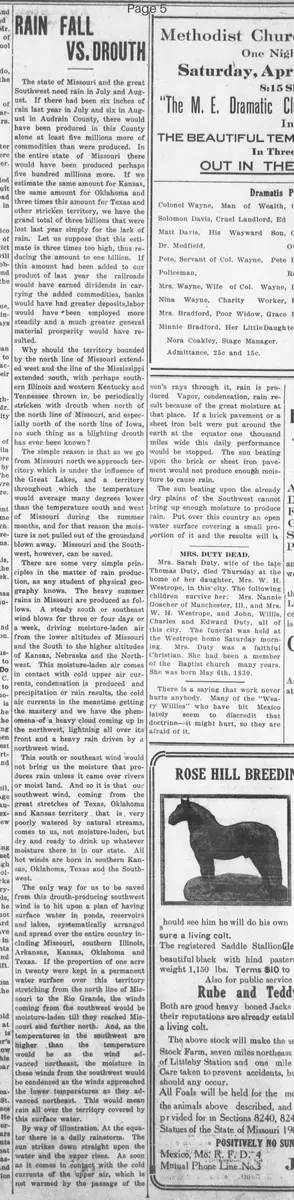
VS. DROUTH
The state of Missouri and the great Southwest need rain in July and August. If there had been six inches of rain last year in July and six in August in Audrain County, there would have been produced in this County alone at least five millions more of commodities than were produced. In the entire state of Missouri there would have been produced perhaps five hundred millions more. If we estimate the same amount for Kansas, the same amount for Oklahoma and three times this amount for Texas and other stricken territory, we have the grand total of three billions that were lost last year simply for the lack of rain. Let us suppose that this estimate is three times too high, thus reducing the amount to one billion. If this amount had been added to our product of last year the railroads would have earned dividends in carrying the added commodities, banks would have had greater deposits, labor would have been employed more steadily and a much greater general material prosperity would have resulted.
Why should the territory bounded by the north line of Missouri extended west and the line of the Mississippi extended south, with perhaps southern Illinois and western Kentucky and Tennessee thrown in, be periodically stricken with drouth when north of the north line of Missouri, and especially north of the north line of Iowa, no such thing as a blighting drouth has ever been known?
The simple reason is that as we go from Missouri north we approach territory which is under the influence of the Great Lakes, and a territory throughout which the temperature would average many degrees lower than the temperature south and west of Missouri during the summer months, and for that reason the moisture is not pulled out of the ground and blown away. Missouri and the Southwest, however, can be saved.
There are some very simple principles in the matter of rain production, as any student of physical geography knows. The heavy summer rains in Missouri are produced as follows. A steady south or southeast wind blows for three or four days or a week, driving moisture-laden air from the lower altitudes of Missouri and the South to the higher altitudes of Kansas, Nebraska and the Northwest. This moisture-laden air comes in contact with cold upper air currents, condensation is produced and precipitation or rain results, the cold air currents in the meantime getting the mastery and we have the phenomena of a heavy cloud coming up in the northwest, lightning all over its front and a heavy rain driven by a northwest wind.
This south or southeast wind would not bring us the moisture that produces rain unless it came over rivers or moist land. And so it is that a southwest wind, coming from the great stretches of Texas, Oklahoma and Kansas territory that is very poorly watered by natural streams, comes to us, not moisture-laden, but dry and ready to drink up whatever moisture there is in our state. All hot winds are born in southern Kansas, Oklahoma, Texas and the Southwest.
The only way for us to be saved from this drouth-producing southwest wind is to hit upon a plan of having surface water in ponds, reservoirs and lakes, systematically arranged and spread over the entire country including Missouri, southern Illinois, Arkansas, Kansas, Oklahoma and Texas. If the proportion of one acre in twenty were kept in a permanent water surface over this territory stretching from the north line of Missouri to the Rio Grande, the winds coming from the southwest would be moisture-laden till they reached Missouri and farther north. And, as the temperatures in the southwest are higher than the temperature would be as the wind advanced northeast, the moisture in these winds from the southwest would be condensed as the winds approached the lower temperatures as they advanced northeast. This would mean rain all over the territory covered by this surface water.
By way of illustration. At the equator there is a daily rainstorm. The sun strikes down straight upon the water and the vapor rises. As soon as it comes in contact with the cold currents of the upper air, which is not warmed by the passage of the sun's rays through it, rain is produced. Vapor, condensation, rain result because of the great moisture at that place. If a brick pavement or a sheet iron belt were put around the earth at the equator one thousand miles wide this daily performance would be stopped.
The sun beating upon the brick or sheet iron pavement would not produce enough moisture to cause rain. The sun beating upon the already dry plains of the Southwest cannot bring up enough moisture to produce rain. Put over this country an open water surface covering a small proportion of it and the results will be
What sub-type of article is it?
What themes does it cover?
What keywords are associated?
Where did it happen?
Story Details
Location
Missouri, Southwest, Kansas, Oklahoma, Texas
Event Date
Last Year, July And August
Story Details
The article discusses the economic losses from drought in Missouri and the Southwest last year, estimated at billions, contrasting it with wetter northern regions influenced by the Great Lakes. It explains rain formation via moisture-laden winds from the south meeting cold air, but dry southwest winds cause drought. Proposes creating widespread ponds and reservoirs to moisten winds and induce rain, illustrated by equatorial rain mechanisms.