Thank you for visiting SNEWPapers!
Sign up free
Editorial
February 24, 1925
Seward Daily Gateway
Seward, Seward County, Alaska
What is this article about?
The editorial critiques humanity's disproportionate fears of rare dangers over everyday risks, urging readers to eliminate petty anxieties, prioritize fearing ignorance and prejudice, and use knowledge to face life confidently while contributing positively to the world.
Clipping
OCR Quality
98%
Excellent
Full Text
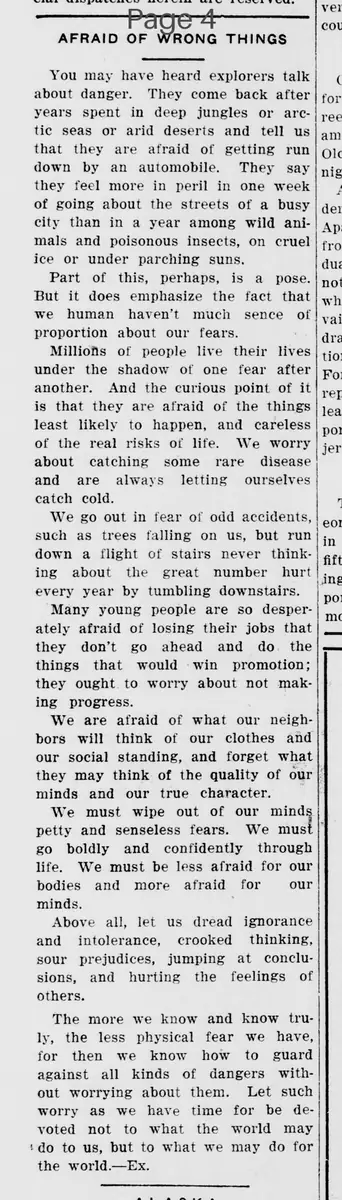
AFRAID OF WRONG THINGS
You may have heard explorers talk about danger. They come back after years spent in deep jungles or arctic seas or arid deserts and tell us that they are afraid of getting run down by an automobile. They say they feel more in peril in one week of going about the streets of a busy city than in a year among wild animals and poisonous insects on cruel ice or under parching suns.
Part of this, perhaps, is a pose. But it does emphasize the fact that we humans haven't much sense of proportion about our fears.
Millions of people live their lives under the shadow of one fear after another. And the curious point of it is that they are afraid of the things least likely to happen, and careless of the real risks of life. We worry about catching some rare disease and are always letting ourselves catch cold.
We go out in fear of odd accidents such as trees falling on us, but run down a flight of stairs never thinking about the great number hurt every year by tumbling downstairs.
Many young people are so desperately afraid of losing their jobs that they don't go ahead and do the things that would win promotion; they ought to worry about not making progress.
We are afraid of what our neighbors will think of our clothes and our social standing, and forget what they may think of the quality of our minds and our true character.
We must wipe out of our minds petty and senseless fears. We must go boldly and confidently through life. We must be less afraid for our bodies and more afraid for our minds.
Above all, let us dread ignorance and intolerance, crooked thinking, sour prejudices, jumping at conclusions, and hurting the feelings of others.
The more we know and know truly, the less physical fear we have, for then we know how to guard against all kinds of dangers without worrying about them. Let such worry as we have time for be devoted not to what the world may do to us, but to what we may do for the world.-Ex.
You may have heard explorers talk about danger. They come back after years spent in deep jungles or arctic seas or arid deserts and tell us that they are afraid of getting run down by an automobile. They say they feel more in peril in one week of going about the streets of a busy city than in a year among wild animals and poisonous insects on cruel ice or under parching suns.
Part of this, perhaps, is a pose. But it does emphasize the fact that we humans haven't much sense of proportion about our fears.
Millions of people live their lives under the shadow of one fear after another. And the curious point of it is that they are afraid of the things least likely to happen, and careless of the real risks of life. We worry about catching some rare disease and are always letting ourselves catch cold.
We go out in fear of odd accidents such as trees falling on us, but run down a flight of stairs never thinking about the great number hurt every year by tumbling downstairs.
Many young people are so desperately afraid of losing their jobs that they don't go ahead and do the things that would win promotion; they ought to worry about not making progress.
We are afraid of what our neighbors will think of our clothes and our social standing, and forget what they may think of the quality of our minds and our true character.
We must wipe out of our minds petty and senseless fears. We must go boldly and confidently through life. We must be less afraid for our bodies and more afraid for our minds.
Above all, let us dread ignorance and intolerance, crooked thinking, sour prejudices, jumping at conclusions, and hurting the feelings of others.
The more we know and know truly, the less physical fear we have, for then we know how to guard against all kinds of dangers without worrying about them. Let such worry as we have time for be devoted not to what the world may do to us, but to what we may do for the world.-Ex.
What sub-type of article is it?
Moral Or Religious
Social Reform
What keywords are associated?
Irrational Fears
Common Risks
Moral Growth
Ignorance
Intolerance
Prejudices
Self Improvement
Editorial Details
Primary Topic
Overcoming Irrational Fears And Prioritizing Moral And Intellectual Concerns
Stance / Tone
Exhortative And Encouraging
Key Arguments
People Fear Unlikely Dangers Like Rare Diseases Or Odd Accidents More Than Common Risks Like Colds Or Falls
Young People Fear Job Loss But Neglect Actions For Promotion
Society Worries About Superficial Judgments On Clothes And Status Over Character And Mind Quality
Advocate Wiping Out Petty Fears To Live Boldly, Fearing Ignorance, Intolerance, Prejudices, And Hurting Others More Than Physical Harms
Knowledge Reduces Physical Fears By Enabling Proper Safeguards, Redirecting Worry To Contributions For The World