Thank you for visiting SNEWPapers!
Sign up free
Literary
September 16, 1846
Morning Star
Limerick, York County, Maine
What is this article about?
An essay questioning the genuineness of Matthias' apostleship as described in Acts chapter 1, arguing it was a mistaken act by the eleven apostles before Pentecost, contrasting it with Paul's direct divine appointment. Signed E. B. F. for the Morning Star.
Clipping
OCR Quality
98%
Excellent
Full Text
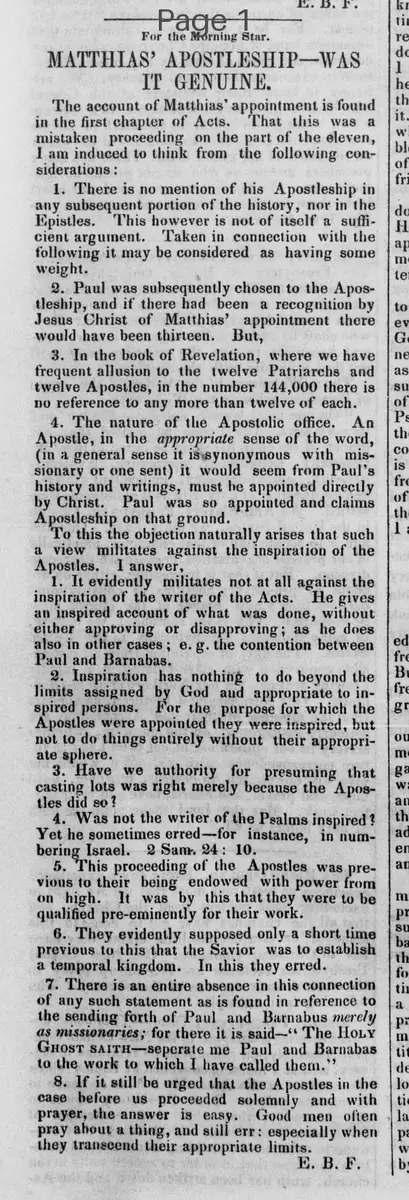
For the Morning Star
MATTHIAS' APOSTLESHIP—WAS IT GENUINE.
The account of Matthias' appointment is found in the first chapter of Acts. That this was a mistaken proceeding on the part of the eleven, I am induced to think from the following considerations:
1. There is no mention of his Apostleship in any subsequent portion of the history, nor in the Epistles. This however is not of itself a sufficient argument. Taken in connection with the following it may be considered as having some weight.
2. Paul was subsequently chosen to the Apostleship, and if there had been a recognition by Jesus Christ of Matthias' appointment there would have been thirteen. But,
3. In the book of Revelation, where we have frequent allusion to the twelve Patriarchs and twelve Apostles, in the number 144,000 there is no reference to any more than twelve of each.
4. The nature of the Apostolic office. An Apostle, in the appropriate sense of the word, (in a general sense it is synonymous with missionary or one sent) it would seem from Paul's history and writings, must be appointed directly by Christ. Paul was so appointed and claims Apostleship on that ground.
To this the objection naturally arises that such a view militates against the inspiration of the Apostles. I answer,
1. It evidently militates not at all against the inspiration of the writer of the Acts. He gives an inspired account of what was done, without either approving or disapproving; as he does also in other cases; e. g. the contention between Paul and Barnabas.
2. Inspiration has nothing to do beyond the limits assigned by God and appropriate to inspired persons. For the purpose for which the Apostles were appointed they were inspired, but not to do things entirely without their appropriate sphere.
3. Have we authority for presuming that casting lots was right merely because the Apostles did so?
4. Was not the writer of the Psalms inspired? Yet he sometimes erred—for instance, in numbering Israel. 2 Sam. 24: 10.
5. This proceeding of the Apostles was previous to their being endowed with power from on high. It was by this that they were to be qualified pre-eminently for their work.
6. They evidently supposed only a short time previous to this that the Savior was to establish a temporal kingdom. In this they erred.
7. There is an entire absence in this connection of any such statement as is found in reference to the sending forth of Paul and Barnabus merely as missionaries; for there it is said—“The Holy Ghost saith—separate me Paul and Barnabas to the work to which I have called them.”
8. If it still be urged that the Apostles in the case before us proceeded solemnly and with prayer, the answer is easy. Good men often pray about a thing, and still err: especially when they transcend their appropriate limits.
E. B. F.
MATTHIAS' APOSTLESHIP—WAS IT GENUINE.
The account of Matthias' appointment is found in the first chapter of Acts. That this was a mistaken proceeding on the part of the eleven, I am induced to think from the following considerations:
1. There is no mention of his Apostleship in any subsequent portion of the history, nor in the Epistles. This however is not of itself a sufficient argument. Taken in connection with the following it may be considered as having some weight.
2. Paul was subsequently chosen to the Apostleship, and if there had been a recognition by Jesus Christ of Matthias' appointment there would have been thirteen. But,
3. In the book of Revelation, where we have frequent allusion to the twelve Patriarchs and twelve Apostles, in the number 144,000 there is no reference to any more than twelve of each.
4. The nature of the Apostolic office. An Apostle, in the appropriate sense of the word, (in a general sense it is synonymous with missionary or one sent) it would seem from Paul's history and writings, must be appointed directly by Christ. Paul was so appointed and claims Apostleship on that ground.
To this the objection naturally arises that such a view militates against the inspiration of the Apostles. I answer,
1. It evidently militates not at all against the inspiration of the writer of the Acts. He gives an inspired account of what was done, without either approving or disapproving; as he does also in other cases; e. g. the contention between Paul and Barnabas.
2. Inspiration has nothing to do beyond the limits assigned by God and appropriate to inspired persons. For the purpose for which the Apostles were appointed they were inspired, but not to do things entirely without their appropriate sphere.
3. Have we authority for presuming that casting lots was right merely because the Apostles did so?
4. Was not the writer of the Psalms inspired? Yet he sometimes erred—for instance, in numbering Israel. 2 Sam. 24: 10.
5. This proceeding of the Apostles was previous to their being endowed with power from on high. It was by this that they were to be qualified pre-eminently for their work.
6. They evidently supposed only a short time previous to this that the Savior was to establish a temporal kingdom. In this they erred.
7. There is an entire absence in this connection of any such statement as is found in reference to the sending forth of Paul and Barnabus merely as missionaries; for there it is said—“The Holy Ghost saith—separate me Paul and Barnabas to the work to which I have called them.”
8. If it still be urged that the Apostles in the case before us proceeded solemnly and with prayer, the answer is easy. Good men often pray about a thing, and still err: especially when they transcend their appropriate limits.
E. B. F.
What sub-type of article is it?
Essay
What themes does it cover?
Religious
What keywords are associated?
Matthias Apostleship
Acts Chapter One
Paul Appointment
Apostolic Inspiration
Casting Lots
Holy Ghost
Biblical Error
What entities or persons were involved?
E. B. F.
Literary Details
Title
Matthias' Apostleship—Was It Genuine.
Author
E. B. F.
Subject
Questioning The Genuineness Of Matthias' Apostleship In Acts
Key Lines
That This Was A Mistaken Proceeding On The Part Of The Eleven, I Am Induced To Think From The Following Considerations:
An Apostle, In The Appropriate Sense Of The Word... Must Be Appointed Directly By Christ. Paul Was So Appointed And Claims Apostleship On That Ground.
It Evidently Militates Not At All Against The Inspiration Of The Writer Of The Acts. He Gives An Inspired Account Of What Was Done, Without Either Approving Or Disapproving;
Good Men Often Pray About A Thing, And Still Err: Especially When They Transcend Their Appropriate Limits.