Thank you for visiting SNEWPapers!
Sign up free
Alexandria Daily Advertiser
Alexandria, Virginia
What is this article about?
Biography of Mademoiselle la Chevalier d'Eon du Beaumont, born 1728 in Tonnerre, Burgundy, who lived as a man, achieving success in diplomacy, military service, and law across Europe, including missions to Russia and Vienna, battles in Germany, and residence in London.
Clipping
OCR Quality
Full Text
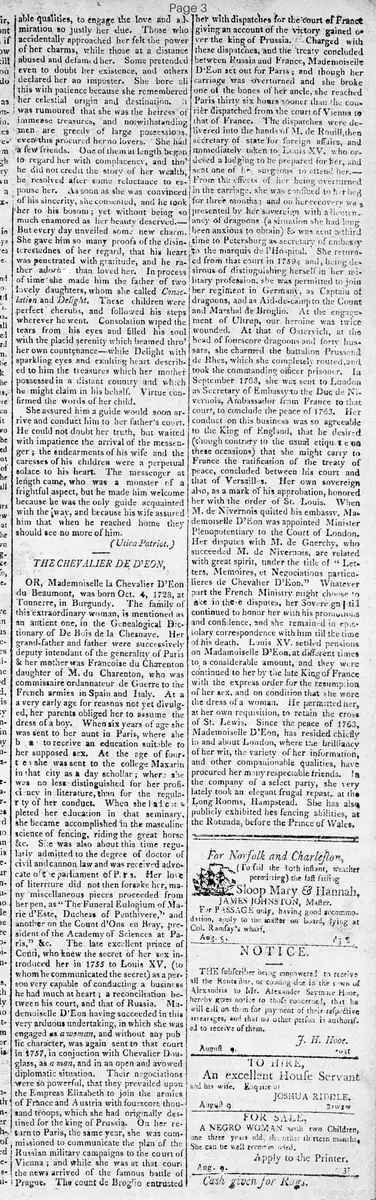
OR, Mademoiselle la Chevalier D'Eon du Beaumont, was born Oct. 4, 1728, at Tonnerre, in Burgundy. The family of this extraordinary woman, is mentioned as an ancient one, in the Genealogical Dictionary of De Bois de la Chesnave. Her grand-father and father were successively deputy intendant of the generality of Paris & her mother was Francoise du Charenton daughter of M. du Charenton, who was commissaire ordonnateur de Guerre to the French armies in Spain and Italy.
At a very early age for reasons not yet divulged, her parents obliged her to assume the dress of a boy. When six years of age she was sent to her aunt in Paris, where she began to receive an education suitable to her supposed sex. At the age of fourteen she was sent to the college Mazarin in that city as a day scholar; where she was no less distinguished for her proficiency in literature, than for the regularity of her conduct.
When she had completed her education in that seminary, she became accomplished in the masculine science of fencing, riding the great horse &c. She was also about this time regularly admitted to the degree of doctor of civil and canon law and was received advocate of the parliament of Paris. Her love of literature did not then forsake her, many miscellaneous pieces proceeded from her pen, as "The Funeral Eulogium of Marie d'Este, Duchess of Penthievre," and another on the Count d'Ons en Bray, president of the Academy of Sciences at Paris." &c.
The late excellent prince of Conti, who knew the secret of her sex introduced her in 1755 to Louis XV, (to whom he communicated the secret) as a person very capable of conducting a business he had much at heart; a reconciliation between his court, and that of Russia. Mademoiselle D'Eon having succeeded in this very arduous undertaking, in which she was engaged as a woman, and without any public character, was again sent to that court in 1757, in conjunction with Chevalier Douglas, as a man, and in an open and avowed diplomatic situation. Their negociations were so powerful, that they prevailed upon the Empress Elizabeth to join the armies of France and Austria with fourscore thousand troops, which she had originally destined for the king of Prussia.
On her return to Paris, the same year, she was commissioned to communicate the plan of the Russian military campaigns to the court of Vienna: and while she was at that court the news arrived of the famous battle of Prague. The count de Broglio entrusted her with dispatches for the court of France giving an account of the victory gained over the king of Prussia. Charged with these dispatches, and the treaty concluded between Russia and France, Mademoiselle D'Eon set out for Paris; and though her carriage was overturned and she broke one of the bones of her ancle, she reached Paris thirty six hours sooner than the courier dispatched from the court of Vienna to that of France. The dispatches were delivered into the hands of M. de Rouillé, then secretary of state for foreign affairs, and immediately taken to Louis XV. who ordered a lodging to be prepared for her, and sent one of his surgeons to attend her.
From the effects of her being overturned in the carriage, she was confined to her bed for three months; and on her recovery was presented by her sovereign with a lieutenancy of dragoons (a situation she had long been anxious to obtain) & was sent a third time to Petersburg as secretary of embassy to the marquis de l'Hospital. She returned from that court in 1759; and, being desirous of distinguishing herself in her military profession, she was permitted to join her regiment in Germany, as Captain of dragoons, and as Aid-de-camp to the Count and Marshal de Broglio.
At the engagement of Uterup, our heroine was twice wounded. At that of Osterwick, at the head of fourscore dragoons and forty hussars, she charged the battalion Prussian de Rhess, which she completely routed, and took the commanding officer prisoner.
In September 1763, she was sent to London as Secretary of Embassy to the Duc de Nivernois, Ambassador from France to that court, to conclude the peace of 1763. Her conduct on this business was so agreeable to the King of England, that he desired (though contrary to the usual etiquette on these occasions) that she might carry to France the ratification of the treaty of peace, concluded between his court and that of Versailles. Her own sovereign also, as a mark of his approbation, honored her with the order of St. Louis.
When M. de Nivernois quitted his embassy, Mademoiselle D'Eon was appointed Minister Plenipotentiary to the Court of London. Her disputes with M. de Guercy, who succeeded M. de Nivernois, are related with great spirit, under the title of "Letters, Memoires, et Negociations particulieres de Chevalier D'Eon." Whatever part the French Ministry might choose to take in these disputes, her Sovereign still continued to honor her with his protection and confidence, and she remained in epistolary correspondence with him till the time of his death.
Louis XV. settled pensions on Mademoiselle D'Eon, at different times to a considerable amount, and they were continued to her by the late King of France with the express order for the resumption of her sex, and on condition that she wore the dress of a woman. He permitted her, at her own requisition, to retain the cross of St. Louis.
Since the peace of 1763, Mademoiselle D'Eon, has resided chiefly in and about London, where the brilliancy of her wit, the variety of her information, and other companionable qualities, have procured her many respectable friends. In the company of a select party, she very lately took an elegant frugal repast, at the Long Rooms, Hampstead. She has also publicly exhibited her fencing abilities, at the Rotunda, before the Prince of Wales.
What sub-type of article is it?
What themes does it cover?
What keywords are associated?
What entities or persons were involved?
Where did it happen?
Story Details
Key Persons
Location
Tonnerre In Burgundy, Paris, St. Petersburg, Vienna, Germany, London
Event Date
Born Oct. 4, 1728; Events From 1755 To 1763 And Later
Story Details
Born in 1728, d'Eon assumed male dress early, excelled in education, law, literature, diplomacy, and military service; conducted secret missions to Russia, delivered crucial dispatches, fought in battles, served in London embassy, later lived as a woman in London.