Thank you for visiting SNEWPapers!
Sign up free
Editorial
January 10, 1850
The Texas Republican
Marshall, Harrison County, Texas
What is this article about?
An editorial defending the South's rights and institutions against unprovoked Northern hostility, highlighting historical Southern concessions on territory and slavery, warning of dangers from submission to anti-slavery forces, and advocating immediate state conventions to instruct Congress and prepare for potential secession.
Merged-components note: Continuation of the same editorial on Southern rights and defense.
Clipping
OCR Quality
72%
Good
Full Text
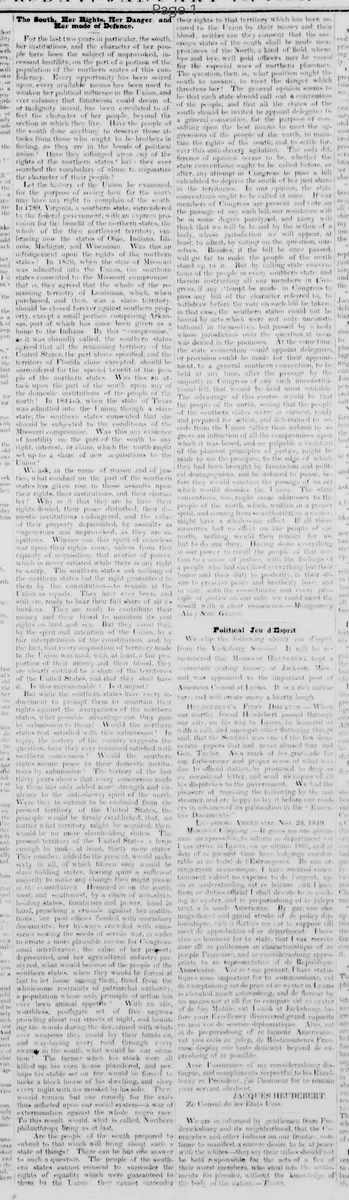
The South, Her Rights, Her Danger, and
Her mode of Defence.
For the last two years in particular, the south
her institutions, and the character of her peo-
ple have been the subject of unprovoked, in-
cessant hostility, on the part of a portion of the
population of the northern states of this con-
federacy. Every opportunity has been seized
upon, every available means has been used to
weaken her political influence in the Union, and
every calumny that fanaticism could dream of,
or malignity invent, has been circulated to af-
fect the character of her people, beyond the
section in which they live. Have the people of
the south done anything to deserve those at-
tacks from those who ought to be brothers in
feeling, as they are in the bonds of political
union? Have they infringed upon any of the
rights of the northern states? Have they ever
searched the vocabulary of abuse to stigmatize
the character of their people!
Let the history of the Union be examined,
for the purpose of seeing how far the north
may have any right to complain of the south.
In 1789, Virginia, a southern state, surrendered
to the federal government, with an express pro-
vision for the benefit of the northern states, the
whole of the then northwest territory, em-
bracing now the states of Ohio, Indiana, Ill-
inois, Michigan, and Wisconsin. Was this an
infringement upon the rights of the northern
states? In 1820, when the state of Missouri
was admitted into the Union, the southern
states consented to the Missouri compromise
that is, they agreed that the whole of the re-
mainning territory of Louisiana, which, when
purchased, and then, was a slave territory
should be closed forever against southern prop-
erty, except a small portion comprising Arkan-
sas, part of which has since been given as a
home to the Indians. By this "compromise,"
as it was absurdly called, the southern states
agreed that all the remaining territory of the
United States, the part above specified, and the
territory of Florida alone excepted, should be
surrendered for the special benefit of the peo-
ple of the northern states. Was this an at-
tack upon the part of the south upon any of
the domestic institutions of the people of the
north? In 1845, when the state of Texas
was admitted into the Union, though a slave
state, the southern states consented that she
should be subjected to the conditions of the
Missouri compromise. Was this any evidence
of hostility on the part of the south to any
right, interest, or claim, which the north might
set up to a share of new acquisitions to the
Union?
We ask, in the name of reason and of jus-
tice, what conduct on the part of the southern
states has given rise to those assaults upon
their rights, their institutions, and their charac-
ter? Why is it that they are to have their
rights denied, their peace disturbed, their do-
mestic institutions endangered, and the value
of their property depreciated, by assaults as
"ingenious and unprovoked, as they are in-
equitous? Whence can this spirit of ceaseless
war upon their rights come, but from that
rapacity of acquisition, that avarice of power,
which is never satiated while there is any right
to usurp. The southern states ask nothing of
the northern states but the right guaranteed to
them by the constitution--to remain in the
Union as equals. They have ever been, and
still are, ready to bear their full share of all its
burdens. They are ready to contribute their
money and their blood to maintain its just
rights on land and sea. But they insist that,
by the spirit and intention of the Union, by a
fair interpretation of the constitution, and, by
the fact, that every acquisition of territory made
to the Union was made, with, at least, a fair pro-
portion of their money and their blood, they
are clearly entitled to a share of the territories
of the United States, and that they shall have
it. Is this unreasonable? Is it unjust?
But while the southern states have every in-
ducement to rouse them to maintain their
rights against the usurpations of the northern
states, what possible advantage can they gain
by submission to them? Would the northern
states rest satisfied with this submission? In-
truth, the history of the country suggests the
question, have they ever remained satisfied with
southern concession? Would the southern
states secure peace to their domestic institu-
tions by submission? The history of the last
thirty years shows that every concession made
by them has only added new strength and vir-
ulence to the anti-slavery spirit at the north.
Were they to submit to be excluded from the
present territory of the United States, the
principle would be firmly established, that, no
matter what territory might be acquired, there
would be no more slaveholding states. The
present territory of the United States is large
enough to make at least, thirty more states.
This number, added to the present, would make
sixty in all, of which fifteen only would be
slave holding states, leaving quite a sufficient
majority to make any change they might please
in the constitution. Hemmed in on the north-
west, and southwest, by a clan of non-slave-
holding states. fanaticism and power, hand in
hand, preaching a crusade against her institu-
tions, her post offices founded with incendiary
documents, her by-ways crowded with emis-
saries sowing the seeds of servile war. in order
to create a most plausible excuse for Congress-
sional interference, the value of her property
depreciated, and her agricultural industry par-
ally paralyzed. what would become of the
people of the southern states, when they would be forced at
last to let loose among them, freed from the
wholesome restraints of patriarchal authority.
a population whose only principle of action has
ever been animal appetite. With an idle.
worthless, profligate set of free negroes
prowling about our streets at night, and haunt-
ing the woods during the day, armed with what-
ever weapons they could lay their hands on,
and way-laying every road through every
swamp in the south, what would be our situa-
tion? The farmer when his stock were all
killed up. his corn house plundered, and per-
haps his stable set on fire, would be forced to
make a block house of his dwelling, and sleep
every night with his musket by his side. There
would remain but one remedy for the evils
thus inflicted upon our social system--a war of
extermination against the whole negro race.
To this result would, what is called, Northern
philanthropy bring us at last.
Are the people of the south prepared to
submit to that which will bring about such a
state of things? There can be but one answer
to such a question. The people of the south-
tern states cannot consent to surrender the
rights of equality which were guaranteed to
them by the Union they cannot surrender
their rights to that territory which has been se-
cured to the Union by their money and their
blood, neither can they consent that the sov-
ereign states of the south shall be made mere
provinces of the North, a kind of field. where
by and bye, well paid officers may be raised
for the especial uses of northern placemen.
The question, then. is, what position ought the
south to assume, to meet the danger which
threatens her? The general opinion seems to
be that each state should call out a convention
of the people. and that all the states of the
south should be invited to appoint delegates to
a general convention, for the purpose of con-
sulting upon the best means to meet the ag-
gressions of the people of the north, to main-
tain the rights of the south. and to settle for-
ever this anti slavery agitation. The only dis-
difference of opinion seems to be. whether the
state conventions ought to be called before, or
after. any attempt in Congress to pass a bill
calculated to deprive the south of her just share
in the territories. In our opinion, the state
conventions ought to be called at once. If our
members of Congress are present and vote on
the passage of any such bill, our resistance will
be in some degree paralyzed. and many will
think that we will be bound by the action of a
body. whose. jurisdiction we will appear. at
least, to admit, by voting on the question, our-
selves. Besides, if the bill be once passed.
will go far to make the people of the north
stand up to it. But by calling state conven-
tions of the people in every southern state and
therein instructing all our members in Con-
gress, if any attempt be made in Congress to
pass any bill of the character referred to, to
withdraw before the vote on such bill be taken.
in that case. the southern states could not be
bound by acts which were not only unconsti-
tutional in themselves, but passed by a body
whose jurisdiction over the question at issue
was denied in the premises. At the same time.
the state convention could appoint delegates.
or provision could be made for their appoint-
ment. to a general southern convention, to be
held at any time, after the passage by the
majority in Congress of any such unconstitu-
tional bill that would be held most suitable.
The advantage of this course would be that
the people of the north, seeing that the people
of the southern states were in earnest, ready
and prepared for action. and determined to re-
cede from the Union rather than submit to Con-
gress an infraction of all the compromises upon
which it was based. and so palpable a violation
of the plainest principles of justice, might be
made to see the precipice, to the edge of which
they had been brought by fanaticism and po-
litical demagogism, and be induced to pause be-
fore they would sanction the passage of an act
which would dissolve the Union. The state
conventions, too, taught issue addresses to the
people of the north, which, written in a proper
spirit. and coming from so authoritative a source
might have a wholesome effect. If all these
measures had no effect on the people of the
north, nothing would then remain for us
but to do our duty. Having done everything
in our power to call the people of that section
to a sense of justice, with the feelings of a
people who had spared nothing but the last
horrors of war to perform their duty to posterity,
in their desire to preserve peace and brotherly love. and
in keeping with the constitution and every prin-
ciple of justice on our side, we could meet the
result with a clear conscience. We again sub-
mit - State Gazette
Her mode of Defence.
For the last two years in particular, the south
her institutions, and the character of her peo-
ple have been the subject of unprovoked, in-
cessant hostility, on the part of a portion of the
population of the northern states of this con-
federacy. Every opportunity has been seized
upon, every available means has been used to
weaken her political influence in the Union, and
every calumny that fanaticism could dream of,
or malignity invent, has been circulated to af-
fect the character of her people, beyond the
section in which they live. Have the people of
the south done anything to deserve those at-
tacks from those who ought to be brothers in
feeling, as they are in the bonds of political
union? Have they infringed upon any of the
rights of the northern states? Have they ever
searched the vocabulary of abuse to stigmatize
the character of their people!
Let the history of the Union be examined,
for the purpose of seeing how far the north
may have any right to complain of the south.
In 1789, Virginia, a southern state, surrendered
to the federal government, with an express pro-
vision for the benefit of the northern states, the
whole of the then northwest territory, em-
bracing now the states of Ohio, Indiana, Ill-
inois, Michigan, and Wisconsin. Was this an
infringement upon the rights of the northern
states? In 1820, when the state of Missouri
was admitted into the Union, the southern
states consented to the Missouri compromise
that is, they agreed that the whole of the re-
mainning territory of Louisiana, which, when
purchased, and then, was a slave territory
should be closed forever against southern prop-
erty, except a small portion comprising Arkan-
sas, part of which has since been given as a
home to the Indians. By this "compromise,"
as it was absurdly called, the southern states
agreed that all the remaining territory of the
United States, the part above specified, and the
territory of Florida alone excepted, should be
surrendered for the special benefit of the peo-
ple of the northern states. Was this an at-
tack upon the part of the south upon any of
the domestic institutions of the people of the
north? In 1845, when the state of Texas
was admitted into the Union, though a slave
state, the southern states consented that she
should be subjected to the conditions of the
Missouri compromise. Was this any evidence
of hostility on the part of the south to any
right, interest, or claim, which the north might
set up to a share of new acquisitions to the
Union?
We ask, in the name of reason and of jus-
tice, what conduct on the part of the southern
states has given rise to those assaults upon
their rights, their institutions, and their charac-
ter? Why is it that they are to have their
rights denied, their peace disturbed, their do-
mestic institutions endangered, and the value
of their property depreciated, by assaults as
"ingenious and unprovoked, as they are in-
equitous? Whence can this spirit of ceaseless
war upon their rights come, but from that
rapacity of acquisition, that avarice of power,
which is never satiated while there is any right
to usurp. The southern states ask nothing of
the northern states but the right guaranteed to
them by the constitution--to remain in the
Union as equals. They have ever been, and
still are, ready to bear their full share of all its
burdens. They are ready to contribute their
money and their blood to maintain its just
rights on land and sea. But they insist that,
by the spirit and intention of the Union, by a
fair interpretation of the constitution, and, by
the fact, that every acquisition of territory made
to the Union was made, with, at least, a fair pro-
portion of their money and their blood, they
are clearly entitled to a share of the territories
of the United States, and that they shall have
it. Is this unreasonable? Is it unjust?
But while the southern states have every in-
ducement to rouse them to maintain their
rights against the usurpations of the northern
states, what possible advantage can they gain
by submission to them? Would the northern
states rest satisfied with this submission? In-
truth, the history of the country suggests the
question, have they ever remained satisfied with
southern concession? Would the southern
states secure peace to their domestic institu-
tions by submission? The history of the last
thirty years shows that every concession made
by them has only added new strength and vir-
ulence to the anti-slavery spirit at the north.
Were they to submit to be excluded from the
present territory of the United States, the
principle would be firmly established, that, no
matter what territory might be acquired, there
would be no more slaveholding states. The
present territory of the United States is large
enough to make at least, thirty more states.
This number, added to the present, would make
sixty in all, of which fifteen only would be
slave holding states, leaving quite a sufficient
majority to make any change they might please
in the constitution. Hemmed in on the north-
west, and southwest, by a clan of non-slave-
holding states. fanaticism and power, hand in
hand, preaching a crusade against her institu-
tions, her post offices founded with incendiary
documents, her by-ways crowded with emis-
saries sowing the seeds of servile war. in order
to create a most plausible excuse for Congress-
sional interference, the value of her property
depreciated, and her agricultural industry par-
ally paralyzed. what would become of the
people of the southern states, when they would be forced at
last to let loose among them, freed from the
wholesome restraints of patriarchal authority.
a population whose only principle of action has
ever been animal appetite. With an idle.
worthless, profligate set of free negroes
prowling about our streets at night, and haunt-
ing the woods during the day, armed with what-
ever weapons they could lay their hands on,
and way-laying every road through every
swamp in the south, what would be our situa-
tion? The farmer when his stock were all
killed up. his corn house plundered, and per-
haps his stable set on fire, would be forced to
make a block house of his dwelling, and sleep
every night with his musket by his side. There
would remain but one remedy for the evils
thus inflicted upon our social system--a war of
extermination against the whole negro race.
To this result would, what is called, Northern
philanthropy bring us at last.
Are the people of the south prepared to
submit to that which will bring about such a
state of things? There can be but one answer
to such a question. The people of the south-
tern states cannot consent to surrender the
rights of equality which were guaranteed to
them by the Union they cannot surrender
their rights to that territory which has been se-
cured to the Union by their money and their
blood, neither can they consent that the sov-
ereign states of the south shall be made mere
provinces of the North, a kind of field. where
by and bye, well paid officers may be raised
for the especial uses of northern placemen.
The question, then. is, what position ought the
south to assume, to meet the danger which
threatens her? The general opinion seems to
be that each state should call out a convention
of the people. and that all the states of the
south should be invited to appoint delegates to
a general convention, for the purpose of con-
sulting upon the best means to meet the ag-
gressions of the people of the north, to main-
tain the rights of the south. and to settle for-
ever this anti slavery agitation. The only dis-
difference of opinion seems to be. whether the
state conventions ought to be called before, or
after. any attempt in Congress to pass a bill
calculated to deprive the south of her just share
in the territories. In our opinion, the state
conventions ought to be called at once. If our
members of Congress are present and vote on
the passage of any such bill, our resistance will
be in some degree paralyzed. and many will
think that we will be bound by the action of a
body. whose. jurisdiction we will appear. at
least, to admit, by voting on the question, our-
selves. Besides, if the bill be once passed.
will go far to make the people of the north
stand up to it. But by calling state conven-
tions of the people in every southern state and
therein instructing all our members in Con-
gress, if any attempt be made in Congress to
pass any bill of the character referred to, to
withdraw before the vote on such bill be taken.
in that case. the southern states could not be
bound by acts which were not only unconsti-
tutional in themselves, but passed by a body
whose jurisdiction over the question at issue
was denied in the premises. At the same time.
the state convention could appoint delegates.
or provision could be made for their appoint-
ment. to a general southern convention, to be
held at any time, after the passage by the
majority in Congress of any such unconstitu-
tional bill that would be held most suitable.
The advantage of this course would be that
the people of the north, seeing that the people
of the southern states were in earnest, ready
and prepared for action. and determined to re-
cede from the Union rather than submit to Con-
gress an infraction of all the compromises upon
which it was based. and so palpable a violation
of the plainest principles of justice, might be
made to see the precipice, to the edge of which
they had been brought by fanaticism and po-
litical demagogism, and be induced to pause be-
fore they would sanction the passage of an act
which would dissolve the Union. The state
conventions, too, taught issue addresses to the
people of the north, which, written in a proper
spirit. and coming from so authoritative a source
might have a wholesome effect. If all these
measures had no effect on the people of the
north, nothing would then remain for us
but to do our duty. Having done everything
in our power to call the people of that section
to a sense of justice, with the feelings of a
people who had spared nothing but the last
horrors of war to perform their duty to posterity,
in their desire to preserve peace and brotherly love. and
in keeping with the constitution and every prin-
ciple of justice on our side, we could meet the
result with a clear conscience. We again sub-
mit - State Gazette
What sub-type of article is it?
Slavery Abolition
Constitutional
Partisan Politics
What keywords are associated?
Southern Rights
Northern Aggression
Slavery Defense
Territorial Compromise
State Conventions
Anti Slavery Agitation
Union Equality
What entities or persons were involved?
Southern States
Northern States
Congress
Virginia
Missouri
Texas
Editorial Details
Primary Topic
Defense Of Southern Rights Against Northern Anti Slavery Aggression
Stance / Tone
Strongly Pro Southern, Warning Against Submission To Northern Usurpations
Key Figures
Southern States
Northern States
Congress
Virginia
Missouri
Texas
Key Arguments
Southern States Have Made Historical Territorial Concessions Benefiting The North
Northern Hostility Is Unprovoked And Seeks To Undermine Southern Institutions
Submission To Exclusion From Territories Would Lead To Southern Political Subjugation
Imagined Scenario Of Social Chaos From Freeing Slaves Without Restraint
Call For Immediate State Conventions To Instruct Congress And Prepare Resistance